Trump's special envoy calls Iran last barrier to Middle East peace
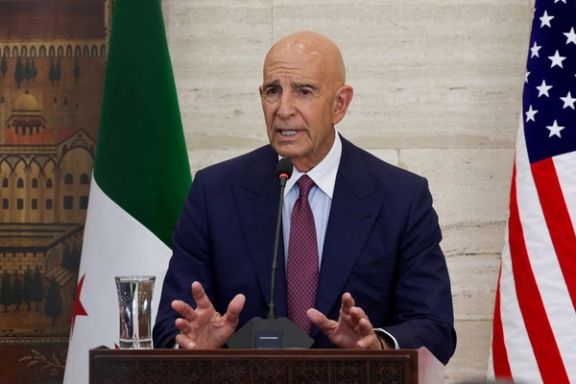
US Special Envoy for Syria Tom Barrack speaks during a press conference with the foreign ministers of Syria and Jordan, Sept. 16, 2025. (Reuters)
Iran is the last obstacle to a new Middle East, US special envoy for Syria Tom Barrack said on Monday, calling for Syria’s reintegration and Lebanon’s break from Tehran-backed Hezbollah to secure what he called “a generation of cooperation.”
“All that stands in the way of progress is a hostile and treacherous Iranian IRGC leadership and its proxies,” Barrack said on X, describing Tehran and its network of militias as the chief obstacle to regional stability.
In a detailed social media statement titled “Syria and Lebanon Are the Next Pieces for Levant Peace,” Barrack said the momentum from the Gaza ceasefire and the Sharm el-Sheikh Peace Summit has created a historic opportunity to rebuild the region—if Iran’s influence can be contained.
Barrack said “the rest of the region is accelerating towards expulsion of Iran’s terrorist proxies,” and argued that the Middle East’s political and economic realignment is already underway.
Turning to Lebanon, Barrack pressed Beirut to distance itself from Iran-backed Hezbollah and embrace US and French-sponsored disarmament efforts.
Hezbollah’s continued dominance, he warned, has left Lebanon “an army without authority and a government without control,” deterring investment and threatening new conflict with Israel.
He described President Donald Trump’s twenty-point peace plan as a blueprint for reconstruction, reconciliation, and economic integration that could transform “a century of conflict into a generation of cooperation.”
Barrack concluded that the Middle East now faces a defining choice: to isolate Iran and embrace reconciliation, or risk losing a rare moment of regional unity and peace.
“Iran stands terminally weakened – politically, economically, and morally,” he added, predicting that Saudi Arabia’s expected entry into the Abraham Accords would accelerate a shift “drawn not by pressure but by prosperity.”
The Abraham Accords, brokered in 2020 by President Donald Trump and his senior adviser son-in-law Jared Kushner, normalized relations between Israel and several Arab states.
Current efforts to expand that framework could gain momentum following the Gaza ceasefire.
About 120,000 Iranians die each year from nutrition-related causes, an Iranian official said on Monday, as soaring food prices and declining consumption of key staples such as dairy, meat, fruits, and vegetables deepen the country’s public health crisis.
Out of 400,000 to 420,000 annual deaths in the country, roughly 35% are linked to malnutrition, Ahmad Esmailzadeh, director of the Nutrition Improvement Office at Iran’s Health Ministry, said at a World Food Day event.
“Deficiencies in diet and lack of essential nutrients have become a major contributor to mortality,” he said.
Government data show that nutritional imbalances—ranging from vitamin and mineral deficiencies to obesity in children and expectant mothers—are escalating nationwide.
Each year, about 10,000 Iranians die due to insufficient intake of omega-3 fatty acids, another 10,000 from not consuming enough fruits and vegetables, and 25,000 from low consumption of whole grains and bread.
Vitamin D deficiency, affecting between 50% and 70% of the population, remains widespread and directly impacts bone and immune health.
Rising prices, falling nutrition
Much of the crisis is attributed to soaring food inflation, which has sharply reduced household access to healthy diets, Tehran-based Rouydad24 wrote on Monday. The consumption of dairy and meat, two vital protein sources, has fallen to less than half of recommended levels.
Even vitamin supplements have become unaffordable for many families, particularly in deprived provinces such as Sistan and Baluchestan, Kerman, and Hormozgan, according to the outlet.
The consequences extend beyond mortality. Rouydad24 quoting nutrition experts reported alarming increases in obesity among children, stunted growth in poorer provinces, and rising rates of chronic illnesses such as hypertension and diabetes.
Research cited by the outlet shows that one in five children and adolescents is overweight or obese, while 30% of pregnant women experience unhealthy weight gain.
Economic and social costs
The financial burden of maintaining a balanced diet is straining family budgets, added the report. As inflation continues, more households are forced to cut back on basic food items, fueling a vicious cycle of malnutrition, illness, and poverty. Experts warn the crisis could have long-term effects on human development, including reduced cognitive performance in children.
“If iodine deficiency in pregnant women continues, the IQ of future generations will decline,” Esmailzadeh cautioned. “Nutrition is not only a health issue but a vital economic and social concern.”
Without comprehensive intervention, the daily warned, Iran will continue to face silent deaths and a worsening decline in public health.
Faculty members of Iran's top science school, Sharif University of Technology, at a graduation ceremony
At least 1,500 engineering and technical faculty members have left Iran’s leading universities over the past five years, according to Karan Abri-Nia, secretary of the Iranian University Professors’ Trade Union.
In an interview with KhabarOnline, Professor Ebrahim Azadegan of Sharif University of Technology said, “These days, we lose one university professor every week.”
Abri-Nia added that between the 2018-19 and 2022-23 academic years, about a quarter of the 6,000 faculty members in key engineering departments at top Iranian universities emigrated.
“I see migration as a wound on the body of our universities, one that keeps deepening,” he said.
The departures highlight a growing brain drain from Iran’s higher education system, long strained by political pressures, economic hardship, and limited academic freedom.
Vetting procedures
The two academics attributed the resignations and departures not only to economic pressures but also to security vetting procedures they said disqualified faculty for reasons such as having signed petitions, being unmarried, or having had a café photo in the US.
Azadegan gave the example of a faculty candidate with a doctorate from Princeton who was rejected from Sharif because “he had a photo with a few girls and boys in a café in America.”
In engineering mechanics at the University of Tehran, Abri-Nia said, “about ten professors either retired early to continue work abroad or went on sabbatical and never returned.”
He added that while many younger scholars accepted research visits abroad, they did not come back, effectively ending their ties to Iranian academia.
The boost in faculty emigration follows the Woman, Life, Freedom protests of late 2022, which both academics said coincided with a decline in intellectual freedom on campuses.
According to Azadegan: “We were faced with a disaster at Sharif University in the last three years: nearly 70 professors left and we still haven’t found adequate replacements.”
Azadegan described the events of 2022 as “dark days” for Sharif University, recalling that security forces attacked the campus during nationwide protests, beating many students and faculty “without cause” and imposing a heavy security presence.
In October 2022, security and plainclothes forces surrounded Sharif University, arrested between 30 and 40 students, and opened fire on those attempting to leave the campus.
He said that even now, women stationed at the university gates warn students about dress code violations, surveillance cameras cover much of the campus, and students are still summoned before disciplinary committees over compulsory hijab rules.
Iran’s Supreme Leader Ali Khamenei meets hundreds of national sports champions and winners of international science Olympiads at the Imam Khomeini Hussainiya in Tehran, October 20, 2025.
Iran’s Supreme Leader Ali Khamenei dismissed US President Donald Trump’s claim that Washington had destroyed Iran’s nuclear program, adding that the United States has no authority over Tehran’s nuclear activities.
The US president’s comments were “nonsense spoken to console disheartened Israeli officials after unexpected defeat in the 12-day war,” Khamenei said on Monday in Tehran during a meeting with Iranian sports and science champions.
"The US president proudly says they bombed and destroyed Iran's nuclear industry. Very well, keep dreaming!" he added.
“The United States is in no position to determine what countries should or should not possess nuclear capabilities,” he said, adding that Iran’s youth-built missiles had already “penetrated and destroyed sensitive Israeli facilities.”
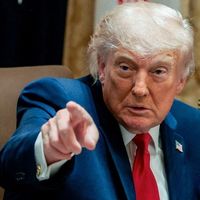
Speaking before the Israeli Knesset last week, President Donald Trump said, “We dropped 14 bombs on Iran’s nuclear facilities, which has been confirmed to have obliterated those facilities, and together we helped stop the world’s number one state sponsor of terrorism from making nuclear weapons. If we didn’t do that, there would be a dark cloud over this [Gaza] deal. This was our last shot.”
However, Khamenei said, “The Zionists never imagined that an Iranian-made missile, created by the hands of young Iranians, could reduce parts of their strategic centers to ashes, but it happened.”
“These missiles are ours, built by our youth, not borrowed or bought from anyone. They remain ready and will be used again if necessary,” he added.
The US president’s visit to Israel, Khamenei said, was an attempt to “revive morale among a defeated regime.”
He described Washington’s comments as “foolish and theatrical behavior,” asserting that such language “reveals how disillusioned the enemy has become.”
“These words were spoken to people who have lost confidence,” he said. “Their 12-day war humiliated them, and the American president went there only to give them spirit.”
Khamenei also accused Western leaders and media of distorting Iran’s progress. “They amplify our shortcomings and conceal our achievements,” he said.
“They want to convince our youth that Iran is dark and stagnant, but every success in sports, science, or technology proves the opposite.”
US accused of partnership in Gaza war
American weapons, logistics, and other resources were provided to Israel and were used against civilians in Gaza, Khamenei said.
He rejected US statements that its actions were aimed at combating terrorism, pointing to civilian casualties.
“They say they fight terrorism. More than 20,000 children and infants were killed in these attacks. Were they terrorists?” he asked.
Khamenei went further, calling the United States itself a producer of terrorism in the region: “You produced ISIS, you unleashed it on the region, and you have kept it as an instrument to use later.”
He accused Washington of direct complicity in the Gaza conflict and in the targeted killings of Iranian scientists, saying, “America is the main partner in this crime.”
Israeli diplomats have been added to WhatsApp groups allegedly operated from Iran as the cyber war between the two countries continues, Israeli media reported on Monday.
Israel’s Foreign Ministry has warned staff about the incident, urging increased caution.
“Recently, there have been reports of [diplomats] being added to WhatsApp groups, not through their contacts. These are groups that are opened and run by our adversaries from phone numbers from Iran, Pakistan, and more,” the advisory said, according to Times of Israel.
“Therefore, it is necessary to be vigilant about the groups you join and are added to, and even change the settings so that you can only be added to the groups by contacts who are registered with you,” it added.
Iran International sought comment from Israel’s Foreign Ministry, which did not respond.
Israeli intelligence analyst Ronen Solomon told Iran International the reports were plausible, adding that a dedicated Revolutionary Guards unit known as Department 50 is responsible for such cyber operations.
“If I’m Iranian, I can build a group where the name is similar to one that they’re already using, so it could be an easy way to collect information. If you have the number of the target you can put it in your list in the phone, and if their privacy definition is ‘all’ and not ‘only contacts’ you can easily do it, but even if you do it, you don’t control their Whatsapp," he said.
According to Solomon, “The Iranians have shown that they can collect lists of diplomats because sometimes it’s listed online, in the public domain of embassies, and they can put you in a special group that’s opened with a cover story. When they’re sharing a post in their group, you’ll also see it in your WhatsApp so you can click on a link and be targeted in a cyber attack."
After the June war between the two archenemies, Iran International reported the uptick in cyber attacks between the two sides.
”Although the Iran-Israel ceasefire has paused direct military engagement, cyber operations have intensified," Marwan Hachem, co-founder of FearsOff cybersecurity experts, told Iran International.
“Since the truce began, nearly 450 cyberattacks have been recorded against Israeli targets—many attributed to pro-Iran hacker groups,” he said at the start of July.
Prices of Iranian-made and assembled cars have surged as the rial weakened against the dollar, with major manufacturers raising official rates to offset mounting costs, Iranian media reported on Monday.
Fluctuations in the exchange rate remain one of the most decisive factors shaping the car market, according to Tabnak website.
“When the dollar is stable, the car market stays calm, but even a slight rise in the exchange rate causes an immediate increase in vehicle prices,” the outlet wrote.
Khabar Online website described the latest changes as “an unusual wave of price adjustments,” saying that prices of several popular models climbed sharply after the dollar strengthened.
Automakers announce new price hikes
Iran Khodro, the country's largest car makers, on Sunday announced updated prices for 42 models, showing an average increase of 6.3 percent -- equivalent to about 389 million rials, or $350 per car. Kerman Motor also raised prices for five of its vehicles by over 14 percent.
Iran Khodro’s Dena Plus Turbo automatic (model 2025) rose by 100 million rials to about 13.3 billion rials -- roughly $12,090. The 2024 version was priced around 11.4 billion rials ($10,360). The Peugeot 207 automatic reached about 13.3 billion rials ($12,090), while its manual model traded near 9.9 billion rials ($9,000). The Tara automatic was listed at 12.7 billion rials ($11,540).
Market pressure mounts amid currency slide
Economists say the dual effect of a weakening rial and official price revisions is fueling rapid inflation in the auto sector.
“Manufacturers and assemblers have formally raised their prices, and that immediately drives another wave of market increases,” said Reza Gheibi, an analyst at Iran International.
The depreciation of the rial -- now trading around 1.1 million per dollar -- has intensified broader economic strains, which analysts link to renewed pressure following the reactivation of UN sanctions under the snapback mechanism.