• العربية
  • فارسی
Brand
  • Iran Insight
  • Politics
  • Economy
  • Analysis
  • Special Report
  • Opinion
  • Podcast
  • Iran Insight
  • Politics
  • Economy
  • Analysis
  • Special Report
  • Opinion
  • Podcast
  • Theme
  • Language
    • العربية
    • فارسی
  • Iran Insight
  • Politics
  • Economy
  • Analysis
  • Special Report
  • Opinion
  • Podcast
All rights reserved for Volant Media UK Limited
volant media logo

Iran ramps up clampdown on businesses amid struggle over social freedoms

Oct 5, 2025, 18:08 GMT+1
An AI-generated image showing a mixed-gender gym

Authorities shut down a sports club in central Iran for holding mixed-gender exercise sessions and arrested the organizers of a “coffee party” on Kish Island amid an ongoing struggle between clerical rulers and the public over social freedoms.

The gym operating in the city of Yazd was sealed by local authorities and a case was opened against its manager, head of the provincial Public Places Surveillance Police said.

"Judicial officials, police officers, and a representative from the local sports and youth department visited the venue and found young men and women working out together," Colonel Ali-Akbar Tabaei said.

The Public Places Surveillance Police, a branch of Iran’s Law Enforcement, monitors businesses and public spaces to enforce Islamic social norms, including gender segregation and dress codes, and can refer violations to judicial authorities.

In a separate incident on Sunday, authorities arrested the organizers of a mixed-gender “coffee party” on Kish Island, a resort island in southern Iran, after videos of the celebration surfaced on social media.

The local prosecutor described the event as “a norm-breaking and illegal act.”

According to US-based rights group HRANA, at least 536 commercial venues were shut down across Iran in 2024, mostly for non-commercial reasons such as violating hijab rules, operating during Ramadan, or opening on religious mourning days.

Most Viewed

Ghalibaf defends Iran-US talks amid hardline backlash
1
INSIGHT

Ghalibaf defends Iran-US talks amid hardline backlash

2
INSIGHT

Iran diplomacy wobbles as factions compete to avoid looking soft on US

3
VOICES FROM IRAN

Bread shortages, soaring prices strain households in Iran, residents say

4
ANALYSIS

The politics of pink: how Iran uses cuteness to rebrand violence

5

Scam messages seek crypto for ships’ safe passage through Hormuz, firm warns

Banner
Banner

Spotlight

  • Tehran moderates see ‘no deal–no war’ limbo as worst outcome
    INSIGHT

    Tehran moderates see ‘no deal–no war’ limbo as worst outcome

  • The future has been switched off here
    TEHRAN INSIDER

    The future has been switched off here

  • Lights out, then gunfire: Witnesses recount Mashhad protest crackdown
    VOICES FROM IRAN

    Lights out, then gunfire: Witnesses recount Mashhad protest crackdown

  • Family told missing teen was alive, then received his body 60 days later
    EXCLUSIVE

    Family told missing teen was alive, then received his body 60 days later

  • Is Iran entering its Gorbachev moment?
    INSIGHT

    Is Iran entering its Gorbachev moment?

  • Iran crackdown reaches cemeteries as graves of slain protesters defaced
    EXCLUSIVE

    Iran crackdown reaches cemeteries as graves of slain protesters defaced

•
•
•

More Stories

Freedom's courtyard: how artists created a space safe from toxic politics

Oct 5, 2025, 16:11 GMT+1
•
Tehran Insider

On the eve of a UN vote to restore sanctions on Iran, an independent art book fair in the courtyard of an old house in Tehran provided a rare haven from serial political horrors.

Nearly a hundred self-publishing artists came from across the country, with a few from abroad, filling the yard with books, zines, postcards, sketches and personal projects.

In Iran, every published book must pass through the censors of the Ministry of Culture.

For years, authorities swiftly seized unlicensed works. Yet in recent months, the state often pretends not to see. Unpermitted concerts are staged, books are printed and sold unlicensed, exhibitions openly defy religious and political red lines, independent theaters perform and participants dress freely.

Only when photos or videos go viral and outrage hardliners does the government intervene, eager to placate the constituency it deems vital for survival.

New normal?

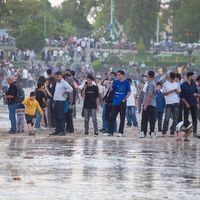
That evening, the turnout itself was striking. The organizers had deliberately avoided publicity, fearing a shutdown, but word spread and the courtyard filled with hundreds of people.

Stalls offered original stories, photo collections, paintings, handmade magazines, and designs unseen elsewhere.

Even the clothing became a statement. Women wore sleeveless dresses and shorts. Some men, too, chose shorts—now more likely to be banned than unveiled women.

I spoke with a young woman who had turned her mother’s life into a photo-book, a couple selling posters on Palestine and Gaza, and a Berlin project created by queer refugees and migrants— extraordinary in a country where queer life faces relentless suppression.

The fair lasted three days, with workshops and discussions, all unlicensed and therefore illegal.

It belonged to the wave of activity born of the Woman, Life, Freedom movement, shaped by the conviction that freedom must be lived, not pleaded for or postponed.

Live not fight

One organizer recalled the police once stopping by, noticing women in sleeveless tops, and saying: “We don’t care about these things. We see worse uptown. Just don’t block driveways.”

The art they ignored entirely.

No one believes this space is permanent. The same authorities who tolerate unveiled women in cafés one week seal those cafés the next. Crackdowns and reopenings follow in cycles.

Yet people do not retreat. They build communities, collaborate and bring into being what they once thought dependent on systemic change.

Politics may dictate sanctions in New York, but in Tehran courtyards people go on writing, printing, painting and performing—in disregard more than defiance—living the freedom they’re no longer willing to wait for.

Iran adds 11 aircraft to civil aviation fleet - IRGC media

Oct 5, 2025, 14:06 GMT+1

Iran has added 11 new aircraft to its civilian fleet as part of an ongoing effort to expand domestic air transport capacity, IRGC media reported on Sunday, citing the head of the Civil Aviation Organization.

Hossein Pourfarzaneh, the organization’s chief, said during a ceremony in Tehran that the newly inducted aircraft-- along with one helicopter and five small passenger planes -- would add more than 2,500 seats to the country’s aviation network.

“These projects are aimed at improving service quality and expanding air connectivity across the country, including to the islands and remote provinces,” Pourfarzaneh was quoted as saying by the Tasnim news agency.

He said 13 transportation projects worth about $125 million had been launched to strengthen Iran’s air infrastructure.

According to Pourfarzaneh, Iran has added over 5,100 passenger seats since 2021.

  • Iran receives Russian MiG-29 jets, expects more advanced systems, lawmaker says

    Iran receives Russian MiG-29 jets, expects more advanced systems, lawmaker says

  • Iran Air receives two used Airbus A330s in oil-for-planes deal with China

    Iran Air receives two used Airbus A330s in oil-for-planes deal with China

Iran has struggled for decades to modernize its aging fleet due to international sanctions restricting aircraft sales and access to spare parts.

More than half of its estimated 330 commercial planes are grounded, forcing Tehran to rely on leased or secondhand aircraft.

Earlier this year, Iran took delivery of several used Airbus A330s from China under barter deals involving oil, according to domestic media reports.

Late in September, an Iranian lawmaker said Russian MiG-29 fighter jets have arrived in Iran and officials also discussed acquiring additional Russian-built jets, including Sukhoi Su-35s, as part of broader defense and transport cooperation with Moscow.

19 major dams near drying as Iran faces severe water shortage

Oct 5, 2025, 13:45 GMT+1

Nineteen of Iran’s major dams are on the verge of drying up and three have completely run out of water, state media reported, citing data from the Iran Water Resources Management Company.

After five consecutive years of drought, the country began the new water year with severely depleted reserves. Nationwide, reservoirs are only 35% full, and inflows to major dams have fallen by half compared with last year.

Dams in Tehran, Khorasan, Kerman, Hormozgan, and Zanjan provinces are among those at critical levels, while the Shamil, Niyan, Voshmgir, Golestan, and Roudbal dams have reached zero storage.

Officials warn that the persistent decline poses growing risks for drinking water, agriculture, and industry across much of the country.

Dozens of Caspian seals found dead on Iran’s northern coast

Oct 5, 2025, 13:12 GMT+1

The deaths of dozens of Caspian seals along Iran’s northern coast have renewed concern over the fragile state of the Caspian Sea ecosystem, state media reported.

At least 54 dead seals have been found on the shores of Mazandaran Province since March, according to environmental officials quoted by Tasnim News Agency.

The Caspian seal (Pusa caspica), the sea’s only native mammal, faces growing threats from pollution, overfishing, shrinking freshwater inflows and rising water salinity.

Environmental experts said entanglement in fishing gear, motorboat strikes and disease are also contributing to the deaths.

They warned that the decline of the species -- a key predator in the marine food chain -- could disrupt the ecological balance of the world’s largest enclosed body of water.

Conservation groups have called for tighter controls on fishing, pollution reduction and regional cooperation among Caspian littoral states to protect the endangered species.

Iran protests neighbors allowing enemy drones and missiles to fly through airspace

Oct 5, 2025, 10:50 GMT+1

Iran has formally protested to some neighboring countries for allowing what it described as “enemy drones, missiles and micro-aircraft” to fly through their airspace during recent regional hostilities, the commander of Iran’s Border Guard said.

Brigadier General Ahmadali Goudarzi told state media that Tehran had documented the incidents and submitted official complaints, without naming the countries involved.

He said Iran’s borders remain “among the most secure in the region” thanks to advanced monitoring systems and coordination with neighboring states.

Goudarzi added that about 96% of Iran’s borders are under direct control of border forces and that operations continue against smuggling and illegal crossings.