Republican senator seeks FBI, Pentagon probe into Iranian influence
US Senator Tom Cotton on Wednesday called on the FBI and Defense Department to investigate what he called an Iranian campaign to influence US policy, branding it a serious national security concern.
Republican senator seeks FBI, Pentagon probe into Iranian influence | Iran International
The Arkansas Republican cited a joint investigation by Semafor and Iran International into the Iran Expert Initiative (IEI), an effort by Tehran's foreign ministry to cultivate ties with academics and think tank analysts to advance the Islamic Republic’s interests.
Cotton's letter focused on Ariane Tabatabai, a former aide to former US Special Envoy for Iran, Robert Malley. Her next post was as Pentagon Chief of Staff for the Assistant Secretary of Defense for Special Operations and Low-Intensity Conflict.
Cotton said in his letter that Tabatabai “is still working with the US intelligence community.”
"Tabatabai and other IEI affiliates should not have been in a position to influence US policy decisions and access our nation's most sensitive intelligence," Cotton wrote.
"While the Biden administration ignored repeated calls from Republicans to remove officials affiliated with IEI and the Iranian government, the Federal Bureau of Investigation (FBI) and the Department of Defense (DoD) should now correct this mistake."
It was not clear what spurred the senator, an outspoken Iran hawk, to issue the call.
"I urge the FBI and DoD to review this matter thoroughly for counterintelligence concerns and potential criminality, given that national security information may have been provided to a foreign government," Cotton continued.
He also called on the FBI and Pentagon to “investigate all current and former government officials affiliated with IEl and take appropriate actions to ensure such officials are no longer able to assist Tehran in damaging US national security.”
Last October, The Free Press reported that Tabatabai had taken on a new role in the defense department which gave her reduced access to intelligence, according to a former Pentagon official.
The Iranian-American academic in her new role oversaw force education and training within the defense secretary's office.
It is not clear if Tabatabai is still working in the same position under the Trump administration.
US President Donald Trump has repeatedly faulted his predecessors for perceived policy failings on Iran but has not explicitly alighted on the IEI in his criticisms.
Fellow Republican lawmakers have cast Iran as an implacable enemy after a justice department indictment sealed last year accused the country's Islamic Revolutionary Guard Corps of a plot to assassinate Trump - charges Tehran denies.
The leaders of China, Russia, North Korea and Iran who appeared together at a Beijing military parade formed an “autocratic alliance” challenging the rules-based order, EU foreign policy chief Kaja Kallas said on Wednesday.
“While Western leaders gather in diplomacy, an autocratic alliance is seeking a fast track to a new world order,” Kallas told reporters in Brussels. “Looking at President Xi standing alongside the leaders of Russia, Iran and North Korea in Beijing today, these aren’t just anti-Western optics: This is a direct challenge to the international system built on rules.”
Xi projects power in Beijing
The comments came as Chinese President Xi Jinping stood flanked by Russian President Vladimir Putin and North Korean leader Kim Jong Un in Tiananmen Square for a showpiece military parade. Iranian President Masoud Pezeshkian was also present, joining more than 25 world leaders at the commemoration of Japan’s surrender in World War II.
Xi warned that humanity faced a choice between “peace or war, dialogue or confrontation” as he oversaw displays of hypersonic missiles, underwater drones and fighter jets. The parade featured tens of thousands of troops in a spectacle that China framed as a symbol of global solidarity with the developing world.
Iran joins sanctioned leaders on stage
For Iran, Pezeshkian’s attendance highlighted its growing alignment with Beijing and Moscow. His presence followed months of speculation after he did not appear at Russia’s Victory Day parade in May, despite Tehran’s deepening security and energy ties with Moscow. The absence then sparked domestic debate in Iran over how its relationship with Russia was being perceived.
Iranian officials have stressed they are seeking to use “every diplomatic capacity” in the East to ease pressure from sanctions and revive leverage in nuclear talks. Standing alongside Xi, Putin and Kim placed Pezeshkian visibly within a bloc of leaders under Western sanctions.
Trump reacts as Kremlin plays down
US President Donald Trump, who was not at the parade, wrote on social media: “Please give my warmest regards to Vladimir Putin and Kim Jong Un as you conspire against the United States of America.” The Kremlin rejected the idea, saying Putin was not conspiring against Washington.
A senior cleric’s claim that Iran’s Supreme Leader endorsed new indirect talks with Washington has raised questions about divisions in Tehran, after Ali Khamenei himself appeared to rule out negotiations in a recent speech.
“The principle of negotiation, even in an indirect form with the United States, was endorsed by the Leader after the war,” said Abdolhossein Khosropanah, Secretary of the Supreme Council of the Cultural Revolution.
Days earlier, on August 24, Khamenei had struck a very different tone, eschewing talks and accusing Washington of seeking Iran’s “surrender.”
The veteran theocrat called the standoff over Tehran's nuclear program “unsolvable” and vowed the Islamic Republic would never bow to US pressure.
Khosropanah’s apparently conflicting citation surprised many. “Why would an official from a cultural body comment on national security?” analyst Damoon Mohammadi told Iran International.
Khamenei, he suggested, may have deliberately floated the idea through an unlikely figure to test domestic reaction.
The contrasting statements underscore intensifying infighting over Iran’s future course.
With the stakes raised by the 12-day war with Israel and the looming prospect of UN sanctions snapping back, Tehran’s factions are split between those urging pragmatic engagement and hardliners who insist any compromise would mean capitulation.
Moderates push diplomacy
President Masoud Pezeshkian has hinted at cautious engagement, despite heavy criticism at home.
Meeting Turkish President Recep Tayyip Erdogan at the Shanghai Cooperation Organization summit in China, he said Iran was ready for indirect dialogue with Washington so long as its nuclear rights were recognized.
Foreign Ministry spokesperson Esmail Baghaei echoed that line, saying Tehran would reinstate IAEA inspections and reduce enrichment to 3.67% if its sovereign right to enrichment were respected.
Hardliners resist
Former negotiator Saeed Jalili remains fiercely opposed, likening pro-diplomacy figures in early August to the Israelites who worshipped the golden calf in Moses’ absence—a possible jab at officials emboldened by Khamenei’s limited public appearances since the war.
Ultra-conservative commentator Mohammadsadegh Shahbazi wrote on X: “There are options beyond negotiation. International structures can be challenged. We must show that Europe and America are not our only paths.”
Washington unmoved
Despite the rhetoric, officials acknowledge Washington has shown no interest in talks. Deputy Foreign Minister Majid Takht-Ravanchi told Iranian media managers in a closed-door meeting Saturday—according to information obtained by Iran International—that the White House had ignored Tehran’s outreach.
Another deputy, Kazem Gharibabadi, reportedly disclosed last week: “We have sent messages to Washington 15 times in different ways to restart the negotiations, but we have not received any response.”
The last round, mediated by Oman, collapsed when the US demanded Iran curb enrichment on its own soil—a demand Khamenei branded a red line. With diplomacy stalled, Israel struck Iranian sites, triggering the 12-day war.
The newly minted head of Iran's Supreme National Security Council said on Tuesday that Tehran remains open to nuclear talks with the United States but accused Washington of evasion.
Larijani, a former parliament speaker and veteran nuclear negotiator, was appointed last month to lead the powerful body in charge of key security decisions, where he also holds a parallel role as Supreme Leader Ali Khamenei's personal representative.
His mandate places him at the center of Tehran’s decision-making apparatus following a 12-day war with Israel in June, and his comments marked the most dovish yet on renewing US diplomacy by a top security official since the conflict.
“The path for negotiations with the US is not closed; yet these are the Americans who only pay lip service to talks and do not come to the table — and they wrongfully blame Iran for it,” Larijani wrote on X, posting on behalf of the council.
"WE INDEED PURSUE RATIONAL NEGOTIATIONS. By raising unrealizable issues such as missile restrictions, they set a path which negates any talks."
Speaking separately to Iranian media managers, Larijani dismissed Western demands that Iran scale back its missile program as unacceptable.
“The enemy says we must back down from our missile capability. Which honorable Iranian today would want to hand over his weapon to the enemy?” he said. “We also see negotiations as the path to resolving the nuclear issue. But by raising issues such as missiles, (it shows) they don’t want talks to take shape.”
His remarks underscore Tehran’s refusal to link missiles to nuclear diplomacy. The 2015 Joint Comprehensive Plan of Action (JCPOA) restricted Iran’s nuclear program but did not directly address missiles. However, UN Security Council Resolution 2231, which endorsed the deal, included language urging restraint on missile development.
Larijani argued that Washington is using the missile issue to derail diplomacy.
“At present, the Americans do not want to negotiate. After all, the war broke out at a time when we were in the middle of negotiations,” he said, referring to the recent 12-day war with Israel.
Larijani's comments come amid escalating nuclear tensions. Britain, France and Germany — the E3 — have triggered the UN’s “snapback” mechanism under Resolution 2231, seeking to restore pre-2015 sanctions over what they call Iran’s serious non-compliance.
Tehran, backed by Russia and China, has rejected the move as null and void. Iranian lawmakers have even threatened to withdraw from the Nuclear Non-Proliferation Treaty (NPT) if sanctions are reimposed.
The SNSC chief’s statement on Tuesday called restrictions on Iran’s missile program “unrealizable,” signaling that while Tehran insists negotiations remain possible, it will not make concessions on what it considers a core pillar of its defense doctrine.
President Donald Trump said his decision to bomb Iranian nuclear sites in June forestalled a nuclear war and provided a major boon to Israel, adding new superlatives to his positive assessment of the attacks.
“Nobody has done more for Israel than I have, including the recent attacks on Iran, wiping that thing out,” Trump said in an interview with Daily Caller published on Sunday.
Trump ordered a United States military campaign dubbed Midnight Hammer on June 22, targeting the nuclear sites at Esfahan, Natanz and Fordow in Iran.
“I stopped seven wars and wiped out a nuclear war that would have happened with Iran. That was going to happen,” Trump said.
The attack involved B-2 stealth bombers armed with 30,000-pound Massive Ordnance Penetrators (MOPs), so-called bunker buster bombs designed to destroy fortified underground facilities.
The Trump administration had set a 60-day deadline to secure a nuclear agreement with Iran. On day 61, with four rounds of negotiations completed and a fifth looming, Israel launched a surprise military attack on Iran on June 13.
France, Germany and the United Kingdom are pressuring Iran to resume talks with the US and resolve disputes over its nuclear program.
The European troika, which are party to a 2015 nuclear deal with Iran, had set a deadline for Tehran to make an effective and tangible move toward diplomacy by the end of August.
The E3 notified the United Nations in late August that they would pursue the reimposition of UN sanctions under the so-called "snapback" mechanism unless Iran returned to nuclear talks, granted inspectors wider access and provided details on its highly-enriched uranium stockpile.
European governments have stressed that there is still time for diplomacy before sanctions formally return.
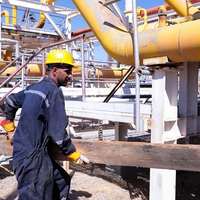
The US Treasury on Tuesday imposed sanctions on an Iraqi-Kittitian businessman and a network of companies and vessels accused of smuggling Iranian oil disguised as Iraqi crude.
The sanctions target Waleed Khaled Hameed al-Samarra’i, based in the United Arab Emirates, along with his firms Babylon Navigation DMCC and Galaxy Oil FZ LLC, and nine Liberia-flagged tankers.
Washington said the network covertly blended Iranian and Iraqi oil through ship-to-ship transfers in the Persian Gulf and in Iraqi ports, marketing it as solely Iraqi in origin.
The Treasury estimated the operation generated about $300 million annually for both Iran and al-Samarra’i.
It accused the group of using shell companies in the Marshall Islands to obscure ownership of vessels and employing tactics such as night transfers and location spoofing to hide activity.
“Iraq cannot become a safe haven for terrorists, which is why the United States is working to counter Iran’s influence in the country,” Treasury Secretary Scott Bessent said in a statement.
“By targeting Iran’s oil revenue stream, Treasury will further degrade the regime’s ability to carry out attacks against the United States and its allies.”
The measures follow sanctions announced in July against another network accused of blending Iranian and Iraqi oil.
For two consecutive years, Chinese records show imports of “Iraqi” oil exceeding Iraq’s declared shipments by around 100,000 barrels per day—worth more than $2.5 billion annually.
The gap has grown since 2021, suggesting a persistent pattern of disguised flows, according to experts.
Iraq’s oil minister Hayyan Abdul-Ghani acknowledged earlier this year that Iranian tankers were using forged Iraqi documents and said the matter had been reported to the United States.