US sanctions Iranian national, foreign firms over drone program support
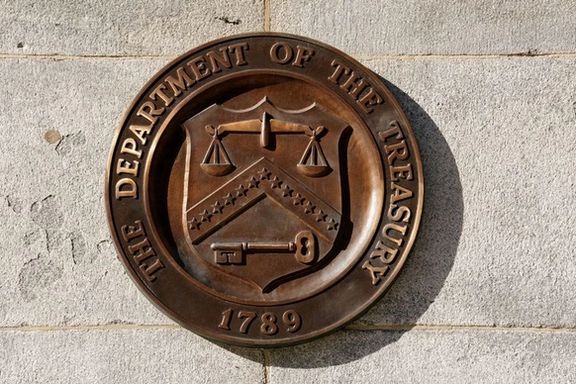
The United States on Thursday imposed sanctions on an Iranian national and five companies in Iran, China, Hong Kong and Taiwan for allegedly supplying technology to Iran’s military drone program, the Treasury Department announced.
“Iran continues to pursue the development of asymmetric weapons capabilities, including unmanned aerial vehicles, to carry out attacks on the United States, our servicemembers and our partners and allies in the region,” said Under Secretary of the Treasury for Terrorism and Financial Intelligence John K. Hurley.
“We will continue to put America first by disrupting Tehran’s ability to further its destabilizing agenda.”
The sanctions target Javad Alizadeh Hoshyar, the CEO of Iran-based Control Afzar Tabriz Co., along with affiliated companies that the Treasury says procured sensitive manufacturing equipment for the Iran Aircraft Manufacturing Industrial Company (HESA).
HESA, a state-owned entity under Iran’s Ministry of Defense and Armed Forces Logistics (MODAFL), produces military aircraft and Ababil-series drones used by the Islamic Revolutionary Guard Corps (IRGC).
Under Hoshyar’s direction, Control Afzar Tabriz Co. allegedly acquired computer numerical control (CNC) machines and routed shipments through foreign intermediaries—including Clifton Trading in Hong Kong, Mecatron and Joemars in Taiwan, and Changzhou Joemars in China—to evade export controls and mask HESA’s involvement, according to the Treasury.
The designations follow another round of sanctions a day earlier against a global shipping and smuggling network allegedly controlled by Mohammad Hossein Shamkhani, the son of Ali Shamkhani, Iran's former national security chief and an adviser to supreme leader Ali Khamenei.
More than 50 individuals and entities were designated on Wednesday, and over 50 vessels identified, in what the US Treasury called its largest Iran-related action since 2018.
Islamic Revolutionary Guard Corps (IRGC) personnel assemble at a military parade in this file photo.
The United States and thirteen allied countries have accused Iran of plotting to kill, kidnap and intimidate individuals in Europe and North America, citing violations of sovereignty and links to international criminal networks.
“These services are increasingly collaborating with international criminal organizations to target journalists, dissidents, Jewish citizens, and current and former officials,” the US State Department said in a joint statement with European countries.
They included the United Kingdom, Albania, Austria, Belgium, Canada, Czechia, Denmark, Finland, France, Germany, the Netherlands, Spain and Sweden.
The governments called on Iranian authorities to immediately halt the activities and pledged to work together to prevent further threats.
On Monday, a Belgian lawmaker of Iranian descent, Darya Safai said the European country's police warned her of an Iranian plot to abduct her via Turkey after she backed labeling the Revolutionary Guards a terrorist group.
Earlier this month, British counter terrorism police said Iran alongside Russia and China is behind a growing number of life-threatening operations on UK soil including assassination and kidnapping plots carried out by criminal proxies.
Additionally, the European Union sanctioned an Iran-linked network over their alleged role in assassination plots and enforced disappearances of dissidents abroad, including on European soil.
Since January 2022, there have been at least 15 attempts at murder or kidnap against British nationals or UK-based individuals, according to a report by UK Parliament’s Intelligence and Security Committee (ISC) this month.
Iran has previously been accused of involvement in the kidnapping and killing of foreign nationals abroad.
In 2020, German-Iranian dissident Jamshid Sharmahd was kidnapped by Iranian operatives from Dubai and forcibly taken to Iran via Oman. He was sentenced to death and executed in what Amnesty called a "grossly unfair trial" in 2023.
Iran also abducted dissident journalist Rouhollah Zam from Iraq after luring him to leave Paris for the Arab country in September 2019. He was later sentenced to death and executed in Iran in 2021.
Iran has stepped up the toxic burning of fuel oil for power generation amid electricity shortages, local media reported Thursday, in a move which is set to further pollute air quality but may do little to ease blackouts.
Tejarat News wrote officials last summer “imposed power outages on citizens under the pretext of ending fuel oil use,” though the practice continued behind the scenes.
“Now it’s clear that mazut never left the government’s agenda—not even last year,” it added.
All major power plants ran on mazut in 2024, Saeed Tavakoli, managing director of the National Iranian Gas Company confirmed Tuesday.
“All power plants across the country used fuel oil at full capacity last year,” he told reporters.
“Despite the president’s emphasis on environmental concerns, this was one of his administration’s adopted strategies.”
“Though the president and his deputy stress environmental protection, when there is an energy imbalance in the country, fuel oil is one of the available sources. In last year’s exceptional conditions, all mazut-fired plants were operational,” Tavakoli added.
“People must now endure pollution, blackouts, and disease at the same time,” Tejarat News warned.
Sanctions, age and mismanagement have taxed Iran's energy infrastructure, and the country has long faced blackouts especially in summer months when water and electricity demand surge.
The economic daily criticized the Pezeshkian administration for what it called a retreat from earlier pledges, adding: “Officials speak of environmental protection and renewable energy, but these same officials chose one of the most harmful fuels for humans and nature last winter.”
In November 2024, the government had ordered a halt to fuel oil use in cities including Arak, Isfahan, and Karaj due to worsening air pollution. That ban has since been quietly revoked.
“The state has now paved the way again for fuel oil use,” Tejarat News said. “But even this return failed to stop the blackouts.”
“Fuel oil burning is no longer an emergency fix—it is now a systematic, institutionalized policy that symbolizes the collapse of energy planning and the state’s neglect of public health and the environment,” it added.
Iran has told European powers it may withdraw from the nuclear Non-Proliferation Treaty (NPT) if UN sanctions are reimposed, Western diplomats told Iran International after last week’s talks in Istanbul.
The message was conveyed during a closed-door meeting last week between Iranian officials and representatives from France, Germany and Britain, known collectively as the E3. The session marked the first formal nuclear discussions since last month’s Israeli and US strikes on Iranian territory.
According to one diplomat present at the meeting, Deputy Foreign Minister Majid Takht Ravanchi said any withdrawal from the treaty should not be interpreted as a step toward building nuclear weapons.
Officials expect sanctions to return
A separate source inside President Masoud Pezeshkian’s government told Iran International that senior Iranian officials have concluded that snapback sanctions under UN Security Council Resolution 2231 are likely and that Tehran must be ready to respond.
Under the 2015 nuclear deal, the snapback mechanism allows a participant to reimpose UN sanctions if Iran is found to be in serious non-compliance. France has recently warned that it will push for global embargoes unless a broader agreement is reached by late August.
Tehran rejects European authority on sanctions
Iran has rejected the legitimacy of any attempt by the E3 to invoke the snapback clause. Foreign ministry spokesman Esmail Baghaei said earlier this week that Britain, France and Germany have no legal standing to trigger the measure and had “marginalized themselves” through their support for Israel and the United States during recent military action.
Baghaei also said Tehran remains opposed to extending Resolution 2231 beyond its scheduled expiration in October.
Talks confined to nuclear file, Iran says
Iranian officials insist that the Istanbul talks were limited to nuclear and sanctions-related issues. Baghaei said no other topics were raised and warned that any attempt to expand the agenda would not be accepted.
“These talks have a clear and limited focus: the lifting of sanctions and matters related to the nuclear program,” he said during his weekly press briefing.
A website tied to Iran’s Revolutionary Guards on Thursday urged parliament to ban the import of dogs, cats and pet supplies, amid growing pressure to restrict pet ownership on religious and cultural grounds.
“If you truly represent the people, protect public rights, especially those of innocent children, and submit a bill to ban all imports of dogs, cats and pet supplies,” Fars News wrote.
The appeal came after the government lifted restrictions on registering import orders for previously banned goods from Eurasian Economic Union countries. The directive, issued by the Trade Promotion Organization, included pet-related items not covered by religious or legal bans.
Fars News criticized the move, saying it contradicted existing dog walking bans and burdened municipalities that already struggle to manage stray animals.
Local crackdowns intensify
Iranian prosecutors have expanded dog walking bans to at least 25 cities, including Kermanshah, Ilam, Hamadan, Kerman and Isfahan. The measures are being enforced under local orders citing Iran’s Penal Code and Constitution as no national legislation has been passed.
Officials have cited Article 638 of the Penal Code, which addresses acts against public morality, and Article 688, which concerns threats to public health. They have also invoked Article 40 of the Constitution, which bars activities that harm others.
Prosecutors in several provinces announced new bans in recent days, reinforcing earlier restrictions first imposed in Tehran in 2019.
“Offenders will face legal action to preserve public decency,” he said, adding that pet ownership reflected “foreign cultural influence.”
Authorities in Ilam, Khalkhal, and other cities have issued similar orders, citing constitutional and penal code provisions relating to public health and morality.
“This practice reflects the promotion of a Western lifestyle,” Khalkhal prosecutor Mozaffar Rezaei said, warning of penalties for transporting or walking dogs in public spaces.
An Iranian oil worker stands besides a rig in this file photo.
Iran condemned a new round of US sanctions on its oil and shipping sectors a day after Washington announced penalties on dozens of firms, vessels and individuals it said were helping Tehran evade restrictions on energy exports.
“These sanctions are cruel and illegal. They aim to weaken Iran’s economy and hurt the welfare of its people,” foreign ministry spokesman Esmail Baghaei said on Thursday, according to state media.
Baghaei said the United States was using sanctions as a tool of pressure and accused Washington of ignoring international norms. “America’s addiction to unilateral action has undermined the foundations of international law,” he said.
“The sanctions violate the sovereignty of states and disrupt global trade,” he added.
Baghaei also said the sanctions amounted to a violation of human rights and called for Washington to be held responsible under international law.
The Treasury also listed vessels linked to a sprawling network led by Hossein Shamkhani, the son of Ali Shamkhani, Iran's former national security chief and an adviser to supreme leader Ali Khamenei.
The sweeping sanctions freeze any US-based assets and prohibit Americans from doing business with the named entities.
The Shamkhani family has also been accused of using its illicit wealth to obtain foreign passports and luxury properties abroad—privileges far removed from the daily struggles of ordinary Iranians.