• العربية
  • فارسی
Brand
  • Iran Insight
  • Politics
  • Economy
  • Analysis
  • Special Report
  • Opinion
  • Podcast
  • Iran Insight
  • Politics
  • Economy
  • Analysis
  • Special Report
  • Opinion
  • Podcast
  • Theme
  • Language
    • العربية
    • فارسی
  • Iran Insight
  • Politics
  • Economy
  • Analysis
  • Special Report
  • Opinion
  • Podcast
All rights reserved for Volant Media UK Limited
volant media logo

US urges Iran to make a deal or brace for more pressure
Jul 23, 2025, 21:15 GMT+1Updated: 22:21 GMT+1
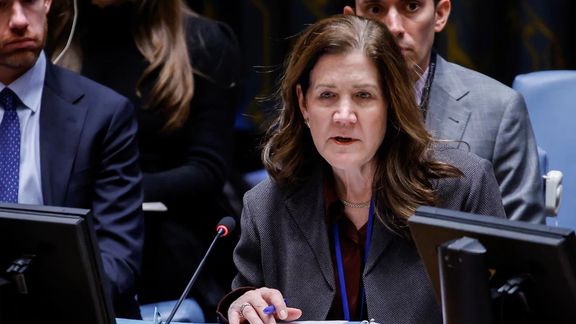
Dorothy Camille Shea speaks during a Security Council meeting about the Middle East at UN Headquarters in New York City, US, January 23, 2025

The United States called on Iran to resume cooperation with the UN nuclear watchdog and return to negotiations over its nuclear program or face even more pressure.

"In the absence of a deal, the United States continues to impose maximum diplomatic and economic pressure to constrain any activities, like the pursuit of a nuclear weapon that would threaten the security of US citizens, personnel, and partners in the region," acting US Ambassador to the United Nations Dorothy Shea told the UN Security Council on Wednesday.

Shea said Tehran must choose between continuing to block international oversight while supporting it's regional allied groups, or engaging in “meaningful, time-bound diplomacy” that could pave the way for peace and reintegration into the global economy.

“Iran can continue its current path of defying the NPT(Non-Proliferation Treaty)-mandated safeguards obligations in a bid to reconstitute its nuclear program in secrecy,” she said.

Iran passed the law suspending cooperation with the IAEA following last month's US and Israeli strikes on its nuclear facilities.

Foreign Minister Abbas Araghchi said this week that Tehran has not ended cooperation with the agency. Instead, he said future coordination with inspectors would now be managed by the country’s Supreme National Security Council.

“Already, Iran's law to suspend cooperation with the IAEA (International Atomic Energy Agency) has obscured international visibility into its program.”

Snapback looms

Shea's warning comes amid growing pressure from the US and its European allies, who have set an end-of-August deadline for Iran to reach a nuclear deal or face the reimposition of full UN sanctions under the JCPOA’s snapback mechanism.

The snapback mechanism, created under UN Security Council Resolution 2231—which endorsed the 2015 nuclear deal—allows any party to the agreement to reimpose sanctions if Iran is found non-compliant.

If no resolution is passed within 30 days to continue sanctions relief, all prior UN measures automatically come back into force.

Iran is set to hold nuclear talks with European powers including Germany, France and the United Kingdom on Friday in Istanbul. However, talks with the United States remain stalled after a planned sixth round in Muscat was cancelled on the eve of the Israel's June 13 strikes on Iran.


Most Viewed

Ghalibaf defends Iran-US talks amid hardline backlash
1
INSIGHT

Ghalibaf defends Iran-US talks amid hardline backlash

2
INSIGHT

Iran diplomacy wobbles as factions compete to avoid looking soft on US

3
VOICES FROM IRAN

Bread shortages, soaring prices strain households in Iran, residents say

4
ANALYSIS

The politics of pink: how Iran uses cuteness to rebrand violence

5

Scam messages seek crypto for ships’ safe passage through Hormuz, firm warns

Banner
Banner

Spotlight

  • Opposition to US talks grows in Tehran as ceasefire deadline nears
    INSIGHT

    Opposition to US talks grows in Tehran as ceasefire deadline nears

  • Tehran moderates see ‘no deal–no war’ limbo as worst outcome
    INSIGHT

    Tehran moderates see ‘no deal–no war’ limbo as worst outcome

  • The future has been switched off here
    TEHRAN INSIDER

    The future has been switched off here

  • Lights out, then gunfire: Witnesses recount Mashhad protest crackdown
    VOICES FROM IRAN

    Lights out, then gunfire: Witnesses recount Mashhad protest crackdown

  • Family told missing teen was alive, then received his body 60 days later
    EXCLUSIVE

    Family told missing teen was alive, then received his body 60 days later

  • Is Iran entering its Gorbachev moment?
    INSIGHT

    Is Iran entering its Gorbachev moment?

•
•
•

More Stories

Veteran activist urges Khamenei to allow fundamental change or resign

Jul 23, 2025, 20:24 GMT+1

An imprisoned Iranian political activist issued a statement on Wednesday demanding Supreme Leader Ali Khamenei admit profound failures following a war with Israel and usher in fundamental change or else quit.

"The Supreme Leader’s misguided strategies and miscalculations have placed the Islamic Republic in its weakest and most fragile state ever,” Mostafa Tajzadeh said in the statement released on his official Telegram channel.

"In this critical situation, Mr. Khamenei has no option but to apologize to the Iranian people and accept fundamental reforms in line with national demands, including by forming a constituent assembly based on completely free and fair elections," he added, "or to resign and step down."

Mostafa Tajzadeh is a reformist politician who served as deputy interior minister during the presidency of Mohammad Khatami from 1997 to 2005.

He is closely aligned with Iran’s reformist political faction and has been imprisoned for 10 of the last 16 years, currently on charges including acting against the state, spreading falsehoods and propaganda.

Critical of Khamenei’s handling of tensions with the United States and Israel, Tajzadeh outlined a series of steps the Supreme Leader should take.

Tajzadeh said the change ought to resemble the 1905-1911 Constitutional Revolution which transformed the Qajar monarchy into a modern government through the establishment of a parliament.

Israeli airstrikes and drone attacks during a 12-day war last month killed hundreds of Iranians including civilians, military personnel and nuclear scientists. Iran's retaliatory missile strikes killed 27 Israeli civilians.

"It must be admitted with great sadness that the result of unnecessary and costly anti-Americanism, as well as the conflict with the will of the majority of the people, has been nothing but a bankrupt economy (and) a bleak outlook," Tajzadeh added.

Iran is currently facing water shortages and electricity outages across the country as decades of sanctions and mismanagement deepens economic hardship.

Iran agrees to IAEA technical team visit, but not to inspect sites

Jul 23, 2025, 18:10 GMT+1

Tehran has agreed to allow a delegation from the International Atomic Energy Agency (IAEA) to travel to Iran for technical talks but not to inspect nuclear sites, Iran's foreign ministry said on Wednesday.

"The delegation will come to Iran to discuss the modality, not to go to the (nuclear) sites," deputy foreign minister Kazem Gharibabadi told journalists in New York.

His remarks come after the IAEA said earlier this month that its team of inspectors had safely left Iran and returned to its headquarters in Vienna, following a new Iranian law that barred cooperation with the UN nuclear watchdog.

Gharibabad also addressed damage to Iran's nuclear sites following the June 22 US strikes on Isfahan, Natanz, and Fordow.

“Our Atomic Energy Organization is currently assessing the damage to the nuclear installations, and we are waiting to receive their report. It is very dangerous work — we do not know what has happened there because of the radiation risks,” he said.

Asked whether Iran remains compliant with the Non-Proliferation Treaty (NPT), Gharibabadi said Iran is committed to the treaty and, as such, should be allowed to exercise its rights, including uranium enrichment.

“We are a member of the NPT. We have obligations and rights… Enrichment is part of the rights of member states… Iran will enrich uranium in accordance with its needs,” he said.

Iran’s uranium enrichment program has long been a source of international tension.

While Tehran insists the program is for peaceful purposes, the IAEA argues that enrichment to high levels of purity lacks any civilian justification.

Renewed diplomacy

Gharibabadi will lead the Iranian delegation for talks with European powers in Istanbul on Friday - in what appears to be a last-ditch effort to salvage a deal and avert a return of United Nations sanctions against Iran.

Washington confirmed on Tuesday that it is coordinating closely with the E3 (Britain, France and Germany) ahead of the Istanbul talks, while remaining "ready to talk directly" to Tehran.

“The Iranian people stand to benefit from negotiating in good faith," state department spokeswoman Tammy Bruce told reporters. “The Iranian leadership has a window of opportunity to choose a path of peace and prosperity for their people.”

Iran bound by non-proliferation treaty even if it exits, veteran expert says

Jul 23, 2025, 10:39 GMT+1
•
Marzia Hussaini

Iran’s potential withdrawal from the Nuclear Non-Proliferation Treaty (NPT) would not exempt it from international legal obligations, one of the world’s foremost experts on nuclear weapons proliferation told Iran International.

David Albright, President of the Institute for Science and International Security (ISIS), said “Iran may announce it has left, but under international law, such a withdrawal wouldn’t be recognized. The prohibition on nuclear weapons would still apply.”

Tehran has floated withdrawing from the NPT, with lawmakers saying a draft bill is ready and could be approved within a day. The threat follows signals from European countries that they may trigger the snapback mechanism to restore sanctions lifted under the 2015 nuclear deal.

Iran also cites US and Israeli attacks on its nuclear sites as violations of international obligations, invoking Article 10 of the NPT as grounds for exit.

Asked about Tehran’s likely direction, Albright said Iran would probably try to delay talks while concealing remaining nuclear assets. “Iran will likely attempt to stall negotiations while hiding surviving assets—including any undeclared centrifuges or uranium stockpiles,” he said.

He further cautioned that pursuing nuclear weapons would backfire. “Nuclear weapons are not going to make Iran safer, they will make the situation exponentially worse—for the regime and, most of all, for the Iranian people,” Albright said.

Devastating setback for Iran

Albright said that Israeli and American attacks did profound damage to Iran's nuclear capabilities, adding that the country’s enrichment infrastructure has suffered a devastating setback particularly at the Fordow and Natanz nuclear sites and may not recover for years, if ever.

"The Iranian nuclear program has been seriously damaged, and for many of the programs, probably they can't recover," Albright said. "This idea of a large-scale enrichment program is really something that has been seriously damaged and may not be replaceable."

Albright, citing satellite imagery from Maxar Technologies and other commercial providers, said the multiple bunker-buster bombs dropped on the underground Fordow facility likely caused "enormous structural damage inside Fordow.”

US attacks on June 22 hit Iran's nuclear sites of Fordow, Esfahan and Natanz, capping off a surprise military campaign by Israel which killed hundreds of people including military personnel, nuclear scientists and civilians.

An initial Pentagon assessment suggested the attacks had only set Iran's nuclear program back by months, but subsequent analysis released by the Central Intelligence Agency said it would take Tehran years to recover.

Albright said while Iran may still possess some residual stockpiles of 60% or 20% enriched uranium, the operational capacity of the Fordow facility has likely been eliminated, and its future viability is in serious doubt.

Around 400 kilograms—more than 900 pounds—of uranium enriched to 60% purity is unaccounted for and now with the International Atomic Energy Agency (IAEA) barred from the country, it is unsure if the location can ever be known.

"Combined with the physical impact of the bombing, we assess that most, if not all, centrifuges at Natanz are either destroyed or inoperable.”

Albright said that the Natanz facility was the backbone of Iran’s enrichment capability, and its destruction marks a strategic turning point.

“Iran now appears incapable of producing new centrifuges, and more importantly, it can’t manufacture UF6 feed gas, without which enrichment is impossible,” Albright added.

'Fear, paranoia' among Iran's technical elite

Prime Minister Benjamin Netanyahu said in an interview following the conflict that Israel had rolled back Iran's nuclear program, but implied Israel had not yet finished its confrontation with the Islamic Republic.

“Israel didn’t just bomb facilities. It eliminated key personnel—scientists and program managers with decades of experience, many of whom were involved in Iran’s early nuclear weapons program in the 2000s,” Albright said.

Albright said Israel released a semi-official list showing that 9 out of 11 nuclear figures it assassinated had direct involvement in Iran’s alleged past nuclear weapons program, adding that some family members of these individuals were also killed.

“This creates a climate of fear and paranoia among Iran’s technical elite, even if the regime wants to rebuild, they now face a workforce that’s terrified, demoralized, and potentially penetrated by foreign intelligence,” Albright added.

Hardline Iran daily slams Araghchi for repudiating Trump death threats

Jul 23, 2025, 10:22 GMT+1

A newspaper affiliated with Supreme Leader Ali Khamenei condemned Iran’s foreign minister for denying threats to assassinate US President Donald Trump, calling it state policy and a matter of justice.

“The issue with Trump and Netanyahu is not assassination, but the implementation of justice,” Kayhan wrote Wednesday, also referring to Israeli Prime Minister Benjamin Netanyahu.

Foreign Minister Abbas Araghchi said in an interview with Fox News on Tuesday that the Islamic Republic does not seek to kill anybody abroad.

"This is not our policy to kill anybody outside Iran, let alone the president of another country," he said, though clerics have issued fatwas calling for his death.

A hardline Iranian cleric close to Iran’s Supreme Leader called on Muslims to kill US President Donald Trump and Israeli Prime Minister Benjamin Netanyahu in June in response to their threats against Khamenei.

The call came days after Ayatollah Naser Makarem Shirazi and Ayatollah Hossein Nouri Hamedani issued separate fatwas against Trump and Netanyahu.

Shirazi said in his statement: “Any regime or individual threatening the leaders of the Islamic Ummah (nation) and acting on those threats qualifies as a mohareb.”

Kayhan described both Trump and Israeli Prime Minister Benjamin Netanyahu as corruptors on earth and mohareb (enemy of God), terms which if invoked in fatwas or decrees under Shi'ite jurisprudence make it religiously obligatory for devout Shi'ite Muslims to act.

The penalty for the crimes in the Islamic Republic's theocratic system is death.

Kayhan also denounced Araghchi’s comment that “this has never been Iran’s policy to wipe out Israel from the map,” calling the comment “against the country’s official and strategic positions.”

The paper cited statements by the Islamic Republic’s founder, Ruhollah Khomeini, who said Israel “must vanish from the page of time,” as well as Khamenei’s 2015 vow that “Israel will not see the next 25 years.”

The front page of the Kayhan newspaper in September 1982, featuring a headline quoting Islamic Republic founder Ruhollah Khomeini saying, “Israel must vanish from the page of time.”
100%
The front page of the Kayhan newspaper in September 1982, featuring a headline quoting Islamic Republic founder Ruhollah Khomeini saying, “Israel must vanish from the page of time.”

The backlash follows criticism from the Revolutionary Guards-affiliated Fars News Agency, which said Araghchi’s recent remarks admitting damage to the country's nuclear facilities and enrichment risked projecting weakness in the wake of the war with Israel.

“Our facilities have been damaged – seriously damaged,” Araghchi said in his interview after US strikes on the country's three main facilities were said to have "obliterated" Iran's nuclear program, according to Trump. “The extent of which is now under evaluation … enrichment has currently ceased."

Fars also faulted him for dismissing clerical fatwas targeting Trump, saying that to deny it undermines national resolve.

In January, Iran's President, Masoud Pezeshkian, said that Iran “never attempted” to kill Trump, “and we never will.”

Iranian satellite to launch aboard Russian Soyuz rocket - IRGC media

Jul 23, 2025, 09:51 GMT+1

An Iranian satellite is set to launch into orbit aboard a Russian Soyuz rocket on Friday, IRGC-linked Tasnim News Agency reported, marking Tehran’s second space-related operation this week.

The launch is scheduled for 9:54 a.m. Tehran time from Russia’s Vostochny Cosmodrome and will carry two primary satellites, Ionosfera-M 3 and 4, alongside 18 smaller payloads, including the unnamed Iranian satellite. Russian media did not mention Iran but said 17 of the small satellites are Russian-made CubeSats, and one is being launched “for the benefit of a foreign customer.”

On Monday, Iran also carried out a suborbital test of its Qased satellite launcher, which Tasnim described as part of ongoing efforts to develop space technologies. Experts say the test, led by the IRGC, also signaled defiance after the 12-day war with Israel and served as a platform for refining ballistic missile capabilities.

“The same rocket that launches satellites can launch missiles; it's the identical technology,” said Fatima Al-Asrar, a Yemeni-American policy analyst. Iran insists its space program is peaceful, but analysts warn that each test advances dual-use military know-how.

“The timing shows Iran wants to project strength despite its recent setbacks,” said Middle East analyst Sina Azodi. Other observers say the launches may be calibrated to stop short of triggering military retaliation while keeping pressure on Western powers.

Such tests have drawn Western concern due to their dual-use potential — the same technology used to launch satellites can also deliver ballistic missiles. In January 2024, the European Troika, Britain, France, and Germany, condemned Iran’s launch of the Soraya satellite aboard the Qaem 100 rocket, warning it used the same base as long-range missile systems.