Afghan families deported from Iran waiting at the border to enter Afghanistan, July 6, 2025
In the midst of mounting economic pressure, international isolation and a series of military setbacks, Iran has launched a drive to deport Afghan migrants, marking the impoverished community's latest blow amid the vagaries of official policy.
According to the UN International Organization for Migration, nearly 700,000 Afghans were deported from Iran in the first half of 2025. A full 130,000 were expelled within just one week after the 12-day war between Iran and Israel. Many had lived in Iran for decades.
Far from an aberration, the recent wave of arrests, public humiliation and mass expulsions of Afghan migrants is a continuation of Tehran's decades-old political manipulation of one of the most vulnerable populations in the region.
The Islamic Republic's founder Ayatollah Ruhollah Khomeini famously declared that "Islam has no borders" and welcomed Afghan refugees fleeing a Soviet invasion in 1979.
But beyond this ideological gesture, Tehran never offered a clear legal or humanitarian framework for integration. Millions of Afghans entered Iran, only to be denied citizenship, legal employment or access to education and healthcare.
Over the decades, Afghan migrants have been treated as expendable tools in Tehran’s shifting policies in the region.
They were recruited to fight in Syria as part of the “Fatemiyoun” Brigade, exploited as cheap undocumented labor inside Iran and periodically threatened with mass expulsion in bouts of official populism.
During moments of domestic discontent, Afghan migrants became convenient targets to deflect public anger.
Under President Ebrahim Raisi, the policy of exploitation took on new dimensions. In the wake of the Taliban's return to power in 2021, a massive influx of Afghan refugees entered Iran and as many as around two million Afghans crossed the border within two years.
Rather than developing a comprehensive migration policy, Tehran allowed its border regions to turn into chaotic transit points run by smugglers and corrupt officials.
Xenophobia
In the aftermath of Israel’s devastating strikes on Iranian military and nuclear sites, domestic frustration reached boiling point.
The Islamic Republic, seeking to redirect the public's discontent, amplified xenophobic narratives portraying Afghans as a threat to national security.
Despite isolated claims of rising crime among Afghans, official figures show otherwise.
Iran's judiciary reports that Afghan nationals comprise only about 6% of the prison population—roughly in line with their proportion of the total population. The majority of these arrests are for undocumented entry or labor violations, not violent or organized crime.
Ghosts of policies past
In 2001, following the fall of the Taliban, I traveled to the border town of Taybad and the nearby Islam Qala crossing and I was able to personally witness the brutal consequences of this policy.
There, I saw mass graves of Hazara refugees who had been forcibly returned by the Islamic Republic and summarily executed by Taliban fighters in the deserts surrounding the town.
Tehran knew that these Shia Hazaras were at extreme risk, yet still arrested them in Iranian cities, detained them in camps in the east and deported them into the hands of their eventual killers. This memory haunts me to this day.
The recent expulsions have also generated heartbreaking testimonies. Haajar Shademani, a 19-year-old Afghan born in Shiraz, told AFP she was forced to leave the only home she ever knew.
Denied access to Iranian universities and now blocked from education under Taliban rule, she faces an uncertain future.
The Islamic Republic’s interference in Afghanistan has extended far beyond its borders. Over the past two decades, the Islamic Revolutionary Guard Corps (IRGC), through its Ansar Corps based in eastern Iran, has pursued an interventionist policy in Afghan affairs.
Military and intelligence advisors operated on the ground while the Ministry of Foreign Affairs established a dedicated Afghanistan Affairs Office, often in conflict with the IRGC’s goals.
These interventions disrupted Afghanistan’s internal balance and forced thousands more civilians to flee.
Moreover, Tehran deliberately resettled the families of Afghan political and military elites inside Iran, creating dependencies that undermined Afghan sovereignty.
This too was part of a broader strategy: open-door policies were never humanitarian in intent—they were designed to serve Iran’s strategic interests.
As Tehran continues to wage psychological warfare against Afghan migrants, reports of mob violence, arson, and public beatings have become more frequent.
In this climate of state-sanctioned hostility, ultra-conservative media figures portray any defense of Afghan rights as treason.
Policymakers and human rights advocates in Washington and European capitals should call out Tehran's exploitation of Afghan refugees.
This community is not a plaything—Afghans are survivors of a conflict-plagued country, and their dignity must not be sacrificed for political expediency.
Afghan migrants deserve justice, protection, and the chance to live free from fear—not another generation of displacement and death.
Iran will host a high-level meeting with Russian and Chinese officials in Tehran on Tuesday, part of a diplomatic effort to shield the country from the threat of reimposed UN sanctions under the 2015 nuclear deal’s snapback mechanism.
“We are in constant consultation with these two countries to prevent activation of the snapback or to mitigate its consequences,” Foreign Ministry spokesman Esmail Baghaei said at a weekly press briefing on Monday. “We have aligned positions and good relations.”
The trilateral talks, which will take place at director-general level, are aimed at coordinating a response to growing pressure from the West over Iran’s nuclear program, Baghaei said.
Tehran has long portrayed Russia and China as reliable allies, citing their support in trade, defense, and diplomatic arenas.
Iran leans on allies as E3 threat looms
The meeting comes as the three European parties to the 2015 nuclear deal—France, Germany, and the UK—have warned they will trigger the snapback mechanism by the end of August unless Iran returns to substantive nuclear negotiations. The mechanism, part of UN Security Council Resolution 2231, allows any JCPOA participant to restore UN sanctions if Iran is deemed non-compliant.
“There is no legal, moral, or political basis for reinstating sanctions that were lifted under the JCPOA,” Baghaei added. “We have been engaged in consultations with Russia and China on this issue for the past year.”
Western nations cite multiple reasons for Iran's non-compliance, including enriching uranium to near weapons level and expelling the UN's nuclear inspectors.
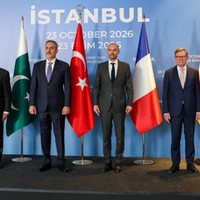
A separate meeting between Iran and the European trio is scheduled for Friday in Istanbul. Baghaei said Monday that the deputy EU foreign policy chief is expected to attend, without naming the official. The Iranian diplomat said the talks would “seriously address sanctions relief and Iran’s nuclear program.”
“We will clearly state our demands,” he added.
Tehran has grown increasingly critical of European governments in recent months, accusing them of siding with the United States and Israel.
“European countries not only failed to condemn the attacks on Iran and its nuclear facilities, they supported them,” Baghaei said. “They must be held accountable.”
Nuclear talks with US remain off the table
Asked about the prospect of renewed engagement with Washington, Baghaei said there were currently no plans for talks.
“I explained today about Iran’s talks with Europe; at the moment, we have no plans for talks with the United States.”
However, he said diplomacy remains “a tool and opportunity to safeguard Iran’s national interests, and that Tehran would not hesitate to use it when necessary.”
Iran and the United States had held multiple rounds of nuclear talks via Omani mediation before Israel launched its 12-day war on Iran, but Washington’s decision to strike Iranian nuclear sites brought the negotiations to an end.
However, in Washington ,US President Donald Trump expects Iran to return to nuclear negotiations, saying that diplomacy is in Tehran's best interest, according to the State Department Spokeswoman Tammy Bruce.
“I know that he expects them to begin to negotiate because that's in their best interest,” Bruce said in an interview with Fox News last week. “He has believed and continues to believe that diplomacy will work here."
Baghaei also dismissed recent remarks by former US Secretary of State Antony Blinken, who told CNN that Iran had agreed to cap enrichment below one percent and discuss weaponization assurances.
“Such a thing did not happen,” he said, calling the remarks “part of US domestic disputes”.
“We are not satisfied with the agency’s approach or with Director General Grossi,” he said. “The Iranian people are angry.”
He added that future cooperation would follow a new framework approved by Iran’s Supreme National Security Council.
Following Israeli and US strikes, Iran passed legislation restricting cooperation with the IAEA unless its security conditions are met.
Iranian officials have since escalated attacks on the agency, including threats to put its chief, Rafael Grossi on trial, with calls in hardline media for his arrest and execution. France, Germany, and the UK jointly condemned the threats in a recent statement.
Israel-backed hackers wiped out $90 million in Revolutionary Guards crypto wallets during last month's war, calling it a landmark campaign to cripple Iran’s financial backbone, The Wall Street Journal reported.
Predatory Sparrow, the group believed to be aligned with Israeli intelligence, demonstrated “surgical precision and total freedom of access,” erasing data and destroying wallets linked to the Islamic Revolutionary Guards Corps (IRGC), according to a report published Sunday.
By targeting Bank Sepah—the Guards’ central financial institution—hackers rendered Iran’s military payroll inoperative and triggered cascading disruptions. “Automated teller machines went dark, and online and in-branch services shut down,” the report said. “Salary and pension payments halted.”
The hackers also penetrated Nobitex, Iran’s dominant cryptocurrency exchange, extracting and burning stablecoins tied to IRGC operational funds.
Nearly 90 percent of the country’s crypto transactions pass through Nobitex, and the group extracted approximately $90 million in stablecoins linked to IRGC funds. These were then burned by transferring them to inaccessible blockchain addresses, permanently removing them from circulation.
“Predatory Sparrow reportedly extracted $90 million from wallets linked to the Islamic Revolutionary Guard Corps, then burned the assets by transferring the funds to addresses where they could not be retrieved, thereby permanently removing them from circulation,” the article said.
The strike ignited a broader panic. Though not directly attacked, Iran’s largest commercial bank, Bank Melli, couldn’t meet demand for cash. The Central Bank of Iran attempted to contain the collapse by injecting liquidity, but confidence evaporated. The rial fell more than 12 percent, and authorities suspended trading on the Tehran Stock Exchange.
The attack denied officials and security personnel access to their own money, directly challenging the government’s ability to sustain loyalty through financial means.
The report also said that the success of the cyber campaign has reframed US strategy. While President Trump said at the NATO summit, “We want [Iranians] to be prosperous, we want them to do well, but they can’t have nuclear weapons," it was a message to Iran's Supreme Leader that he must relinquish the nuclear program or face economic collapse.
The report said that sanctions that drive the Islamic Republic finances into vulnerable channels such as crypto and informal banking will likely be part of that strategy, in addition to shifting US cyber policy from passive backing to active involvement in offensive operations alongside Israel.
“Cyber warfare also rewards live-fire experience," the article said. "The more Washington and Jerusalem operate together in combat, the stronger their alliance grows. And when the next big test comes—as it surely will—the nations that have trained together under fire will dominate the field."
Iran’s top air defense commander said the country's skies are being vigilantly guarded “day and night” following the recent 12-day conflict with Israel.
Brig. Gen. Alireza Sabahifard, who leads the Khatam al-Anbia Air Defense Base, said Iran’s air defense forces are operating with “open eyes and full strength” and will, in his words, “rub the nose of aggressors into the dirt” backed by military capabilities and “trust in God.”
The Khatam al-Anbia Central Headquarters, Iran’s highest operational military command, oversees planning, coordination, and operational supervision of all armed forces. Its air defense base is responsible for coordinating and operating air defense activities across both the Army and the Revolutionary Guards (IRGC).
On Sunday, Mahmoud Mousavi, the army’s deputy for operations, said Iran has replaced air defense systems damaged during last month's conflict with Israel.
"Some of our air defenses were damaged, this is not something we can hide, but our colleagues have used domestic resources and replaced them with pre-arranged systems that were stored in suitable locations in order to keep the airspace secure," Mousavi added.
During the June conflict, Israel's air force took control of Iranian airspace, delivering a significant blow to the country's air defenses, while Iran's armed forces responded with successive waves of missile and drone attacks on Israeli territory.
Israeli military officials say that 120 air defense systems were destroyed or disabled since the first wave of attacks—around a third of Iran’s pre-war total. Long-range systems, including Russian-supplied S-300s and Iran’s Bavar-373 batteries, were among those targeted.
Iran has replaced air defense systems damaged during last month's conflict with Israel, said Mahmoud Mousavi, the army’s deputy for operations.
"Some of our air defenses were damaged, this is not something we can hide, but our colleagues have used domestic resources and replaced them with pre-arranged systems that were stored in suitable locations in order to keep the airspace secure," Mousavi added.
During the June conflict, Israel's air force took control of Iranian airspace, delivering a significant blow to the country's air defenses, while Iran's armed forces responded with successive waves of missile and drone attacks on Israeli territory.
“We were able to cover the skies using existing and new systems, securing the airspace of our dear Iran,” he said. “The enemy, despite its desperate efforts, failed to achieve its goals.”
Major General Abdolrahim Mousavi, Chief of Staff of the Armed Forces, also echoed that message. “Air defense proved on the front lines of protecting Iran’s skies that it will resist any level of threat,” he said. “Downing so many enemy aircraft shows the courage and will of our defenders.”
Iran says it has downed several Israeli fighter jets but has not provided any footage or additional details.
Israeli forces struck targets across Iran freely during the 12-day war, including in and around the capital.
Israeli military officials say that 120 air defense systems were destroyed or disabled since the first wave of attacks—around a third of Iran’s pre-war total. Long-range systems, including Russian-supplied S-300s and Iran’s Bavar-373 batteries, were among those targeted.
“Iran relied on a fragmented mix of Russian S-300s, Chinese batteries, and local Bavar-373 systems – none of which were adequately integrated… The air defense radar was Russian and Chinese made, which have known issues of target discrimination, without any integration among bases and military units,” wrote the Global Defense Corp.
The short-range air defence system Azarkhsh is displayed during an unveiling ceremony in Tehran, Iran, in this picture obtained on February 17, 2024.
Mossad operations and precision strikes
In late June, Israeli Defense Minister Israel Katz directed the military to prepare an enforcement plan against Iran, which includes maintaining air superiority, blocking missile development, and deterring Iran's regional activities.
The plan, according to Katz’s, aimed to ensure Israel can respond kinetically to future threats.
A security source speaking to N12 also said Mossad operatives inside Iran played a central role in shaping the battlespace, deploying loitering munitions and attack drones, and establishing a covert launch site in the heart of Iran to suppress air defenses.
The War Zone website, a resource for the defense industry, released more details of Iran’s defense being destroyed.
“Among the targets reportedly prosecuted by Israeli operatives within Iran was an air defense site near Tehran. Shortly before the operation began, Israeli drones launched from within Iran struck surface-to-air missile launchers there, clearing the way for the larger strike, which also involved Israeli Air Force (IAF) fighter jets."
"This would also explain the apparent inactivity by Iranian air defense sites during the Israeli bombardment. At the same time, the IAF has also been flying suppression and destruction of enemy air defenses (SEAD/DEAD) operations that the service says have destroyed “dozens of radars and surface-to-air missile launchers,” wrote the website.
Airspace remains exposed
Iran’s geographic scale -- roughly 1.6 million square kilometers -- poses a constant challenge for integrated air defense. The Islamic Republic lacks a modern fighter fleet to complement its missile systems and has relied on Cold War-era aircraft. Several of these have been destroyed on the ground in recent strikes, according to Israeli military imagery.
After limited Israeli strikes targeted Iranian missile factories last October, Iran later showcased Russian-made air defenses and its Bavar-373 system to project defensive strength, but Israeli aircraft, including F-35 stealth fighters, encountered little documented resistance during the 12-day conflict.
Israel’s June attacks on Iran had been planned since November following serious warnings about the advancement of Tehran's nuclear program, according to Israeli media reports approved by the country’s military censor.
Details released Saturday night -- despite tight security censorship in Israel over last month’s conflict with Iran -- revealed that in January, the military intelligence team issued an early warning following advances in Iran’s weapons program.
"The nuclear team in the Control Department issues a concrete warning about the launch of a coordinated project to produce the final stage required for launching a nuclear missile in Iran," it said.
Around the same time, the research division of Israel’s military intelligence also issued a warning, identifying a covert team of Iranian nuclear scientists allegedly working on previously undeveloped components needed to complete the final stage of a nuclear missile launch.
The head of military intelligence, Shlomi Binder, established a special team with several tech experts with an emphasis on nuclear weapons to plan the attacks on Iran's nuclear infrastructure. They also focused on how to do simultaneous assassinations of the country's military and nuclear chiefs.
In May, Binder issued his own warning to the political echelon: "I would like to alert decision-makers to disturbing developments in the field of nuclear weapons in Iran. It appears that Iran is continuing to make determined progress that is shortening the technological and cognitive distance required to complete the development of a nuclear weapons device.”
On June 13, Israel launched a series of surprise attacks which led to the deaths of around 30 military commanders and nuclear scientists and a 12-day war which caused widespread destruction to both sides.
As the fragile ceasefire holds by a thread, the United States is now awaiting Iran’s return to the negotiating table for a new nuclear agreement. Both Washington and Tel Aviv have warned that failure to reach a deal could trigger further military strikes.