95 Iranian journalists faced 110 judicial actions since January, rights group says
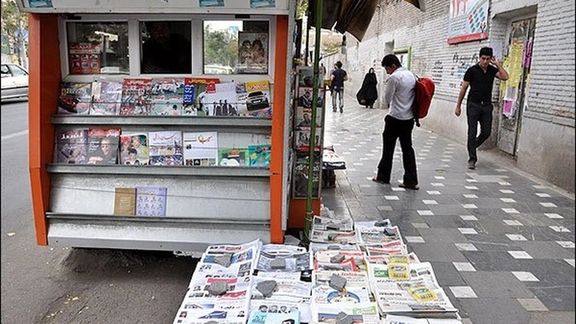
A newspaper stand in Tehran
At least 95 Iranian journalists and media organizations faced 110 judicial and security actions between January and June 2025, according to the Defending Free Flow of Information Organization (DeFFI).
During this period, authorities opened 46 new judicial cases amid a growing crackdown on press freedom.
From January 1 to June 1, suppression of free speech intensified after Masoud Pezeshkian’s election as president, with press freedom indicators hitting unprecedented lows, the group said.
“During this period, the suppression of free information, which had taken on new and complex dimensions since Masoud Pezeshkian’s election as president, expanded significantly," wrote DeFFI.
"Indicators of freedom of expression recorded an unprecedented decline, judicial and security actions against journalists and media outlets increased sharply, and the Islamic Republic escalated cross-border threats against Iranian reporters at an alarming rate."
In the past six months, courts sentenced ten of the journalists collectively to 22 years and three months in prison, the report added.
One of the harshest sentences was given to Iranian-American journalist Reza Valizadeh, imprisoned in Tehran’s Great Prison, and sentenced to 10 years and additional penalties by the Tehran Appeals Court.
The judiciary’s most frequent accusation against journalists was “publishing falsehoods to disturb public opinion.”
Other common charges included “slander and defamation,” “propaganda against the regime,” “assembly and collusion against national security,” “removal of hijab,” and “disclosure of classified documents.”
The DeFFI documented at least 112 violations of journalists’ legal rights during the period. These included arbitrary arrests, denial of access to chosen lawyers, prohibition of family visits or phone contact, seizure of personal belongings without court orders, psychological torture, and physical abuse by security personnel.
Since the Islamic Republic’s founding, Iranian authorities have routinely arrested, tortured, and imprisoned journalists, writers, and activists critical of the government.
Following widespread protests that began in September 2022, repression of the press intensified and shows no sign of easing.
The crackdown coincides with increased pressure after the outbreak of war between Iran and Israel, during which over 700 people have been arrested on allegations of collaboration with Israel.
United Nations experts have urged Iran to end the post-ceasefire repression, warning that “post-conflict situations must not be used as an opportunity to suppress dissent and increase repression.”
A proposed Iranian law expanding espionage and national security charges and criminalizing ties with foreign entities has been halted for revision following a review by the country’s top oversight body.
The pause shows a swift post-war drive to crack down on alleged Israeli spying is hitting some obstacles even in the hardliner-dominated establishment.
Iran's Guardian Council sent back the controversial bill to parliament for revisions, citing ambiguities in definitions and potential conflicts with Islamic law and constitutional principles.
The draft legislation seeks to impose harsher punishments—including the death penalty—for a broad range of alleged activities defined as espionage or collaboration with Israel, the United States, and other “hostile” states or groups.
The bill, titled the “Intensification of Punishment for Espionage and Cooperation with the Zionist Regime and Hostile States Against National Security and Interests,” was approved by Iran’s parliament late June but faced scrutiny from the Guardian Council, which is tasked with ensuring that legislation complies with Islamic law and the constitution.
"The necessity of precision in legal definitions is critical," said Hadi Tahan Nazif, spokesperson for the Guardian Council. "There is ambiguity in identifying who determines 'hostile states and groups.' It must be clarified which official institution makes that designation."
Tahan Nazif further warned that vaguely defined terms like “creating division” or “undermining national security,” as used in Article 4 of the bill, could infringe on constitutionally protected rights. “Such qualitative language may, in practice, restrict legitimate freedom of expression. These ambiguities must be resolved,” he said.
Among the most contentious points is the bill’s expansion of the crime of “spreading corruption on earth” (efsadfel-arz)—a charge that can carry the death penalty.
The Guardian Council objected to Article 2, which equates“any direct or indirect assistance”to Israel with corruption on earth. The Council said this could lead to capital punishment for acts that do not meet the strict criteria for that charge under Islamic law.
“In Islamic jurisprudence, the conditions for establishing the crime of corruption on earth are specific and strict. Broadening its scope without meeting these conditions is contrary to Sharia,” Tahan Nazif explained.
At the same time, the Council criticized the bill for limiting some cases—such as widespread distribution of unlicensed communications equipment used in organized opposition—to prison terms, when it argued they could meet the threshold for corruption on earth.
Another key concern centers on retroactive enforcement. Article 9 of the bill says that the law applies to offenses committed before its ratification, contradicting Article 169 of Iran’s Constitution, which prohibits retroactive criminal laws.
“No act or omission may be considered a crime under a law enacted after the fact,” Tahan Nazif emphasized, echoing the constitutional safeguard.
Despite its critique, the Guardian Council affirmed the importance of robust legal tools to defend national security, particularly in the wake of the 12-day Iran-Israel war, the spur of the latest emergency legislation.
“Our intent is not to obstruct legislation but to ensure laws are both enforceable and aligned with the constitution and Sharia, while also safeguarding citizens’ rights,” Tahan Nazif said.
Mohsen Dehnavi, the spokesperson for Iran’s Expediency Council, said on Wednesday that its supervisory board supports the general framework of the bill but some provisions in the draft were ambiguous.
A legal path to expanded crackdowns?
The bill follows heightened internal security measures and increased arrests, particularly since last month's war which saw devastation wrought on both sides of the conflict.
On Wednesday, Tehran’s prosecutor Ali Salehi confirmed that several cases involving alleged espionage, intelligence leaks, and smuggling of explosives are under urgent investigation.
“These cases involve individuals accused of sending maps and GPS coordinates to the Zionist regime, as well as transferring explosive materials,” Salehi said at an event in Tehran. “With full support from the judiciary and security forces, investigations are proceeding swiftly.”
Salehi also addressed allegations of espionage tied to the recent conflict: “Once investigations are complete, the public will be informed. The judiciary will not tolerate any actions that compromise national security.”
Escalating rhetoric
The bill and judicial statements come amid intensified rhetoric in Iranian state media. This week, Fars News Agency, which is affiliated with the Islamic Revolutionary Guard Corps (IRGC), published an editorial calling for the mass execution of detainees accused of collaborating with Israel and Western intelligence services.
“In the current conditions, those who enabled the killing of hundreds of Iranian citizens through espionage and weapons smuggling deserve to be executed in the style of 1988,” the editorial said, referencing mass executions of political prisoners. Amnesty International estimates that at least 5,000 people were executed during that period, often following secret trials without due process.
The article described the 1988 executions as “a brilliant chapter” in Iran’s history and saying that the public supports similar action today against what it termed “domestic terrorist networks.”
Definitions and penalties
The legislation, in its current form, criminalizes a broad range of activities under national security offenses.
It introduces the death penalty for espionage or intelligence cooperation with Israel, the United States, or their affiliated entities. The same punishment would apply to the manufacture, transfer, or import of drones for military or surveillance purposes, if deemed to involve "malicious intent."
The bill also imposes prison terms of 10 to 15 years for disseminating content—such as news, videos, or images—considered to harm national security or sow division.
Penalties ranging from six months to 10 years would apply to the use or distribution of unauthorized communication equipment, including satellite internet services like Starlink, depending on scale and intent.
Additionally, the bill allows for retroactive prosecution of offenses committed before its passage, a provision that legal experts say violates constitutional safeguards.
The draft is expected to return to parliament for clarification and possible amendment before undergoing a final review by the Guardian Council.
Last month, in the wake of the war with Israel, Iran arrested over 700 people in a mass roundup, accused of working for the Jewish state.
Iran International confirmed on Tuesday that recently published materials from the hacked Telegram accounts of its journalists are linked to two separate cyberattacks carried out in the summer of 2024 and January 2025.
“The hackers may have accessed the computers of affected colleagues by installing malware via their compromised Telegram accounts. These incidents have been addressed as part of our continuing work with the relevant security authorities,” read a statement by the channel.
Earlier on Tuesday, Iranian state outlets published screenshots from internal Telegram chats linked to Iran International.
The attacks were carried out by the cyber group known as Banished Kitten (also referred to as Storm-0842 and Dune). The group operates under the Cyber Threat Countermeasures Unit of the Domestic Security Directorate of Iran’s Ministry of Intelligence, under the supervision of Yahya Hosseini Panjaki, whose identity was first exposed by Iran International.
"These cyberattacks are part of a broader campaign of threats targeting Iran International, including physical threats against our staff," the statement added.
"As a news organization committed to independent journalism, we implemented the necessary measures following these incidents to protect our staff and audiences," it said.
"We remain resolute in our mission to deliver accurate, uncensored news to our audience, and we will not allow these threats—online or offline—to disrupt our work. These attempts to intimidate us will not succeed," the channel added.
Iran International is a Persian-language TV news network that broadcasts 24/7 and has a strong following in Iran, despite government efforts to restrict access to the internet and satellite signals. Tehan has labelled it a terrorist organisation.
Iran International has previously been the subject of threats and attacks. In 2023, a man was convicted under terrorism laws after filming outside its premises, and in 2024, Pouria Zeraati, the television host of the "Last Word" program on Iran International was stabbed in London.
A media outlet affiliated with Iran’s Revolutionary Guards (IRGC) has openly called for the mass execution of perceived enemies of the state, invoking the precedent of mass killings carried out in 1988 following a decree by then-Supreme Leader Ruhollah Khomeini.
In an article published this week, the semi-official Fars News Agency described current detainees accused of collaborating with Israel and Western intelligence agencies as “deserving of execution in the style of 1988.”
“In the current conditions, when some mercenary elements—Iranians and foreign nationals—have enabled the killing of hundreds of Iranian citizens, including women, children and civilians, by transferring intelligence to the Zionist enemy and smuggling weapons into the country, they deserve to be executed in the manner of 1988," the article said.
The publication argued that the 1988 executions were a “brilliant chapter” in the Islamic Republic’s fight against terrorism and said that “society today recognizes the need for such proper measures against domestic terrorist networks.”
Between July and September 1988, thousands of political prisoners were summarily executed across Iran after a fatwa by Ayatollah Khomeini.
Amnesty International estimates the death toll at a minimum of 5,000. Victims, many of whom had already been serving sentences for political dissent, were subjected to secret trials and then executed. Their bodies were buried in unmarked graves, and families were never officially notified.
“The anguish caused to families by this ongoing crime constitutes torture,” Amnesty said in a 2023 report, adding that “the extrajudicial executions and the ongoing enforced disappearances amount to crimes against humanity.”
The Iranian authorities have never acknowledged the full scope of the killings. Families of the victims have been subjected to intimidation, denial of burial rights, and the destruction of mass grave sites. Amnesty International and other human rights groups continue to call for accountability.
In 2016, an audio recording surfaced in which Grand Ayatollah Hossein Ali Montazeri, once heir apparent to Khomeini, condemned the executions in a meeting with judiciary officials involved in the process. “I believe the greatest crime in the history of the Islamic Republic, for which history will condemn us, has been committed by you,” he said. “Your names will go down in history as criminals.”
Montazeri was subsequently dismissed from power and placed under house arrest until his death in 2009.
Calls for renewed repression
In its editorial, Fars revisited the history of the 1980s and described dissident organizations such as the Mojahedin-e Khalq (MEK) as armed insurgents who “attempted to hijack the revolution from within.”
The article said the MEK collaborated with Iraq during the Iran-Iraq war and “committed atrocities against civilians,” framing the 1988 executions as both justifiable and necessary for national security.
“Unlike the false portrayal by opposition media that the 1988 executions were against human rights, today the public sees the necessity of repeating such decisive actions,” Fars wrote, also defending the role of late President Ebrahim Raisi, who was one of the judiciary officials implicated in the process.
Iran is intensifying a nationwide crackdown in the wake of its 12-day war with Israel, targeting ethnic and religious minority groups as well as foreign nationals.
Late in June, Fars reported that Iranian intelligence forces arrested more than 700 Iranians accused of acting as agents for Israel.
No Iranian official has yet responded to or repudiated Fars’ latest statements. Iranian authorities typically avoid direct acknowledgment of the 1988 killings in public discourse, though some judiciary and government figures have repeatedly defended them as lawful.
Iran’s parliament passed an emergency bill late last month to increase penalties for espionage and collaboration with “hostile states,” allowing suspects to be tried under wartime conditions.
Judiciary chief Gholamhossein Mohseni-Ejei said those arrested in the context of Israel’s recent attacks would be prosecuted under “wartime legal provisions.”
Judiciary spokesperson Asghar Jahangir said on state TV that current espionage laws are “too general” and inadequate for addressing recent cases, adding that legal reforms are needed to handle detainees linked to the conflict with Israel.
Iranian digital ads on a smart phone screen, File Photo
A nationwide internet outage likely imposed by the Tehran beginning just after midnight on July 6 has deepened concerns among a weary public over the already parlous state of the economy and access to information.
Confirmed by global observatory NetBlocks, the blackout caused a near-total loss of connectivity. Though partial access later returned, traffic remains just 20% of pre-conflict levels.
The latest shutdown follows a string of disruptions that began during the 12-day June conflict with Israel, when authorities restricted access under the guise of national security.
Iran’s Telecommunications Infrastructure Company has acknowledged the incident but offered no explanation. Meanwhile, accounts linked to officials remained active, fueling claims of selective, politically-driven censorship.
Economic shock, mass disruption
Prolonged outages are dealing vast damage to Iran’s digital economy.
The Iran Internet Businesses Guild Association estimated over $1.5 million in hourly losses and warned more than 400,000 small and mid-sized businesses are at risk.
The Tehran Union of Internet-Based Shops cited the vulnerability of small digital vendors and service providers.
“Every hour of blackout brings almost a $1.5 million loss to small businesses,” it said.
Sweden-based economist Ahmad Alavi called shutdowns “one of the most economically damaging decisions a government can make,” especially in a low-productivity economy where many rely on digital services.
“These blackouts drive both human and financial capital out of the country,” Alavi warned. “Freelancers, programmers, and entrepreneurs facing unstable access will increasingly emigrate or transfer assets abroad.”
“This is more than a technical glitch,” said Alavi. “It’s a full-blown economic shock affecting production, finance, investment, and public services.”
Mahtab Gholizadeh, a Berlin-based economic journalist, notes that with over 60% of the population under 30, Iran’s youngest and most connected generation, is being cut off from opportunity and global networks.
Resistance, risk and digital Control
Amid growing restrictions, some entrepreneurs have turned to Starlink satellite internet to stay connected—despite legal bans and the threat of imprisonment.
Mohammad, a small business owner, is one of them. “I know the risks,” he said, declining to use his full name due to likely official reprisals.
“But I’d rather face them than die in poverty.”
Many others, particularly in handicrafts and beauty, are redirecting efforts to regional export markets in the Persian Gulf.
Meanwhile, the government continues to promote domestic messaging platforms like Rubika, Baleh and Eitaa, but public uptake remains low. Users and businesses cite privacy concerns, limited features and poor engagement.
Shohreh, an entrepreneur in the beauty industry, tried moving some of her work to the Iranian app Soroush after international platforms were blocked but noted little customer traction.
“Many of our products are considered illegal on these networks,” she said. “Let alone finding proper channels to market or sell them.”
Unequal access, declining trust
The internet crisis has revived a controversial push for tiered access, giving preferential connectivity to state agencies and approved professionals while limiting the general public.
The idea has resurfaced through recent proposals from IT trade groups, but critics say it would formalize digital inequality. Tech outlet Zoomit called the idea “digital apartheid.”
Iran remains one of the world’s most censored internet environments. Around 84% of users rely on VPNs to get online, and over 90% engage with blocked global platforms.
Analysts warn that repeated shutdowns are fueling brain drain, startup collapse, and a crisis of investor confidence.
In an open letter, the Iran Internet Businesses Guild Association urged authorities to stop DNS tampering and bandwidth throttling, warning of systemic collapse.
“The normalization of blackouts,” said Alavi, “is isolating Iran from the global digital economy and destroying what little trust remains in its future.”
Iran has accused detained political activist Hossein Ronaghi of “propaganda against the Islamic Republic in favor of Israel” over an Instagram story he posted after the start of Israel’s strikes during the recent 12-day war, Iran International has learned.
The charge was brought under Article 8 of the Law on Confronting Israeli Actions.
Ronaghi was arrested on June 23 by order of Tehran’s prosecutor and the Culture and Media Court, and a 30-day temporary detention order has been issued. He is being held in a Ministry of Intelligence safe house.
Ronaghi’s family has not been informed of his whereabouts, and his longtime lawyers, Saeed Jalilian and Milad Panahipour, have not been permitted to represent him.
Authorities have said only judiciary-approved lawyers are allowed in this case.
On Friday, UN experts, including Mai Sato, the UN Special Rapporteur on the situation of human rights in the Islamic Republic of Iran, expressed concern over the detention of Ronaghi and his brother, Hassan.
The UN experts urged Iranian authorities to end the post-ceasefire crackdown, saying, “Post-conflict situations must not be used as an opportunity to suppress dissent and increase repression.”
In the past decade, the dissident activist has been arrested several times and has staged hunger strikes in prison. He was first arrested, along with his brother Hassan, in the aftermath of the disputed presidential elections in 2009 for assisting journalists and political activists to circumvent internet censorship. In addition, he was charged with insulting the Supreme Leader Ali Khamenei in his blog posts.
Ronaghi was also detained in September 2022 during the Woman, Life Freedom protests sparked by the death in custody of 22-year-old Mahsa Amini. He was detained along with his lawyers in front of the Evin Prison prosecutor's office. Iranian authorities later released Ronaghi on bail.