• العربية
  • فارسی
Brand
  • Iran Insight
  • Politics
  • Economy
  • Analysis
  • Special Report
  • Opinion
  • Podcast
  • Iran Insight
  • Politics
  • Economy
  • Analysis
  • Special Report
  • Opinion
  • Podcast
  • Theme
  • Language
    • العربية
    • فارسی
  • Iran Insight
  • Politics
  • Economy
  • Analysis
  • Special Report
  • Opinion
  • Podcast
All rights reserved for Volant Media UK Limited
volant media logo
TEHRAN INSIDER

Israeli bombs shattered homes—and our sense of safety

Tehran Insider
Tehran Insider

Firsthand reports from contributors inside Iran

Jul 8, 2025, 21:55 GMT+1Updated: 07:53 GMT+0
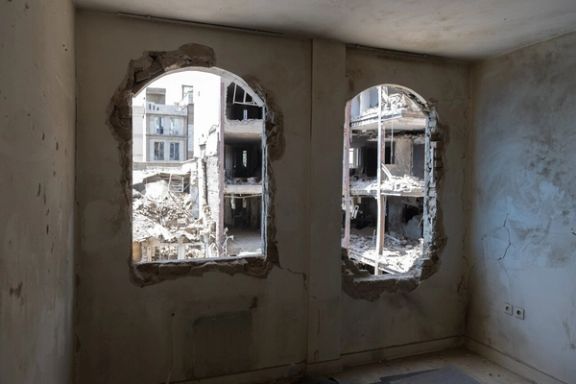
A destroyed building can be seen through the shattered windows of a room opposite, Tehran, Iran, July 4, 2025

This is Tehran, two weeks after the ceasefire with Israel. Shops are open, people are out, the air is as polluted as ever—and the dread that began last month still hasn’t lifted.

Many are convinced it will start again.

“More homes will collapse. More people will die,” says Masoud, the electrician fixing the lights in our building’s corridors. “We have our carry-on ready by the door.”

Fears aren’t as sharp as last week, but many in the neighborhood still talk about safe and unsafe spots. The strike on Evin Prison—and the video of a blast at a busy junction in northern Tehran—hammered home the reality of war.

“We were at my in-laws’, right next to the prison. We thought it was the safest place—no way they’d hit a prison. But they did,” says Shadi, who lives with her husband and their two children in the apartment above us.

“The chandelier broke off and glass shattered everywhere. My son and his grandma had surface cuts. It could have been far worse.”

The prison bombing has seeded a new fear, Shadi says. “If even the prison isn’t safe, then what is? Not hospitals, not universities, not schools, not kindergartens.”

Kindergarten—that’s another image that cannot be unseen: shattered dolls and toys flung across the room. By sheer chance, it had closed 15 minutes before impact.

'Did they hit again?'

Officials say over 3,200 residential units were destroyed in Tehran. Thousands are now homeless. The wreckage has chipped away at war supporters.

One of them is a close friend of mine from university—Yara.

Before, when I warned that war meant destruction, he’d say: “This isn’t war. It’s just precision strikes against officials and bases, not civilians.”

Yara was lucky not to be physically hurt, but he was close enough to enough loud explosions to have nightmares—per his partner.

“He still jumps up at night and asks me, zadan (did they hit?)”

'They're still here'

Not all war supporters have changed their minds. In many homes, even emotional bonds were frayed under the bombs. When the ceasefire came, some were relieved, others angry.

“We endured the war, and they’re still here,” you hear many say.

They—who are still here—refers to Iran’s ruling elite, the Islamic Republic, the regime, as many prefer to call it.

Quite a few people I know hoped a few days of bombing would force the regime to collapse or walk away. The further you get from the epicenter, the deeper the divide, perhaps because you haven’t heard the blasts or watched the walls crumble.

I remember a conversation on day two of the war, before the full fear had set in. I asked a cousin and his wife to leave Tehran with us, for the sake of their kids.

“What if there are evacuation alerts like Beirut?” I implored. “Tehran will lock down. You won’t be able to leave.”

They refused, pointing me to their conversations with ChatGPT.

In the worst-case scenario, you could grab your bag and walk a couple of blocks to safety, they argued. “Any such alert would cover a couple of alleys at most. That’s what a precision strike is.”

ChatGPT had reassured them.

A new reality

Later, they told me what happened when evacuation orders hit districts six and seven—two major parts of the city. They had stayed. We had left.

“People were fleeing in panic in the middle of the night. Car horns nonstop,” my cousin’s wife said. “I sat in the car with my head in my hands, hoping nothing would explode nearby.”

That’s everyone’s fear these days—that the pause in fighting ends and they, or someone they love, are near an unannounced target of another “precision strike.”

And then there are the costs few talk about.

Many companies have laid off staff. It’s peak moving season in Tehran—leases ending, rents rising. People don’t know whether to stay, sign, or leave.

We thought we were used to suspended life—constant inflation, sudden, irreversible shifts in the economy and politics. But this is something else. A new phase entirely.

Most Viewed

Ghalibaf defends Iran-US talks amid hardline backlash
1
INSIGHT

Ghalibaf defends Iran-US talks amid hardline backlash

2
INSIGHT

Iran diplomacy wobbles as factions compete to avoid looking soft on US

3
VOICES FROM IRAN

Bread shortages, soaring prices strain households in Iran, residents say

4
ANALYSIS

The politics of pink: how Iran uses cuteness to rebrand violence

5

Scam messages seek crypto for ships’ safe passage through Hormuz, firm warns

Banner
Banner

Spotlight

  • Diplomacy tolls at Hormuz as conflict returns to its doorstep
    OPINION

    Diplomacy tolls at Hormuz as conflict returns to its doorstep

  • Opposition to US talks grows in Tehran as ceasefire deadline nears
    INSIGHT

    Opposition to US talks grows in Tehran as ceasefire deadline nears

  • Tehran moderates see ‘no deal–no war’ limbo as worst outcome
    INSIGHT

    Tehran moderates see ‘no deal–no war’ limbo as worst outcome

  • The future has been switched off here
    TEHRAN INSIDER

    The future has been switched off here

  • Lights out, then gunfire: Witnesses recount Mashhad protest crackdown
    VOICES FROM IRAN

    Lights out, then gunfire: Witnesses recount Mashhad protest crackdown

  • Is Iran entering its Gorbachev moment?
    INSIGHT

    Is Iran entering its Gorbachev moment?

•
•
•

More Stories

US says strikes on Iran established deterrence as world watched

Jul 8, 2025, 18:17 GMT+1

The US President and Secretary of Defense said the military operation targeting three nuclear sites in Iran sent a strong message to the world, including US adversaries.

"Our so-called enemies were watching. They watched every minute of it," Trump said at a televised Cabinet meeting on Tuesday.

"It was a perfect military performance, the likes of which we haven't seen in a long time," he added recalling the operation codenamed Midnight Hammer.

“What was demonstrated on the world stage was American military might and capability,” Pete Hegseth said in his brief before the president spoke.

“It was not just Fordow and Isfahan and Natanz, but the whole world took notice of that.”

The June 22 strikes targeted Iran's three key nuclear sites with bunker-buster bombs. It was hailed "perfect" by the Trump administration but questioned by some Democratic lawmakers citing an early intelligence assessment.

Trump rejected doubts about the strikes' impact, praising the pilots and others involved.

“Those machines flew for 37 straight hours. They didn’t stop. They went skedaddle... They dropped the bombs, and somebody said skedaddle... And every bomb hit its mark—and hit it incredibly,” he said

"They were right in the most dangerous airspace in the world…and they went right through…by the time they (Iran) found out they were there, they were already gone. That was the word, skedaddle, get the hell out of here," he added.

Iran puts flag before faith after war with Israel

Jul 8, 2025, 17:32 GMT+1
•
Maryam Sinaiee

Tehran’s patriotic messaging in the wake of the war with Israel reached new heights when Supreme Leader Ali Khamenei, in his first public appearance since the ceasefire, requested that a patriotic song be sung at the year’s flagship religious ceremony.

The request—made to Mahmoud Karimi, a hardline maddah closely aligned with Khamenei—capped not only ten days of mourning but two weeks of state-sponsored flag-waving to rally a war-worn people.

In processions that traditionally focus on the martyrdom of Imam Hussein, mourners this year chanted not just elegies, but songs about Iran and its ancient glory.

The one Khamenei called for begins with the line: “You remain in my soul and spirit, O homeland.”

Patriotism over piety

Muharram marks the death of the Shiites’ third Imam, killed in 680 CE at the Battle of Karbala.Iranians typically observe the month with processions, recitations, and rituals such as chest-beating or striking the back with chains. Events may be state-funded or grassroots.

This year, however, the ceremonies unfolded just weeks after the 12-day war with Israel and a fragile ceasefire.

State media and cultural institutions quickly moved to frame the mood, promoting a unified nationalist-religious narrative. A new slogan was emblazoned on banners, billboards, and public screens across cities: Iran, loyal to Hussein, will always prevail.

For the first time, patriotic anthems like O Iran—composed in 1944 and long associated with opposition movements—were performed during ceremonies. In previous years, such songs might have drawn censure or bans.

In many neighborhoods, the Iranian tricolor flew alongside the black and green standards of Karbala. Officials and local municipalities provided logistical and financial support to mourning groups that embraced the new tone.

State control, grassroots defiance

Khamenei’s Ashura appearance followed three nights of absence from the annual ceremonies held at his residence—an unusual break that had fueled speculation about his health.

His brief presence, and the seemingly spontaneous request for My Iran, was widely viewed as carefully orchestrated: a symbolic moment signaling that patriotic devotion now held equal standing with religious mourning in the Islamic Republic’s ideological framework.

The regime has long drawn on the defiance of Imam Hussein to frame its political posture, casting enemies such as Israel, the United States, and domestic critics as modern-day Yazids.

But Muharram has never been solely the regime’s domain. Despite increasing state choreography, it remains a space where protest and dissent can still break through.

During the widespread protests of 2022, some mourning groups adopted openly critical tones, invoking the deaths of young protesters at the hands of security forces. Echoes of that defiance surfaced again this year.

Iran hit Israeli military sites during June airstrikes - Reuters

Jul 8, 2025, 14:59 GMT+1

Iranian airstrikes last month hit several Israeli military sites, according to a Reuters report citing an Israeli military official — the first apparent public confirmation that such locations were struck.

The unnamed official, speaking under customary anonymity, said that “very few” sites were hit and all remained operational.

No further details were provided by the official on the specific locations or extent of the damage.

Iran launched multiple waves of missile against Israel during the 12-day war that began on 13 June when Israeli airstrikes hit Iranian nuclear and military sites and killed several IRGC top commanders.

Iranian strikes frequently targeted major cities including Tel Aviv and Haifa, as well as military areas around Beersheba.

Several residential buildings were also hit, though the Israeli military said most of the missiles and drones were intercepted.

Iran and Israel agreed to a US-backed ceasefire on June 24 after the United States bombed the Islamic Republic's nuclear facilities.

The British daily Telegraph reported on Monday that Iranian missiles struck five Israeli military facilities, citing satellite radar data reviewed by US researchers.

The data, provided by a research group at Oregon State University, suggest that six Iranian missiles hit military targets across northern, central, and southern Israel, including what the report describes as a major air base, an intelligence facility, and a logistics center.

A more comprehensive analysis of the damage to both Israeli and Iranian infrastructure is expected from the Oregon State research group within two weeks, according to the report.

60% of Israelis say war goals achieved against Iran - poll

Jul 8, 2025, 12:03 GMT+1

According to latest data from the Israel Democracy Institute, nearly two thirds of Israelis said they felt the country had achieved its goals in the 12-day war on Iran.

After the 12-day war which saw 15,500 Israelis displaced and 28 dead, respondents were asked, “In your opinion, did Israel achieve its goals in the war against Iran?”

The majority of Jews, 60%, think that Israel achieved most or all of the goals it set for itself when it launched surprise attacks on Iran on June 13.

However, there were large differences between Jews and the country’s 20% Arab population, of whom only 37% said they agree.

The survey, published by the independent think-tank on Monday, was based on a representative sample of the population in Israel aged 18 and above, comprising 603 Jewish interviewees and 150 Arab interviewees.

The majority of Jewish Israelis had backed war with Iran, but in the wake of the operation which saw more than 450 ballistic missiles fired at the Jewish state, reflections on the operation’s enduring success continue.

US President Donald Trump says that Iran’s nuclear program was “obliterated” by American strikes on Iran's three key nuclear facilities which took place after Israel destroyed swathes of Iran's military infrastructure.

The war left over 1,100 Iranians dead and thousands more injured, according to rights group HRANA.


At least two killed and two missing in latest Houthi attack on ship off Yemen

Jul 8, 2025, 11:20 GMT+1

Two seamen are believed to have been killed and another two missing after an attack on a Greek-managed cargo ship off the coast of Yemen by the Iran-backed Houthis, according to Reuters.

This brings the death toll to six since the group began its maritime attacks in support of Iran-backed Hamas in Gaza in November 2023.

The attack came just hours after the group, which many Western countries have listed as a terrorist organization, claimed to have sunk a bulk carrier in the Red Sea.

According to the European Union’s Operation Aspides task group specializing on protecting shipping in the Red Sea region, the attack happened 50 nautical miles southwest of the port of Hodeidah.

The vessel, which was Liberia-flagged, had 22 crew members, 21 Filipinos and one Russian, as well as armed guards on board.

It was attacked with sea drones and rocket-propelled grenades fired from manned speedboats, sources said.

An official from Cosmoship Management, which manages the vessel, told Reuters that the vessel's bridge was hit and telecommunications were impacted.

While crew were told to abandon after it suffered serious damage, the lifeboats had been destroyed in the assault.

On Monday, the Houthis had claimed responsibility for sinking the MV Magic Seas, for what the spokesman for the group said was “repeated violations by its owning company of the ban on entering the ports of occupied Palestine.”

The raid involved gunfire and rocket-propelled grenades from eight skiffs as well as missiles and four uncrewed surface vessels.

The statement also warned: “We are not satisfied with sinking just one ship, there is more to come.”

While the Houthis said the group had sunk the ship, Michael Bodouroglou, a representative of Stem Shipping, one of the ship's commercial managers, said there was no independent verification, according to Reuters.

If proven to have been sunk, it would make it the third ship to be sunk since November 2023 when the group began the blockade, following a call by Iran’s Supreme Leader Ali Khamenei.

On Sunday morning, Israel announced it had struck multiple Houthi targets.

In May, the US made a ceasefire with the group after at least 174 attacks on US warships, in addition to the group's more than 145 attacks on commercial vessels, as of March figures. That ceasefire did not include other nations.