• العربية
  • فارسی
Brand
  • Iran Insight
  • Politics
  • Economy
  • Analysis
  • Special Report
  • Opinion
  • Podcast
  • Iran Insight
  • Politics
  • Economy
  • Analysis
  • Special Report
  • Opinion
  • Podcast
  • Theme
  • Language
    • العربية
    • فارسی
  • Iran Insight
  • Politics
  • Economy
  • Analysis
  • Special Report
  • Opinion
  • Podcast
All rights reserved for Volant Media UK Limited
volant media logo

Iran-backed Hezbollah rejects calls to disarm as US pushes for action
Jul 6, 2025, 11:07 GMT+1Updated: 07:54 GMT+0
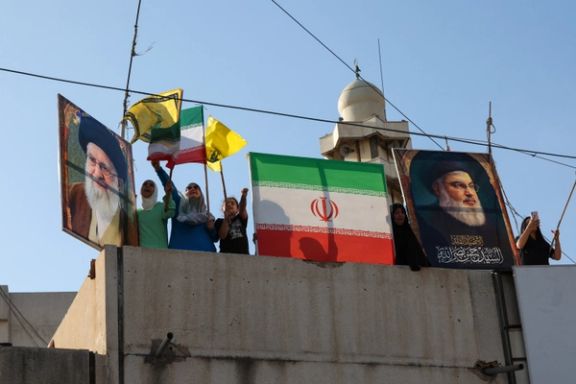
People celebrate what they say is Iran's victory, after US President Donald Trump announced a ceasefire between Israel and Iran, in Beirut, Lebanon June 25, 2025.

Hezbollah leader Naim Qassem on Sunday rejected international pressure on the Iran-backed group to surrender its weapons, saying Israeli threats would not force disarmament.

“This threat will not make us accept surrender,” Qassem said in a video message for the occasion of Ashura, a major Shia Muslim religious commemoration, amid a fragile ceasefire brokered in November by the US and France.

“The resistance will continue even if the whole world stands against it.”

Washington has called for Hezbollah to disarm completely. Lebanese authorities are expected to deliver a response to US envoy Thomas Barrack's June proposal when he arrives in Beirut on Monday, according to Reuters.

A Lebanese official speaking to AFP on condition of anonymity said authorities have already begun dismantling parts of Hezbollah’s military infrastructure in southern Lebanon, near the Israeli border.

But Qassem, who took over leadership of the Lebanese group following the killing of Hassan Nasrallah in an Israeli airstrike last year, made clear on Sunday that Hezbollah does not intend to relinquish its core weapons or strategic capability.

“The ceasefire was supposed to stop aggression, but violations have continued,” Qassem said. “No one can ask the resistance to drop its arms while the aggression is ongoing.”

Both Hezbollah and Israel continue to cite continuous violations of the ceasefire.

Qassem added that Hezbollah’s defensive posture was essential for Lebanon’s sovereignty. “Without the resistance, Israel would have overrun our villages,” he said, adding that disarmament would be akin to legitimizing occupation.

In a message to US and Israeli officials, he said: “We reject normalization, which is humiliating and degrading. The American-Israeli formula—‘either you surrender or we kill you’—is laughable and outdated.”

Hezbollah has faced mounting pressure in recent months following its war with Israel, which destroyed large parts of Beirut’s southern suburbs and southern Lebanon and left tens of thousands displaced.

The group is also grappling with financial strain and the loss of its long-time Syrian ally after the fall of former president, Bashar al-Assad, in December.

While sources close to Hezbollah told Reuters that internal discussions have taken place about scaling back its armed presence, Qassem’s speech signaled that any compromise would not include full disarmament. He insisted that Hezbollah’s arsenal is a red line.

He also reaffirmed Hezbollah’s alignment with Iran, offering praise to Supreme Leader Ali Khamenei and the Iranian people for their support. “They have stood firm and prevented Israel from achieving its objectives,” he said.

Hezbollah’s position remains at odds with the stance of Lebanon’s government, which has pushed for a monopoly on arms and full implementation of the ceasefire.

Last week, Lebanese Prime Minister Nawaf Salam said that his government is intensifying its efforts to confine weapons solely to state institutions and to extend its authority across the country as part of a broader push to advance the implementation of a ceasefire.

Most Viewed

Ghalibaf defends Iran-US talks amid hardline backlash
1
INSIGHT

Ghalibaf defends Iran-US talks amid hardline backlash

2
INSIGHT

Iran diplomacy wobbles as factions compete to avoid looking soft on US

3
VOICES FROM IRAN

Bread shortages, soaring prices strain households in Iran, residents say

4
ANALYSIS

The politics of pink: how Iran uses cuteness to rebrand violence

5

Scam messages seek crypto for ships’ safe passage through Hormuz, firm warns

Banner
Banner

Spotlight

  • Diplomacy tolls at Hormuz as conflict returns to its doorstep
    OPINION

    Diplomacy tolls at Hormuz as conflict returns to its doorstep

  • Opposition to US talks grows in Tehran as ceasefire deadline nears
    INSIGHT

    Opposition to US talks grows in Tehran as ceasefire deadline nears

  • Tehran moderates see ‘no deal–no war’ limbo as worst outcome
    INSIGHT

    Tehran moderates see ‘no deal–no war’ limbo as worst outcome

  • The future has been switched off here
    TEHRAN INSIDER

    The future has been switched off here

  • Lights out, then gunfire: Witnesses recount Mashhad protest crackdown
    VOICES FROM IRAN

    Lights out, then gunfire: Witnesses recount Mashhad protest crackdown

  • Is Iran entering its Gorbachev moment?
    INSIGHT

    Is Iran entering its Gorbachev moment?

•
•
•

More Stories

Missiles go silent but Iran-Israel cyber war is just ramping up

Jul 6, 2025, 00:59 GMT+1

A shadow war of mutual cyber-attacks between Iran and Israel has replaced missile fire and air strikes as a fragile truce holds, security experts told Iran International.

"Although the Iran-Israel ceasefire has paused direct military engagement, cyber operations have intensified," Marwan Hachem, co-founder of FearsOff cybersecurity experts, told Iran International.

“Since the truce began, nearly 450 cyberattacks have been recorded against Israeli targets—many attributed to pro-Iran hacker groups,” he said.

Attacks on Iran's finance, infrastructure and energy complex, Hachem said, were fewer but more sophisticated and have been traced to actors linked to Israeli intelligence.

"Post-ceasefire, there are only about 10 known cyberattacks by pro-Israeli actors against Iran ... the fewer Israeli attacks tend to be more targeted and impactful.”

During the war, a pro-Israeli hacking group known as Predatory Sparrow claimed credit for a major cyberattack on Iran’s Bank Sepah.

The group also later said it had drained around $90 million from Nobitex, Iran’s largest cryptocurrency exchange, adding it had posted Nobitex source code lists on X.

In spite of a ceasefire, however, the cyber war goes on.

“The era of silent digital aggression has arrived, and even allies may become targets in this murky domain of quiet offensives. The illusion of peace doesn’t extend to cyberspace. In fact, we expect cyber operations to grow more aggressive—only more covert. Silence is no indicator of safety.”

Daily attacks

Israeli cyber expert Boaz Dolev, from Clearsky Cyber Security, said there are daily attempts to hack small to medium sized businesses in Israel, and as yet, have not succeeded in attacking critical infrastructure.

“There is a lot of smoke all of the time. Iran didn’t disrupt Israel’s infrastructure by cyber-attacks but some Israeli companies were hacked and some sensitive information was leaked."

“We think they’ve breached dozens of Israeli companies, small to medium sized ones," Dolev added. "Most of them are providing services to large organizations in Israel so there is some sensitive information that was inside."

“They tried to do it by using vulnerabilities in computer systems, or sending it as phishing, but as much as I can say, they didn’t succeed most of the time. The ones they breached and hacked, they can start the destruction process, and some companies have had servers hacked and deleted.”

One cyber expert in Israel who asked not to be named, said Israel remains “much stronger than Iran in the cyber arena”.

“They can do whatever they want in Iran. The question is how they’re using the power and who you’re going to attack, when, and what will be the damage,” he added.

“This is why they decided to attack the financial system in Iran," the expert added. "It was a message for Iran that said the infrastructure is more vulnerable than they can imagine.”

New Tehran blast video emphasizes Israeli war's civilian toll

Jul 5, 2025, 18:50 GMT+1
•
Maryam Sinaiee

A new video showing two massive blasts near Tehran's Tajrish square has delivered a vivid illustration of the civilian toll a 12-day Israeli war wrought on Iran.

The video shows two powerful blasts roughly a second apart just steps away from the main hospital in the Tajrish area, near the capital's bustling Qods Square.

One hits a building, sending a huge cloud of smoke up on the other side of the street, and another lands between cars at an intersection.

The second blast hurls the vehicles and a huge plume of smoke high into the air.

At the time of the explosions, around 15:30 local time on June 15, the street was busy with vendors, shoppers, metro passengers and traffic as many had still not left the capital for safer places.

Other videos of the incident posted earlier on social media showed extensive flooding caused by damage to a major water pipeline from the second blast, adding to the chaos. A three-year-old child reportedly drowned in the flood.

The 12-second footage, released on social media on Thursday, appears to be from a traffic surveillance camera.

The footage emphasized the harm endured by Iranian civilians apart from Israeli strikes which assassinated commanders and nuclear scientists and pummeled key military and nuclear facilities until a June 24 ceasefire.

Iran's health ministry reported 610 people were killed in the conflict and 4,746 injured.

Independent tallies put the toll higher—1,190 according to the US-based human rights group HRANA, which reported military deaths just above 400, with the rest either civilians or yet to be determined.

Verified

Some activists and social media users allege that the video was digitally manipulated or AI-generated.

However, Factnameh, an Iranian fact-checking website, and BBC both deemed the footage genuine, comparing it with other images from the area of the impact.

Victims

Iran reported 18 people killed, including a pregnant woman and her child, and 46 injured in the strike but has not released a full list of victims.

The Israeli military reported the killing of Brigadier General Mohammad Kazemi, chief of the IRGC Intelligence Organization, his deputy Brigadier General Hassan Mohaqeq, and military intelligence officer Mohsen Bagheri on the same day.

Iran confirmed their deaths but neither side has disclosed the exact location of their deaths.

Destroyed homes in Astaneh Ashrafieh
100%
Destroyed homes in Astaneh Ashrafieh

Other incidents with high civilian casualties

On June 23, Israel launched several missiles at Tehran’s Evin Prison, calling the site a “tool of repression.”

Among the dead were two prison officials, Ruhollah Tavasoli and Vahid Heydarpour, as well as Evin's top prosecutor Ali Ghanaatkar. Dozens of detainees, medical staff, visiting families — including a young child — and even a bystander were also killed.

Another Israeli attack on June 24 in Astaneh Ashrafieh in northern Iran killed 16 people, most of them from the same extended family, and completely destroyed several homes.

The bombing targeted nuclear scientist Mohammad-Reza Sadighi, who had survived an earlier Israeli attack in Tehran but lost his 17-year-old son Hamidreza in the airstrike.

Iran hit five Israeli military bases in 12-day war – The Telegraph

Jul 5, 2025, 13:38 GMT+1

Iranian missiles struck five Israeli military facilities during last month’s 12-day war, according to satellite radar data reviewed by US researchers and published by The Telegraph on Saturday.

The data, provided by a research group at Oregon State University, suggest that six Iranian missiles hit military targets across northern, central, and southern Israel, including what the report describes as a major air base, an intelligence facility, and a logistics center.

“The radar signatures we analyzed show definitive blast patterns at five separate military sites,” Corey Scher, a researcher with the Oregon State team, told The Telegraph. “These are consistent with missile strikes that likely occurred during the height of the conflict.”

The Israel Defense Forces (IDF) declined to confirm or deny the reported damage. “What we can say is that all relevant units maintained functional continuity throughout the operation,” a military spokesman told The Telegraph.

The Telegraph reported that the missile strikes described in the radar data appear to be separate from the 36 previously reported impacts on residential and industrial areas, which caused widespread damage.

Iranian missile penetration increased during conflict, report says

According to The Telegraph, the proportion of Iranian missiles that penetrated Israeli air defenses increased during the war, rising from about 2 percent early in the conflict to roughly 16 percent by day seven.

The report did not offer definitive reasons for the increase, but cited expert suggestions that the causes “may include the rationing of a limited stock of interceptor missiles on the Israeli side and improved firing tactics and the possible use of more sophisticated missiles by Iran.”

Iranian officials told The Telegraph that the use of simultaneous drone and missile attacks was intended to confuse Israeli defense systems. “Many [drones] don’t even get through—but they still cause confusion,” one unnamed Iranian official said.

The Israeli media on Friday quoted a military official as saying that Iran began the conflict with around 400 missile launchers and that “we destroyed more than 200 of them, which caused a bottleneck in their missile operations.”

The same official estimated that Iran started the war with 2,000 to 2,500 ballistic missiles and is pursuing mass production that could dramatically expand its arsenal.

A more comprehensive analysis of the damage to both Israeli and Iranian infrastructure is expected from the Oregon State research group within two weeks, according to the report.

The group uses radar-based methods that detect changes in the built environment, but it acknowledged that full confirmation of military site hits would require either on-the-ground access or high-resolution satellite imagery.

Israel killed top Iranian general despite all precautions, daughter says

Jul 4, 2025, 17:30 GMT+1

Israel managed to find and kill a top Revolutionary Guards commander despite his forswearing of communication methods that aided Israeli assassinations before, his daughter revealed, amid allegations that Israel used WhatsApp to track down its targets.

“My father’s location changed every few hours. He carried no smart devices or phones. Security protocols were followed, yet during his time commanding the war headquarters, he was repeatedly targeted for assassination by Israel,” Mahdieh Shadmani, daughter of Ali Shadmani, wrote on Instagram on Friday.

Ali Shadmani, who had been appointed commander of Iran's Khatam al-Anbiya Central Headquarters, was killed just four days after assuming the post. His predecessor, Gholam Ali Rashid, had been killed in an Israeli strike.

Mahdieh Shadmani added that her father was not in uniform at the time of his assassination and was tracked and killed while wearing “plain, dusty clothes without military insignia.”

She made the remarks in reaction to allegations that Israel used WhatsApp messaging app to track down Iranian military commanders.

During the twelve-day war, Iranian state media urged citizens to delete WhatsApp from their smartphones, alleging that the app gathered information it passed to Israel.

WhatsApp denied the accusation and warned that such claims could be used as a pretext to restrict access to the service for users in need of information inside Iran.

Israel killed a number of top commanders from Iran’s Islamic Revolutionary Guard Corps during the war.

Among the confirmed deaths were Armed Forces Chief of Staff Mohammad Bagheri, Revolutionary Guards chief Hossein Salami, IRGC Aerospace Force Commander Amir Ali Hajizadeh and IRGC Deputy for Operations Mehdi Rabbani.

Khamenei absence raises hackles among 'victory' weary public

Jul 4, 2025, 17:03 GMT+1

Supreme Leader Ali Khamenei’s declaration of victory in the recent war with Israel and the United States continues to be met with disbelief and ridicule by many ordinary Iranians who mock his televised remarks from a hidden location.

In dozens of messages sent to Iran International's submissions line, Iranians lambasted Khamenei for what they called a false triumph narrative delivered from underground.

“This shameless coward sends messages from a rat hole while the Israeli prime minister walks among his people,” one person said. “Even a kid can tell what really happened.”

In a June 26 speech broadcast from an unknown location, the 86-year-old theocrat said Israel “was nearly brought to its knees" and that Iran had dealt the United States “a harsh slap”.

“If he’s telling the truth, let him come out and speak," another person told Iran International. "He’s still hiding in the sewers."

Mockery was sharp and specific in almost all messages. Another described the leader as “a baby-faced coward high on his own smoke, completely out of touch.”

A leader underground, a public exhausted

A Tehran resident added: “We’ve lived under this regime for nearly fifty years. We’ve learned to reverse everything they say. If he says we crushed them, it means we were crushed.”

Khamenei’s continued isolation was a recurring theme for contributors.

“He hasn’t seen sunlight for weeks. He’s delusional from being underground too long,” one message read. “Come up and see if even a dozen people still believe your story.”

Several messages questioned why, if victory had truly been achieved, key Iranian figures like Foreign Minister Abbas Araghchi reportedly had to request safe passage from Israel just to leave Iranian airspace. Others said even funeral processions of senior commanders were clearer signs of defeat than any speech.

“You weren’t leading anything,” said another viewer. “You hid while others died. Then you reappeared to lecture us from a camera.”

“We’re tired. We’ve survived forty-six years of war, lies and plunder. Enough,” said another.

One contributor predicted there would be no refuge from an inevitable popular backlash: “One day, the people will raise a new flag with bare hands. That day, there will be no bunker and no lie left for you to hide behind.”

Ali Khamenei has not appeared at any public gathering or event since the start of the 12-day war with Israel. He skipped the funerals of slain military commanders and nuclear scientists, and did not even attend the annual mourning ceremonies held at the Hussainiyah in his Tehran compound.