• العربية
  • فارسی
Brand
  • Iran Insight
  • Politics
  • Economy
  • Analysis
  • Special Report
  • Opinion
  • Podcast
  • Iran Insight
  • Politics
  • Economy
  • Analysis
  • Special Report
  • Opinion
  • Podcast
  • Theme
  • Language
    • العربية
    • فارسی
  • Iran Insight
  • Politics
  • Economy
  • Analysis
  • Special Report
  • Opinion
  • Podcast
All rights reserved for Volant Media UK Limited
volant media logo

US bombs Iranian nuclear sites, urges Tehran to end war with Israel

Jun 22, 2025, 01:00 GMT+1Updated: 07:59 GMT+0
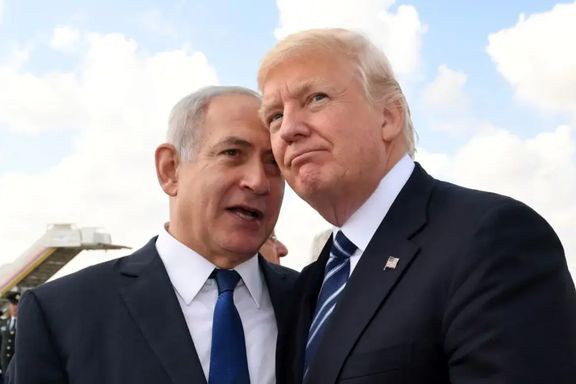
US President Donald Trump is seen speaking to Israeli Prime Minister Benjamin Netanyahu in the White House.

US President Donald Trump on Saturday launched the most serious ever US attack on its Mideast arch-nemesis Iran on Saturday, saying air strikes had hit three nuclear facilities including the underground nuclear site Fordow but calling for peace.

"We have completed our very successful attack on the three Nuclear sites in Iran, including Fordow, Natanz, and Esfahan," Trump said on Saturday.

Trump had hinted at a potential intervention for days and US bunker-busting bombs are widely viewed as the only ordnance capable of penetrating the underground Fordow site.

"All planes are now outside of Iran air space. A full payload of BOMBS was dropped on the primary site, Fordow," he added in a post on Truth Social.

"All planes are safely on their way home. Congratulations to our great American Warriors. There is not another military in the World that could have done this. NOW IS THE TIME FOR PEACE!"

Israel launched a surprise attack on Iran last week which has drawn Iranian missile fire, and Trump mooted possible US involvement, urging Tehran to resolve its nuclear impasse with Washington through talks.

Iranian Foreign Minister Abbas Araghchi said Iran would not negotiate under fire but wanted to pursue diplomacy.

Tehran has repeatedly vowed to target the substantial US military presence in the region if it comes under direct attack.

"This is an historic moment for the United States of America, Israel, and the world. Iran must now agree to end this war," Trump added in another post.

B-2 bombers were used in the US attacks against Iran's nuclear facilities, Reuters reported citing a US official.

The US had informed Israel in advance about the attack on Iran and the matter was coordinated, Walla News reported citing a senior Israeli official.

Most Viewed

Ghalibaf defends Iran-US talks amid hardline backlash
1
INSIGHT

Ghalibaf defends Iran-US talks amid hardline backlash

2
INSIGHT

Iran diplomacy wobbles as factions compete to avoid looking soft on US

3
VOICES FROM IRAN

Bread shortages, soaring prices strain households in Iran, residents say

4
ANALYSIS

The politics of pink: how Iran uses cuteness to rebrand violence

5

Scam messages seek crypto for ships’ safe passage through Hormuz, firm warns

Banner
Banner

Spotlight

  • Opposition to US talks grows in Tehran as ceasefire deadline nears
    INSIGHT

    Opposition to US talks grows in Tehran as ceasefire deadline nears

  • Tehran moderates see ‘no deal–no war’ limbo as worst outcome
    INSIGHT

    Tehran moderates see ‘no deal–no war’ limbo as worst outcome

  • The future has been switched off here
    TEHRAN INSIDER

    The future has been switched off here

  • Lights out, then gunfire: Witnesses recount Mashhad protest crackdown
    VOICES FROM IRAN

    Lights out, then gunfire: Witnesses recount Mashhad protest crackdown

  • Family told missing teen was alive, then received his body 60 days later
    EXCLUSIVE

    Family told missing teen was alive, then received his body 60 days later

  • Is Iran entering its Gorbachev moment?
    INSIGHT

    Is Iran entering its Gorbachev moment?

•
•
•

More Stories

US attacks on Iran: what we know so far

Jun 22, 2025, 01:00 GMT+1

US President Donald Trump announced US forces had attacked Iranian nuclear sites on Saturday, ramping up the biggest Mideast flare-up among major powers in over twenty years.

Trump strikes

  • Trump announced US attacks successfully attacked three main nuclear sites in Iran.
  • “BOMBS dropped on all, mainly Fordow”, Trump announced.
  • Trump said 6 huge MOAB-type bombs and missiles fired from submarines were used in the attacks, he was quoted by Fox News Host Sean Hannity.

Tension mounted ahead of attacks

  • Trump had said earlier in the day that still prefers to solve the nuclear issue with Iran through diplomacy, according to US secretary of state, Marco Rubio.
  • Iran and the United States kept up their communication over the weekend, NBC news reported.
  • Dozens of US military aircraft have been tracked flying toward the Middle East in recent days.

Israel kept military campaign on Iran, Plot foiled in Cyprus

  • The nine-day Israeli military campaign has killed 865 people and wounded over 3,000, human rights group HRANA said.
  • A new wave of Israeli airstrikes targeted cities across Iran—from Bandar Abbas, Ahvaz, and Marvdasht in the south to Tabriz, Salmas and Babol in the north.
  • The Israeli military says its air force has struck three F-14 fighter jets belonging to the Iranian Armed Forces in central Iran.
  • Iran is targeting Israeli civilians both inside the country and abroad, Israeli Foreign Minister Gideon Sa’ar said, after Cypriot authorities foiled a suspected Iranian-linked plot in Limassol.
  • Hezbollah's late secretary general Hassan Nasrallah's longtime bodyguard Abu Ali al-Khalil was killed in an airstrike in Tehran.
  • A video sent to Iran International shows significant damage to the cyber police (FATA) headquarters in Tehran, amid ongoing Israeli strikes on Iranian targets.
  • Iran’s Supreme Leader Ali Khamenei has named three senior clerics as possible successors in case he is killed in the war with Israel, names not revealed, his son Mojtaba is not among them.

Planned executions, German national arrested

  • Iran must halt planned executions, Amnesty International warned of a surge in politically motivated death sentences following the escalation of hostilities with Israel.
  • Iran’s Revolutionary Guards have arrested a German national, Marek Kaufmann, for alleged spying near restricted military and nuclear sites in Markazi province.
  • Iran has denied that it reduced missile launches because of depleted stockpiles. Says the change reflects a new strategy focused on quality over quantity.
  • Five members of Revolutionary Guards were killed in an Israeli strike on targets in Khorramabad, a city in the west of Iran.
  • Saeed Izadi, commander of the Palestine Corps within Iran’s Quds Force, was killed in a strike on an apartment in Qom.

Israeli strikes kill more Iranian generals as US moves B-2 bombers

Jun 21, 2025, 16:34 GMT+1

Israeli airstrikes across Iran on Saturday killed senior military personnel and a nuclear scientist while the United States moved heavy B-2 bombers to a Pacific airbase as it weighs attacking Iran's nuclear facilities.

Israel escalated its military campaign against Iran, striking nuclear facilities and missile infrastructure while killing members of a military unit responsible for foreign operations, the Revolutionary Guards Quds Force

A new wave of Israeli airstrikes late Saturday targeted multiple cities across Iran—from Bandar Abbas, Ahvaz and Marvdasht in the south to Tabriz, Salmas and Babol in the north, Sanandaj and Kermanshah in the west and Tehran, Qom, and Isfahan in the center, according to eyewitnesses and media reports.

Iranian state media confirmed the deaths of five Revolutionary Guards members in Khorramabad and released the names of 15 air defense personnel killed in recent strikes.

Saeed Izadi, commander of the Quds Force’s Palestine Corps, was killed in a strike in Qom, Israeli defense minister said early Saturday. Israel Katz described Izadi as a key figure behind Hamas's October 7 attack and a central node in Iran’s funding of armed allies in the region.

Israel said it had also taken out senior Revolutionary Guards drone commander Aminpour Joudaki and Quds Force arms transfer chief Behnam Shahriari.

An attack in Tehran killed Iranian nuclear scientist Isar Tabatabaei Ghomsheh and his wife.

Hezbollah forces killed in Tehran

An Israeli airstrike in Tehran killed Abu Ali al-Khalil, who had served as slain Hezbollah Secretary General Hassan Nasrallah’s personal bodyguard for decades, Al Arabiya reported citing sources in the Lebanese group.

Al-Khalil's son was also killed in the attack, Palestinian news agency Quds News Network reported.

In addition to Al-Khalil, Haider al-Musawi, a senior member of the Iran-linked militia group Sayyid al-Shuhada, was killed in the airstrikes, according to Israel's Channel 12.

Among the locations hit were the Isfahan nuclear facility and a centrifuge production site within the same complex, which the Israeli military said is central to Iran’s nuclear weapons development.

Other targets included drone launch vehicles, missile infrastructure, radar installations, and air defense systems.

The Iranian government confirmed that the Isfahan site had been struck but reported no casualties or radiation leaks.

Explosions were also heard in many cities including Shiraz, Mashhad, Tabriz, and Tehran, where the cyber police headquarters was severely damaged. Cyber police is known for its role in online surveillance and repression.

Iran in turn continued its retaliatory missile launches against Israel while imposing a near-total internet blackout which has effectively halted the flow of information.

Iranian missile impacts were reported in Tel Aviv, the Negev and Haifa. Israel said its air defense systems successfully intercepted multiple incoming salvos.

US moves B-2 bombers

The Pentagon is deploying stealth B-2 bombers across the Pacific from their base in Missouri, officials cited by US media reported, signaling that the Trump administration is positioning them for a possible strike on Iran.

The aircraft are capable of carrying the 30,000-pound GBU-57 bunker buster, which defense experts believe is the most likely conventional weapon to inflict damage on Iran’s fortified Fordow uranium enrichment site.

US President Donald Trump says he will make his decision about joining the Israeli war on Iran in two weeks to give diplomacy a last chance.

However, Israeli officials have told the United States they may not wait until the end of the two-week deadline to strike Iran’s underground Fordow nuclear facility and could act alone, Reuters reported Saturday, citing two sources familiar with what they described as a tense phone call.

“The Israeli officials said they do not want to wait the two weeks that US President Donald Trump presented on Thursday as a deadline for deciding whether the US will get involved in the Israel-Iran war," the report said citing the sources.

The White House is expected to hold a national security meeting on Saturday afternoon on Iran.

Iranian Foreign Minister Abbas Araghchi warned Saturday that any US involvement would be dangerous, insisting Tehran would not negotiate under bombardment.

Khamenei picks possible successors amid war, son Mojtaba not among them - NYT

Jun 21, 2025, 11:59 GMT+1

Iran’s Supreme Leader Ali Khamenei has named three senior clerics as possible successors in case he is killed in the war with Israel, The New York Times reported, citing three Iranian officials familiar with his emergency war plans.

The unprecedented step reflects the seriousness with which the 86-year-old leader views the current threat environment, as Israeli airstrikes continue to target Iranian military and nuclear assets.

Khamenei, who is now operating from a secure underground location and communicating through a trusted aide, has also named backups for key military positions in case more senior commanders are killed, the NYT cited the officials as saying.

“Ayatollah Khamenei’s son Mojtaba, also a cleric and close to the Islamic Revolutionary Guards Corps, who was rumored to be a front-runner, is not among the candidates,” the report said.

The identity of the three clerics has not been disclosed, but the move is seen as an effort to ensure a swift and orderly succession via the Assembly of Experts if the supreme leader is assassinated or dies unexpectedly.

As Iran International previously reported, Khamenei was relocated to an underground bunker in Lavizan, northeast Tehran, shortly after the airstrikes began. His close family, including Mojtaba, are also at the facility. The transfer followed internal assessments of vulnerability at top levels of Iran’s leadership.

In a separate report, Iran International learned that Khamenei has delegated key powers to the Supreme Council of the Revolutionary Guards in what officials described as a wartime precaution, allowing critical decisions to proceed should the Supreme Leader become incapacitated.

Iran will lose war and nuclear program, former Iran envoy Elliott Abrams says

Jun 20, 2025, 20:19 GMT+1
•
Negar Mojtahedi

Iran will lose its ongoing conflict with Israel and its nuclear program, President Trump’s former Iran envoy and prominent neoconservative Elliott Abrams told Eye for Iran, as the conflict between the two countries entered its second week.

"I really think this is going to end by a negotiation,” said Abrams, who served as US Special Representative for Iran from 2020 to 2021.

"They're going to lose this nuclear weapons program, and the question is whether they do it the hard way or the easy way."

Even if the Islamic Republic refuses to surrender, Abrams said more Israeli strikes—followed by a possible US attack targeting an underground nuclear facility—would eventually lead to negotiations, much the way talks settled the Iran–Iraq war.

Eliminating the underground Fordow site in central Iran would likely hinder Tehran’s ability to quickly rebuild its nuclear program but it may not necessarily prevent it from using suspected secret sites to produce nuclear weapons, a prominent nuclear expert said this week.

According to Richard Nephew, a former negotiator during the Obama administration, the United States and Israel must acknowledge that Fordow is not the only pathway for an Iranian nuclear weapons program.

Iran, he argued in a Washington Institute thinktank report, may have other centrifuges available, including at secret sites, and is “probably already at work.”

For his part, Abrams said Fordow is essential to Iran’s program and a necessary military objective, but not a total solution without a broader diplomatic or military campaign.

Abrams was a prominent advocate of preemptive military action against Iraq during George W. Bush’s presidency.

Weapons of mass destruction alleged to be held by Baghdad were never found and the invasion led to a civil war which killed several thousand US troops and tens of thousands of Iraqis.

Trump’s two-week window is ‘strategic’

"Khamenei will soon have that choice: preserve the regime—or risk its collapse under American attack," said Abrams.

White House Press Secretary Karoline Leavitt told reporters Thursday that Trump would decide within two weeks whether to authorize a military strike on Iran.

Trump has previously given himself two-week deadlines on other major decisions—particularly related to the Russia–Ukraine war—and then failed to meet them.

Questions about how Trump will handle the conflict between Israel and Iran have swirled over the last week, and the president has yet to give a straight answer.

Based on Abrams' tenure as Trump’s Iran envoy, he sees this two-week window as a psychological negotiating tactic to throw his adversaries off balance.

It also provides the president with time to explore more options, he added, to see where negotiations may head, and to assess what Israel can accomplish on its own inside Iran.

If Israel is unable to destroy Iran’s fortified Fordow nuclear facility, Abrams believes Trump will likely order a US airstrike using bunker-buster bombs, without deploying troops. That window also allows the US to position its military assets and to give Iran a final chance to negotiate.

“He is moving planes and ships, particularly aircraft carriers and carrier task forces from far away into the Gulf area, the Eastern Mediterranean area, and it takes a week or 10 days,” Abrams told Eye for Iran. “So I don't read into this that he's decided not to do anything.”

“It's a way of giving yourself options until the very last minute.”

Trump’s inner circle

During his tenure as special representative on Iran, Abrams viewed influencing trusted inner-circle figures—like Pompeo during Trump’s first term—as the most effective way to shape Trump's decisions.

Trump’s decision-making is shaped by a small group of trusted advisors, not outside pressure or foreign leaders. Those around him—especially top generals and intelligence officials—play a key role in what happens next.

Currently, his trusted circle, according to Abrams, includes Vice President Vance, Secretary of State Rubio, Generals Kane and Kurilla, and CIA Director Ratcliffe—all of whom remain deeply committed to preventing a nuclear Iran.

“I think he's paying a lot of attention to these two top generals—General Kane, who's the Chairman of the Joint Chiefs of Staff, and General Kurilla, who's the head of CENTCOM, both very experienced four-star generals,” Abrams said.

The generals do not make their opinions known, but from what Abrams gathers, they tend to have a more aggressive stance on Iran and its proxies.

As tensions escalate and the clock on Trump’s two-week window ticks down, all eyes are on Fordow—and on Tehran’s next moves.
Grief, rage, solidarity: Iranians under fire, out of sight

Jun 20, 2025, 14:48 GMT+1
•
Maryam Sinaiee

The war may have begun as a clash between Israel and the Islamic Republic, but for many Iranians now caught in the crossfire, it has become an intimate reality, marked by both grief and rare solidarity.

In the wake of mass evacuations from Tehran and other cities, a wave of grassroots support has emerged.

Iranians across social media are offering shelter, food, and medical help. Families far from the strikes are hosting refugees, doctors are providing free virtual consultations, and volunteers are caring for the elderly, infirm, and even abandoned pets.

“This is the least I can do now,” wrote Yasser Saiedy, an Iranian cardiologist based in Germany, offering remote consultations on X.

Others share stories of restraint—people letting others buy bread first, rationing water, making sure no one is left behind. Acts of solidarity, unfolding in the shadow of devastation.

A war without warning

Israeli airstrikes have hit Tehran and other cities with little or no notice, drawing criticism from many Iranians and some international observers.

One strike on Tehran’s District 18, near Mehrabad Airport, came just over an hour after a 2:00 AM warning. Activists noted the area’s high population of child laborers and street children.

“Under no circumstances is the death of children justifiable,” wrote Hamed Farmand of the International Coalition for Children with Incarcerated Parents. “Just as the death and starvation of Palestinian children has no name other than murder and genocide.”

Some of the over 320 civilian casualties of Israel's attacks
100%
Some of the over 320 civilian casualties of Israel's attacks

Iranian authorities have also faced criticism for failing to sound sirens, issue warnings or war-time guidelines through state media.

“It still hasn’t occurred to anyone to sound a siren or even issue a radio warning,” Tehran resident Sahar Karimi posted on X. “Ordinary people are dying, nobody cares?”

The government has released no official death toll, but rights groups report over 320 civilian deaths, including dozens of children.

Outrage and despair

The Center for Human Rights in Iran (CHRI) condemned the violence on Wednesday, denouncing “the deliberate targeting of civilians” and calling for an immediate ceasefire and a path to diplomacy.

London-based human rights lawyer Shadi Sadr called Israel’s evacuation warnings a form of forced displacement.

“The forcible displacement of a civilian population is a crime against humanity under international law. Full stop,” she wrote.

Frustration deepened after US President Donald Trump urged people to evacuate Tehran—a suggestion many called detached from reality.

Nobel Peace Laureate Narges Mohammadi responded promptly, reminding those ordering people to flee that Tehran is not only home to millions of people, but thousands of schools, hospitals, and businesses.

“Which of them are we meant to carry on our shoulders to save from death and devastation,” she asked in an Instagram post. “Do not destroy my city. End this war.”

No side feels like home

As the war drags on, many Iranians—at home and in exile—say they can’t side with either party to the conflict.

“This was not our war,” Sadr wrote, “but it is increasingly becoming ours, as our loved ones are being taken hostage by two criminal states.”

In the early days, some Iranians welcomed the strikes, hoping for a quick end to the regime.

“You know what is the worst nightmare of every Iranian now,” an exiled activist posted on X, “that US and Israel, having started this destruction, do not finish it, leaving the people of Iran to the hard and brutal days that the Islamic Republic will unleash upon us once it is over.”

In Tehran—in the midst of it all—perspective and tone is slightly different.

“They thought it would end with (supreme leader Ali) Khamenei’s death and the regime collapsing,” Abbas, a 46-year-old office worker in Tehran, says in a message on an encrypted app. “But as war drags on, they’ll realize that that was never a priority for Israel.”