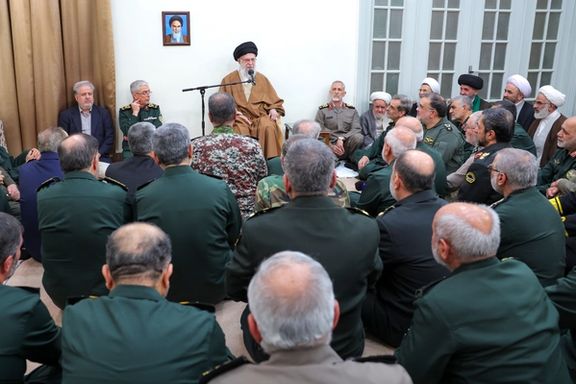
Iran's supreme leader Ali Khamenei speaking to a group of top military commanders, Tehran, Iran, 14 April 2025
As Iran faces its biggest military challenge in decades amid relentless Israeli attacks nationwide and assassinations of its top military leadership, one man stands atop its complex military apparatus.
Though a network of powerful institutions and senior military advisors shape Iran’s defense strategy, ultimate authority over military decisions lies with Supreme Leader Ali Khamenei.
This network includes a select group of Khamenei’s personal military aides, the General Staff of the Armed Forces (GSAF), the Supreme National Security Council (SNSC), and the Military Advisors Center in the Leader’s Office.
Khamenei swiftly reshuffled the military leadership on June 13 in response to Israel's targeted strike that killed at least twenty top Iranian military commanders.
These included Iran's Chief of the General Staff of the Armed Forces (GSAF), Major General Mohammad Bagheri, and IRGC Commander-in-Chief Major General Hossein Salami.
He appointed Major General Abdolrahim Mousavi as Chief of the GSAF, Major General Mohammad Pakpour as the new Commander-in-Chief of the IRGC, and Major General Amir Hatami as the Commander-in-Chief of the Artesh (regular Army).
Khamenei's top military advisors
Two of Khamenei’s top military advisors, Ali Shamkhani and Gholam-Ali Rashid, who also served as acting chief of the GSAF, were also targeted.
Ali Shamkhani: Admiral Shamkhani, appointed as Khamenei’s senior military and political advisor in May 2023, is currently in critical condition in the hospital. He previously served as Secretary of the Supreme National Security Council (SNSC) for over a decade and was widely seen as a key behind-the-scenes figure in Iran's nuclear talks with the United States.
Gholam-Ali Rashid: Major General Rashid, a longtime commander of Khatam al-Anbiya Central Headquarters—Iran’s top joint operational planning command—was also killed in the attack.
Rashid had served as acting chief of the General Staff for seventeen years.
Ali Shahbazi: Major General Shahbazi, a former commander-in-chief of the army and chief of the Joint Staff (now GSAF), currently heads the Military Advisory Center within the Leader’s Office.
The little-known elite advisory body provides strategic counsel on defense doctrine, intelligence operations, senior military appointments, and regional proxy strategies, including nuclear policy.
Yahya Rahim-Safavi: Major General Rahim-Safavi, a former IRGC commander-in-chief, has served as a senior military aide to Khamenei since 2007.
Hossein Dehghan: Brigadier General Dehghan, also a former IRGC commander, heads the Defense and Security Commission in Khamenei’s office.
The General Staff of the Armed Forces (GSAF)
The GSAF is Iran’s highest military planning and coordination body, reporting directly to the Supreme Leader. It oversees all branches of Iran’s armed forces: the army, the IRGC, the Basij, and the Law Enforcement Command.
On June 13, Major General Abdolrahim Mousavi became the first army officer appointed as chief of the GSAF.
Mousavi is known for his hardline stance; in 2018, he declared that his “greatest wish is the annihilation of Israel.”
Supreme National Security Council (SNSC)
The SNSC formulates Iran’s national security and foreign policy. Chaired by the president, it includes top officials from the military, intelligence services, judiciary, parliament, and the foreign ministry.
However, no decision becomes official without Khamenei’s approval.
The Supreme Leader also appoints two voting representatives to the council, one of whom is typically the SNSC’s secretary.
Ali-Akbar Ahmadian, appointed by President Ebrahim Raisi in 2021, currently serves as the council’s secretary and one of Khamenei’s two representatives. Saeed Jalili, the SNSC’s former secretary, has served as Khamenei’s other representative on the council since 2008.
Rescue personel work at a residential building following missile attack from Iran on Israel, at central Israel June 15, 2025.
Israel continued its expansive military campaign against Iran on Saturday, striking energy and military infrastructure across the country, while Iran launched another salvo of missiles into Israeli territory.
The latest exchanges have raised fears of further escalation and devastation, as both sides harden their rhetoric and show no signs of backing down.
Here's a brief summary of the main developments so far.
Israel escalates with oil strikes as death toll surpasses 200
Israel struck Tehran refinery at Rey, Shahran oil depot, and a facility in Tabriz, intensifying its campaign.
Strikes also targeted Tehran’s defense ministry and a military base in Kermanshah.
Rights group HRANA reported 215 killed and nearly 700 injured, most of them civilians.
The Israeli military said it has hit 150 targets across Iran since Friday.
Iran hits Haifa, Tel Aviv in fresh missile salvo
Iran has launched over 200 missiles since Friday, with a new wave early Sunday targeting Haifa and Tel Aviv among others.
Twelve people were killed and at least 385 injured in Israel by Iranian strikes early Sunday local time - with around 35 reported missing.
Tehran warned the US, UK, and France that any military support for Israel could trigger retaliatory strikes on regional bases and naval assets.
Civilian toll mounts
HRANA reports 215 deaths in Iran, with over 50 military personnel among them.
Nearly 700 Iranians have been injured, most civilians.
About 385 israelis have been injured, most civilians.
Global leaders pleas for calm
The UK, France, and Pope Leo XIV urged restraint and de-escalation.
EU officials warned of a “spiral of violence” and emphasized preventing Iran from acquiring nuclear weapons.
IAEA chief Rafael Grossi said the Natanz site’s enrichment areas were among those destroyed.
US Defense Secretary Pete Hegseth said President Trump still hopes for “a path to peace.”
Israel claims hits on nuclear and military sites
The IAEA confirmed extensive above-ground damage at Natanz but said Fordow and Khondab were unharmed.
Israel said it destroyed missile launch systems at Tehran’s Mehrabad airport and hit radar and command centers.
Targets included underground storage sites and active airbases.
Iran signals withdrawal from US talks
Iran's foreign minister Abbas Araghchi told EU chief Kaja Kallas that US-Iran nuclear talks are now “unjustifiable.”
Foreign Ministry spokesman Baghaei said a final decision on participation in the next round of talks would be made by Sunday.
Israel kill several top Iranian generals
Israel’s opening strikes killed top Iranian commanders: IRGC chief Hossein Salami, Armed Forces head Mohammad Bagheri, and Aerospace Force commander Amir Ali Hajizadeh.
Several nuclear scientists and intelligence officials were also killed.
Markets, global transport feel the shock
Oil prices surged up to $77 per barrel.
Wall Street dropped sharply on Friday; volatility is expected to continue.
More than 1,800 flights were affected due to airspace closures over Iran, Iraq, Jordan, and Israel.
The UK and Greece issued maritime advisories for the Red Sea and Strait of Hormuz.
The exchange rate for the US dollar in Iran exceeded 960,000 rials on Sunday morning.
Diplomatic efforts intensify but falter
Netanyahu has spoken with Trump, Putin, Starmer, Macron, Merz, and Modi.
Iran summoned the Swiss ambassador to warn the US against helping Israel’s defenses.
Iranian lawmakers publicly urged Khamenei to authorize nuclear weapons development.
Strategic outlook: containment or collapse?
US intelligence sources told CNN Israel may be using the operation to pursue regime change, though not openly stated.
Iran has reshuffled its top command rapidly to maintain continuity.
With diplomacy faltering and military exchanges intensifying, both sides appear to be preparing for prolonged confrontation.
Russia's President Vladimir Putin and US President Donald Trump talk during a bilateral meeting at the G20 leaders summit in Osaka, Japan, June 28, 2019.
Donald Trump told his Russian counterpart the United States remains open to renewed nuclear negotiations with Iran, but Iranian President Masoud Pezeshkian said Tehran will not return to talks until Israeli attacks stop.
Donald Trump and Vladimir Putin held a 50-minute call on Saturday focused on the escalating conflict between Israel and Iran, after Oman's foreign minister announced the sixth round of Tehran-Washington talks will not take place.
“Putin condemned Israel's military operation against Iran and expressed serious concern about a possible escalation of the conflict, which would have unpredictable consequences for the entire situation in the Middle East,” Kremlin aide Yuri Ushakov said Saturday.
Trump said that his special envoy Steve Witkoff was ready to resume nuclear talks with Iran's foreign minister, according to the Russian president's foreign policy adviser.
“While there will be no meeting Sunday, we remain committed to talks and hope the Iranians will come to the table soon,” Axios quoted a US official as saying.
However, Pezeshkian told French President Emmanuel Macron in a phone call, “The Islamic Republic will not sit at the negotiating table under pressure, irrational demands, double standards—or during continued Israeli aggression."
Iranian Foreign Minister Abbas Araghchi told EU foreign policy chief Kaja Kallas on Saturday that continued Israeli attacks—and US support for them—made talks “unjustifiable.”
Foreign ministry spokesman Esmaeil Baghaei also said Israel's strikes had “rendered diplomacy meaningless.”
Yet behind the scenes, there may still be movement. Despite Iran’s hard public line, two Western diplomats told Axios that Araghchi privately indicated Tehran could return to talks once it concludes its military response to Israel’s strikes.
issiles launched from Iran are intercepted as seen from Tel Aviv, Israel, June 13.
Iran launched over 200 missiles at Israel killing one and injuring at least 60 people after Israeli attacks killed its top military leadership and pounded armed forces and nuclear sites leaving scores of Iranians dead.
A first wave of Iranian attacks comprised around 200 missiles, a source close to the Israeli government told Iran International, adding that fewer than 10 landed. Two more waves followed, residents and Israeli media reported.
Fourteen people were injured in a strike on a Tel Aviv building near the defense ministry, paramedics and Israeli media reported.
Several others were injured in other parts of Tel Aviv including a woman who succumbed to her injuries.
A source close to the Israeli government told Iran International that the "massive" hit to the building and the killing of and injuries to civilians meant the Jewish State would now consider targeting Iran's oil and gas infrastructure in retaliation, a potentially major escalation.
Israel's military urged residents to take shelter and said missile defense interceptions were ongoing.
Waves of Israeli airstrikes had hit nuclear facilities, military bases and the private homes of senior leaders all over Iran in an unprecedented attack by Israel against its Mideast arch-nemesis.
The strikes killed Hossein Salami, the head of Iran's Islamic Revolutionary Guard Corps, armed forces chief of staff Mohammed Bagheri, air force commander Amir Ali Hajizadeh, and several top nuclear scientists.
79 people were killed and hundreds wounded in Tehran alone, according to local health authorities, as a nationwide casualty count was yet to emerge.
US President Donald Trump on Friday lauded Israel's broad surprise attack against Iran which assassinated Tehran's top commanders, urging the Islamic Republic to sign a nuclear deal or face more punishment.
“They missed the opportunity to make a deal. Now, they may have another opportunity. We’ll see," US President Trump told NBC news in an interview on Friday.
Trump added added that Iranian officials were reaching out to the United States. "They're calling me to speak."
Supreme Leader Ali Khamenei survived and vowed to punish Israel for the attack.
Israeli forces say they intercepted incoming Iranian drones over neighboring Syria and Jordan on Friday and the Israeli military's head of operations Major General Oded Basiuk on Friday urged readiness because "the enemy’s response will come".
New Revolutionary Guards commander Mohammad Pakpour said Iran would respond to Israel's attacks and Tehran would open "the gates of hell", while Iran summoned the Swiss ambassador who represents US interests in Tehran and warned Washington against blocking Iranian counterattack.
An Israeli official told Iran International that Israel carried out a complex and multi-phase operation that disabled the launch of hundreds of Iranian ground-to-ground missiles aimed at Israeli territory.
"Painful fate"
Khamenei vowed retaliation, saying in statement, ""By God’s will, the powerful arm of the Islamic Republic’s armed forces will not let it go unpunished."
"With this crime, the Zionist regime has prepared a bitter and painful fate for itself—and it will undoubtedly face it."
A senior Israeli official told Iran International that leaders' homes and not civilians were targeted in the strikes in Tehran.
Iran's Natanz and Fordow nuclear sites were hit but only sustained superficial damage, a spokesperson for Iran’s Atomic Energy Organization said.
"Unilateral action"
Further Iranian retaliation could swiftly follow after it launched two direct missile attacks on Israel last year, and Washington began drawing down personnel in the region on Wednesday as tensions flared.
Iran's Persian Gulf neighbors Saudi Arabia, the United Arab Emirates and Qatar condemned the attack. Arab capitals, while often wary of Tehran, are keen to avoid a regional conflict or Iranian attacks on US bases in their countries.
"Tonight, Israel took unilateral action against Iran," Secretary of State Marco Rubio said in a statement issued by the White House on Thursday. "We are not involved in strikes against Iran and our top priority is protecting American forces in the region,"
"Let me be clear: Iran should not target US interests or personnel."
Israeli Prime Minister Benjamin Netanyahu gave a video address in which he said the operation was an open-ended campaign to remove what he called Iran's threat.
"Moments ago, Israel launched Operation Rising Lion, a targeted military operation to roll back the Iranian threat to Israel's very survival," Israeli Prime Minister Benjamin Netanyahu said in a video address on Friday local time.
"This operation will continue for as many days as it takes to remove this threat for decades, the tyrants of Tehran have brazenly openly called for Israel's destruction. They backed up their genocidal rhetoric with a program to develop nuclear weapons."
Confrontation stepped up
Tehran launched hundreds of missiles at Israel in October last year following Israeli military successes against its armed allies in the region and the assassination of a top Palestinian official on Iranian soil.
Israel retaliated with nationwide air strikes which hit Iranian air defenses but the confrontation quickly ended.
Iran and Israel are bitter foes whose decades of shadow conflict burst into the open last year after the October 7, 2023 attack on Israel by Iran-backed Hamas militants plunged the region into renewed conflict.
An Israeli F15 Fighter Jet on its way to conduct air strikes in Yemen is seen at an unidentified location in this handout photo released July 20, 2024
A senior Israeli official has warned that Israel is ready to launch a military strike on Iran if the next round of nuclear talks between Tehran and Washington, set for Sunday in Oman, fail to yield results.
The official, speaking to Iran International, said Israel is closely monitoring developments and could act unilaterally if necessary.
“The United States would require approximately three days to evacuate non-essential diplomatic personnel and their families from the region,” the source said. “That evacuation process reportedly began on Wednesday and is expected to be completed by Sunday, aligning with the timeline for the talks.”
According to multiple sources, the United States has already begun evacuating non-essential diplomatic personnel and their families from the region.
Israeli media reported Thursday that Strategic Affairs Minister Ron Dermer and Mossad Director David Barnea are set to meet US Special Envoy Steve Witkoff ahead of the talks in Oman.
Witkoff, speaking at an event for the Israeli medical charity United Hatzalah in New York on Wednesday, stressed that Iran must be permanently denied the ability to develop nuclear or missile capabilities.
“We must stand resolute and united against this danger and ensure that Iran never obtains the means to achieve its deadly ambitions no matter what the cost,” he said.
A senior Iranian official told Reuters that a regional ally had informed Tehran of the potential for an Israeli strike. "The tensions are intended to influence Tehran to change its position about its nuclear rights," the official said, but emphasized that Iran would not compromise on its right to uranium enrichment.
US President Donald Trump said Wednesday that American personnel were being withdrawn due to increasing threats in what he described as a “dangerous place.” He added that Washington remains committed to preventing Iran from acquiring a nuclear weapon.
Iran's Islamic Revolutionary Guard Corps (IRGC) issued a warning Thursday. “If our hands are untied, we will win victories that will make the enemy regret its actions,” IRGC commander-in-chief Hossein Salami said, signaling Iran’s readiness for any military confrontation.
An IRGC-affiliated outlet, Javan, warned that Tehran was prepared to walk away from negotiations if its national demands were not met, saying that Iran was negotiating “from a position of strength” and possessed sufficient nuclear expertise to act as a deterrent.
The New York Times, citing a senior Iranian official, reported Wednesday that Iranian military and government leaders had already held high-level meetings to discuss their response to any possible Israeli military strike.
Attacking Iran without US help
NBC News reported Thursday that while Israel would prefer to coordinate with the US, including intelligence or logistical support for strikes on Iranian nuclear facilities, it is prepared to act alone.
“While Israel would most likely prefer US military and intelligence support... it showed in October that it can do a lot alone,” the report said.
The same report cited five sources saying that Israel’s considerations of unilateral military action have intensified as the US inches closer to a preliminary deal with Tehran—one that reportedly includes provisions on uranium enrichment that Israel finds unacceptable.
US evacuating Baghdad embassy
Tensions have also led to regional security measures with the US embassy in Baghdad set to be evacuated partially.
Iraq’s state news agency also reported that steps to evacuate US personnel were underway not only in Iraq but across several Middle Eastern countries.
The UK Maritime Trade Operations (UKMTO) issued a security advisory on Wednesday, warning that increased regional tensions could impact maritime safety.
“UKMTO has been made aware of increased tensions within the region which could lead to an escalation of military activity having a direct impact on mariners,” the alert read.
The Washington Post reported Wednesday that the nuclear talks might not proceed as planned, citing two US officials who described the diplomatic environment as rapidly deteriorating.
Iran’s Defense Minister Aziz Nassirzadeh warned on Wednesday that Tehran would target American bases in the region if negotiations collapse and hostilities break out. “If a conflict is imposed on us... all US bases are within our reach and we will boldly target them in host countries,” he said.
Despite the rising tensions, Oman’s Foreign Minister Badr al-Busaidi confirmed Thursday that the sixth round of US-Iran nuclear negotiations will proceed as scheduled on June 15.
US Central Command (CENTCOM) chief Army General Michael Kurilla (second from left) meets with military personnel
The top US military commander in the Middle East told Congress on Tuesday that Iranian weakness offers Washington a historic opportunity to advance its interests but a vulnerable Tehran may seek deterrence in nuclear weapons.
"We can seize the initiative to optimize our posture to defend the Homeland, strengthen our economic outlook, take back our right to freedom of navigation, and sustain the upper hand against an increasingly desperate Iran," US Central Command (CENTCOM) chief Army General Michael Kurilla said.
"Iranian leadership understands their acute vulnerability, and the precision of Israel’s response demonstrates that Iran will remain critically exposed to future Israeli operations, even if their former defenses are reconstituted," Kurilla said in a statement to the US House Armed Services Committee.
Israel launched air strikes on Iran in October in response to a missile attack on its soil, in an operation it said knocked out Iranian air defenses and missile production capacity.
"Significantly weakened, Iran finds itself with fewer options," Kurilla added. "In addition to an active chemical weapons program, there is one remaining pillar the Regime may consider its best chance at restoring deterrence and imposing its will on the Region – the threat of developing a nuclear weapon."
The US intelligence community assesses that Iran is not building a nuclear weapon nor has such a move been authorized by its Supreme Leader yet but that a taboo on discussing the bomb in public discourse was eroding.
Iran's proxies in Middle East
Kurilla said Tehran's attempt to capitalize on the Palestinian armed group Hamas's attack on Israel on Oct. 7, 2023 has largely failed after serial military setbacks.
"After Hamas's attack on Israel, Iran operationalized its entire proxy network and arsenal of standoff capabilities – two pillars of their strategic approach – in pursuit of one goal: to seize a once-in-a-generation opportunity to reshape the region to its advantage."
Iran's losses could be the United States' gain, Kurilla suggested, without mentioning any specific course of action.
"We now have an unprecedented opportunity to advance the vision of a prosperous and integrated Middle East in which US national interests are advanced and Iran’s violent attempts to upend this peaceful order are defeated."