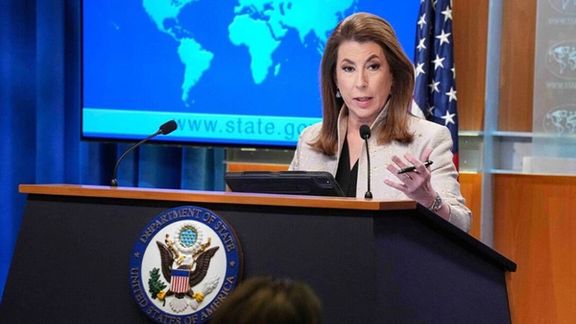
Iran and US made further progress in fifth round of talks, State Dept says
"The talks (with Iran) continue to be constructive. We've been able to say that in these particular talks, which is beneficial. And in this case, they were constructive as well. And we made further progress," State Department spokesperson Tammy Bruce said Tuesday.
"Both sides have agreed to meet again in the near future. And we are grateful to, once again, our Omani partners for their continued facilitation of the process," she added.
Nearly all members of Iran’s parliamentary presidium were re-elected on Tuesday with no real competition or surprise, in an uneventful session that mirrored the widespread apathy outside.
Despite weeks of speculation that the ultraconservative Paydari Party would mount a serious challenge to Speaker Mohammad Bagher Ghalibaf, no meaningful competition materialized.
Even Iran’s tightly controlled state media struggled to hide the stagnation.
“The political atmosphere in Iran has never been as banal as it is today,” the conservative daily Farhikhtegan wrote in its editorial on Tuesday. “Public trust in both politics and politicians is at its lowest point.”
During the session, lawmakers barely addressed the parliament’s performance. Instead, they praised Ghalibaf’s military service during the Iran-Iraq War, deflecting attention from governance failures.
Farhikhtegan warned that many lawmakers appear unwilling or unable to manage even basic parliamentary affairs—raising concerns about the legislature’s capacity to provide oversight or hold the cabinet accountable.It also alleged that some figures outside parliament had attempted to influence the internal vote.
Ghalibaf, a former Revolutionary Guards commander, won comfortably after one of his two rivals, Ahmad Ghavami, withdrew just before the vote. The only remaining contender, Ahmad Rastineh, posed little threat.
Rastineh had claimed he was running to end what he called Ghalibaf’s undemocratic control of the legislature. However, his interventions appear to have focused more on silencing radical voices than asserting a distinct policy direction.
Legislative paralysis
In the past year, the parliament (or Majles) advanced only two major initiatives: one to enforce compulsory hijab and another to restrict social media.
The former was blocked by President Massoud Pezeshkian and the Supreme National Security Council, who feared backlash from Iran’s politically active women.
The latter also met resistance from the public and the executive. Under pressure from youth in particular, Pezeshkian overturned a ban on WhatsApp and is reportedly working to lift other platform restrictions.
Yet the parliament’s most glaring failure remains economic reform. Lawmakers have made little progress in combating corruption, reducing inequality, or improving living standards.
Some political commentators—including prominent reform advocate Abbas Abdi and former vice president and presidential candidate Mostafa Hashemi Taba—argue that legislative efforts alone cannot solve Iran’s economic crisis.
The Majles, they assert, has lost much of its relevance, and only systemic reform—especially the redistribution of financial resources—can address the country’s deeply rooted structural challenges.
Iranian officials have acted swiftly to contain the potential damage to fragile Tehran-Riyadh relations following the arrest of a well-known Iranian cleric in Saudi Arabia for harshly criticizing the kingdom.
Hojatoleslam Gholamreza Ghasemian was detained in Medina on Monday after sharing a video on Instagram in which he launched a scathing attack on Saudi Arabia’s recent social and cultural transformations.
“Iran in no uncertain terms condemns any attempt to harm Muslim unity, particularly in the spiritual atmosphere of the Hajj,” Iranian Foreign Minister Abbas Araghchi posted in English on X Tuesday, adding that Tehran would not allow anyone to sabotage relations with Saudi Arabia.
“The highly competent management of this year's Hajj is well appreciated by Iran."
Iran’s ambassador to Riyadh, Alireza Enayati, also appeared to reassure Saudi authorities that Tehran disapproved of Ghasemian’s comments.
“Pilgrims respect the sanctity of the Two Holy Mosques and adhere to the governing regulations," Enayati posted on X in Arabic.
"No one will approve of bad or offensive speech.”
Earlier, however, judiciary spokesman Asghar Jahangiri, representing a hardline-dominated branch of the Islamic Republic, had called Ghasemian’s arrest “unjustified and unlawful.”
Saudi authorities twice provided consular access to the detained cleric, the consular chief at Iran's foreign ministry Majid Rezapanah said on Tuesday, in what may be interpreted as a goodwill gesture.
Saudi authorities have yet to comment on the incident.
Controversial broadside
In the video recorded in Muslim holy city of Medina shortly before his arrest, Ghasemian accused Saudi Arabia of moral decline.
“You no longer need to go to Antalya (in Turkey) for casinos, brothels and obscene concerts; instead, you can go to Mecca and Medina, here!” he said in the video while expressing alarm over what he described as the “will to give dominance to atheism” in Saudi Arabia.
Ghasemian, 52, was a supporter of ultra-hardliner candidate Saeed Jalili in the 2024 Iranian presidential election. He has longstanding ties to vigilante groups involved in attacks on the British and Saudi embassies in Tehran in 2011 and 2016—incidents that led to ruptures in diplomatic relations.
While around 100 individuals were arrested over the Saudi embassy incident, several who were convicted were later quietly acquitted.
Domestic blowback
Ghasemian’s remarks have triggered a backlash within Iran, where many see them as jeopardizing recent diplomatic progress with Mideast rival Riyadh.
The moderate conservative news outlet Asr-e Iran on Tuesday criticized Ghasemian and suggested that he be detained upon return to Iran if released by Saudi Arabia.
“Given his fame and his association with certain officials, it is necessary for the Islamic Republic to immediately and explicitly distance itself from his foolish remarks so that his positions are not attributed to Tehran,” Asr-e Iran wrote.
The outlet also suggested Ghasemian may have had a “mission to cause trouble for the country”, presumably by ultra-hardliners who disapprove of Tehran’s rapprochement with Saudi Arabia and nuclear talks with Washington.
“The acts of Ghasemian and those like him must be seen in the context of conspiracies that aim to prevent normalization of Iran's relations with its surrounding world,” Salar Ahmadi, a member of the central council of the reformist Neda-ye Iranian or Iranians’ Voice Party, posted on X. “The reason: past Experience!”
Ultra-hardliners, however, rallied in support of the cleric. “We will not remain silent until Hojatoleslam Ghasemian is released from the clutches of the House of Saud,” Mojtaba Vahdati, an ultra-hardliner activist with 11,000 followers on X, posted.
Other pro-government voices warned against turning Ghasemian into a political martyr. “Don’t turn someone into a hero who will once again force the foreign ministry to plead with the Saudis,” activist Hamed Aghel posted on X, pointing out that Iran would not tolerate such accusations from a foreigner.
Recent diplomatic progress
Shi'ite Tehran and Sunni Riyadh agreed to mend fences in a 2023 deal mediated by Beijing.
Ghasemian’s comments came weeks after a major diplomatic breakthrough: a historic visit by Saudi Defense Minister Prince Khalid bin Salman to Tehran in April—the highest-level visit by a Saudi official in decades.
Prince Khalid met with Iran’s Supreme Leader Ayatollah Ali Khamenei and conveyed a message from his father King Salman bin Abdulaziz.
Tehran and Riyadh appear keen to stay in close touch as high-stakes US-Iran talks enter crunch time.
Araghchi visited Riyadh in early May to meet his Saudi counterpart and discuss the lay of the land in the region and progress in the nuclear talks.
Political prisoner Pedram Madani is facing imminent execution in Iran after being resentenced to death for alleged espionage for Israel, drawing sharp rebukes from rights groups and public figures.
Nobel Peace Prize laureate Nargess Mohammadi described the case as “a blatant act of injustice,” citing what she called coerced confessions, denial of legal representation and a biased judicial process.
“Pedram was denied a lawyer of his choosing. His confession was extracted under pressure and torture in solitary confinement,” Mohammadi wrote on Instagram.
“They hang innocent youths by the neck while knowing full well the confessions were false and the prisoner, even under their own laws, does not deserve the death penalty.”
Madani, who is around 40 years old, was arrested in 2019 on charge of spying for Israel and sentenced to death by a Revolutionary Court on charges of “corruption on earth.”
According to Norway-based Iran Human Rights (IHR), Iran’s Supreme Court overturned the death sentence three times, but each time the case was reassigned to other courts which reinstated the verdict.
Madani was moved Sunday from Tehran’s Evin Prison to Ghezelhesar Prison, and his family was summoned for a final visit—moves widely interpreted as indicators of imminent execution.
“Death sentences in Iran, especially on charges such as espionage, are issued and carried out without any due process. These executions are extrajudicial killings that the international community should not remain indifferent to,” said Mahmood Amiry-Moghaddam, director of IHR.
Madani’s case has triggered renewed calls for action from civil society and former detainees.
The official support account for Olivier Grondeau, a French national recently freed from Iranian detention, posted, “Three times, his death sentence was overturned by the Supreme Court. Yet, he is scheduled to be executed tomorrow. We demand the immediate cancellation of his execution.”
From Evin Prison, civil activist Mehdi Mahmoudian said Madani was previously misled with false promises of clemency from intelligence agencies.
Mahmoudian described Madani as the third inmate in a month to be removed from Evin’s Ward 4 for execution, warning of a “terrifying pattern of accelerated capital sentences.”
Iran late last month executed Mohsen Langarneshin, a 32-year-old network security engineer accused of helping Israel carry out assassinations and bomb attacks. However, a prominent activist, human rights groups and a leaked call from the condemned prisoner indicated the charges were false.
At least 113 executions have been recorded in the first 25 days of 2025, IHR said, underscoring what it calls a deepening execution crisis.
“As long as executions go on,” the Grondeau support group wrote, “every day in Iran will be a day of mourning.”
US President Donald Trump warned Israeli Prime Minister Benjamin Netanyahu in a phone call last week against taking any steps that might disrupt ongoing US-Iran talks, Axios reported on Tuesday citing a White House official and a source familiar with the details.
Trump and other senior US officials have become increasingly worried that Israel could launch a strike on Iran’s nuclear infrastructure or engage in other actions that might derail the diplomatic process, the official was quoted as saying.
Trump told the Israeli prime minister that the "other option" is on the table, apparently referring to the military option, but that he wants to see first if a diplomatic solution is possible, the Axios report said.
Two major energy agreements signed between US companies and the Kurdistan Regional Government (KRG) have sparked swift backlash from Baghdad and could undercut Iran’s long-standing economic and political grip on Iraq.
During a high-profile visit to Washington in May, KRG Prime Minister Masrour Barzani announced the deals with HKN Energy and WesternZagros, targeting development of the Miran and Topkhana-Kurdamir gas fields in the western part of the region near the Syrian border. Together, the projects are valued at $110 billion over their lifetime.
The US-KRG energy deals have sent a powerful message—both to Baghdad and to Tehran. If realized, they could shift Iraq’s energy independence and diminish Iran’s regional clout.
US Energy Secretary Chris Wright praised the deals at the Al-Monitor Global Institute in Washington on May 22, calling them “very aligned with President Trump’s agenda.”
He added, “We need Iraq and others off Iranian dependence.”
Secretary of State Marco Rubio met with Prime Minister Barzani in Washington on May 23. According to the State Department, the Secretary praised the energy agreements and reaffirmed US support for a strong and resilient Kurdistan Region within a sovereign and prosperous federal Iraq.
But analysts believe without a breakthrough in Baghdad-Erbil relations and tangible infrastructure investment, the deals remain aspirational—more of a political statement than a pipeline to regional transformation.
Iran’s gas grip at risk
Iran currently supplies around 25% of Iraq’s electricity needs through natural gas exports. Should the Kurdish projects proceed, that influence could be seriously eroded.
According to Iman Nasseri, Managing Director for the Middle East at FGE, Iran has little to gain financially from its gas exports to Iraq, and growing domestic shortages are shifting Tehran’s calculus.
He told Iran International, “They’re (Iraq) receiving gas for free because they have the excuse of not being able to pay due to US sanctions....Iran would welcome any scenario that could get Iraqis off the contract that they have signed with the Iranians [...] because they are short in natural gas at the moment."
Nasseri said that while the gas fields targeted by the US-KRG deals—estimated to hold 13 trillion cubic feet collectively—are indeed substantial, the main obstacles to their development have always been political and economic, not technical.
Strategic implications for Iran
Meanwhile, Baghdad swiftly denounced the agreements. Iraq’s Oil Ministry declared them “null and void." A senior Iraqi official told Reuters the central government had not been informed in advance.
KRG’s Ministry of Natural Resources defended the move, citing existing legal frameworks and long-standing contracts validated by Iraqi courts.
Energy analyst Dalga Khatinoglu told Iran International that the gas reserves in Iraqi Kurdistan—estimated at over 211.9 trillion cubic feet —are large enough to position the region as a major exporter to Turkey and Europe.
While Iran holds five times more gas, he warned, Tehran risks losing its most critical energy customers if the Kurdish fields come online.
“Iran earns $5 billion a year from gas exports to Iraq and Turkey,” Khatinoglu said, underscoring the threat to both revenue and regional influence. If Kurdish gas starts reaching Turkey and Europe, Iran not only loses market share—it loses geopolitical leverage.
US policy or political signal?
Ambassador John Craig, a former senior US diplomat, told Iran International the announcement may signal more of a “test” than a decisive turning point.
“The KRG is testing the water—to see how the Iranians react to it and how the US reacts to it,” he said, emphasizing that Iran “no longer has the punch” it once did following Israeli strikes that “took out all their munitions factories” and weakened Tehran’s regional leverage.
Craig is a former US ambassador to Oman under President Clinton and later served as director for the Middle East at the National Security Council under President George W. Bush.
He said that while the Kurdish leadership may see an opening to act more independently, the projects are far from being realized. “This is not going to happen in the next 10 months, no. It’s long term,” he said. “Exploration, production, development—it could take three to five years.”
Nasseri also described the deals as more symbolic than real, likening them to ‘wishful thinking’ without the conditions needed for execution. He emphasized that Kurdistan currently lacks a viable off-taker, adding, "you can’t develop gas without finding a place and an off-taker that can consume that gas.”