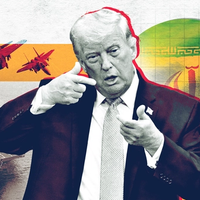
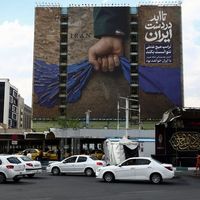
Kioumars Heydari, commander of Iran’s army ground forces, issued a warning against any potential adversary.
“Any enemy, at any level or scale, that makes a wrong move will be met with our unmatched power and face severe punishment,” he said.

Iran’s Foreign Minister Abbas Araghchi said the United States resorted to negotiations after sanctions failed to achieve their goals.
“The Americans are negotiating with us because they’ve become disappointed in sanctions,” he said.
“From the beginning, they said they would impose crippling sanctions on the Islamic Republic, but that wish never came true. They could not cripple the Iranian people.”
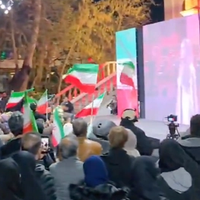
Members of the Basij, a paramilitary wing loyal to Iran’s leadership, staged a protest Thursday outside the Fordow nuclear facility, chanting slogans against the United States.
Demonstrators shouted, “Nuclear energy is our absolute right” and “No compromise, no surrender, battle with America,” according to Iranian media.
The rally comes ahead of Friday’s planned nuclear talks between Iranian and US representatives in Rome. Officials in Tehran have recently expressed skepticism about the outcome amid rising diplomatic tensions.

Iran’s top financial regulator said ongoing negotiations still carry potential for progress, but warned against unrealistic expectations.
Hojjatollah Seydi, head of the Securities and Exchange Organization, said in Mashhad that “we are hopeful about the negotiations, but no one expects a rosy outcome.”
He identified six major challenges—including Israel, technical hurdles, China, Europe, and domestic hardliners—that could affect both the talks and Iran’s financial markets.
Mohammad Bagheri, Iran’s armed forces chief, said the country’s high defense readiness deters adversaries.
“They have realized that any aggression against Iran’s territory will come at a heavy cost, without bringing them any gain,” he said Thursday.


The US State Department has appointed Iran hawk Xiyue Wang, held prisoner in Tehran for over three years on spy charges, as a senior adviser for Iran, Politico reported on Wednesday.
Wang, who has been outspoken about opposing nuclear negotiations with Iran, recently joined the Bureau of Near Eastern Affairs.
Wang was held for 1,216 days in Tehran’s Evin Prison and released in 2019 in exchange for an Iranian scientist convicted in the US of violating sanctions.
He had traveled to Iran as a Princeton graduate student with permission from the Iranian foreign ministry before being arrested and imprisoned on espionage charges.
In a 2021 lawsuit, Wang accused Princeton University of failing to support him during his detention and of pressuring his family to stay quiet. “They sent me to Iran and left me there,” Wang said at the time.
The US and Iran are set to begin a fifth round of indirect talks in Rome on Friday in spite of remarks from Iran's Supreme Leader this week doubting they will be able to reach an agreement if US terms remain set on stopping Iran's uranium enrichment.