Trump says Iran has US proposal, must move quickly
US President Donald Trump said Friday that Iran has received his administration’s proposal on a nuclear deal and warned that Tehran must act fast.
“They have a proposal. More importantly, they know they have to move quickly or something bad—something bad's going to happen,” Trump told reporters aboard Air Force One after departing the United Arab Emirates.
Axios reported Thursday that the Trump administration formally presented the proposal during the fourth round of indirect negotiations in Oman last Sunday. According to US and diplomatic sources cited by Axios, it was the first written offer made by White House envoy Steve Witkoff since talks began in early April.
Iranian Foreign Minister Abbas Araghchi reportedly took the proposal back to Tehran for consultations with Supreme Leader Ali Khamenei, President Masoud Pezeshkian, and other senior officials.
The proposal outlines parameters for a civilian nuclear program and monitoring arrangements.
US President Donald Trump gestures, while he boards Air Force One, in Abu Dhabi, United Arab Emirates, May 16, 2025.
People walk in Eminonu district, as the New Mosque is seen in the background, in Istanbul, Turkey, April 23, 2025.
Iran and the three European signatories to the 2015 nuclear deal held talks in Istanbul to discuss the state of nuclear and sanctions-lifting negotiations, Iranian Deputy Foreign Minister Kazem Gharibabadi said on Friday.
Gharibabadi said he and fellow Deputy Foreign Minister Majid Takht-Ravanchi hosted the political directors of the UK, France, and Germany for discussions aimed at advancing diplomatic efforts.
“Iran and the E3 are determined to sustain and make best use of diplomacy,” he wrote on X. “We will meet again, as appropriate, to continue our dialogue.”
A German diplomatic source told Iran International ahead of the meeting that discussions would focus on Iran’s nuclear program, but stressed, “These are not negotiations.” The source said Germany was represented by Dominik Mutter, Political Director at the Federal Foreign Office.
Earlier this week, Iranian Foreign Minister Abbas Araghchi said Iran remained open to talks with Europe, “even if their own policies have led to some isolation in these negotiations.”
Few details have emerged from the meeting, and no major breakthroughs have been announced.
Under the UN resolution that endorsed the 2015 nuclear deal, the three European signatories – Britain, France, and Germany – have the authority to reimpose UN sanctions on Iran through a mechanism known as the "snapback," if they determine that Tehran is not complying with the agreement.
Diplomats told Reuters that the E3 could move to trigger the snapback mechanism as early as August if no significant progress is made in negotiations. The deadline to do so under the resolution is October 18.
Separately, US Secretary of State Marco Rubio met Friday in Istanbul with the national security advisors of the UK, France, and Germany to discuss both Iran and the war in Ukraine, according to a US official and a Reuters witness.
The United States and Iran have held four rounds of indirect nuclear negotiations mediated by Oman since April. Both sides have described the talks as “constructive,” though no formal agreement has been reached.
Meanwhile, during his visit to Persian Gulf states this week, US President Donald Trump said Iran had “sort of agreed” to American terms and declared, “We’re getting very close to a deal.” Trump reiterated that Iran must never obtain a nuclear weapon and warned Tehran faces either “a very, very nice step” or “a violent step — the violence like people haven’t seen before.”
On Friday, Trump added that Iran has received a formal US proposal and must act quickly. Axios reported that the written proposal was handed to Iranian negotiators during the fourth round of talks in Oman and taken back to Tehran for consultation with senior officials.
A US Treasury delegation met with several Hong Kong banks last month to warn them against facilitating Iranian oil shipments to China, sources familiar with the matter told Bloomberg, as Washington steps up efforts to enforce sanctions targeting Tehran’s oil revenues.
The meetings took place on April 7 and were led by Jesse Baker, deputy assistant secretary of the Treasury for Asia, the sources said. Banks were urged to uncover the ultimate owners behind front companies and flag suspicious non-dollar transactions linked to Iran, they added.
Representatives from HSBC, Standard Chartered, and Bank of China (Hong Kong) were among those in attendance, according to the sources. The Treasury, HSBC, and Standard Chartered declined to comment.
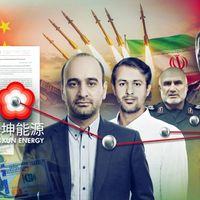
The move preceded the US sanctioning of nine Hong Kong-registered entities accused of helping Iran sell oil to China. OFAC said the firms acted as intermediaries for Sepehr Energy Co., linked to Iran’s military, and Chinese buyers.
Last week, Iran International reported that Sepehr Energy worked on behalf of the Iranian military and created a network of shell companies to sell sanctioned oil to Asia, including dealings with a Netherlands-based firm allegedly aware of its government ties.
Iran and the three European signatories to the 2015 nuclear deal held talks in Istanbul on the state of nuclear and sanctions-lifting negotiations, Iranian Deputy Foreign Minister Kazem Gharibabadi said on Friday.
Gharibabadi said he and fellow Deputy Foreign Minister Majid Takht-Ravanchi hosted the political directors of the UK, France, and Germany for discussions aimed at advancing diplomatic efforts.
“Iran and the E3 are determined to sustain and make best use of diplomacy,” Gharibabadi wrote on X. “We will meet again, as appropriate, to continue our dialogue.”
Iran will never give up uranium enrichment, a senior cleric in Qom said Friday, calling the technology a symbol of national self-reliance and scientific strength.
“Enrichment is a sign of self-sufficiency and scientific power,” said Mohammad Saeedi, the Friday prayer Imam of Qom. “Preserving it sends a clear message to the world that the Islamic Republic will never give up the Iranian people's rightful claim under foreign pressure.”
He said nuclear energy is a strategic necessity for Iran’s future, especially as global fossil fuel reserves decline. “Nuclear energy plays a key role in securing Iran’s long-term energy needs,” he said, adding that it also serves important purposes in medicine, agriculture, and biotechnology.
Tehran’s interim Friday prayer Imam said remarks by US President Donald Trump during his visit to Persian Gulf countries reflect Washington’s concern over Iran’s growing influence, calling the Islamic Republic the main obstacle to American and Israeli actions in the region.
“This gentleman who spoke in Arab countries knows what has happened in Iran in terms of building power,” said Mohammad-Hassan Aboutorabi-Fard. “This great power today stands as the main barrier to US aggression and crimes.”
He said Iran is seen by the US and Israel as a threat because it unites the Islamic world.
“While the US president claims to bring security to the region, Gaza is under total siege,” he said.
Trump, speaking in Saudi Arabia, accused Iran of fueling chaos across the Middle East and called it the region’s most destructive force.