• العربية
  • فارسی
Brand
  • Iran Insight
  • Politics
  • Economy
  • Analysis
  • Special Report
  • Opinion
  • Podcast
  • Iran Insight
  • Politics
  • Economy
  • Analysis
  • Special Report
  • Opinion
  • Podcast
  • Theme
  • Language
    • العربية
    • فارسی
  • Iran Insight
  • Politics
  • Economy
  • Analysis
  • Special Report
  • Opinion
  • Podcast
All rights reserved for Volant Media UK Limited
volant media logo

Rubio says Iran’s fate lies with Supreme Leader as nuclear talks reach critical stage

May 16, 2025, 06:57 GMT+1

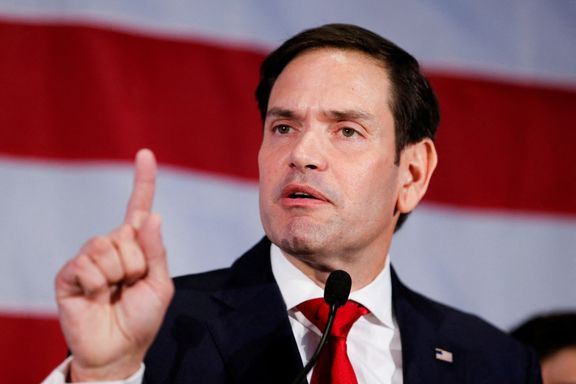
Secretary of State Marco Rubio said Thursday the United States has offered a limited window for diplomacy with Iran for a peaceful resolution on its nuclear program, but warned that the decision now rests with Iran’s Supreme Leader.

“In the end, the decision lies in the hands of one person, and that's the Supreme Leader in Iran, and I hope he chooses the path of peace and prosperity, not a destructive path, and we'll see how that plays out,” Rubio said in an interview from Turkey.

He emphasized the US distinction between the Iranian establishment and its people. “Our problem is not with the Iranian people. The Iranian people are peaceful people, an ancient civilization and culture we admire greatly. Our problem is with a clerical regime that is behind every problem in the region.”

Rubio blamed Tehran for backing regional instability. “Hezbollah, Hamas, the Houthis, the militias that have conducted attacks out of Iraq and Syria, they all track back to the Iranian regime. Syria, all the instability in Syria tracks back to the Iranian regime.”

“It’s a regime that every day and every Friday chants, you know, death to Israel, death to America. We have to believe them when they say that,” he added. “A regime like that can never have nuclear weapons.”

Rubio pointed to the latest report from the International Atomic Energy Agency, which showed Iran’s stockpile of 60% enriched uranium grew from 182 kilograms to 275 kilograms in early 2025.

“They are fairly close. Too close for comfort, to a nuclear weapon,” Rubio said in an interview from Turkey. “Once you're at 60, you're 90% of the way there. You are, in essence, a threshold nuclear weapons state, which is what Iran basically has become.”

US and Iranian officials have held four rounds of talks since President Donald Trump took office. Both sides have described the negotiations as “constructive” so far.


US Secretary of State Marco Rubio
100%
US Secretary of State Marco Rubio

Most Viewed

Iran International says it won’t be silenced after London arson attack
1

Iran International says it won’t be silenced after London arson attack

2
INSIGHT

Hardliners push Hormuz ‘red line’ as US blockade tests Iran’s leverage

3
VOICES FROM IRAN

Hope and anger in Iran as fragile ceasefire persists

4

US sanctions oil network tied to Iranian tycoon Shamkhani

5

Iran halts petrochemical exports to supply domestic market

Banner
Banner

Spotlight

  • Hardliners push Hormuz ‘red line’ as US blockade tests Iran’s leverage
    INSIGHT

    Hardliners push Hormuz ‘red line’ as US blockade tests Iran’s leverage

  • Ideology may be fading in Iran, but not in Kashmir's ‘Mini Iran'
    INSIGHT

    Ideology may be fading in Iran, but not in Kashmir's ‘Mini Iran'

  • War damage amounts to $3,000 per Iranian, with blockade set to add to losses
    INSIGHT

    War damage amounts to $3,000 per Iranian, with blockade set to add to losses

  • Why the $100 billion Hormuz toll revenue is a myth
    ANALYSIS

    Why the $100 billion Hormuz toll revenue is a myth

  • US blockade targets Iran oil boom amid regional disruption
    ANALYSIS

    US blockade targets Iran oil boom amid regional disruption

  • Iran's digital economy battered by prolonged blackout
    INSIGHT

    Iran's digital economy battered by prolonged blackout

•
•
•

More Stories

US says nuclear talks with Iran ‘constructive’, backs diplomacy

May 16, 2025, 06:53 GMT+1

The State Department said Thursday that nuclear talks between the United States and Iran have been “constructive,” and stressed that President Donald Trump remains committed to a diplomatic solution.

“The president has been clear that Iran can never have a nuclear weapon,” Deputy Spokesperson Tommy Pigott told reporters. “He wants diplomacy. He wants to see a diplomatic solution here.”

Pigott said he would not discuss private negotiations but repeated that the talks have been described as productive by those involved.

Asked about Trump’s recent comments in the Middle East suggesting a deal is near, Pigott said, “The talks have been constructive. We continue to engage in a way that supports our goal — preventing Iran from obtaining a nuclear weapon.”

IAEA inspections disproportionately scrutinized Iran, atomic chief says

May 15, 2025, 21:16 GMT+1

The head of Iran’s Atomic Energy Organization said on Thursday that more than 25% of all International Atomic Energy Agency (IAEA) inspections in 2024 were conducted in Iran, despite the country accounting for only about 3 percent of the global nuclear industry.

“All of the country’s nuclear activities have been carried out within the framework of cooperation with the International Atomic Energy Agency and are under the continuous supervision of this body,” state media quoted Mohammad Eslami as saying on the sidelines of the closing ceremony of the 31st National Nuclear Conference in Mashhad.

"Currently, IAEA inspectors regularly, both in announced and unannounced visits, inspect the country’s nuclear facilities," he added.

Eslami criticized what he described as double standards, unfair treatment, and negative media narratives targeting Iran. “This is a repetitive and worn-out issue that has never and will never prevent our progress,” he said.

Israel concerned over emerging US-Iran nuclear deal – Jerusalem Post

May 15, 2025, 20:08 GMT+1

There is concern in Israel over the emerging nuclear agreement between Iran and the United States, The Jerusalem Post reported, citing two Israeli officials who said the potential deal is seen as problematic for Israel.

According to the report, Israel maintains that Iran should not be allowed to enrich uranium under any circumstances, including for civilian purposes.

The newspaper cited two Western officials saying that while negotiations have made progress, it remains uncertain whether the talks will result in a final agreement.

Iranian soldiers stand guard inside the Natanz uranium enrichment facility, 322km (200 miles) south of Iran's capital Tehran March 9, 2006.
100%
Iranian soldiers stand guard inside the Natanz uranium enrichment facility, 322km (200 miles) south of Iran's capital Tehran March 9, 2006.

Iran demonstrates reverse engineered US drone missile on helicopter

May 15, 2025, 19:51 GMT+1

A social media account with apparent access to a sensitive Iranian military site posted a video on Thursday depicting missiles fixed to an Iranian military helicopter which it said were copied from those attached to US attack drones.

The aircraft was marked with the insignia of the Islamic Revolutionary Guard Corps.

Iranian military officials in recent days have cited Iran's prowess as a strong deterrent against any US military solution to the nuclear standoff with Iran which has been repeatedly mooted by US President Donald Trump.

Iran set for soaring inflation and near-zero growth, grim IMF outlook finds

May 15, 2025, 19:46 GMT+1
•
Dalga Khatinoglu

Iran is facing one of its bleakest economic outlooks in years, data published by the International Monetary Fund (IMF) suggests, with inflation surging, fiscal deficit growing and nominal economy shrinking—all indicators of potential long-term instability.

Iran’s real GDP is set to grow by just 0.3% in 2025, the IMF's Regional Economic Outlook for the Middle East and Central Asia published this month projected.

That’s a sharp fall in its October 2023 estimate for this year of 3%.

The revision appears to reflect the tightening of US sanctions under President Donald Trump, who has promised to slash Tehran’s oil revenues and restrict its access to international finance.

In April alone, the Trump administration imposed eight new packages of sanctions targeting tankers and trading networks that facilitate the sale of Iranian oil. Between January and April 2025, imports from China—Iran’s primary oil buyer—fell to 1.38 million barrels per day (bpd), about 7 percent below the 2024 average.

The IMF estimates both production and exports to fall by 300,000 bpd in 2025. Independent energy analytics firms such as Kpler, Vortexa, and TankerTrackers have predicted a steeper drop, as much as 500,000 bpd.

Surplus narrows, capital flees

Iran’s total exports, including non-oil goods and services, is projected to decline by 16% this year to $100 billion, according to the IMF. Imports are expected to fall 10% to $98 billion, leaving a slim trade surplus of just $2 billion, compared to $10 billion last year.

Despite running trade surpluses in recent years, capital flight remains alarmingly high.

Iran’s Central Bank estimates that $14 billion exited the country in the last nine months of 2024. That comes atop $20 billion the year before. Since 2018, when Trump introduced his so-called maximum pressure campaign against Tehran.

Currency falls, economy shrinks

Perhaps the most shocking of IMF figures is those of Iran’s nominal GDP—which reflects the size of an economy in global terms. Iran’s nominal GDP will fall from $401 billion in 2024 to $341 billion this year, according to the report.

The primary reason behind this dramatic fall is the collapse of Iran’s currency, Rial, which lost nearly half its value in 2024.

While real GDP appears relatively stable domestically as it adjusts for inflation and ignores currency devaluation, the dollar-denominated figures reveal a steep contraction.

In 2000, Iran’s economy was larger than those of the United Arab Emirates, Turkey and Saudi Arabia. Today, all three have surpassed Iran, with GDPs more than three times that of Iran in the case of the latter two.

Prices soar, pockets empty

Adjusting for ever-rising prices in Iran, the IMF has upped its inflation estimate for 2025: from 37% in its last report to just above 43% in the latest.

Iran now ranks fourth in the world in inflation, beaten by Venezuela, Sudan, and Zimbabwe only.

Several factors are fueling the surge: the rial’s collapse, restricted access to foreign reserves, excessive domestic borrowing, and rising import costs under sanctions.

What next?

Most troubling for Iran’s government could be the IMF's estimate that the country would need oil prices to reach $163 per barrel just to balance its 2025 budget. That is more than double the current global average.

In its latest budget, the administration of president Masoud Pezeshkian has assumed daily oil exports of 1.85 million bpd at $67 per barrel. But the IMF expects actual exports to average just 1.1 million bpd, indicating a substantial shortfall.

This is a familiar story. Successive administrations in Iran have run deficits amounting to roughly one-third of total public spending, plugging the gap with heavy borrowing and money printing—both of which have fueled inflation and monetary instability.

The IMF projects Iran’s gross government debt to rise to just under 40% of GDP in 2025, and a couple of points above it in 2026 — troubling figures for an economy already under severe external pressure.