Lack of documentation hampers search for missing Baluch workers - Paper
The absence of identification documents is leaving an unknown number of Baluch workers unaccounted for following the explosion at Rajaei port, with no active search underway for them, a field report in Payam-e Ma newspaper highlighted.
The newspaper's correspondent visited the Khoon Sorkh village near Rajaei port and spoke with residents in the port workers' neighborhood. Mohammad Abdollahi, a member of the village council, said that the majority of workers at Rajaei port are Baluch.
One resident, identified only as Mohammad, told the newspaper, "God knows how many of these workers were inside those warehouses or containers. One of the contractors told us 20 of his workers are missing, but he doesn't dare to say anything because they need to be able to work at the port again."
Esmail Hajizadeh, the executive secretary of the Hormozgan Province Workers' House, had previously said that the number of Baloch daily wage workers from Sistan-Baluchistan province who died remains unclear. According to him, some of these workers did not possess identification cards or did not have them on their person at the time of the incident.
A series of incidents unfolded in Alborz Province, west of Tehran, on Saturday evening, including two fires, reports of an explosion, and a magnitude 4.0 earthquake, according to official statements and eyewitness accounts.
One major blaze broke out at a cardboard manufacturing factory in the city of Nazarabad.
Stormy weather in the area caused the fire to spread to 12 nearby units, a local governor said, adding that efforts are underway to bring the blaze under control.
The cause of the fire is not yet known, and there have been no reports of casualties.
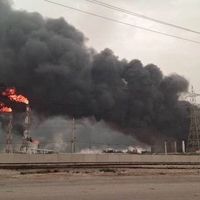
Around the same time, another fire was reported near the Montazer Ghaem power plant in the city of Fardis.
The state-run YJC news agency initially released a video that purportedly showed no fire at the facility.
However, Iranian officials later confirmed the report. Hossein Ashouri, head of the Fardis fire department, said the fire began around 8:41 p.m. in a portable cabin next to a waste platform near the power station.
Strong winds caused the flames to spread over approximately 2,000 square meters. Nine additional fire trucks were deployed, and the blaze was brought under control.
Preliminary findings suggest the fire was caused by negligence on the part of the person stationed in the cabin.
Reports of explosion
Iranian officials have denied any link between the fire and the power plant's operation. However, widespread power outages were reported in several areas of the province.
Residents across Alborz Province told Iran International they heard an explosion shortly before 9 p.m., moments before experiencing an earthquake.
Iran’s Seismological Center confirmed that the 4.0-magnitude quake struck at a depth of 8 kilometers near Mahdasht, on the border of Alborz and Tehran provinces.
A senior official at Shahid Rajaei port has dismissed media reports suggesting the presence of explosives or hazardous materials at the facility, calling the reports exaggerated and aimed at stirring public concern.
Behzad Faraji, deputy for operations and dangerous goods at the port, emphasized that the port adheres strictly to international maritime regulations for handling dangerous cargo, known as the IMDG Code.
“Dangerous goods are divided into nine categories under these guidelines,” Faraji said. “Explosives (Class 1) and radioactive materials (Class 7) are not stored in any port under these rules. I can say with certainty that there are no explosives at Shahid Rajaei Port.”
He added that the rumors being circulated are baseless and intended to create unnecessary public alarm.
US President Donald Trump dismissed national security adviser Michael Waltz after a series of clashes that included Waltz’s behind-the-scenes talks with Israel about striking Iran, the Washington Post reported on Saturday.
Two people familiar with the matter said Waltz held “intense coordination” with Israeli Prime Minister Benjamin Netanyahu on military options against Iran before Netanyahu’s early-February Oval Office meeting with Trump.
One of those people said, “It got back to Trump and the president wasn’t happy with it,” and added that Waltz “wanted to take US policy in a direction Trump wasn’t comfortable with because the US hadn’t attempted a diplomatic solution.”
The Israeli prime minister’s office on Saturday rejected the Washington Post report, saying, “Netanyahu had a cordial meeting with Mike Waltz and Steve Witkoff at Blair House in February before his meeting with President Trump at the White House.”
The statement adds that Waltz later joined VP JD Vance for another meeting with Netanyahu before departing Washington.
“Since then, the Prime Minister, the former national security adviser, and Steve Witkoff have had one phone call, which did not concern Iran.”
A top clerical official warned Saturday that casting doubt on decisions made in the name of national interest can weaken the Islamic Republic’s leadership and serve hostile agendas.
“Creating suspicion about expediency-based decisions weakens the leadership’s standing and is against the interests of the system,” said Ali Saeedi, head of the Ideological-Political Office of Iran's Supreme Leader Ali Khamenei.
He emphasized that throughout Islamic history, leaders—including the Prophet and Imams—made pragmatic choices to protect the broader mission of Islam.
Saeedi outlined a list of consequences for failing to grasp the logic behind such decisions, including weakening unity, spreading rumors, and empowering adversaries. He warned elites against misinterpreting the leadership’s judgments or politicizing sensitive decisions.
His remarks come amid an alignment among clerical and political figures who have recently pushed back against criticism of indirect Iran-US negotiations.
Former minister Mostafa Pourmohammadi said Saturday that dismissing the talks as desperate or imposed stems from poor historical understanding—adding that national survival must guide current strategy.
Iran’s escalating water crisis is not only draining its aquifers but also laying the groundwork for potentially devastating earthquakes, a leading geology expert warns.
Mehdi Zare says human responses to prolonged drought—particularly rampant groundwater extraction—are altering underground stresses and could trigger seismic activity in cities like Tehran, Isfahan, and Mashhad.
“Droughts can indirectly influence seismicity through human activities, particularly over-extraction of groundwater, which alters subsurface conditions,” Zare wrote on Rokna news Saturday.
These shifts may activate critically stressed faults, he added, especially in tectonically sensitive regions.
As aquifers are depleted, the earth’s crust begins to rebound, redistributing pressure and modifying fault dynamics. This process, compounded by reductions in pore pressure, brings fault lines closer to rupture.
In some areas of Tehran, groundwater levels are falling by up to two meters a year. Land subsidence has reached 31 centimeters annually in parts of southwest Tehran, according to government data released in March.
The 2017 Malard earthquake near Tehran, which measured magnitude 5.0, occurred near one such subsiding zone. Zare notes that similar patterns have been observed in California, India, and Spain, where changes in groundwater levels preceded swarms of small but revealing earthquakes.
Ali Beitollahi, head of earthquake engineering at Iran’s Ministry of Housing research center, warned of a destructive cycle. “Population grows, water becomes scarce, more dams and wells are built—and so we drill again,” he said.
He criticized the government’s approach, which focuses on securing more water rather than managing demand. “We are now hearing plans to drill deep wells in Tehran this summer,” Beitollahi said. “Our mismanagement is taking us to a dangerous place.”
Iran’s water reserves have fallen to critical levels, accelerating the risk of shortages and forcing officials to consider rationing months before peak summer demand.
Tehran's water supply is critically strained as key dams plummet to record lows, worsening a nationwide drought. Latian and Mamlou dams are at 12% capacity, Lar at 1%, and Karaj at 7%.
Nationwide rainfall is 82.9% of normal, and dam inflow is only 42%. Officials urge a 20% reduction in water use, as 19 provinces face water stress.
With 40 percent of Tehran’s aquifer already depleted and critical urban centers still expanding, experts say the time to act is rapidly closing. Without structural water governance reform and population redistribution, Iran risks turning drought into disaster—both above ground and below.