• العربية
  • فارسی
Brand
  • Iran Insight
  • Politics
  • Economy
  • Analysis
  • Special Report
  • Opinion
  • Podcast
  • Iran Insight
  • Politics
  • Economy
  • Analysis
  • Special Report
  • Opinion
  • Podcast
  • Theme
  • Language
    • العربية
    • فارسی
  • Iran Insight
  • Politics
  • Economy
  • Analysis
  • Special Report
  • Opinion
  • Podcast
All rights reserved for Volant Media UK Limited
volant media logo

Israel says it intercepted Iranian planes sent to aid Syria's Assad

Apr 28, 2025, 10:18 GMT+1
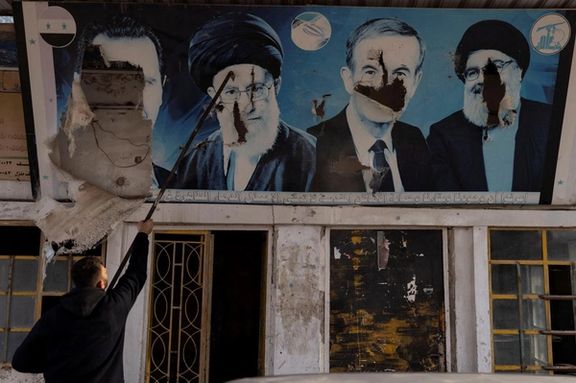
A worker tears down pictures of Syria's Bashar al-Assad and his allies in the region at a gas station in Nubl, Aleppo, Syria, on December 11, 2024.

Israeli Prime Minister Benjamin Netanyahu said on Sunday that the air force diverted Iranian aircraft carrying troops to help former Syrian president Bashar al-Assad amid the country’s revolution last year.

“They had to rescue Assad,” Netanyahu said, adding that Iran wanted to send “one or two airborne divisions” to help the Syrian leader.

“We stopped that. We sent some F-16s to some Iranian planes that were making some routes to Damascus,” he said. “They turned back.”

Netanyahu made the announcement on Sunday in a speech which revealed insights into the country’s role in the fall of the long-time ruler, who was overthrown by insurgents in December.

At a Jewish News Syndicate conference, he said that Tehran sought to bolster Assad's position, especially after Hezbollah, a major ally in Lebanon, sustained considerable losses during last year's conflict with Israel.

Targeted airstrikes decimated Hezbollah's leadership, killing scores of top figures, including its long-time head Hassan Nasrallah, and obliterating extensive infrastructure both above and below ground.

Most Viewed

Ghalibaf defends Iran-US talks amid hardline backlash
1
INSIGHT

Ghalibaf defends Iran-US talks amid hardline backlash

2
INSIGHT

Iran diplomacy wobbles as factions compete to avoid looking soft on US

3
VOICES FROM IRAN

Bread shortages, soaring prices strain households in Iran, residents say

4
ANALYSIS

The politics of pink: how Iran uses cuteness to rebrand violence

5

Scam messages seek crypto for ships’ safe passage through Hormuz, firm warns

Banner
Banner

Spotlight

  • Diplomacy tolls at Hormuz as conflict returns to its doorstep
    OPINION

    Diplomacy tolls at Hormuz as conflict returns to its doorstep

  • Opposition to US talks grows in Tehran as ceasefire deadline nears
    INSIGHT

    Opposition to US talks grows in Tehran as ceasefire deadline nears

  • Tehran moderates see ‘no deal–no war’ limbo as worst outcome
    INSIGHT

    Tehran moderates see ‘no deal–no war’ limbo as worst outcome

  • The future has been switched off here
    TEHRAN INSIDER

    The future has been switched off here

  • Lights out, then gunfire: Witnesses recount Mashhad protest crackdown
    VOICES FROM IRAN

    Lights out, then gunfire: Witnesses recount Mashhad protest crackdown

  • Is Iran entering its Gorbachev moment?
    INSIGHT

    Is Iran entering its Gorbachev moment?

•
•
•

More Stories

Iran says major cyberattack on infrastructure repelled

Apr 28, 2025, 08:20 GMT+1

Iran said it foiled a major cyberattack targeting its infrastructure on Sunday in the midst of blazing fires following the explosion which rocked its key container port in Bandar Abbas.

"One of the most widespread and complex cyber attacks against the country's infrastructure was identified and preventive measures were taken," IRGC-affiliated Tasnim News quoted Behzad Akbari, CEO of Iran’s Telecommunications Infrastructure Company and Deputy ICT Minister as saying on Monday.

Akbari did not provide further details on the origins of the hack.

Only in September, Iran's Cybersecurity Strategic Management Center announced a state of cyber-readiness, issuing a red alert for financial, monetary, and communication sectors, and an orange alert for other sectors, according to Iranian media reports.

"Organizations are advised to maintain round-the-clock availability of technical teams and rapid response units due to the potential for cyber attacks," it said.

In the past Iran has blamed Israel for cyber attacks. A cyberattack that 70% of Iran's petrol stations in December 2023 was claimed by Gonjeshk-e-Darande or Predatory Sparrow, a hacking group that Iran has previously accused of having links to Israel.

In October 2021, Iran experienced a cyberattack that disrupted its fuel distribution system, affecting approximately 4,300 gas stations. Gholamreza Jalali, head of Iran’s civil defense organization, attributed the attack to foreign actors, specifically accusing the United States and Israel.

The cyberattack came just one day after Tehran and Washington concluded a third round of nuclear talks on Saturday in Oman.

Meanwhile, emergency services were fighting the fallout of a deadly explosion in Iran’s Rajaei Port in Bandar Abbas, with authorities yet to disclose the cause.

Emergency support was sent from Tehran's allies in Moscow to fight the disaster which saw at least 40 killed and hundreds more injured, according to Iran's official figures.

However, one worker at the port contacted Iran International saying that at least 23 women were killed in their office alone.

Iran denies presence of military cargo at blast-hit port

Apr 27, 2025, 13:59 GMT+1

Iran's Ministry of Defense said on Sunday that no military-related cargo was present at the Shahid Rajaei Port in Bandar Abbas, where a deadly explosion occurred over the weekend.

Defense Ministry spokesperson Brigadier General Reza Talaei-Nik told state media, "There were no imported or exported shipments related to military use or rocket fuel at the site of the incident," dismissing foreign media reports as psychological operations.

“Investigations and evidence confirm that no imported or exported cargo for fuel or military applications was present within the fire-stricken area or Shahid Rajaei port. Certain foreign media outlets are engaging in targeted sensationalism aligned with enemy psychological operations,” he said.

The remarks come following reports that the massive blast -- which killed at least 28 people and injured more than 1,000 -- was linked to the storage of sodium perchlorate, a chemical used in the production of solid rocket fuel.

While the exact cause remains undetermined, a source close to Iran’s Islamic Revolutionary Guard Corps told the New York Times that sodium perchlorate -- a precursor chemical used to make ammonium perchlorate, an important component in solid rocket fuel -- was the likely cause of the explosion.

Investigations into the cause of the blast are ongoing, Iranian officials said, adding that the Ministry of Interior and disaster management authorities are leading the probe. Authorities pledged to publicly disclose findings once the investigation concludes.

Earlier this year, shipping data tracked by The Maritime Executive indicated that two vessels owned by the US-sanctioned Islamic Republic of Iran Shipping Lines (IRISL) — the MV Golbon and MV Jairan — transported sodium perchlorate from China to Bandar Abbas in February and March.

The chemical is later processed at facilities such as Parchin and Khojir in Iran’s solid-fueled ballistic missile programs.

It remains unclear whether the containers from the shipments were still stored at the Sina container terminal at the time of the blast or if they played a role in the explosion.

Blast reported at Iran's Bandar Abbas port, cause unclear – local media

Apr 26, 2025, 10:00 GMT+1

A loud explosion was heard at the Shahid Rajaee port in Iran’s southern city of Bandar Abbas on Saturday, local media reported.

Local media quoted the residents as saying the blast shook the ground and was heard in nearby towns.

Hormozgan province’s crisis management chief, Mehrdad Hassanzadeh, said the blast was caused by "the explosion of several stored containers in the port yard" and that "injured individuals are currently being evacuated from the site."

According to Tasnim news agency, the explosion occurred at an administrative building inside the port.

However, Tasnim later reported that a fuel tank had exploded for unknown reasons, prompting the deployment of rapid response teams and the suspension of all port operations.

The National Iranian Oil Refining and Distribution Company (NIORDC) said in a statement that "the explosion had no connection with the refineries, fuel storage tanks, or oil pipelines related to this company in the area," and that "operations at facilities in Bandar Abbas are continuing without interruption." It added that firefighting and emergency teams from nearby oil companies were on standby to assist port authorities.

There are conflicting accounts about the cause of the explosion, and no official confirmation has been issued.

There were no immediate reports of casualties, but Tasnim said the blast caused extensive damage.

This is a developing story.

Paraguay designates Iran’s Guards as terror group, US applauds

Apr 25, 2025, 11:01 GMT+1

Paraguay has formally designated Iran’s Islamic Revolutionary Guard Corps (IRGC) as a terrorist organization and expanded its classification of Hamas and Hezbollah to include all components of both groups.

The presidential decree issued Thursday cited the Guards’ systematic involvement in human rights violations and participation in terrorist activities on a global scale as justification for the blacklisting. The move was swiftly applauded by the United States as well as Israel.

The US State Department welcomed the decision, calling it “a critical blow to Iran’s terror network in the Western Hemisphere.”

“The important steps Paraguay has taken will help cut off the ability of the Iranian regime and its proxies to plot terrorist attacks and raise money for its malignant and destabilizing activity, including in the Tri-Border Area Paraguay shares with Argentina and Brazil," spokesperson Tammy Bruce said in reference to a region long suspected of financial activity linked to Hezbollah.

Paraguayan President Santiago Peña’s decree also broadens Paraguay’s 2019 designation of the military wings of Hezbollah and Hamas to include their political and social branches, citing their failure to separate military activity from political engagement.

“With these decisions, Paraguay reaffirms its unwavering commitment to peace, international security, and the strict respect for human rights,” Peña said in a statement. He called on the international community to act in a coordinated manner to dismantle terrorist networks.

Israel’s Foreign Minister Gideon Sa’ar praised the move, urging more nations to join in designating the IRGC. “Iran is the world's leading exporter of terrorism and extremism... more countries should follow suit,” he wrote on X.

The United States designated the IRGC as a foreign terrorist organization in 2019 under the Trump administration — the first time Washington had assigned such a label to part of another country’s official military.

Israel, Saudi Arabia, and Bahrain have similarly blacklisted the group. However, within Europe, only a few nations have taken such steps independently.

The European Parliament passed a non-binding resolution in early 2023 calling on the EU to designate the IRGC as a terrorist organization, citing its role in human rights abuses and external operations.

However, the European Union has so far declined to make the designation official, citing legal and diplomatic concerns. Canada listed it in 2014.

The move remains under discussion in the UK as critics of the move argue that an IRGC designation would sever communication between the two.

The IRGC, a powerful branch of Iran’s armed forces, oversees the Quds Force, which is responsible for overseas operations and is accused by Western governments of orchestrating attacks and funding proxy groups, including Hezbollah and Hamas. All three organizations have been widely sanctioned or designated as terrorist groups by the US, Canada, and several other nations.

The Paraguayan decree comes at a time of renewed nuclear negotiations between Iran and the United States. A third round of indirect talks is expected to take place this weekend in Oman, amid growing concerns over Tehran’s nuclear advancements.

“The United States will continue to work with partners such as Paraguay to confront global security threats,” Bruce said. “We call on all countries to hold the Iranian regime accountable and prevent its operatives, recruiters, financiers, and proxies from operating in their territories.”
Iranian envoy walks back criticism of Lebanese bid to disarm Hezbollah

Apr 24, 2025, 16:20 GMT+1

Iran's Ambassador to Beirut Mojtaba Amani visited Lebanon’s foreign ministry to walk back earlier comments which appeared to call the Mediterranean country's delicate efforts to disarm the Iran-back Hezbollah group a conspiracy.

Amani had initially declined an earlier summons but attended Thursday’s meeting following a backlash over a post last week in which he warned of a conspiracy threatening regional stability—widely seen as a reference to efforts to disarm Hezbollah.

Iran's embassy in Beirut said the post was general in nature and “applied to all countries without exception, including Iran,” and that the visit aimed to prevent “any misunderstanding or misinterpretation” between the two countries.

"Amani emphasized the need to prevent enemies from sowing discord between Iran and Lebanon, believing that vigilance and cooperation are the guarantees for warding off such attempts," the embassy said on its official X account.

The Lebanese foreign ministry confirmed the meeting and said senior official Hani Shmaytelli reminded Amani of “the need to adhere to diplomatic protocols … on the sovereignty of states and non-interference in their internal affairs.”

Last week Amani warned against what he called a disarmament conspiracy, saying on X: “We in the Islamic Republic of Iran understand the danger of this conspiracy and its threat to the security of the region’s peoples."

"We warn others against falling into the enemy's trap. Preserving deterrent capability is the first line of defense for sovereignty and independence and must not be compromised.”

In a televised interview earlier this week, Amani struck a more conciliatory tone, saying the issue of Hezbollah’s weapons was for the Lebanese government to decide. “We are committed to what the Lebanese agree upon,” he said.

Iran, the embassy quoted Amani as saying, maintains its "unwavering commitment to supporting the independence, sovereignty, stability and security of the Lebanese Republic."

The diplomatic exchange comes amid renewed pressure in Lebanon to disarm Hezbollah, which is designated a terrorist organization by the United States, United Kingdom, and European Union.

Lebanese President Joseph Aoun recently said the group should be brought under state control following losses in recent clashes with Israel. A US- and France-brokered ceasefire remains in place, though both sides have reported violations.