Lawmakers urge aggressive US crackdown on Iran’s military, financial allies
House Foreign Affairs Committee hearing titled “A Return to Maximum Pressure: Comprehensively Countering the Iranian Regime’s Malign Activities,” on April 1, 2025.
US lawmakers and expert witnesses called for a more aggressive US strategy to confront Iran's nuclear ambitions, proxy networks, and financial enablers at a House Foreign Affairs Committee hearing on Tuesday.
Rep. Michael Lawler, who chairs the Middle East and North Africa Subcommittee, opened the hearing titled “A Return to Maximum Pressure: Comprehensively Countering the Iranian Regime’s Malign Activities,” by contrasting the Trump administration’s “maximum pressure” approach with what he called a dangerously lenient stance under President Biden.
“Joe Biden’s foreign policy decisions in the Middle East were ill conceived, disorganized, and at times fatal, including for US service members,” Lawler said.
He charged that Biden “left the world more volatile and less safe than he found it,” accusing his administration of “appeasing terrorists and enabling an “unholy alliance” between Iran, Russia, and China, with policies resulting in higher revenue flows from oil sales and an accelerated nuclear program.
He called for a crackdown on Iran’s oil exports—especially to China—arguing that “a nuclear Iran is not an option.” Lawler warned that “one way or another, Iran’s nuclear ambitions are finished,” and praised the Trump administration for “restoring the much-needed and most effective maximum pressure campaign.”
Norman Roule, a former US intelligence official and current advisor at CSIS, laid out the scope of the threat.
“Iran now appears capable of producing its first quantity of 90% enriched uranium, sufficient for one nuclear weapon in about a week. Tehran's current stockpile of 60% enriched uranium is sufficient for about seven nuclear weapons,” he said.
Roule warned that Iran’s military allies such as Hezbollah in Lebanon remain dangerous despite recent setbacks. “The Islamic Revolutionary Guard Corps Quds Force aims to revive these groups,” he said, pointing to Iran’s attempts to reestablish influence in the Red Sea via Sudan as Iran's Houthi militia in Yemen continues its maritime blockade and attacks on US vessels.
“Iran looks like a country building a nuclear weapons program,” he said, although it “has yet to make the final steps required because it either fears discovery and the subsequent military consequences or believes its current approach offers diplomatic advantages.”
Claire Jungman of United Against Nuclear Iran focused on Iran’s financial backbone. “Despite US sanctions, Iran continues to export over 1.5 million barrels of oil per day, earning tens of billions of dollars annually,” she said.
“These revenues are not just supporting Iran's economy, they are directly funding terrorism, nuclear escalation and regional destabilization.”
She emphasized the central role of the IRGC, adding, “Up to half of Iran's oil exports are now controlled by the Islamic Revolutionary Guard Corps.
“Every barrel of Iranian oil sold on the black market strengthens the IRGC’s hand bankrolling groups like Hamas, Hezbollah and the Houthis.”
Jungman called for a sweeping enforcement campaign. “Sanction every vessel, registry, insurer, captain and port that helps move Iranian oil,” she urged.
“Cutting off the money is our best tool to constrain Iran's most dangerous activities.”
Dana Stroul, Director of research at the Washington Institute, argued the time is ripe for decisive action. “The Iranian regime is on its back foot,” she said. “The pillars of its security strategy… are more vulnerable today than at any time in the history of the regime.”
She urged combining diplomacy with a credible military threat. “The administration must keep its military options open by maintaining a robust US military posture in the region,” she said.
“Real opportunities exist to block Iran from pursuing a nuclear weapons capability… but the United States must lean into diplomacy as well.”
Witnesses and lawmakers alike agreed that Iran is under pressure, but without sustained enforcement, the opportunity to constrain its ambitions may be lost.
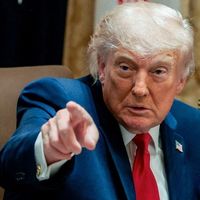
"If they don't make a deal, there will be bombing — and it will be bombing the likes of which they have never seen before," Trump was quoted as saying during a phone interview with NBC News' Kristen Welker.
Trump on Friday also warned that “bad, bad things” would happen if Tehran did not agree to a nuclear deal.
Last month, Trump signed a directive restoring the so-called maximum pressure policy on Iran of his first term and warned of "catastrophic" consequences if Tehran does not make a deal on its nuclear program.
Trump's maximum pressure approach in his first term beginning in 2018 pummeled Iran's economy, causing a dramatic decline in oil exports and skyrocketing inflation.
A drone is seen during a military exercise in an undisclosed location in Iran, handout image obtained on October 4, 2023
The United States on Tuesday imposed sanctions on six firms and two individuals in Iran, China and the United Arab Emirates accused of supplying drone components to Iran’s Quds Aviation Industries and its military partners.
The move marks part of a stepped-up enforcement effort under a recent presidential directive ordering a “maximum pressure” campaign of sanctions on Tehran.
“Iran’s proliferation of UAVs and missiles—both to its terrorist proxies in the region and to Russia for its use against Ukraine—continues to threaten civilians, US personnel, and our allies and partners,” Treasury Secretary Scott Bessent said.
“Treasury will continue to disrupt Iran’s military-industrial complex and its proliferation of UAVs, missiles, and conventional weapons that often end up in the hands of destabilizing actors, including terrorist proxies,” he added in a statement.
“The United States will use all available means to expose and disrupt Iran’s growing UAV and missile development programs and weapons proliferation,” the State Department said in support of the sanctions. “We will continue to act against the complex schemes Iran uses in third countries to conceal its acquisition and its transfers of sensitive technology.”
"We will continue to act against the complex schemes Iran uses in third countries to conceal its acquisition and its transfers of sensitive technology. Iran uses this technology and the proceeds from arms sales to bolster its military industrial base to build missiles and UAVs, which are used against fellow countries, as well as exported to Russia, terrorist proxy groups around the Middle East, and to other actors of concern," added Tammy Bruce, the State Department Spokesperson.
The designated entities include Rah Roshd, an Iran-based supplier linked to the Mohajer-6 drone, and Chinese manufacturer Zibo Shenbo, which allegedly shipped tens of thousands of motors to Iran. UAE firms, including Infracom and Diamond Castle, were named as intermediaries.
The sanctions freeze US-based assets and bar transactions with US persons. Concurrently, the Justice Department charged two Iranians with conspiring to smuggle US technology to the Islamic Revolutionary Guard Corps, the Iranian transnational paramilitary group the US classifies as a foreign terrorist organization.
Western powers accuse Iran of providing drones and missiles to Russia for its full-scale invasion of Ukraine.
Iranian drones have repeatedly been deployed in attacks on Ukraine’s infrastructure and other civilian targets. The Shahed 136 drone is typically launched alongside cruise and ballistic missile attacks to overwhelm Ukrainian air defenses.
Iran launches a biological capsule through a "Salman" Rocket at an undisclosed location in Iran, in this picture obtained on December 6, 2023.
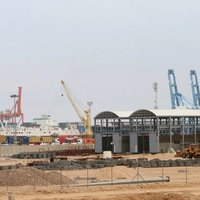
Iran has started the second phase of construction at its Chabahar space launch facility, which will be dedicated to launching heavier semi-heavy liquid-fueled rockets, the Iranian Space Agency announced on Tuesday.
Speaking to the Revolutionary Guards (IRGC) affiliated Tasnim, the head of the country’s space agency said that the first phase of the space launch site, focused on solid-fuel rockets, is expected to become operational this year.
Hassan Salarieh said the second phase, now underway with the groundbreaking, follows extensive studies and the preparation of necessary contracts.
He emphasized the strategic importance of the Chabahar facility, located in southeastern Iran, noting its potential to become Iran's "space gateway" for accessing international markets due to its geographical advantages for launching satellites into various orbits, including sun-synchronous and geostationary orbits.
Chabahar’s proximity to open waters and the equator offers benefits in terms of launch efficiency and fuel consumption.
The development of the Chabahar Space Center is a key component of Iran's ten-year space program.
While Iran asserts its space program is for scientific advancement, it acknowledges the dual-use nature of its technologies, which have raised concerns in Western countries, particularly the United States, due to their potential link to the development of long-range ballistic missiles.
Despite international scrutiny and technical challenges, Iran says it has been steadily advancing its space capabilities, with the Chabahar facility poised to become its primary launch site, surpassing existing centers like the Imam Khomeini Space Center in Semnan province.
President Masoud Pezeshkian recently stated that Iran's space and missile technologies serve a deterrent purpose, while Defense Minister General Aziz Nasirzadeh has linked the ballistic missile program to the country's satellite launch efforts, highlighting plans to potentially offer launch services to friendly nations.
An illustration shows the flags of China, Iran and Russia
Russia has warned against strikes on Iran's nuclear infrastructure as China called for diplomatic efforts after US President Donald Trump threatened to bomb the country if Tehran did not come to an agreement over its nuclear program.
"Threats are indeed being heard, ultimatums are also being heard," Russian Deputy Foreign Minister Sergei Ryabkov told the Russian journal International Affairs in an interview on Tuesday.
"We consider such methods inappropriate, we condemn them, we consider them a way for (the United States) to impose its own will on the Iranian side," he added.
Trump on Sunday warned that Iran could face bombing and secondary tariffs if a nuclear deal was not reached with Washington.
Ryabkov warned that a US strike on Iran, particularly targeting its nuclear infrastructure, could have catastrophic consequences for the entire region.
"There is still time, and the 'train has not left the station' yet. We must intensify efforts to reach a reasonable agreement," Ryabkov said. "Russia is ready to offer its services to Washington, Tehran and all parties interested in resolving this issue."
Kremlin spokesman Dmitry Peskov also said last month that Russian President Vladimir Putin had agreed to mediate nuclear talks between Washington and Tehran.
China also expressed concerns on Tuesday, with Ministry of Foreign Affairs spokesperson Guo Jiakun saying that the Iranian nuclear issue should be resolved through diplomatic means.
"China maintains that resolving the Iranian nuclear issue through political and diplomatic means is the only right option and that new consensus needs to be reached," Jiakun said in response to a reporter's question about Trump's threats against Iran during a press briefing.
"The US needs to show political sincerity and resume talks as soon as possible. Slapping sanctions, pressuring, and threatening with the use of force will lead nowhere,” he added.
Earlier in March, an Emirati official brought a letter from Trump proposing nuclear talks with Tehran, which the Islamic Republic's Supreme Leader Ali Khamenei rejected, saying such a proposal was deception from Washington amid crippling sanctions on Iran.
Iran officially responded to a letter last Wednesday seeking a nuclear deal. While Iran has rejected direct negotiations with the United States, Iran's President Masoud Pezeshkian said indirect talks can continue, adding that Ali Khamenei's response to Trump’s letter was delivered to the US contact in Oman.
Iranian biochemist Ghazaleh Madani has been nominated for the German Start-up Award as 'newcomer of the year' for her work with cancer research.
Madani, 29, is one of three finalists for the category, as announced by the German Start-up Association, and from over 400 applications, a 27-member jury nominated 24 individuals including the young Iranian.
According to a report by German newspaper Tagesspiegel, Madani completed her medical studies at the Isfahan University of Medical Sciences before leaving Iran in 2020 Iran due to the political situation in the country without providing further details.
She studied biochemistry and molecular biology at the University of Potsdam and received her master's degree in 2023.
Tagesspiegel's report quoted Madani as saying that she dedicated herself to cancer research because she herself had lost several family members to the disease.
Her start-up, CanChip, specializes in developing 3D tumor models for cancer research.
Award finalists represent a wide range of industries, including medical technology, AI, sustainability, and engineering. The awards ceremony is scheduled to take place next month on May 22.
A screengrab obtained from a handout video released by CENTCOM on March 15, 2025 by US Central Command
The White House said on Monday that a top Houthi missile expert was killed in US strikes, as President Donald Trump warned that that military action against the Iran-backed Houthi rebels in Yemen would continue until the group no longer threatens maritime security.
"The choice for the Houthis is clear: Stop shooting at US ships, and we will stop shooting at you. Otherwise, we have only just begun, and the real pain is yet to come, for both the Houthis and their sponsors in Iran," Trump said in a Truth Social post.
Following Trump’s remarks, the United States Central Command (CENTCOM) confirmed ongoing attacks on Houthi positions in Yemen on Tuesday, releasing video footage of the strikes.
The White House said that recent US strikes in Yemen have resulted in the death of a top Houthi missile expert. However, the US military has not confirmed the death, and the identity of the Houthi commander remains unclear.
National Security Advisor Mike Waltz, in comments to CBS News after the March 15 strikes, said that the first wave of attacks killed “their head missileer.”
Reuters reported that unnamed US officials said they were unaware of any independent confirmation from the US military regarding the death of the individual in question.
While on March 15, CENTOM said in a press release that its forces initiated an operation consisting of precision strikes against Iran-backed Houthi targets across Yemen, it did not provide further details on the targets.
Trump also referred to the death of Houthi leaders in his post on Truth Social, saying "The Iran-backed Houthi Terrorists have been decimated by the relentless strikes over the past two weeks. Many of their fighters and leaders are no longer with us."
US Air Force Lieutenant General Alexus Grynkewich did not mention a missileer in his comments about US strikes on Houthi positions on March 17 but confirmed that an aerial drone facility was targeted, along with several key leaders, the Reuters report added.
The strikes, the largest US military operation in the Middle East since Trump took office, aim to pressure the Iran-backed Houthis to end their attacks on shipping in the Red Sea, including US warships.
The group has carried out over 100 attacks on shipping since late 2023, citing solidarity with Palestinians in Gaza. What began as a campaign against Israeli-backed ships has led to a total blockade on global shipping with multiple international seamen killed in attacks.