Iran’s trade with East Asia crumbles under weight of sanctions
An Iranian tanker in the Persian Gulf - File photo
Iran’s commercial ties with East Asia have withered under the sustained pressure of US-led sanctions, pushing once-robust relations with countries like Japan and South Korea into near dormancy, according to a former senior Iranian diplomat.
Economic ties with Japan have collapsed despite the absence of political disputes, said Ali Majedi, Iran’s former ambassador to Germany, Japan, and Brazil.
“Europe still does some business with us,” Majedi said, but “But East Asia, outside of China, doesn’t work with us at all anymore.”
The former official said sanctions had affected trade not just with the West, but with Asian economies such as Japan, South Korea, and India, where commercial relations have reached a minimum.
“When I was in Tokyo in 2004, Japan was importing 750,000 barrels of oil per day and trade between us exceeded $10 billion,” Majedi added. “Now, even for items not under sanctions, trade is practically nonexistent.”
While China remains Iran’s last major oil customer in the region, Majedi said other East Asian nations have largely fallen in line with US restrictions. He added that smaller countries in the region still depend on American security guarantees and avoid Iranian trade out of fear of secondary sanctions.
Findings by Iran International show that while Iran’s oil sales to China dropped sharply last month, the decline in export revenues began months earlier, coinciding with US sanctions on dozens of tankers carrying Iranian crude.
The Biden administration imposed sanctions on dozens of tankers carrying Iranian oil after Iran’s missile attack on Israel in early October last year. While this initially led to a relative decline in Iranian oil offloading at Chinese ports, Beijing fearing potential US sanctions under Donald Trump's administration, prohibited sanctioned oil tankers from entering Shandong port.
Iran’s only oil customers are small, independent Chinese refineries, known as "teapots," most of which are based in Shandong, where 90% of Iranian oil cargoes is discharged.
Data from Kpler shows that Iran’s oil deliveries to China fell below 850,000 barrels per day in January, compared to over 1.8 million barrels per day in October last year.
An Iranian tanker in the Persian Gulf - File photo
Iran’s oil minister, Mohsen Paknejad, has denied that new sanctions and enforcement efforts by the Trump administration against Iran’s energy exports have had a significant impact.
“Right now, we are still exporting oil. There has been no disruption in our shipment routes,” Paknejad told Iranian state media.
Asked about Washington’s efforts to bring Iran’s oil exports to zero, Paknejad said such statements remain unproven. “All of this is being said for now. What is happening in practice is that we are exporting,” he said.
Asked if Iran is ready to deal with tougher sanctions enforcement by the US, Paknejad said, “Naturally, if any restrictions are imposed on Iran's oil sales, we have taken the necessary measures to respond.”
Paknejad also denied any decline in oil sales, saying Iran set a record for crude exports in the Iranian month of Dey (Dec21–Jan. 20).
Earlier this month, the US Treasury imposed sanctions on Paknejad, breaking with its usual practice of sparing senior political officials. The move was part of a broader effort to tighten enforcement on Iranian oil exports, which Washington says help fund Tehran’s military and security forces, including the Islamic Revolutionary Guard Corps (IRGC).
Paknejad’s comments on Saturday also follow a report earlier this week from Iraq’s Oil Minister Hayan Abdel-Ghani, who said that Iranian tankers intercepted by US forces in the Gulf were found to be using forged Iraqi documents.
"We received verbal inquiries about oil tankers detained by US naval forces. It turned out these tankers were Iranian and were using fake Iraqi manifests," Abdel-Ghani said on Iraqi state TV.
Iran denied the claim, saying its oil exports are conducted “within accepted trade frameworks,” and reaffirmed its position in a call between Paknejad and his Iraqi counterpart on Friday.
The dispute comes amid a broader US effort to crack down on alleged fuel smuggling and sanctions evasion by Iranian-linked networks. In December, Reuters reported that a smuggling network using forged documents was generating at least $1 billion annually for Iran and its allies in Iraq.
Members of Lebanon's Hezbollah hold flags during a rally commemorating the annual Hezbollah Martyrs' Day in Beirut's southern suburbs, Lebanon November 11, 2022.
The US Treasury Department on Friday sanctioned five individuals and three companies accused of helping fund Hezbollah through a Lebanon-based sanctions evasion network allegedly backed by Iran’s Revolutionary Guards’ elite Quds Force.
“These evasion networks strengthen Iran and its proxy Hezbollah and undermine the courageous efforts of the Lebanese people to build a Lebanon for all its citizens,” said Bradley T. Smith, Acting under secretary for terrorism and financial intelligence in a statement.
The individuals and companies designated are part of a network of revenue-generating commercial enterprises owned or controlled by Hezbollah that facilitate and mask oil sales for the IRGC's Quds Force while also providing Hezbollah with crucial access to the formal financial system, according to the Treasury.
The network, it said, was overseen by senior Hezbollah finance officials including Muhammad Qasir until his death in late 2024 and his son-in-law Muhammad Qasim al-Bazzal.
The Treasury said the network used front companies to disguise oil sales and other business activity that generated millions of dollars for Hezbollah.
It added that US Department of State’s Rewards for Justice program is also offering up to $10 million for information that leads to the disruption of Hezbollah’s financial networks.
The US sanctions come on the same day Israel launched a major airstrike on southern Beirut for the first time since a November ceasefire in what it says was a response to a rocket attack from Lebanon.
The strike hit a building in Beirut’s southern suburbs in the Dahiyeh area which Israel said was used to store drones by the Iran-backed Shi’ite militant group.
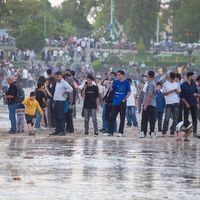
People walking in Iran's historic Naqsh-e Jahan square, Isfahan, Iran, March 25, 2025
A senior adviser to Iran’s Supreme Leader urges the government to cede more economic control to the people, arguing that this is necessary to address sanctions, soaring inflation, and a rapidly depreciating currency.
By some estimates, 80% of Iran’s economy is controlled directly and indirectly by the state or affiliated religious foundations operating under Ali Khamenei’s orders.
Ali Larijani, a senior adviser to Khamenei, told the Eco Iran website that “what Iran’s economy needs is security, and that does not mean control by security institutions,” a clear jab at the influence of the IRGC and other forces.
Criticizing the involvement of security organizations in the economy, Larijani, a former parliamentary speaker, said Iran’s economy should be controlled by the people rather than the government. He also called for administrative reforms, global engagement, and resolving Iran’s nuclear issue through dialogue.
Larijani emphasized that "the government controls some 85 percent of Iran's industries and mines," but argued that it lacks the efficiency to manage these sectors effectively.
He also stressed the need for the government to ensure security for the private sector by passing relevant laws and persuading the Supreme Leader to support the move.
Speaking on Iran's foreign policy and negotiations with the United States, Larijani stated, "If the Americans had acted wisely, they could have changed the course of Washington's relationship with Tehran." He argued that US sanctions have hindered Iran’s economic development, emphasizing that economic prosperity is unattainable under such restrictions.
Washington imposed oil export and international banking sanctions on Iran after President Donald Trump withdrew from the JCPOA nuclear deal in 2018. Iran’s already struggling economy, burdened by inefficiencies, immediately sank into a prolonged recession, while its currency depreciated 25-fold.
Regarding the future of nuclear negotiations, Larijani stated, "Everything depends on US behavior. There is a gap between what the United States declares and what it actually does." He also emphasized that Iran should pursue its national interests in both the East and the West.
Meanwhile, in an interview with a Tehran-based website, Iranian economist Ali Ghanbari, addressing the current financial crisis, noted that some Iranian politicians appear to overlook the fundamental principle that every country must prioritize its own national interests.
Ghanbari stated, "Realistically speaking, it is unlikely that the country's economic situation—regarding inflation, poverty, and unemployment—will improve significantly compared to last year, as Iran's economy remains constrained by structural issues in foreign policy that are beyond the government's control."
The economist added, "We cannot expect any improvement in the country's economic situation as long as sanctions pressure continues." He noted that this is in addition to the broader issue of insufficient domestic and foreign investment in Iran.
Ghanbari stressed that the defining characteristic of Iran's economic policy is "confusion," a problem that has become even more evident following the impeachment and dismissal of the former Minister of Economy.
As a way forward, Ghanbari suggested that Iran should abandon the idea of indirect talks and engage in direct negotiations with the United States, arguing that intermediaries only complicate the process.
He also urged the government to prioritize its employees to safeguard its social capital. At the same time, he emphasized that if Iran is serious about easing tensions and sanctions in the coming year, it must carefully select its strategic partners, a veiled reference to Tehran’s preference for close ties with China and Russia.
While both Larijani and Ghanbari emphasized the need to address foreign policy challenges to resolve Iran’s economic woes, analyst Hamid Aboutalebi suggested that a new path for dialogue with the United States may have emerged. Writing on the conservative Nameh News website in Tehran, he pointed to recent conciliatory remarks by Trump’s Middle East adviser, Steve Witkoff, as a potential opening.
Aboutalebi further argued that the Iranian government should move away from propaganda campaigns against Washington and pursue direct negotiations to de-escalate tensions.
International sanctions are costing each Iranian citizen an estimated 530 million rials or about $500 annually in the non-oil trade sector alone, a former central bank governor has said.
Mohammad Hossein Adeli, the former head of the Central Bank of Iran under President Akbar Hashemi Rafsanjani, told the Khabar Online website that sanctions force Iranian traders to pay a premium of 10% to 20% above market prices for goods destined for Iran.
Economic hardships for Iranians have mounted as US-led sanctions and official mismanagement have sent costs of living soaring and the currency to historic lows.
The need to use covert routes to bypass sanctions necessitates multiple layers of documentation to conceal the final destination of goods, he added.
Establishing shell companies in third countries to aid in obscuring the destination further inflates the final price of imported goods.
Estimating the sanctions-evasion processes add almost a third to the original price of each product, Adeli referred to Iran's foreign trade volume of approximately $150 billion in the Iranian year 1402 (March 2023-March 2024).
"Thirty percent of this amount is $50 billion. This figure... is equivalent to the government's annual budget."
The figure totals 530 million rials per Iranian citizen annually, meaning a family of four effectively bears an additional monthly expense of 180 million rials (about $180) due to the sanctions' impact on non-oil trade.
While Iranian authorities estimate a family of three requires about $400 monthly for basic needs, the average worker earns approximately $120 per month.
Adeli's assessment focuses solely on the non-oil trade sector. Oil exports, which make up the bulk of government revenue, are also heavily sanctioned.
In a report late last year, Iran International estimated that sanctions-evasion tactics and the use of trustee companies cost Iran at least $13.5 billion in oil export revenue during the Iranian year 1403 (March 2024-March 2025).
In February, US President Donald Trump signed a directive to reinstate the so-called maximum pressure policy against Iran, aimed at bringing Iranian oil exports to zero. He emphasized that the Islamic Republic should no longer be able to sell oil to other countries.
The Liberian-flagged oil tanker Ice Energy transfers crude oil from the Iranian-flagged oil tanker Lana (former Pegas), off the shore of Karystos, on the Island of Evia, Greece, May 26, 2022.
The US Justice Department has filed a civil forfeiture complaint seeking to seize $47 million in proceeds from the sale of nearly one million barrels of Iranian oil, alleging the funds benefited the IRGC and its Qods Force, both designated as terrorist organizations.
The complaint, filed in the US District Court for the District of Columbia, outlines an alleged scheme between 2022 and 2024 to illicitly ship, store, and sell Iranian oil for the benefit of the Islamic Revolutionary Guard Corps (IRGC) and the IRGC-QF.
According to the Justice Department, facilitators used deceptive tactics to conceal the oil's Iranian origin, falsely labeling it as Malaysian.
The alleged scheme involved manipulating the tanker's Automatic Identification System (AIS) to conceal that the oil was loaded from an Iranian port.
Additionally, the facilitators are accused of presenting falsified documents to a storage and port facility in Croatia, claiming the oil was of Malaysian origin.
Storage fees in Croatia were reportedly paid in US dollars through US financial institutions, transactions that authorities believe would have been rejected had the institutions been aware of the oil's Iranian connection.
The petroleum product was ultimately sold in 2024, leading to the seizure of the $47 million in proceeds that are now subject to the forfeiture complaint.
The Justice Department further contends that the petroleum is the property of the National Iranian Oil Company (NIOC), which it accuses of perpetuating a federal crime of terrorism by providing material support to the IRGC and IRGC-QF.
The complaint alleges that profits generated from such sales support the IRGC's "full range of malign activities," including the proliferation of weapons of mass destruction and their delivery systems, support for terrorism, and human rights abuses both within Iran and internationally.
The Justice Department noted that funds successfully forfeited that are linked to a state sponsor of terrorism may be directed, in whole or in part, to the US Victims of State Sponsored Terrorism Fund.
The case is being investigated by the FBI's Minneapolis Field Office and Homeland Security Investigations in New York, with Assistant US Attorneys and a Trial Attorney from the National Security Division handling the litigation.
The Justice Department emphasized that a civil forfeiture complaint is merely an allegation, and the government bears the burden of proving forfeitability in the civil forfeiture proceeding.
In February, US President Donald Trump's signed a directive restoring the so-called maximum pressure policy on Iran of his first term aimed at driving the Islamic Republic's oil exports to zero.
Oil is critical for Iran's economy, accounting for around 15% of Iran's GDP and at least half of the government's budget, employing around a third of the country's 25 million workers.
Under the Biden administration, Iran's oil revenues surged due to weak sanctions enforcement. Trump has vowed to reverse it and bring the oil exports to zero, if Iran refuses to curtail its nuclear program.