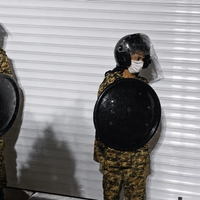
Revolutionary Guards flex muscles with naval parades in three seas
IRGC naval parade in Bandar Abbas on March 27, 2025.
Naval forces under Iran's Revolutionary Guards put on a show of force on Thursday with simultaneous rallies in the seas astride the country and a top commander warned against any attack as tensions with Washington flare.
“In the waters of the Persian Gulf, the Sea of Oman and the (Caspian Sea), we have established security and strength, and we will prevent any enemy adventurism,” Islamic Revolutionary Guard Corps (IRGC) naval commander Alireza Tangsiri said at a rally in the southern port city of Bandar Abbas.
Tangsiri said that IRGC naval units and their regional allies had turned regional waterways into a “theater for defeating the enemies", the IRGC-affiliated Tasnim website quoted him as saying, in a possible reference to Iran's Houthi allies in Yemen who have imposed a maritime blockade in the Red Sea.
The exercises featured over 3,000 vessels, according to the IRGC, which said the parade was timed ahead of International Quds Day, an annual event promoted by Iran to express support for Palestinians.
Organizers said boats operated by the IRGC and civilian volunteers paraded in 13 locations spanning the Persian Gulf, the Makran coast and the Caspian Sea.
At one of the southern sites, pro-government demonstrators burned representations of the Israeli flag.
The exercise comes as the US military has deployed long range bombers at a strategic Indian Ocean airbase, a spokesperson told Iran International, as Washington ramps up rhetoric against Iran and continues a bombing campaign on Houthi fighters in Yemen amid the Iran-backed group's blockade of commercial shipping in the Red Sea region.
US President Donald Trump has demanded Tehran come to a deal over its nuclear program or face a military intervention and warned any attack by the Houthis would be treated as emanating from Iran, after the group, listed as a foreign terrorist organization by the US, launched multiple attacks on US warships.
Top Iranian leaders have rejected the ultimatum and deny seeking nuclear arms.
President Trump reportedly issued a two-month deadline to Iran, via the United Arab Emirates, to agree to a new nuclear arrangement, vowing military consequences should Tehran fail to comply.
Iran and the IRGC have been connected to multiple tanker hijackings and attacks in areas including the Strait of Hormuz and Gulf of Oman.
Just last year, amid the Houthi blockade, Iran seized a tanker with Iraqi crude destined for Turkey in retaliation for the confiscation in 2023 of the same vessel and its oil by the US, according to Iranian state media.
US immigration agents have detained an Iranian doctoral student at the University of Alabama amid renewed scrutiny of the Trump administration’s widening crackdown on international students.
University officials confirmed that Alireza Doroudi, a PhD student in mechanical engineering, was arrested off-campus by US Immigration and Customs Enforcement (ICE). The reason for Doroudi’s detention has not been made public.
Doroudi, an Iranian citizen, was in the US on a student visa and specialized in metallurgical engineering, according to public records.
In a statement, the University of Alabama College Democrats described the arrest as a “cold, vicious dagger through the heart of UA’s international community,” and said ICE had yet to provide any justification. “Our fears have come to pass,” the group added.
Doroudi’s detention also comes as the Trump administration considers new travel restrictions that could fully suspend visa issuance for citizens of countries including Iran. If implemented, the policy would block legal entry for Iranian nationals and further tighten immigration rules.
In February, several Iranians deported by US authorities were sent to detention centers in Panama, where they reported harsh conditions and limited access to food, medicine, and legal aid. Advocacy groups have warned that deported Iranians, including religious minorities, face risk of persecution.
The arrest follows detentions at other US universities. This week, a Turkish doctoral student at Tufts University was taken into ICE custody after being accused by the Department of Homeland Security of supporting Hamas.
Earlier this month, Mahmoud Khalil, a recent Columbia University graduate and organizer of pro-Palestinian campus protests, was arrested by immigration officers in New York. Khalil is a US permanent resident.
A B-2 Stealth Bomber performs a flyover at the 126th Rose Parade in Pasadena, California January 1, 2015
The US military has deployed long range bombers at a strategic Indian Ocean airbase, a spokesperson told Iran International, as Washington ramps up rhetoric against Iran and continues a bombing campaign on Houthi fighters in Yemen.
"B-2 Spirit bombers have arrived at Naval Support Facility Diego Garcia," a US Strategic Command spokesperson said, referring to the strategic British territory.
The military grouping and its units "routinely conduct global operations ... to deter, detect and, if necessary, defeat strategic attacks against the United States and its allies," the spokesperson added, saying it does not comment on specific actions.
US President Donald Trump has demanded Tehran come to a deal over its nuclear program or face a military intervention and warned any attack by the Houthis would be treated as emanating from Iran.
A joint UK-US military base at Diego Garcia has previously been used to launch US strikes on the Middle East including Iraq and Afghanistan, with the deployment suggesting the potential for large-scale air operations in the region.
The US military deployed the B-2 stealth bombers along with C-17 cargo planes and 10 aerial refueling tankers in the last two days, defense industry outlet The War Zone reported on Wednesday citing satellite imagery.
Flight tracking data and satellite imagery analyzed by open-source intelligence analysts suggest the arrival or transit of at least five B-2 Spirit stealth bombers, capable of carrying the Massive Ordnance Penetrator (MOP) – a 30,000-pound bunker-buster bomb and the 20,000-pound Massive Ordnance Air Blast (MOAB) or "Mother of All Bombs."
C-17 cargo planes are capable of transporting personnel, equipment and munitions while the refueling tankers enable sustained long-range air operations.
In October, the United States used B-2 stealth bombers for strikes on Houthi underground weapons facilities in Yemen for the first time.
President Trump reportedly issued a two-month deadline to Iran, via the United Arab Emirates, to agree to a new nuclear arrangement, vowing military consequences should Tehran fail to comply.
The report of the deployment came hours after Iran unveiled what it termed a new missile city, run by the Islamic Revolutionary Guard Corps (IRGC).
Iranian state media reported the display of various domestically produced missiles, including long-range ballistic types, with Chief of Staff of the Armed Forces Mohammad Bagheri vowing enhanced missile capabilities in the future.
Iranian soldiers on the country's border with Afghanistan
Tehran seeks to erect walls all around Iran, a senior armed forces official said, as part of a sweeping effort to tighten the country’s border security.
“For a long time, the Supreme Leader and all officials have sought to seal the country’s borders, while maintaining designated crossings for legal trade and travel,” the head of Iran’s military judiciary Ahmadreza Pourkhaghan said on Wednesday.
“Since early 2024, serious efforts have been made to implement this plan and sealing the borders has been placed on the agenda of the armed forces,” he added, not elaborating on details of the plan or its timeline.
Iran shares more than 5800 km (3600 miles) of land border with seven countries: Afghanistan and Pakistan to the east, Iraq and Turkey to the west, and Armenia, Azerbaijan and Turkmenistan to the north—which makes border security a complex and resource-intensive challenge.
The eastern border has long been Tehran’s main concern due to smuggling and flashpoints for cross-border militant activity from Pakistan in particular.
“In the eastern borders, around 150 kilometers of these walls have already been built,” Pourkhaghan asserted following a visit to Iran’s border areas. “We hope that within the next two years, the eastern borders will be fully sealed, followed by the western borders.
It remains unclear how the project will be funded or whether Iran will face pushback from its neighbors. Officials have not provided a timeline for when a potential construction on the mountainous western borders will begin.
Illicit cross-border trade is a significant source of income for many residents in Iran’s border provinces of Kurdistan in the West and Sistan-Baluchestan in the Southeast.
Residents will still have access to designated customs points and trade hubs, Pourkhaghan told reporters, but any large-scale border fortifications is likely to raise economic concerns in the deprived, restive communities.
Women loyal to the Houthi movement hold up rifles as they take part in a parade to show support for the movement in Sanaa
US defense secretary Pete Hegseth urged public messaging emphasizing Iran's support of the Houthis in texts leaked to an American journalist, saying the public was largely ignorant about the Yemeni militia.
"I think messaging is going to be tough no matter what - nobody knows who the Houthis are - which is why we would need to stay focused on: 1) Biden failed & 2) Iran funded," Hegseth allegedly wrote according to a screenshot published by The Atlantic magazine.
Democrats in Washington have expressed outrage over the inclusion of a prominent journalist from The Atlantic in a conversation among senior officials over commercial messaging app Signal about plans for a military campaign against the the Houthis.
But President Donald Trump and senior aides have swatted away the criticism, saying no classified information was discussed as dismissing the Atlantic as a partisan publication.
Following the administration's reaction, The Atlantic published a lengthy transcript from the chat in which officials discussed the public framing of the campaign.
Washington launched dozens of air strikes on March 16 against the Iran-backed Houthi group that local authorities say killed at least 31 people.
Following an attack by Iran-backed Hamas attack on Israel on October 7, 2023 and Israel's incursion into Gaza, the Houthis began attacking commercial and military vessels in the waterways astride Yemen in what they called solidarity with Palestine.
The group seized control of much of the war-torn country in 2014 and has been provided advanced drone and missile technology by Iran.
Addressing Vice President JD Vance, Hegseth's reported comments in the group chat emphasize the administration's hawkish stance on the Islamic Republic and criticism of Trump's predecessor Joe Biden as too soft on Tehran.
A goal of the campaign, Hegseth said according to The Atlantic, was to "Reestablish deterrence, which Biden cratered."
Tensions with the Houthis and Tehran are ramping up and the US military deployed to an Indian Ocean air base in the last 48 hours a squadron of heavy bombers, cargo plans and refueling tankers according to a defense news outlet.
Fighters from the Iraqi Nujaba militia departing Syria
The leadership in Baghdad is pressuring Tehran-aligned armed groups not to attack Israeli targets to avoid a punishing military response, The New Arab news outlet reported on Wednesday.
The move follows a reported effort by a senior Iranian military commander urging Tehran's armed allies in Iraq and Yemen to stand down attacks on their Mideast nemesis, potentially signaling an Iranian desire for detente in the region.
Iran faces an ultimatum by US President Donald Trump to ink a new nuclear deal or face attack after its home front and armed allies in the region have been dealt historic military blows from Israel in over a year of war
Influential figures in Prime Minister Mohammed Shia al-Sudani’s government and the Coordination Framework coalition — a group of Iran-aligned political factions — are urging militia leaders not to carry out operations that could trigger retaliation from Israel or the United States, The New Arab reported citing Iraqi sources.
Some Iran-backed militias in Iraq have moved and reorganized their weapons stockpiles and bases in recent days, the report added, anticipating possible Israeli strikes in response to earlier drone and missile attacks launched from Iraq.
Earlier this month, Iraqi Foreign Minister Fuad Hussein said the United States had stepped in to stop Israel from launching retaliatory strikes on Iraqi territory.
A senior member of the Iraqi Resistance Coordination, the umbrella group for pro-Iran militias in Iraq, was quoted by The New Arab as saying that the government and senior political leaders have directly appealed to faction commanders.
The source, who spoke on condition of anonymity, said groups like Kata'ib Hezbollah and Harakat al-Nujaba are still considering fresh attacks on Israel if it continues its military operations in Gaza and Lebanon.
After the Hamas-led assault on October 7, 2023, seven Iraqi armed factions formed what they called the Islamic Resistance in Iraq. They launched drones and missiles at Israeli targets, including strikes that reached the Golan Heights.
Following a deadly drone strike in January 2024 on a US outpost in Jordan known as Tower 22 — which killed three US soldiers and injured 47 — the US launched retaliatory airstrikes on Iran-backed militia sites in Iraq and Syria.
Soon after, Kata'ib Hezbollah said it would pause operations against US forces to avoid putting pressure on the Iraqi government, which had called for calm.
Esmail Qaani, commander of Iran’s elite Quds Force, visited Baghdad recently and reportedly told allied militias not to respond to threats from Israel or the US.
Qaani met with leaders of the Coordination Framework, commanders of the Popular Mobilization Forces (PMF), and Iran’s ambassador to Iraq, Mohammad Kazem Al-Sadegh, according to Asharq Al-Awsat and Shafaq News.
A similar message was also passed by the senior commander to Yemen’s Houthi movement through intermediaries in Iraq. The effort is seen as part of Tehran’s strategy to prevent a broader war at a time of rising tensions across the region.