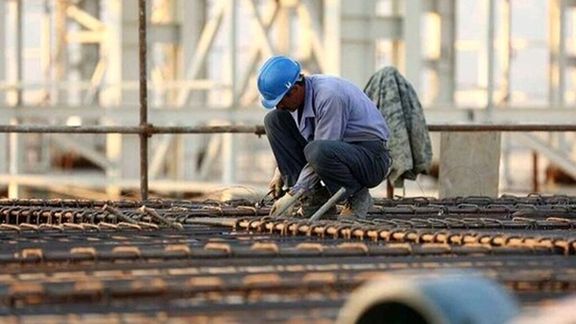
Workplace fatalities claimed the lives of over a thousand Iranian workers between March and September, a notable year-on-year increase that labor activists attribute to authorities' lack of attention to worker safety.
According to data from Iran's Legal Medicine Organization, the figure from the year 1403 (March 21 to September 22, 2024) represents an average of roughly 180 deaths per month, or approximately 45 workers per week, a 15-percent rise year on year.
The majority of the victims were male (1,066), with 11 female workers also losing their lives. Tehran province recorded the highest number of deaths with 217, followed by Isfahan with 81 and Mazandaran with 70.
The most common cause of death in the first six months of the 1403 was falls from height, accounting for 498 fatalities, followed by being struck by hard objects (246 deaths), electrocution (155 deaths), burns (65 deaths), and suffocation (35 deaths). The cause of death for 78 workers was not specified in the report.
Data from the Statistical Center of Iran shows that the number of fatalities rose from 1,625 in the Iranian year 1397 (March 2018-March 2019) to 2,115 in 1402 (March 2023-March 2024), marking a 30% increase over that period.
Labour activists attribute the escalating number of workplace deaths to a lack of safety measures by employers, negligence, and inadequate oversight by labor inspectors.
Ehsan Sohrabi, a labor activist and former member of the Supreme Council for Technical Protection, criticized the Ministry of Labour's lack of attention to worker safety.
He told ILNA that while official figures from the Ministry of Labour and Social Security tend to be lower, the Legal Medicine Organization's data provides a more reliable picture of the increasing rate of workplace accidents and fatalities.
Sohrabi warned that the full-year statistics for 1403 are likely to show a further record increase in workplace deaths, emphasizing that safety in workshops is not being taken seriously and warnings are being ignored.
"If the overall statistics for workplace accidents in the year 1403 are published by the country's Legal Medicine Organization, we will realize that we have once again broken records in this area. Safety in workshops is not taken seriously, and unfortunately, warnings fall on deaf ears," he said.
Chief of Staff of Iran's Armed Forces Mohammad Bagheri (left) and the commander of the IRGC Aerospace Force, Amirali Hajizadeh, at an undisclosed underground facility (March 2025)
Iran's Islamic Revolutionary Guard Corps (IRGC) unveiled what state media dubbed a new missile city, showcasing a variety of domestically produced missiles, as tensions with the United States escalate.
The display comes against a backdrop of heightened rhetoric from Washington, which has warned of potential military action if Tehran does not curb its nuclear program, limit its missile development, and cease support for regional militant groups.
The unveiling, widely covered by Iranian domestic media, featured senior military figures including the Chief of Staff of the Armed Forces, Mohammad Bagheri, and the commander of the IRGC Aerospace Force, Amirali Hajizadeh, at an undisclosed underground facility.
Reports identified various missile types at the location, including the KheibarShekan, Haj Qassem, Ghadr H, Sejjil, and Emad.
Despite Bagheri's assertions of significantly enhanced missile capabilities and preparations for a future capacity far exceeding Iran's strikes on Israel, the claim that these bases are new cannot be independently verified, as their locations are typically undisclosed.
Iran’s military has previously released images of similar underground facilities, prompting speculation that the newly publicized base may be an older site repurposed for a fresh media campaign.
Adding a nuanced layer to the display, Iranians on social media have pointed out a potential shift in symbolic messaging.
Unlike a similar video released previously showcasing a comparable missile base with both US and Israeli flags painted on a corridor floor – a common practice at Iranian state buildings and military bases intended for symbolic humiliation – the current unveiling reportedly only features the Israeli flag.
The absence of the US flag has been interpreted by some online as a possible signal that Iran might be subtly toning down its direct rhetoric towards the US amidst the heightened tensions and the significant US military buildup in the region.
The IRGC Aerospace Force commander, Hajizadeh, has previously claimed that Iran possesses hundreds of such underground missile sites across the country, a number so vast that unveiling one per week would take two years.
Iran has long prioritized the development of its missile program, which it views as a crucial deterrent, in the absence of an effective air force.
The unveiling also occurs as the United States is in the middle of a bombing campaign on Iran-backed Houthis in Yemen.
Washington says that the Houthis are directed by Tehran, a claim Iran denies, and has threatened direct action against Iran if its support for the group continues.
Trump, in late March, said that confronting Iranian threats was reaching its final stages, suggesting resolution through either negotiation or military action.
A recent report by Axios also indicated that Trump’s letter to Supreme Leader Ali Khamenei has set a two-month deadline for a new nuclear agreement, threatening military intervention if no deal is reached.
Newly recruited fighters who joined a Houthi military force intended to be sent to fight in support of the Palestinians in the Gaza Strip, march during a parade in Sanaa, Yemen December 2, 2023
As controversy over leaked attack plans gripped Washington, US President Donald Trump said the strikes had successfully battered the Houthis in Yemen and that their Iranian patrons must soon negotiate a nuclear deal or else.
"The Houthis are absolutely on the run, the worst of them have been killed," Trump told reporters at the White House. "This is not an incompetent group of people. They make their own missiles. They get their missiles also from Iran. It's an offshoot of Iran, another offshoot."
"You have Hamas, you have Hezbollah, you have the Houthis. You've got a lot of stuff going on with Iran, and we sent a letter to Iran. You're going to have to be speaking to us one way or the other pretty soon, because we can't let this happen."
The remarks come after consternation in Washington among Trump's opponents about the inclusion of a prominent journalist in a chat conversation among senior officials about plans for a military campaign against the group.
Following an attack by Iran-backed Hamas militants on Israel on October 7, 2023 and Israel's incursion into Gaza, the Houthis began attacking commercial and military vessels in the waterways astride Yemen in what they called solidarity with Palestine.
The group, which controls much of the war-torn country, has been provided advanced drone and missile technology by Iran.
His ultimatum over the nuclear standoff was delivered in the form of a letter to Iran's Supreme Leader Ali Khamenei, who has rejected previous overtures and said Trump and the United States cannot be trusted.
Iran denies seeking a nuclear weapon and the US director of national intelligence on Tuesday said Washington continues to assess that Tehran has not yet resolved to build one but that decision-makers there are increasingly promoting the idea.
Two top Trump officials have appeared to vary in recent days on the administration's precise demands on Iran.
White House National Security Advisor Michael Waltz said on Sunday that Washington seeks the full dismantling of Iran's nuclear program: "This is the full program. Give it up, or there will be consequences."
A softer line appeared to be mooted by Trump’s Middle East envoy, Steve Witkoff on Friday: “We should talk. We should clear up the misconceptions. We should create a verification program so that nobody worries about weaponization of your nuclear material."
Asked by Iran International if there was a discrepancy between the two sets of statements, a state department spokesperson said the president's line was unequivocal.
"President Trump has been clear: the United States cannot allow Iran to acquire a nuclear weapon," the spokesperson said.
"The President expressed his willingness to discuss a deal with Iran. If the Iranian regime does not want a deal, the President is clear, he will pursue other options, which will be very bad for Iran."
IAEA Director General Rafael Grossi speaks during a press conference on the opening day of his agency's quarterly Board of Governors meeting in Vienna, Austria, March 3, 2025.
The UN nuclear watchdog warned that any new agreement with Iran is impossible before Tehran resolves outstanding questions about uranium traces found at undeclared sites.
"Common sense dictates you cannot build on a shaky basis," the head of the International Atomic Energy Agency (IAEA) said in an interview with Bloomberg, stressing that unresolved issues concerning uranium traces discovered at undeclared locations must be addressed.
"We discovered traces of uranium at places that were not supposed to have hosted any nuclear activity," he said, adding that satisfactory answers from Iran are still lacking. "We haven't had, I must say, answers or satisfying answers, to these questions."
The IAEA chief indicated that the current state of discussions with Iran regarding the unresolved uranium traces is not meeting the agency's expectations. "Well, we are not I must admit, we are not where we would like to be."
He acknowledged US President Donald Trump's outreach to Iran's Supreme Leader and his own recent and planned visits to Tehran, but underscored the necessity of addressing these past issues to establish a solid foundation for future negotiations.
"These things come together because you have, on one hand, these unresolved questions from the past. And then, yeah, at the same time the possibility of having some viable agreement form for the future."
The IAEA chief also highlighted the catastrophic potential of a nuclear-armed Iran in the volatile Middle East.
"The addition of that to the pot of nuclear weapons would be catastrophic," he said.
He called for continued efforts by the United States, European allies, and Iran to find a viable path forward as a matter of necessity, but only after the past discrepancies are resolved.
Iran's uranium stock refined to up to 60% grew by 92.5 kilograms (kg) in the past quarter to 274.8 kg, one of the IAEA reports said. According to an IAEA yardstick, the amount is enough in principle for six nuclear bombs if enriched further.
While Tehran has reduced IAEA inspections since 2021 and in 2023 barred a third of the inspectors, it continues to argue that its nuclear activities are peaceful.
One US dollar equals more than twenty 50,000-rial banknotes.
Iran’s currency hit a record low of 1,039,000 rials to the US dollar on Tuesday, as the absence of nuclear talks with the US continues to fuel economic uncertainty.
The rial has halved in value since President Masoud Pezeshkian took office in August, deepening concerns over Iran’s worsening economic outlook, amid continuing US economic sanctions and negative regional developments for Iran.
The steep decline began after Israel launched devastating attacks on Iran’s proxy, Hezbollah, in Lebanon in September, undermining Tehran’s regional influence. The election of Donald Trump, who takes a harder line on the Islamic Republic, has added to the uncertainty.
Last week, the currency dropped to one million per US dollar in Tehran, a day after Trump warned Iran of retaliation if its Houthi allies in Yemen retaliated against US airstrikes designed to weaken them.
The rial, which was valued at around 40,000 per dollar in early 2018, began to plummet after Trump withdrew from the JCPOA nuclear deal in May of that year and imposed tough economic sanctions, pushing inflation above 40%.
Prices for food and other essential goods have recently surged, with inflation in these categories estimated at 100%. As the rial continues to lose value, even higher inflation is expected in the coming months.
File photo of a United Nations Human Rights Council meeting
The United Nations Human Rights Council is set to vote on extending the mandates of both its fact-finding mission on Iran and its human rights rapporteur, citing ongoing and systemic human rights violations, according to a draft resolution seen by Iran International.
The resolution, expected to be voted on within 10 days, condemns systematic human rights violations in Iran and calls on the Islamic Republic to end its structural impunity for perpetrators of crimes and to fully cooperate with the UN's Special Rapporteur and the Independent International Fact-Finding Mission.
"The structural impunity that the Islamic Republic has granted to officials and agents of suppression and perpetrators of crimes against the people strengthens the chain of violence and violates the victims' right to justice," the draft resolution read.
In April 2024, the Council voted to extend the Fact-Finding Mission’s mandate for an additional year.
As per the resolution, the mandate of the UN Special Rapporteur on the situation of human rights in Iran is also expected to be extended for another year, with a focus on monitoring, documenting, and assessing Iran's progress in implementing the council’s recommendations.
The resolution, drafted by Iceland, Germany, North Macedonia, Moldova, the United Kingdom, and Northern Ireland, highlights concerns over the suppression of women, ethnic and religious minorities, and the increasing use of the death penalty.
The resolution calls on Iran to amend discriminatory laws, ensure fair trials, lift restrictions on civil society, and allow access to the country for UN human rights investigators.
The council condemns the use of capital punishment to create public fear and suppress political dissent, warning that Iran's punitive approach, including death sentences for crimes not meeting the "most serious crimes" threshold, violates international law.
The resolution also cites the suppression of freedom of expression and assembly, harassment of journalists and media workers, restrictions on human rights defenders and civil activists, and widespread discrimination against minorities as key human rights violations.
The Independent International Fact-Finding Mission, established following widespread protests in 2022, will continue to gather evidence of human rights violations related to the suppression of protests, including gender and ethnicity-based discrimination and excessive use of force.
The mission's mandate includes preparing evidence for potential future legal proceedings to hold perpetrators accountable.
The UN Human Rights Council's decision follows reports by the fact-finding mission documenting widespread human rights violations, including torture and sexual violence in prisons, which they say constitute crimes against humanity.
In a letter to UN member states earlier in March, 42 Iranian and international human rights organizations called for the renewal of the Special Rapporteur's mandate and the continuation of an independent investigative mechanism with a broad mandate to build on the fact-finding mission's work.
UN Special Rapporteur Mai Sato warned of Iran's increasing use of executions to suppress dissent, with at least 169 executions recorded in January and February alone.
"Countries should make an informed decision considering the human rights situation in the Islamic Republic," Sato said earlier in the month, expressing hope that her mandate would be extended. "There are many human rights issues in Iran that need to be monitored and addressed, and ideally, prevented."
Iran has summoned the German ambassador and British charge d'affaires over their countries' role in drafting the resolution, describing the move as provocative and irresponsible.
Iran's allies, including Venezuela, North Korea, and China, have dismissed the UN fact-finding mission as politically motivated.