Armed seminarians attacked protesters during 2022 uprising, Iranian cleric says
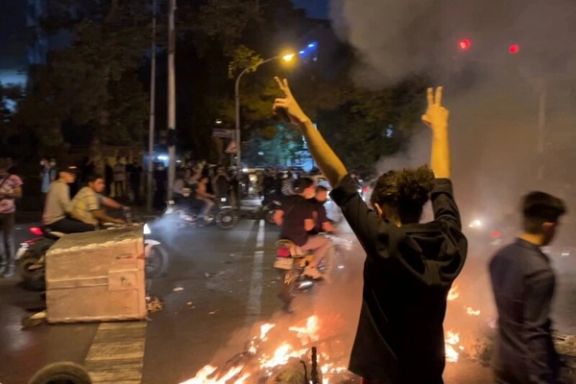
A protester with arms upraised during a demonstration in Tehran in 2022.
An Iranian cleric has accused a group of seminarians of wielding knives and machetes against protesters during the 2022 nationwide uprising, alleging they clashed with demonstrators before returning in bloodied clothes and changing into clerical robes.
“These people claimed to be seminarians, but after Mahsa Amini’s case, they poured into the streets armed with knives and machetes, confronting the people,” Mohammad Ashrafi Esfahani told the Tehran-based Didban News website.
“They would return in bloodied clothes and then dress as clerics again," he added in the Tuesday interview.
Ashrafi Esfahani said individuals linked to prominent cleric Alireza Panahian were involved in violent crackdowns on protesters.
Mohammad Ashrafi Esfahani
“Has there ever been a precedent in Shia history for a seminarian to wield a machete and attack people? Yet, Panahian’s group did exactly that,” he said of the violence following the death in police custody of Mahsa Amini.
The young woman died at the custody of morality police, sparking the national Woman, Life, Freedom movement.
His comments come amid a broader power struggle between clerical factions, with Ashrafi Esfahani accusing Panahian’s followers of attempting to seize control of religious institutions for financial and political gain.
“We filed a complaint and reported this to the authorities,” he said. “But it is still unclear who is supporting these individuals.”
Iran's FM Abbas Araghchi speaking at UN Human Rights Council in Geneva on February 24,2025.
Iran defended its human rights record and condemned Western sanctions at a United Nations Human Rights Council meeting in Geneva.
“For decades, the Iranian people have faced grave challenges, including unjust economic sanctions and terrorism, which have had many devastating impacts on their social and economic rights,” Foreign Minister Abbas Araghchi said in a speech on Monday.
Araghchi, however, did not acknowledge that sanctions against Iran include those for human rights violations, which have targeted both individuals and entities across government sectors from the IRGC to the prison services. Other sanctions have been for Iran's support of Russia's war on Ukraine and its ongoing nuclear program.
The number of people executed in Iran rose from 834 to 901 in 2024, including 31 women, the UN Human Rights Office said in January. The figures have reached record highs since 2022.
While Araghchi said Tehran is committed to improving human rights and cited achievements in education, healthcare, and women's rights, Iran has restricted women's freedoms, including the violent enforcement of hijab laws.
Iran has frequently used violence to suppress demonstrations, including the 2022 protests following the death of Mahsa Amini in morality police custody. Iranian forces killed hundreds of protesters, and arrested thousands more.
Iran's top diplomat also warned against the “politicized use of human rights” as a tool for pressure saying, “Human rights may not be used as a leverage of political and economic pressure or interference in the internal affairs of countries.”
The Islamic Republic has been accused of detaining foreign nationals and dual nationals on vague charges as a means of gaining leverage in diplomatic negotiations—a practice rights groups describe as 'hostage diplomacy'.
Ultra-hardliner Saeed Jalili and his allies—widely regarded as President Masoud Pezeshkian’s chief rivals—are maneuvering to expand their political influence through upcoming city and village council elections, according to Iranian media.
While Jalili only briefly referenced the importance of these elections in a speech last week, his public appearances and speeches have notably increased in recent months. In these speeches, Jalili emphasized that the development budget allocated to the country’s top cities exceeds the national development budget, pointing to the significance of these local councils.
“It appears that Jalili’s statements should be considered a signal of the [active] participation of him and his supporters in the seventh city council elections,” an article published by Rozan Online read on Saturday.
The publication’s report also argued that these elections could intensify rivalries within the hardliner/ultra-hardliner camp, particularly in cities like Tehran, where Parliament Speaker Mohammad-Bagher Ghalibaf, a former mayor of the capital, and his supporters still wield some influence in the municipality.
Jalili and his supporters’ plans for the elections on June 19 will not only heighten competition among three factions—led by Jalili, incumbent Tehran Mayor Alireza Zakani, and Ghalibaf—but could also lead to new coalitions or deeper divisions within this political faction, Rozan’s piece noted.
Ghalibaf has been relatively supportive of Pezeshkian’s “national unity” government and is often accused by Jalili’s supporters on social media of betraying the “revolutionary cause.”
Jalili has no executive experience. He led Iran’s nuclear negotiations during the presidency of populist Mahmoud Ahmadinejad and currently represents Supreme Leader Ali Khamenei in the Supreme National Security Council (SNSC). Additionally, he serves on the Expediency Discernment Council (EDC), also by Khamenei’s appointment.
“The Jalili circle has become hyperactive in parliament and on social media in unison with him,” a piece by Khabar Online read – a media outlet linked to former conservative parliamentary speaker Ali Larijani.
The publication speculated on Saturday that securing control over city and village councils could be a stepping stone for Jalili’s presidential ambitions in the next election.
Khabar Online’s report also suggested that if Jalili’s supporters gain a majority in the Tehran City Council, he could position himself as the mayor of the capital, following Ahmadinejad’s footsteps, who later became president.
Jalili, who competed against Pezeshkian in the June 2024 runoff presidential election, does not formally lead any political party. However, he has strong backing from the ultra-hardliner Paydari Party and its allies, including the Iran Morning Front (Jebhe-ye Sobh-e Iran), a political party established only a year ago. Both parties officially endorsed and campaigned for Jalili in the recent presidential election.
Jalili and his supporters are staunchly opposed to any negotiations with the United States regarding Iran's nuclear program, missile capabilities, and regional influence. They also reject Iran's accession to Financial Action Task Force (FATF) conventions, which could help remove Iran from the global money-laundering watchdog’s blacklist.
The ultra-hardliner Paydari Party, a small but influential faction in parliament, has been behind several controversial legislative efforts, including the strict hijab law and the recent attempt to impeach Economy Minister Abdolnasser Hemmati. The Paydari Party and the Iran Morning Front also have a strong presence in key state institutions, including the state-run broadcasting organization (IRIB), where Jalili’s brother, Vahid Jalili, serves as a cultural deputy. In this role, he wields significant influence over IRIB’s policy direction.
The city and village council elections are the only elections in Iran that do not require candidate vetting by the ultra-hardliner Guardian Council, allowing for broader participation than in parliamentary and other elections.
In smaller towns and villages, competition in local government council elections is often driven by ethnic and tribal factors which may bring more voters to the ballot boxes.
However, in major cities like Tehran, where political concerns take precedence, voter turnout could be very low like in last year’s parliamentary elections.
A recent survey by the Iranian Parliament Research Center indicates that the vast majority of Iranians (81%) rely on VPNs to bypass internet censorship.
The survey, based on telephone interviews with 1,100 participants in December 2024, indicates that 49.4% of VPN users rely on free services, while 30.3% opt for paid alternatives. Only 18.9% of respondents reported not using a VPN.
The survey also shed light on public sentiment regarding potential changes to internet restrictions under President Masoud Pezeshkian.
A significant 24.8% of participants expressed "no hope at all" for the lifting of filtering and social restrictions. An additional26.7% indicated"low" hope. In contrast, 20.5% expressed "high" hope, and 11.2% "very high" hope. 16.8% either did not answer or responded"don't know."
Lifting internet filtering was one of Pezeshkian’s main campaign promises in the presidential election in 2024.
He had said, "I would put my neck on the line to solve the filtering issue."
Dr. Kylie Moore-Gilbert, a researcher and former prisoner in Iran, in an undated photo.
Dr. Kylie Moore-Gilbert, a researcher and former prisoner in Iran, has criticized Australian Senator Fatima Payman for defending Iran’s treatment of women in an interview with the state-run Press TV.
In a post on X, Moore-Gilbert called Payman’s remarks “nonsense,” rejecting the senator’s claim that Iran allows women to participate in democracy.
She pointed out that Payman had previously attended a Senate inquiry into Iran’s human rights abuses and questioned why she would agree to speak with Press TV.
“The English-language propaganda arm of the Islamic Republic [is] known for broadcasting false confession videos and forced interviews with prisoners before they are executed," she said.
“The irony of a strong and powerful woman originally from Afghanistan… denying that her Iranian sisters face similar challenges just next door,” Moore-Gilbert wrote, adding that Payman’s stance contradicts her past expressions of solidarity with Iranian protesters.
Payman’s interview, in which she accused Western media of biased coverage on Iran, has sparked backlash, with critics arguing that her comments downplay the Islamic Republic’s record on women’s rights.
A screengrab from a video showcasing an exhibit to promote hijab at Tajrish subway station in Tehran (February 2025)
A new high-tech public art display at a Tehran metro station aimed at cajoling women into wearing hijabs has been met with scorn by some Iranians describing the immersive exhibit as a state-backed "repentance room."
A video showcasing the interactive installation at Tajrish station established by the Tehran municipality and run by the Daughters of the Revolution group aired on state television Tuesday.
The group, known for promoting an Islamic lifestyle and championing the Islamic veil is headed by Bahareh Jangravi, who said the project was a means of spreading the importance of wearing the hijab, in the wake of a national mass rebellion against the Islamic Republic's mandatory dress code.
The video shows women whose attire violates hijab rules weeping in the room. They are then offered headscarves by metro officials and encouraged to comply with the theocracy's strict regulations.
Concerns have also been raised on social media platforms about the authenticity of the video, with some suggesting that the women depicted either paid actors or women acting under duress.
Jangravi explained that her group's name, "Daughters of the Revolution," was chosen in response to the "Girls of Enghelab (Revolution) Street" movement, a wave of symbolic protests against mandatory hijab inspired by activist Vida Movahed's 2017 public act of defiance.
Vida Movahed protesting against compulsory hijab in Tehran in December 2017
The interactive installation also features images of slain Islamic Revolutionary Guard Corps commanders and other figures revered by the Islamic Republic.
They include the slain commander of the IRGC foreign operations arm Qassem Soleimani and Hamas leader Yahya Sinwar. The two figures revered by Iran's military-clerical establishment were killed by the United States and Israel, respectively.
The exhibit is a scaled model of the shrine of Imam Husayn ibn Ali, the third Shia Muslim Imam. Through VR goggles, visitors can explore a lifelike virtual rendering of the actual shrine and its surroundings in Karbala, Iraq.
The initiative has drawn widespread criticism, with many viewing the room as an inappropriate use of public space to enforce the government's ideological agenda.
Critics question the municipality's involvement, arguing it oversteps its mandate and diverts resources from pressing urban issues.
Similar controversies have surrounded previous actions by the municipality, such as the deployment of "hijab guards" in metro stations and the burial of "unknown martyrs" at universities and recreational sites, along with the construction of mosques in parks.
The controversy highlights the ongoing struggle over hijab enforcement in Iran since the nationwide Woman Life Freedom protest movement following the death of 22-year-old Mahsa Amini in the custody of morality police in September 2022.
A large number of women in Tehran and other major cities continue to defy the mandatory hijab, a trend that began with the 2022 protests.
The widespread non-compliance has strained police enforcement efforts, prompting the government to explore alternative methods, including a controversial new bill that emphasizes fines, deprivation of public services and the so-called cultural initiatives over direct confrontation.