Police storm stage, arrest rap artists in Tehran underground show
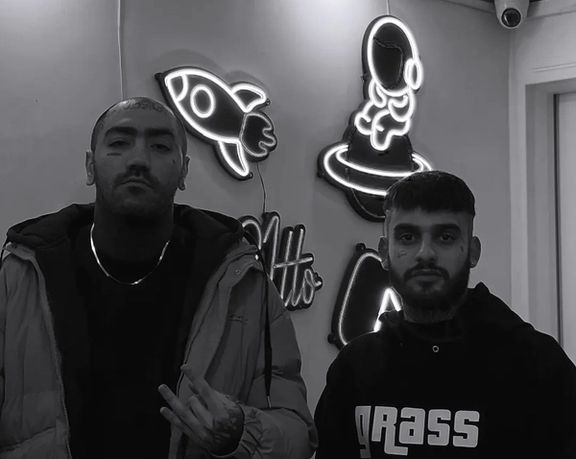
Hip hop music producer Rasam Sohrabi and rapper Arash Seyedi, known as Eycin in an undated photo.
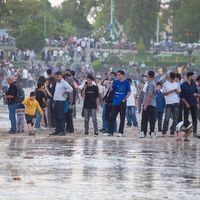
Security forces arrested Iranian rapper Arash Seyedi, known as Eycin and his producer Rasam Sohrabi during a live underground performance at a cafe in western Tehran on Thursday, eyewitnesses told Iran International.
“He had a performance at a café in western Tehran in Janatabad when plainclothes officers and the police arrived, arrested him and his composer, and detained several people there,” one source said, requesting to remain anonymous for security reasons.
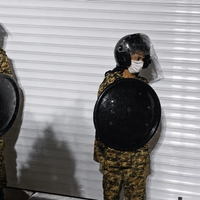
A video obtained by Iran International shows the moment the officers storm the venue and detain the underground rapper. A masked man can be seen in the footage, who the source said was one of those who detained Eycin.
“They came with a van and took everyone away. The venue was also sealed off,” the source added, "Eycin had scheduled several performances in cafes, on a tour, in Qeshm in recent weeks."
The fans were later released but two sources told Iran International that Eycin and his composer remained in detention.
A source said that both Eysin and Sohrabi appeared in court on Friday morning, however the charges against them remain unknown.
An image of duo surfaced on Iranian rap Telegram channels on Friday evening, showing them handcuffed.
“Lately, rappers have been organizing a lot of underground performances through various methods. It seems like they want to crack down before it spreads,” the source said.
International human rights organizations have condemned Iran's suppression of artistic expression in recent years.
In the aftermath of Iran's nationwide protests sparked by the death in custody of Mahsa Amini in September 2022, at least two rappers - Toomaj Salehi and Saman Yasin - were sentenced to death in connection with their music. Following an international outcry, their death sentences were revoked.
Author Salman Rushdie poses during a photocall ahead of the presentation of his book "Knife: Meditations After an Attempted Murder" at the Deutsches Theater in Berlin, Germany, May 16, 2024.
A man charged with stabbing Salman Rushdie was found guilty of attempted murder by a New York court on Friday, in the latest twist to a decades-long ordeal for the famous novelist menaced by an Iranian death warrant.
The trial began this month of Hadi Matar in the 2022 attack on Rushdie, the irreverent author whose death was called for by Islamic Republic founder Ayatollah Ruhollah Khomeini in an infamous fatwa, or Islamic decree.
Matar, a 27-year-old American of Lebanese Shi'ite extraction, had pleaded not guilty to second-degree attempted murder and assault.
Rushdie was among the first to testify, calmly describing the assault and removing spectacles blacked out in one lens to reveal his wounded eye.
Jurors in the Mayville, New York courtroom heard how the knife attack at a New York lecture unfolded in a matter of seconds, leaving Rushdie half blind and fighting for his life in hospital.
Moments before 77-year-old Rushdie was stabbed on stage, a poet was introducing the book event on the topic of keeping writers safe from harm.
The defendant was accused of running on stage and stabbing Rushdie up to 10 times. The attack also damaged Rushdie’s liver and paralyzed one hand.
Matar's lawyers had argued prosecutors had not proved his guilt beyond a reasonable doubt.
In July 2024, two years after the incident, an unsealed indictment charged the defendant with providing material support to Iran-backed Hezbollah sometime between September 2022 and August 2022.
The indictment did not specify how Matar is linked to the group and his trial is due to be held separately in Buffalo, New York.
Rushdie is an atheist born in India to a Muslim Kashmiri family. He was forced to spend about 10 years in hiding throughout the United Kingdom and United States for much of the 1990s after Khomeini's fatwa.
Khomeini had called in 1988 on “the proud Muslim people of the world” to kill the author of “The Satanic Verses,” which centered on the life of the Prophet Mohammad.
Etienne de Ricaud (4th from left), Lily Farhadpour (4th from right), and the film team hold a photo of Maryam Moghaddam and Behtash Sanaeeha at the My Beloved Cake photocall during the 74th Berlinale International Film Festival Berlin at the Grand Hyatt Hotel on February 16, 2024, in Berlin, Germany.
Hundreds of prominent filmmakers including top global celebrities have signed an open letter demanding Iranian authorities drop propaganda and obscenity charges against the two directors of recent film "My Favorite Cake".
The independent film about a widow's quest for companionship defied strict censorship laws in Iran to gain international acclaim, sparking outcry over the persecution of its creators.
The petition launched on Change.org calls for the immediate and unconditional dismissal of charges against the two filmmakers Maryam Moghaddam and Behtash Sanaeeha, who face trial in Tehran’s revolutionary court on March 1.
The charges include propaganda against the system, producing and distributing a film with obscene content, violating public morality and decency, and screening the film without a distribution license.
The petition has garnered widespread support from the global film community, with signatories including Pedro Almodóvar, Juliette Binoche, Jean-Pierre Dardenne, Jafar Panahi, Mohammad Rasoulof, Agnieszka Holland, Joachim Trier, Céline Sciamma, Arthur Harari, Dominik Moll and the directors of the Venice, Berlin, and Rotterdam film festivals.
The statement signed by the filmmakers condemns the prosecution of Moghaddam and Sanaeeha, describing it as part of a broader crackdown on artistic expression in Iran.
It highlights that the directors have faced "months of interrogation and two years of continuous travel bans" for making the film, which portrays the life of a middle-aged woman in Tehran struggling with loneliness and societal expectations.
The film, which received critical acclaim internationally, screened in competition at the 2023 Berlin Film Festival, winning the FIPRESCI Jury Award, and later received the Silver Hugo at the Chicago Film Festival.
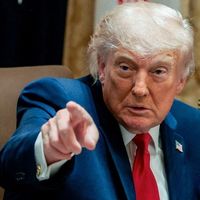
US President Donald Trump favors diplomacy over war but is determined to stop Iran from acquiring nuclear weapons, Secretary of State Marco Rubio said in an interview on Thursday.
“The president’s a peacemaker,” Rubio told independent journalist Catherine Herridge. “He’d prefer to avoid (war) and avoid those circumstances," adding that the United States under Trump “is not going to allow a nuclear Iran.”
Rubio did not discuss specific strategies but said that if Washington decided to act, “it could bring about the end of the Iranian regime,” in some of the most hawkish comments yet on Tehran from a senior member of the Trump administration.
Trump’s focus, Rubio said, remains on avoiding conflict.
As the world watches whether the US can achieve a deal with Moscow over the war in Ukraine, Rubio suggested the two countries may have a common interest in preventing Iran from becoming a nuclear power.
“There are things we could cooperate on geopolitically,” he said. “I’m not sure the Russians are fans of the Iranian regime having nuclear weapons.”
His comments come as US and Russian officials held their first discussions this week in Saudi Arabia on ending the three-year conflict.
Iran, which has sought stronger ties with Russia and China under Supreme Leader Ali Khamenei’s “Look East” policy, has faced economic strain due to US sanctions.
But Iranian media has warned that Moscow may not be a reliable partner and has raised concern that Russia could shift its stance.
Trump has criticized his predecessor, Joe Biden, for being too lenient on Iran and has reinstated the “maximum pressure” sanctions campaign from his first term.
While Trump has expressed reluctance to support an Israeli military strike on Iran’s nuclear program, he has also said he prefers a diplomatic agreement, a proposal that Khamenei has publicly rejected.
US intelligence reports cited by The Wall Street Journal and The Washington Post indicate that Israel sees Iran as vulnerable after October 26 airstrikes, which reportedly US and Israeli leaders say crippled Iran’s air defenses.
Israel, the newspapers reported, perceives the US as more open to military action against Iran under Trump’s leadership.
embers of the Iranian army take part in the annual military drill, dubbed “Zolfaghar 99”, in the Gulf of Oman, Iran on September 8, 2020.
Iran’s armed forces are set to begin a large-scale military exercise dubbed Zolfaghar 1403 on Saturday as tensions with Israel and the United States persist over Tehran’s nuclear program.
The drills, led by the Iranian Army, will span an area from the Makran, in southeastern Iranian coast, to the northern Indian Ocean, covering strategic waters up to the 10-degree latitude.
The Makran coast, which lies along Iran’s border with Pakistan on the Arabian Sea, is a key military and economic zone, home to the country's growing naval infrastructure.
Admiral Habibollah Sayyari, the commander of the exercise, warned that any attack on Iranian interests would not go unanswered. He said, “Any enemy that thinks it can harm our interests on land, in the air, or at sea will certainly suffer great damage.”
He added that the Zolfaghar 1403 exercise will demonstrate Iran’s latest military capabilities, showcasing the strength of ground forces, air defense, strategic naval forces, and the Joint Air Defense Headquarters.
Sayyari’s remarks come amid reports that Israel is considering launching an attack on Iranian nuclear sites as early as the first half of this year.
According to The Wall Street Journal and The Washington Post, US intelligence findings from last month indicate that Israel views Iran as vulnerable following the October 26 Israeli air strike, which reportedly knocked out large portions of Iran’s air defenses. The reports also suggest that Israel perceives increased US willingness to support military action, particularly with President Donald Trump back in the White House.
During a recent visit to Washington, Israeli Prime Minister Benjamin Netanyahu said that Israeli strikes had "crippled Iran's air defenses."
While Zolfaghar 1403 is an Army-led exercise, Iran has also recently conducted joint drills between the Iranian Army and the IRGC, focusing on defending key nuclear sites such as Natanz and Fordow.
The exercises, which are set to continue until mid-March, come after Iran unveiled the Zagros, its first signals intelligence (SIGINT) vessel for electronic surveillance. Additionally, Iran has expanded its drone fleet, receiving 1,000 new drones to bolster its capabilities.
As Iran ramps up its military posture, US Central Command (CENTCOM) and the Israeli Defense Forces (IDF) are closely coordinating on regional security.
On Wednesday, CENTCOM Commander Gen. Michael Erik Kurilla hosted IDF Chief of Staff Lt. Gen. Herzi Halevi at headquarters in Tampa, Florida, where they discussed Iran’s growing influence along with the ceasefire in Gaza, hostilities in Lebanon, and the Iran-backed Houthis in Yemen. The CENTCOM statement, published on Thursday, reaffirmed the deep US-Israel military partnership as both countries assess Tehran’s actions in the region.
Last month, 110,000 paramilitary Basij forces took part in a large-scale IRGC drill aimed at preparing for potential security threats in Tehran.
With Iran ramping up military activities across multiple fronts, the region remains on high alert as the country signals its readiness to counter any external threats. Iranian military commanders have been making frequent statements about their military capabilities, and recently have renewed direct threats against Israel.
A high-ranking general in Iran’s Revolutionary Guards has said that a third large-scale missile attack on Israel will wipe out the country and destroy Tel Aviv and Haifa.
“Operation True Promise 3 will be carried out at the right time, with precision, and on a scale sufficient to destroy Israel and raze Tel Aviv and Haifa to the ground,” General Ebrahim Jabbari said.
In 2024, Iran launched two large-scale missile and drone attacks against Israel, but with limited success.
Israeli air defenses, combined with intervention from the US and other allies, intercepted most of the projectiles, preventing significant damage.
The general, who is an adviser to IRGC chief commander Hossein Salami, was speaking on Thursday to paramilitary forces during ongoing drills, dubbed “The Great Exercise of Prophet Mohammad's Power.”
Jabbari claimed that “the United States can do nothing against Yemen.” He added that the resistance fronts in Lebanon, Iraq, and Palestine are at the peak of readiness, and Supreme Leader Ali Khamenei also ordered to increase the range of missiles.
Israel's Foreign Minister Gideon Sa'ar said on X that it took the threat seriously and was prepared to defend itself.
“If the Jewish people have learned anything from history, it is this: if your enemy says his goal is to annihilate you—believe him,” Sa’ar said, citing Iran International’s original article on Jabbari’s threat.
“We are ready."
Tehran faced significant setbacks in the region in 2024, including Israeli operations that severely weakened Hezbollah in Lebanon and the overthrow of Bashar al-Assad in Syria. In October, an Israeli airstrike reportedly delivered a decisive blow to Iran’s Russian-supplied air defense system.
Since Donald Trump took office in the United States, Tehran has grown increasingly insecure, issuing repeated warnings against further attacks. It has also conducted continuous military drills since early January.
General Jabbari at length praised IRGC Quds Force former commander Qasem Soleimani and Hezbollah leader Hassan Nasrallah who was killed by a targeted Israeli air raid last September.
They were “teachers who trained a whole generation of younger commanders,” he said.
Praising what he called their devotion to Khamenei, he said, “These martyrs believed their success lay in absolute obedience to the Supreme Leader.”