Iran says 'not difficult' to assure Trump it does not seek nuclear arms
Iranian soldiers stand guard inside the Natanz uranium enrichment facility, 322km (200 miles) south of Iran's capital Tehran March 9, 2006.
Demonstrating to US President Donald Trump that Iran does not seek nuclear weapons will not be difficult and is achievable, foreign minister Abbas Araghchi said on Wednesday, in an apparent olive branch to Tehran's main adversary.
"If the main issue is ensuring that Iran does not pursue nuclear weapons, this is achievable and not a difficult matter," Araghchi said.
Trump said on Tuesday he hoped for an agreement denying Iran nuclear weapons.
"They cannot have a nuclear weapon," he told reporters at a press conference held after signing a memorandum to restore his so-called maximum pressure policy against Iran.
"If ... they can convince us that they won't, and I hope they can," Trump continued, "It's actually very easy to do, I think they're going to have an unbelievable future."
The US President's directive on squeezing Tehran on Tuesday seeks to deny Iran nuclear weapons, limit its ballistic missile program and halt support for terrorism.
The head of Iran's Atomic Energy Organization, Mohammad Eslami, also weighed in on Trump's directive, saying Tehran has not and will never pursue nuclear weapons.
While Tehran has maintained its nuclear program is for peaceful purposes, it has accelerated its uranium enrichment to up to 60% — close to the 90% threshold that is considered weapons-grade, according to the UN nuclear watchdog.
The Iranian foreign minister's latest comments did not directly address Trump's sanctions directive but instead appeared to signal Tehran's openness to negotiations on the nuclear issue.
Trump on Wednesday expressed hope for a nuclear agreement, telling reporters that he would be willing to engage in talks with his Iranian counterpart.
Iran's First Vice President Mohammad Reza Aref said that although a meeting between "two human beings" is not impossible, engaging in talks with Trump is not currently on the Islamic Republic's agenda.
Fatemeh Mohajerani, the spokesperson for the presidential administration, also reacted to the US president's remarks regarding his readiness to negotiate with the Iranian president, saying, "Our country's foreign policy has always been based on a set of fixed principles."
"We follow three key principles: the dignity of the country and its people, wisdom in understanding underlying issues, and expediency. All national matters, particularly relations with other countries, are pursued based on these principles."
In his Wednesday remarks, Araghchi dismissed Trump’s renewal the previous day of the so-called maximum pressure strategy of his first term aiming to reduce Iranian oil exports to zero.
"Maximum pressure is a failed experiment, and trying it again will only lead to another failure," Araghchi told Iranian media on Wednesday.
In Trump's first term in office, Iran's oil exports were reduced to near zero by re-imposing sanctions. Under former US President Joe Biden, however, Iran's oil exports increased starting in 2021 as Tehran found ways to circumvent those sanctions.
An Iranian lawmaker said he would kill Donald Trump after the US president threatened to obliterate Iran if it sought to assassinate him.
"For my part, I would say that whenever I get the opportunity, I will not hesitate for a moment to kill you, Donald Trump," said Mojtaba Zarei, a member of the Iranian Parliament's Foreign Policy Commission.
"And I am a political official speaking this diplomatically," he said in a post on Iranian social media platform Eitaa.
While signing a sanctions directive on Tuesday to increase pressure on Tehran, Trump was asked about the potential fallout for Iran if it made an attempt on his life.
US law enforcement last year accused Iran's Islamic Revolutionary Guard Corps, a powerful paramilitary organization, of organizing a plot to kill Trump in retaliation for his order to assassinate its foreign operations chief Qassem Soleimani in 2020.
"If they did that, they would be obliterated," Trump said.
"That would be the end. I've left instructions - if they do it, they get obliterated. There won't be anything left."
Iranian foreign ministry spokesperson Esmail Baghaei reacted to the remarks on Wednesday, saying, “Tehran reserves its right to pursue a legal process for achieving justice regarding the killing of national champions and senior officials to achieve results in domestic and international courts.”
Iran's president on Wednesday played down a memorandum signed by US President Donald Trump aimed at reducing Tehran's oil exports to zero but offered no reaction after Trump said he was willing to speak with his Iranian counterpart.
"The US says it is sanctioning Iran, but if we manage our resources well and maintain good relations with our neighbors, how can a country with such capacity and longstanding ties with its neighbors be easily sanctioned?" President Masoud Pezeshkian said in an event held at the country's energy ministry.
His comments came one day after the US president restored his so-called maximum pressure policy on Iran with a presidential memorandum signed ahead of his meeting with Israeli Prime Minister Benjamin Netanyahu in Washington DC.
In Trump's first term in office, Iran's oil exports were reduced to near zero after he re-imposed the sanctions that had been lifted under a 2015 nuclear deal between Tehran and world powers. Under former US President Joe Biden, however, Iran's oil exports increased starting in 2021 as Tehran found ways to circumvent the curbs.
"They think everything we have depends on oil and want to block our oil exports, while there are many ways to neutralize their objectives," Pezeshkian said Wednesday.
However, he did not address Trump's mooted openness to engage in conversations with his Iranian counterpart after signing the directive.
"I would reach out (to Iranians). I'm the one that doesn't care whether I reach out or they reach out. A lot of people say let them reach out," Trump told reporters on Tuesday. "To me it doesn't matter. It's just talks. I want to see peace in the Middle East and elsewhere."
Iran's First Vice President Mohammad Reza Aref said that although a meeting between "two human beings" is not impossible, engaging in talks with Trump is not currently on the Islamic Republic's agenda.
The Iranian government spokeswoman also reacted to Trump's remarks regarding his readiness to negotiate with the Iranian president.
"Our country's foreign policy has always been based on a set of fixed principles. We follow three key principles: the dignity of the country and its people, wisdom in understanding underlying issues, and expediency," Fatemeh Mohajerani said.
"All national matters, particularly relations with other countries, are pursued based on these principles."
Tehran dismissed US President Donald Trump’s warning that any attempt by Iran to assassinate him would result in the country’s destruction, calling the remarks "provocative".
While signing a sanctions directive on Tuesday to increase pressure on Tehran, Trump was asked about a reported plot by the IRGC, Iran's powerful military and intelligence force, to assassinate him in retaliation for the killing of General Qasem Soleimani.
"If they did that, they would be obliterated. That would be the end. I've left instructions if they do it, they get obliterated. There won't be anything left," the US President said in response.
Iranian foreign ministry spokesperson Esmail Baghaei responded to the statement on Wednesday, saying that, “Tehran reserves its right to pursue a legal process for achieving justice regarding the killing of national champions and senior officials to achieve results in domestic and international courts.”
During his first term, in 2020, Trump ordered the killing of Soleimani in Iraq. Soleimani led the Islamic Revolutionary Guard Corps’ Quds Force and Iran's influence and proxy efforts in the Middle East.
Since then, US authorities have tracked several threats against Trump and former officials linked to Soleimani's assassination.
A threat to Trump’s life from Iran led to heightened security ahead of a July campaign rally in Pennsylvania, where Trump was shot in the ear, according to US officials. At the time, officials stated they did not believe Iran was involved in the assassination attempt. In November 2024, the US Justice Department revealed that an Iranian plot to kill Trump before the presidential election had been thwarted.
“Iran did not plot President-elect Donald Trump’s assassination,” President Masoud Pezeshkian told NBC last month, adding, “All the assassinations and acts of terror we see happening in Europe and elsewhere, can we see the footsteps of Iranian nationals or other nationals?”
Before the President's denial, Supreme Leader Ali Khamenei's official account on X shared an image of Trump under the shadow of a drone in 2021. The Farsi tweet, which included the word "vengeance" in red, read: "Soleimani's murderer and he who ordered it will have to pay." The post was later deleted.
Russian President Vladimir Putin and Iranian President Masoud Pezeshkian meet in Moscow, Russia January 17, 2025
Political figures in Tehran are divided over ties with Moscow and Beijing. Some warn that Russia could exploit Iran’s tensions with the US, while others stress the importance of trade ties with both countries.
In an interview with Didban Iran website, reformist politician Mahmoud Mirlohi said that Iran must maintain an independent foreign policy and leverage its ties with Russia and China to improve relations with the United States.
"We should not allow Russia to use Iran as a pawn in its dealings with the United States," Mirlohi warned.
He also warned of the potential fallout from Iran's military support for Russia in its war against Ukraine, calling it "a serious cause for concern." He stressed that "Iran's strategic cooperation with Russia should not come at the expense of improving relations with other countries."
Russia is one of the signatories of the 2015 JCPOA nuclear agreement between Iran and world powers. Negotiations to revive the deal, which had been ongoing for 12 months in Vienna during the US President Joe Biden administration, were abruptly halted in March 2022 following Russia's invasion of Ukraine.
Earlier this year, Iran and Russia signed a treaty, their first major agreement since 2001, aimed at deepening bilateral ties, though it did not establish a military alliance or impose binding obligations on either side.
"The 20-year strategic cooperation agreement with Russia should not limit Iran's ties with other countries, nor should we allow Russia to use Iran as a bargaining chip in its negotiations with the West," Mirlohi said.
Mirlohi also argued that, historically, Iranians have few positive memories of their relationship with Russia.
"Beyond hostile relations before, during, and after the Qajar era, Russia in recent years has failed to uphold its commitments, including delays in completing the Bushehr nuclear power plant and withholding S-300 air defense systems and Sukhoi SU-35 fighters, despite Iran paying for them in advance. This history has fueled concerns about the recent agreement between Iran and Russia," the politician said.
Mirlohi cautioned that Iran must balance its relations between East and West. He noted that while agreements among BRICS countries, including Russia and Iran, offer opportunities, "we should not expect them to solve all of Iran's problems, as the global banking system remains dependent on Europe and the US." He added that the importance of continued engagement with the EU and the US to protect Iran's interests.
In an interview with Mehr News, Tehran-based economic analyst Albert Boghozian emphasized the importance of trade deals with China and Russia, saying that they could help drive Iran’s economic development.
He said, however, that Tehran's economic ties with Moscow are less significant than those with China.
“We conduct extensive transactions with China, which is seeking new markets. Given the sanctions, we are particularly interested in trade conducted in our partners’ currencies—using roubles for transactions with Russia and yuan for deals with China—since we cannot process payments for imports through Swift,” he told Mehr News.
Boghozian also warned of the risks associated with relying on roubles and yuan due to their lower value compared to the US dollar. “It is risky to hold our foreign currency reserves in these currencies, but it remains our only option for bypassing US sanctions.”
As an example of challenges in trade deals with China and Russia, Iranian media—including the IRGC-linked Fars News Agency—have recently scrutinized the Tehran Municipality's purchase of subway trains from China.
The deal has faced significant delays, prompting Tehran City Council Chairman Mehdi Chamran to urge the press to stop discussing the issue.
While media outlets have criticized the opacity of trade agreements with China, Chamran argued that public debate could make the issue even more complex, adding that Beijing is still in the process of manufacturing the trains Tehran has ordered.
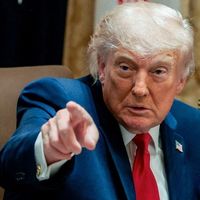
US President Donald Trump speaks as he signs documents in the Oval Office at the White House in Washington, US February 4, 2025.
US President Donald Trump on Tuesday signed a directive restoring the so-called maximum pressure policy on Iran of his first term and warned of "catastrophic" consequences if Tehran does not make a deal on its nuclear program.
Trump said he hoped for an agreement denying Iran nuclear weapons "so that it doesn't end up in a very catastrophic situation," but sounded a dovish note by saying he was prepared to speak with his Iranian counterpart.
"I really want to see peace, and I hope that we're able to do that. They cannot have a nuclear weapon," he told reporters at a press conference alongside Israeli Prime Minister Benjamin Netanyahu in the White House.
"It's very simple. I'm not putting restrictions. They cannot have one thing. They cannot have a nuclear weapon," Trump said.
Iran has denied seeking a nuclear weapon, but Israel has long contended Tehran wants a bomb and that its arch-enemy poses an existential threat.
In withdrawing the United States from a 2015 international nuclear deal in his first term, the Trump administration cited not only its alleged inability to curb Iran's quest for a bomb but also the deal's failure to address Iran's missile program or support for armed allies in the region.
Trump added that if he believed Iran was going to possess a nuclear bomb, that would be "very unfortunate" for Tehran.
"If, on the other hand, they can convince us that they won't, and I hope they can ... it's actually very easy to do, I think they're going to have an unbelievable future."
Iran Directive
Trump earlier in the day signed a directive reviving the maximum pressure policy aimed at driving the Islamic Republic's oil exports to zero.
"This is one that I'm torn about," Trump told reporters in the Oval Office. "Everybody wants me sign it. I'll do that. It's very tough on Iran," he said.
Asked if he would engage in conversations with his Iranian counterpart, Trump responded, "I would." It was not clear whom he meant.
Iran was "too close" to being able to acquire a bomb, Trump added, saying the US has the right to block Iran's oil sales to other nations and threatened Iran with "total obliteration" should they seek to kill him in retaliation.
US law enforcement last year accused Iran of seeking Trump's assassination as retaliation for his order to kill top Iranian commander Qassem Soleimani in 2020.
Trump said he hoped he would not have to follow through on the memorandum.
"Hopefully we're not going to have to use it very much. We will see whether or not we can arrange or work out a deal with Iran and everybody can live together."
Speaking before his White House meeting with Netanyahu, Trump said his predecessor Joe Biden allowed Iran to grow stronger and richer.
"They're not weak. They're very strong right now," he said.
Netanyahu praised Trump for the renewed pressure on Iran, his original decision to pull out of the nuclear deal and helping midwife a Gaza ceasefire deal freeing some Israeli hostages.
Israeli military blows over the course of a 15-month war with Iran and its armed allies, he told the news conference, had weakened the Islamic Republic.
"Israel has never been stronger and the Iran terror axis has never been weaker," he said.
'Malign influence,' snapback
The directive instructs the US Treasury to enforce sanctions and compliance measures against entities that breach current restrictions, Reuters reported earlier on Tuesday citing a US official.
Trump's policy on Iran will be aimed at denying Washington's Mideast nemesis all paths to a nuclear weapon and countering Iran's "malign influence," the official was quoted as saying.
Secretary of State Marco Rubio will also adjust or retract sanctions waivers, working with the Treasury to reduce Iranian oil exports to zero, the official added.
The US ambassador to the United Nations will work with allies to "complete the snapback of international sanctions and restrictions on Iran," the official said.
Snapback refers to the restoration of UN sanctionson Iran which were lifted by a 2015 international deal over Iran's nuclear program, which would likely need to be activated by European parties to the agreement after the US withdrew in 2018.
Trump's maximum pressure approach in his first term beginning in 2018 pummeled Iran's economy, causing a dramatic decline in oil exports and skyrocketing inflation.
In response, Tehran began to taper its adherence to the nuclear deal and ramped up military involvement in the region. During his first term, Trump also ordered the assassination of top Iranian commander Qassem Soleimani in a drone strike in 2020, depriving Iran of its wiliest military operator in the region.
Israeli Prime Minister Benjamin Netanyahu is due to meet Trump in Washington on Tuesday, and their strategy on Iran and its nuclear program is due to loom large.
Over 15 months of punishing military blows by Israel against Iran and its armed Mideast allies has weakened the so-called Axis of Resistance Tehran leads.
Trump said last month that he hoped a deal over Iran's nuclear program would mean the United States did not have to support an Israeli attack on Iran.
Long opposed to foreign wars, Trump has nevertheless adopted a hard line on Iran, saying that Iran cannot be allowed to have a nuclear weapon but also maintaining that Washington should not pursue regime change.