Viral video shows naked woman standing on police car in Iran
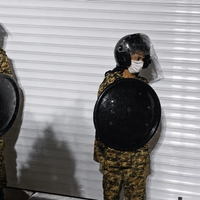
A video circulating on social media shows a woman standing naked on a police vehicle in Iran in the latest instance of a woman disrobing in public and dramatically flouting the Islamic Republic's dress strictures.
The exact time and location of the footage are unclear, but social media users say it has been recorded in the religious city of Mashhad within the past two weeks.
The new video is circulating three months after a similar incident at Tehran's Islamic Azad University, where a female Iranian student stripped to her underwear in protest after reportedly being assaulted by security forces.
During the student's arrest, Ahoo Daryaei was subjected to severe physical assault, including her head striking either a car door or a pillar, which caused heavy bleeding. “Blood stains from the student were reportedly seen on the car’s tires,” the report noted.
Since the emergence of the Woman, Life, Freedom movement in Iran, sparked by the death of Mahsa Amini in September 2022 while in police custody over hijab violations, hardliners have intensified efforts to enforce strict dress codes for women.
Despite widespread public defiance, government measures to reinforce mandatory hijab laws have escalated, resulting in the closure of businesses and the impoundment of vehicles associated with hijab offenses.
An Iranian daily criticized Foreign Minister Abbas Araghchi, arguing that his recent diplomatic approach toward the United States, particularly his demands for the release of blocked funds, has been misguided.
In a Sunday editorial, Ham-Mihan, a newspaper aligned with Iran’s Reformist faction, argued that the Foreign Ministry’s performance over the past six months has led to a diminished and weakened position in at least three key areas.
The newspaper pointed to Iran’s handling of overtures for negotiations with the United States as a key concern.
Iran’s policy toward Washington has long been a sensitive and contentious issue, especially after the US withdrawal from the JCPOA nuclear deal in 2018 and the imposition of sanctions. With President Donald Trump’s return, many Iranian politicians and commentators are voicing concerns over the possibility of harsher sanctions as the country struggles with a deep economic crisis.
Ham-Mihan said that efforts at engagement—whether overt or behind closed doors—have consistently encountered resistance from hardliners in both Tehran and Washington.
Beyond internal challenges, Ham-Mihan warned that Trump’s different view of foreign policy makes Iran’s diplomatic messaging particularly sensitive.
“One of Trump’s main arguments for withdrawing from the JCPOA was the lack of economic benefits for American companies,” the paper added, suggesting that any new diplomatic overtures must be framed in a way that aligns with Trump’s priorities.
Araghchi, however, has been criticized for failing to take such dynamics into account. The newspaper pointed to his recent interview with Al Jazeera, in which he asked for the release of frozen Iranian assets as a confidence-building measure.
Ham-Mihan argued that this approach misjudged Trump’s negotiating style and contrasted it with other Iranian officials who have suggested offering American companies investment opportunities in Iran instead.
The newspaper also expressed alarm over the apparent disarray within Iran’s foreign policy structure. Unlike the administration of President Hassan Rouhani where the foreign ministry led negotiations, figures like former Supreme National Security Council Secretary Ali Shamkhani and Strategic Council on Foreign Relations President Kamal Kharrazi now seem to be pursuing independent agendas, leading to confusion.
Iranian Foreign Minister Abbas Araghchi and Syrian President Bashar al-Assad (right) meet in Damascus on December 1, 2024.
Additionally, Ham-Mihan criticized some of Araghchi’s recent regional visits, suggesting they have become more about symbolic appearances than meaningful diplomatic efforts.
The paper particularly highlighted his trips to Beirut and Damascus right before Bashar al-Assad's fall, arguing that they failed to achieve meaningful results to bolster Iran's influence and instead reinforced the country's image as a passive observer rather than an influential actor.
The newspaper urged Araghchi to reassess his approach, warning that without a more unified and strategic direction, the Foreign Ministry risks becoming increasingly sidelined in shaping Iran’s diplomatic agenda.
Rouzbeh Parsi, Director of the Swedish Institute for International Affairs’ Middle East program
A Swedish lawmaker called for the dismissal of Rouzbeh Parsi from the Swedish Institute for International Affairs, following a media investigation linking him to a Tehran-directed influence network.
Nima Gholam Ali Pour, an Iranian-born member of Sweden’s Parliament, said on Saturday that Parsi, who heads the Middle East and North Africa program at the institute, should not be employed by an organization funded by taxpayers.
“I will continue to work on this issue in the Riksdag until Rouzbeh Parsi is fired. It is completely unacceptable that a person who has promoted the interests of the Iranian regime should work for a tax-financed organization in Sweden,” he wrote on X.
His remarks follow a report by Sweden’s TV4, which linked Parsi to a network established by Iran’s foreign ministry to influence Western policy. The network referenced emails shared by Iran International, which had earlier revealed Tehran’s attempts to influence foreign analysts in a 2023 collaborative investigation with Semafor.
Gholam Ali Pour highlighted Iran’s history of espionage and illicit operations in Sweden, writing, “The Iranian regime has been conducting espionage in Sweden for decades. The regime has also planned assassinations in Sweden and uses criminal networks in Sweden to carry out acts of violence against other states and individuals.”
His comments come months after Sweden’s Security Service and Israel’s Mossad warned that Tehran was leveraging criminal groups in Europe to target Israeli embassies and individuals.
According to Reuters, Sweden’s security agency announced in May that Iranian operations had extended to foreign diplomatic representatives as well as opposition figures within the Iranian diaspora.
In a reference to European efforts to designate Iran’s Islamic Revolutionary Guard Corps as a terrorist organization, Gholam Ali Pour questioned Parsi’s role. “Should we expect the Institute of Foreign Policy to also employ “researchers” who support North Korea, Russia and China?” he asked.
Parsi has denied any cooperation with Tehran, saying that while Iran sought to shape Western perspectives, his participation was in the interest of foreign governments, including the UK’s Foreign Office.
Iran FM Abbas Araghchi (right) during an interview with Aljazeera that was aired on January 31, 20204.
Iran would retaliate if its nuclear facilities were targeted, Foreign Minister Abbas Araghchi said, warning that such an attack would lead to a war in the region.
In an interview aired on Al Jazeera, Araghchi called military action against Iran’s nuclear sites “one of the greatest historical mistakes the US could make.”
His comments follow growing concerns in Tehran that a second Trump administration could green light an Israeli attack on Iran.
On January 23, Donald Trump said that he hoped a deal over Iran's nuclear program would make it so that the United States did not have to support an Israeli attack on Iran.
Asked by a reporter in the Oval Office whether he would support Israel striking Iran's nuclear facilities, Trump said: "Obviously, I'm not going to answer that question."
"It would really be nice if that could be worked out without having to go that further step ... Iran hopefully will make a deal, and if they don't make a deal, I guess that's okay too."
In his interview with Al Jazeera, Araghchi suggested that unfreezing Iranian assets could serve as a confidence-building measure facilitating a deal between the two sides.
“The US has frozen Iran’s assets in various locations and has not fulfilled its commitments to release them. This move could be the first step toward establishing trust between us,” he said.
Trump withdrew from the 2015 nuclear deal in 2018, reinstating sanctions as part of his maximum pressure strategy. Iran responded by expanding its nuclear activities beyond the agreement’s limits.
During his campaign, Trump has indicated he would restore his previous policies, aiming to secure a broader deal that includes Iran’s missile program and regional influence.
A spokesperson for Israeli Prime Minister said on Thursday that Israel is closely monitoring Iran’s actions.
“War is one way to achieve our objectives… Even if Iran claims to comply, we must remain skeptical – it could be a deception. Trump’s previous policy of ‘maximum pressure’ worked, and Israel expects to collaborate with him to restore it,” he told the Jerusalem Post.
“If a deal is possible, he will try to make a deal. But in the end, there’s a limit to how much diplomacy can achieve. We’ll give it a chance, but the clock is ticking. If necessary, we will act – with or without American approval.”
The families of French citizens Cécile Kohler, Jacques Paris, and Olivier Grondeau and former French hostages held a gathering in Paris on Saturday to protest their continued detention in Iran.
Cécile Kohler's sister Naomi told Iran International that her sister's conditions in prison are terrible and that interrogators are trying to break her psychologically.
1,000 days have passed since the arrest of French teachers Cécile Kohler and Jacques Paris. Grondeau has also been under arrest for 843 days.
On Friday, French President Emmanuel Macron called for their release. "I am thinking of them and their families, whom I will be receiving soon. Their detention is undignified and arbitrary. We demand their release."
Cécile Kohler and Jacques Paris have spent nearly three years in Ward 209 of Tehran’s Evin Prison, their freed compatriot said earlier this month, a secret detention facility notorious for harsh conditions which is operated by the country’s intelligence ministry.
In his first interview since his release in June 2024, Louis Arnaud described the harrowing realities of life in the ward, where prisoners face extreme isolation, constant surveillance and relentless psychological pressure.
“Jacques (Paris) and Cécile (Kohler) have been there for almost three years now,” Arnaud told FRANCE 24.
Prisoners in Ward 209 endure blindfolded interrogations, forced confessions and limited contact with the outside world, according to Arnaud.
The French Foreign Ministry summoned the Iranian ambassador on January 10 over the issue of French nationals who were "hostages of the state of the Islamic republic of Iran."
"Their situation is unbearable, with undignified detention conditions that, for some, constitute torture under international law," the ministry said, adding that French nationals are advised not to travel to Iran.
Iran's Supreme Leader Ali Khamenei and his advisor Ali Larijani
Ali Larijani, an advisor to the Supreme Leader, signaled a softer stance on Iran’s nuclear program, calling it vital but stressing that it should not overshadow broader progress, as “people must live their lives.”
The nuclear program is a pillar of our development, but not its entirety, he said on Saturday, stressing that despite his direct role in past negotiations, its scope must remain within defined limits.
"The nuclear issue is part of our national strength, but it is not all of it. People must live their lives, and progress must be achieved in various fields. The nuclear agreement [JCPOA] preserved nuclear knowledge, ensuring its continuation, but reduced the number of centrifuges from 9,000 to 5,000," Larijani, who is considered a moderate conservative in the Islamic Republic's political spectrum, argued.
His comments come as Iran’s leadership wrestles with the idea of re-engaging with Washington over the nuclear program in order to reduce US economic sanctions.
Mahmoud Vaezi, the former chief of staff to ex-President Hassan Rouhani, suggested that Tehran should talk to President Donald Trump through key figures inside the US rather than third countries.
"Trump today is different from before—he’s got four years of experience under his belt," Vaezi said on Saturday. "It’s better to talk to him through certain people in the US rather than countries with their agendas." It was unclear whether Vaezi was referring to those who have long advocated for accommodation with Tehran or other intermediaries.
Vaezi also warned against letting Israel dictate Iran’s place on America’s foreign policy agenda. His stance echoes that of Foreign Minister Abbas Araghchi, who recently said that while Tehran is open to discussions, any new deal will be much harder to achieve than in 2018.
"The situation is different and much more difficult than the previous time," Araghchi said. "Lots of things should be done by the other side to buy our confidence … All we have heard is just nice words, and this is obviously not enough."
After Trump said earlier this month that it would be "nice" to resolve the nuclear crisis without escalation or military action from Israel, reactions in Iran have been anything but uniform.
While some officials hint at a willingness to explore diplomacy, hardline clerics are having none of it. Mohammad-Mehdi Hosseini Hamedani, the Friday prayer Imam of Karaj and the Supreme Leader’s representative in Alborz province lashed out at those pushing for talks, accusing them of misleading the public.
"The enemy threatens us daily, yet some still talk about negotiations," he warned. Another cleric, Abdolnabi Mousavi-Fard, called any broad discussions with Washington a "surrender to illegitimate American demands."
Their pushback comes after Supreme Leader Ali Khamenei made an ambiguous statement earlier this week, telling officials to “know their enemy” before entering any talks. Some see this as a quiet nod to negotiations, while others insist it’s just another reminder to stay wary of the US.
The debate over whether to engage with Trump is exposing deep divisions in Iran’s leadership. While some see an opportunity, hardliners are digging in, warning that diplomacy could mean dangerous compromises. Reformists argue that isolation is not a sustainable strategy and that engagement with global powers, including the US, could help lift sanctions and improve Iran’s economy.