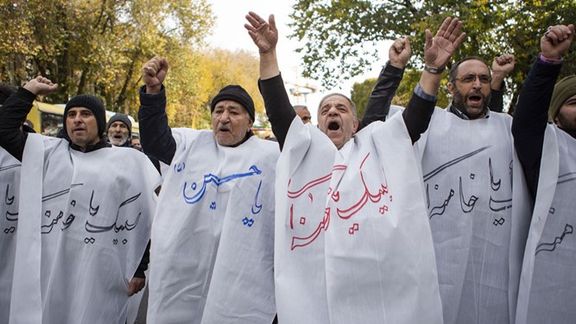
Pro-establishment protesters in Iran wearing shrouds with Khamenei's name printed on them
The protest by a guest on a program aired by Iran’s state television has ignited widespread debate over the Islamic Republic's emphasis on the veneration of death and its aversion to expressions of joy.
At the conclusion of each episode of the program The Black Box, guests are presented with a black box containing a folded white shroud tied with a black ribbon, along with a mock death notice featuring their photo. In this program, intended to be a light-hearted one-on-one talk show, guests are then asked to share their feelings about confronting their own mortality.
The shroud symbolizes the government’s Shia ideology, representing a wish for the recipient to achieve the honor of martyrdom or simply depart from an unworthy earthly life and go to paradise.
Around fifty episodes of the program have been aired over the past ten months with guests chosen from among recognized political, artistic, athletic, and academic personalities.
Many Iranians only heard the controversial program’s name a few days ago because Iran's ideologically driven state television has lost most its audience to satellite TV channels. Many Iranians turn to these both for news and entertainment.
The program drew widespread attention after a guest shared a video on social media. In his post, Hadi Amel, a popular television wrestling reporter, criticized the state broadcaster for the insensitivity of the gift he was presented with at the end of the show.
Amel revealed that he had protested immediately in the studio, demanding that the footage of the incident not be aired. Despite his request, he noted in his post, a re-run of the episode was broadcast last week. "It was unethical. They broke my heart," he said.
Amel’s post and a video clip of the controversial scene quickly went viral on Persian social media with thousands commenting.
In the aired program, Amel is visibly shocked upon opening the black box and discovering the gift symbolizing his "future." "I don’t like this. I don’t like talking about death," he says, placing the death notice face down on the table.
The presenter appears equally uncomfortable, turning to the production team and asking, "Is this what you wanted?" He then calls the gesture "bad taste."
“You wouldn’t kill so many people, commit such injustices, carry out executions, or engage in so much corruption if you truly understood the meaning of a shroud, a death notice, or the day of death,” a viewer said in an audio message sent to Iran International TV, addressing the Islamic Republic authorities. “You are the ones who should be gifted shrouds, as you are nearing your final day,” he added.
Shortly after, an excerpt from another episode surfaced on social media, showing the shocked reaction of another guest, Maryam Razzaghi-Azar, a prominent professor of pediatric endocrinology. Upon receiving the gift, she protested, stating that she did not want her children to see the shroud and death notice. She then insisted that the presenter tear it to pieces.
The intense public backlash compelled Peyman Jebelli, the head of the state broadcasting organization (IRIB), to address the controversy. Speaking to reporters, he acknowledged the criticism, agreeing that the gift was in poor taste. Jebelli also claimed to have reprimanded the producers responsible for the decision.
Despite the public outcry, pro-establishment figures and social media users argued that the criticism was unfounded because only two of the nearly fifty guests of the program were offended by the gift while some others, including ultra-hardliner lawmaker Hamid Rasaei, had even welcomed it.
Speaking to Iran International TV, prominent Washington-based Iranian sociologist Hossein Ghazian explained that the program’s controversy stems from its production and broadcast by a state-owned media outlet. He suggested that if a similar concept had been produced by, for example, a Belgian television channel, it might have been seen as creative. However, Iranians reacted negatively because the program is perceived as a reflection of the state’s ideology, he noted.
Ghazian argued that, within this ideology, life is viewed as a fleeting phenomenon unworthy of significant focus, while death is regarded as eternal. “In political terms, this implies that people should not expect much improvement in their living conditions from the government,” he added.
The IRIB has completely degenerated,” psychologist Azadeh Jazini wrote in an X post to fellow citizens. “This toxic system, which opposes life and happiness, has now stooped to presenting gifts that induce mental collapse. Stay away from this media outlet, not just for your own mental well-being but also to protect the mental health of your children.
Some of Iran's Reformist politicians have recently called for a secular government; a notion that is in sharp contrast with the religious governing system that has been ruling in Iran since the 1979 Islamic revolution.
The most recent case is Faezeh Hashemi, a former Reformist lawmaker and daughter of a former Iranian president, who was recently released from prison in Tehran after serving part of her sentence for supporting the 2022 protests. In a YouTube interview this week, she said, "I am against religious government," and asserted her belief that "Iran needs to have nuclear bombs."
The Reformist movement, which emerged in Iran at the turn of the century, simply aspired for more respect for the rule of law, more democracy and less dogmatic rigidity, but it was considered to be part of the Islamic Republic.
Faezeh Hashemi, the outspoken daughter of former President Akbar Hashemi Rafsanjani, was a leading member of Iran's fifth parliament [1996-2001). She was popular for her ideas about women's social liberties at the time and later. She was also the publisher of the daily newspaper Zan [Woman], which was banned by the Islamic government in 1999.
Most of the issues she discussed in the interview turned out to be controversial. According to Rouydad24 website, which is a relatively moderate source, only she could have been expected to express such views.
Hashemi remarked that "The stage for the latest presidential election was orchestrated to guarantee Pezeshkian's victory." She added that, "Khamenei and Pezeshkian have reached an agreement to address some of Iran's fundamental issues."
Recommending major changes, she commented, "I believe the Iranian political system should change its doctrine about domestic political issues and some foreign policy matters about the region."
However, in a statement somewhat at odds with her reformist views on domestic politics, Hashemi declared, "I believe in possessing a nuclear bomb. While the world has embraced nuclear deterrence, why should we deprive ourselves of it?"
On a key foreign policy issue, she said: "We have to maintain relations with the United States and that will be made possible only through opening our embassies in each other's countries."
Explaining her political leanings, she said, "Like my father, I am a conservative who wants reforms." She also claimed that her father's death during an afternoon swim in January 2017, while under the watch of several IRGC officers, "was not due to natural causes." Additionally, she remarked, "I have heard that former President Raisi's family suspects his death in a 2024 helicopter crash was suspicious."
In a highly controversial statement that contradicts Supreme Leader Ali Khamenei's narrative about enemies conspiring against the Islamic Republic, Faezeh Hashemi declared, "I absolutely do not believe in enemies!" She also expressed her opposition to the imposition of religion and compulsory hijab on women, stating, "I wear hijab myself, but I support women who choose not to."
In another significant development last week, prominent reformist commentator Abbas Abdi questioned the commitment of Islamic Republic officials to the concept of a religious government. Writing in Etemad newspaper, he stated, "Republics are founded on the people's vote. What happens if the people say they no longer want a religious government?
Criticizing the ideas of Ayatollah Mesbah Yazdi, the ideological architect and patron of ultraconservative groups like the Paydari Party, which advocate for an Islamic government over an Islamic Republic, Abbas Abdi wrote: "In Iran’s current system of governance, if a significant portion of the population openly opposes a religious government, the country’s religious leader would be compelled to confront them and impose the religious government and its laws by force."
Judges Ali Razini (left) and Mohammad Moghiseh (right) were assassinated in Tehran on January 18, 2025
Judges Mohammad Moghiseh and Ali Razini, assassinated in Tehran on January 18, had decades-long histories of handing down death sentences and lengthy prison terms to dissidents in numerous cases.
The cases handled by the two judges, both of the clerical rank of hojjat ol-eslam, involved political dissidents, activists, followers of the Baha’i faith, dissident clerics, and those accused of security-related "crimes."
Both Razini and Moghiseh were frequently referred to as "hanging judges" by critics and are primarily remembered for their roles in the 1988 mass executions of political prisoners.
Judge Ali Razini
Born in the western Hamedan Province in 1953, Razini held a variety of high-ranking judicial positions over his career. He began serving as a magistrate in the Revolutionary Court of Tehran as early as 1980, just a year after the Islamic Revolution, when he was only 23.
Razini went on to hold numerous senior roles, including:
• Chief judge of the Special Clerical Court
• Chief of the Judicial Organization of the Armed Forces
• Head of Tehran’s Department of Justice
• Chief of the Administrative Justice Court
• Legal deputy of the Judiciary chief under Sadegh Amoli-Larijani
At the time of his assassination, Razini served as the chief of Branch 41 of the Supreme Court. However, specific details about his appointment to this position remain unclear.
Razini had survived another assassination attempt by a member of Mahdaviyat, a dissident radical Shia group devoted to the Cult of the 12th Imam, Mahdi, in January 1998 when he was the head of the Tehran Department of Justice.
Judge Mohammad Moghishe
Judge Mohammad Moghiseh, born in Sabzevar in 1956, was appointed to the Supreme Court in November 2020 and headed its Branch 53 at the time of his assassination. Prior to this, he served as the chief judge of the Islamic Revolutionary Court in Tehran where he had a record of over thirty years as a judge. Moghiseh was known to use aliases, including "Naserian."
In December 2019, the US Treasury sanctioned Moghiseh and Judge Abolghasem Salavati, the head of the Tehran Revolutionary Court, for human rights violations.
Moghiseh was among the security and judicial officials involved in pursuing the execution of prisoners during the 1980s, particularly in the summer of 1988.
Survivors of those executions have described him as one of the harshest judicial figures in the prisons of the 1980s.
Role in prison purges of the 1988
The mass executions in 1988 targeted members of the MEK (Mojahedin-e Khalq) and, to a lesser extent, leftist prisoners. These executions, which began in July, were carried out based on two orders issued by Supreme Leader Ruhollah Khomeini. Many of the victims were teenagers or people in their 20s, serving prison sentences as political activists, with no history of armed actions against the government.
The condemned were subjected to brief interrogations by "death committees," which included future President Ebrahim Raisi. These sessions, often lasting only a few minutes, determined the prisoners' fates based on their willingness to denounce their political views and affiliations.
Estimates of the number of victims vary widely. Historian Ervand Abrahamian places the figure between 2,500 and 6,000, while the MEK claims the toll is as high as 30,000.
Many victims were buried in unmarked mass graves, such as the Khavaran cemetery near Tehran. Their families were often denied accurate death certificates and were barred from visiting the graves to mourn their loved ones.
Rescue team works following a crash of a helicopter carrying Iran's President Ebrahim Raisi, in Varzaqan, East Azerbaijan Province, Iran, May 20, 2024.
The Iranian Armed Forces released a statement on Saturday, rejecting any suggestion that the helicopter crash involving President Ebrahim Raisi was caused by anything other than bad weather.
This comes after an interview with a family member of Raisi cast new doubts on the official explanation of an accident.
“These claims are far from the truth and appear to be either a result of ignorance or presented with particular intentions,” the statement said. It emphasized that “The cause of the helicopter crash that led to the martyrdom of Ayatollah Raisi and his companions was solely ‘the complex weather and geographical conditions of the area.’”
On May 19, 2024, a helicopter crash in northwestern Iran killed everyone on board, including President Ebrahim Raisi, Foreign Minister Hossein Amir-Abdollahian, and several others. The president was returning from a visit to a dam project, with three helicopters carrying the official delegation. The other two helicopters completed their flights without issue.
On Friday, Mojtaba Mousavi, the brother of Mehdi Mousavi, head of Raisi’s security team, said in an interview that his brother had been opposed to the trip to the Republic of Azerbaijan border but had to proceed under pressure from the president’s office.
Speaking to the Iran24 website, Mojtaba said: “Seyyed Mehdi did everything he could to cancel the trip but couldn’t. He even sent a formal letter, with a copy to the IRGC commander, saying that the IRGC Protection Unit opposed the trip but, as part of its duty, would accompany the president.”
He added that Gholamhossein Esmaeili, Raisi’s chief of staff, had insisted that Raisi is determined to make this trip.
Mojtaba recalled his brother saying: “Where should I take him? To the zero-point of the border? They have surveillance over Iran; it’s near Israel’s neighbor, Aliyev’s territory.”
Iranian officials and political figures have previously raised the possibility of intentional sabotage.
Last month, Iranian lawmaker Kamran Ghazanfari accused the United States, Israel, and Azerbaijan of plotting the crash. Speaking at a conference, he rejected the weather-related explanation, calling it “implausible.”
“Everyone would laugh at the officials’ explanation that Raisi’s helicopter crashed due to weather conditions and dense clouds,” he said. He hinted at an assassination plot involving foreign powers.
The US State Department has denied any involvement. Spokesperson Matthew Miller said in May that Iran had sought help after the crash but said logistical constraints prevented the US from assisting. “We were asked for assistance by the Iranian government,” Miller said in May. “Ultimately, largely for logistical reasons, we were unable to provide that assistance.”
Leadership rivalries and whispers of political sabotage
Beyond accusations of foreign sabotage, some Iranians have pointed to internal rivalries. Mehdi Nasiri, a former editor of the hardline Kayhan newspaper, suggested Raisi’s death might have been tied to succession plans for Supreme Leader Ali Khamenei.
Nasiri speculated that Raisi’s crash could have been orchestrated by those backing Mojtaba Khamenei, the Supreme Leader’s son, as his father’s successor. “In the last session of the previous Assembly of Experts, representatives spoke about Mojtaba Khamenei’s leadership, which was met with reactions from figures like Raisi and others,” Nasiri said. He noted that Raisi’s death coincided with leadership changes in the Assembly, including the removal of figures opposing Mojtaba’s succession.
The Assembly has the constitutional power to determine Iran's next Supreme Leader.
The deaths of Raisi and others, such as Hamas leader Ismail Haniyeh in Tehran, have raised fears of heightened threats to Iran’s leadership from both foreign and domestic sources. While Israel has denied involvement in Raisi’s crash, speculation persist. An unnamed Israeli official told Reuters in May, “It wasn’t us.”
Despite denials, figures like Ghazanfari continue to claim foreign interference, reflecting the tensions in Iran’s complex relationships with its adversaries.
Two Supreme Court judges were shot dead in Tehran on Saturday, state media reported, in a rare deadly attack on senior officials which remains largely unexplained.
Mohammad Moghiseh and Ali Razini, both clerics, were named as the victims. Initially, reports suggested that a third judge had been targeted, but this was later denied by the Judiciary.
State media added that the assailant committed suicide after the shooting.
IRGC-affiliated Fars News reported that the attacker was a staff member responsible for refreshments at Iran's judiciary headquarters who used a handgun in the attack.
The Judiciary Media Center, however, issued a different account regarding the incident suggesting the assailant entered from outside.
"This morning, an armed infiltrator at the Supreme Court carried out a premeditated assassination targeting two brave and experienced judges renowned for their fight against crimes against national security, espionage, and terrorism."
"As a result of this terrorist act, two dedicated and revolutionary judges—steadfast in their defense of public security—were killed."
Iran's Supreme Court counts dozens of judges among its ranks.
The shooter was not involved in any cases in the court nor had been inside as a visitor, the outlet added, saying he died by suicide before police could apprehend him.
ILNA news also reported that several members of staff at Tehran's Courthouse, or Palace of Justice, were arrested on the prosecutor's orders, without elaborating.
"Over the past year, the Judiciary has undertaken extensive measures to identify, pursue, arrest, and prosecute agents and elements affiliated with the despised Zionist regime," ISNA News reported, saying Razini was previously targeted in what it called a terrorist assassination attempt.
A ceasefire deal announced this week between Israel and Hamas signals a defeat for the Palestinian militant group's main backer Iran, a former hostage in Tehran who also influenced the ceasefire negotiations told Iran International.
Nizar Zakka, head of Hostage Aid Worldwide, was abducted in 2015 by the Islamic Revolutionary Guard Corps (IRGC) after attending a conference in Tehran.
The US-Lebanese dual national was locked up four years in Iran’s notorious Evin prison, spending 18 months in solitary confinement, despite being officially invited to the country by a Vice President at the time.
Zakka was released June 2019 in exchange for Negar Qods Kani, an Iranian prisoner in the United States.
Nizar Zakka with Shahindokht Molavardi, who was Vice President for Women and Family Affairs .
“The whole concept of hostage taking has been created and developed by the Islamic Republic of Iran. They (Iran) have built their foreign policy based on hostage taking,” said Zakka on this week’s episode of Eye for Iran podcast.
Hamas and Iran - which arms, funds and trains the Palestinian militant group - had high hopes for the October 7, 2023 attack on Israel which killed 1,200 soldiers and civilians and saw the abduction of 250 foreign and Israeli hostages.
Both framed the deadliest day in Israel's history as the beginning of the end of their hated enemy. But after Israel's fearsome incursion into Gaza devastated the enclave, killing nearly 45 thousand Palestinians, and air strikes pounded Iran and its allies for 15 months, Zakka says Iran is unlikely to view hostage-taking so favorably.
“It's a big lesson that (hostage diplomacy) will not work,” said Zakka.
One of Hamas senior leaders Khalil al-Hayya characterized the ceasefire deal as success for the group, defining it as a "historic moment."
"Our people have thwarted the declared and hidden goals of the occupation. Today we prove that the occupation will never defeat our people and their resistance,” al-Hayya said in a televised speech from Qatar.
Zakka said in fact Iran and its proxy lost their ability to negotiate with people's lives the moment a ceasefire was reached.
It is no coincidence that hostages are at the center of the conflict between Hamas and Israel, Zakka said, as Hamas is carrying on a tradition from the inception of the Islamic Republic after revolutionaries in 1979 seized the US embassy and dozens of US hostages in Tehran in 1979.
The Islamic Republic has for nearly five decades sought to trade foreign detainees with governments in exchange for prisoners or economic and political concessions.
The failure of Iran’s militant proxies and the agreement that on principle has been reached between both sides demonstrates that Tehran’s foreign policy tactic doesn’t have the sway it used to, according to Zakka.
Iran sees it otherwise. The IRGC referred to the ceasefire as a victory for Gaza and the Palestinian people.
A blood-splattered mural depicting Israeli hostages in Gaza was unveiled in Tehran last year with the message: “No hostage will be released,” written in Farsi and Hebrew. Now, it appears, they will.
Mural in Tehran depicting Israeli hostages in Gaza.
If the Israeli cabinet and government formally approve the ceasefire, the first six-week phase will take effect on January 19.
The deal reached Wednesday would see the release of 33 hostages over the next six weeks in exchange for hundreds of Palestinians imprisoned in Israel. The Jewish state would pull back in parts of Gaza allowing the return of displaced Palestinians along with humanitarian aid.
Ceasefire role
“I am so happy. I love it. I did a lot. I worked a lot. Yesterday on Israeli TV Channel 12, they said that the ceasefire was made because of my advocacy and my work," said Zakka.
Zakka was in direct contact with President-elect Donald Trump, encouraging him to take a firm stance to bring back all the hostages, not just Americans among them.
Trump, Zakka said, listened.
“I asked President Trump to pressure Bibi Netanyahu,” said Zakka, "We explained to President Trump that if he would accept to make a deal for only four Americans and leave the rest behind, that would be like signing the death certificate for all the other hostages in Gaza. I told Trump that Bibi Netanyahu will kill everybody."
The conversations between Zakka and Trump took place over WhatsApp and email, he said.
Zakka said the bombing of Gaza also puts the lives of Israeli hostages in jeopardy too. When he was imprisoned in Iran, he said he used to pray for the Americans to bomb the IRGC facilities but with the devastation in Gaza, he realized that would put innocent lives at risk too.
"I feel so much for these people because they are bombed by Israel, their own country, and then taken hostage by Hamas, using them as a human shield."
Ending hostage diplomacy
The American-Lebanese technology expert and former businessman has made it his life's mission to make sure Iran does not engage in future hostage-taking and helping save the lives of other hostages.
Speaking on Eye for Iran, Zakka was in Damascus searching the underground cells for Austin Tice, a US journalist who disappeared during ousted President Bashar al-Assad’s rule.
He is now considered missing, and Hostage Aid Worldwide believes he is being held against his will in a safehouse. Zakka declined to elaborate to protect the investigation.
Zakka is also lobbying the United Nations (UN) to strengthen the International Convention Against the Taking of Hostages to include punishments for violators and for the UN manage talks with countries that engage in hostage diplomacy.
When Iran detained Italian reporter Cecilia Sala last month, for example, Italy negotiated directly for her release.
“We cannot let the Iranian regime negotiate with each country separately, take hostages, and get away with it," Zakka said. "We need to stand together as an international community against hostage-taking.”