Tehran celebrates Gaza ceasefire as Israeli defeat
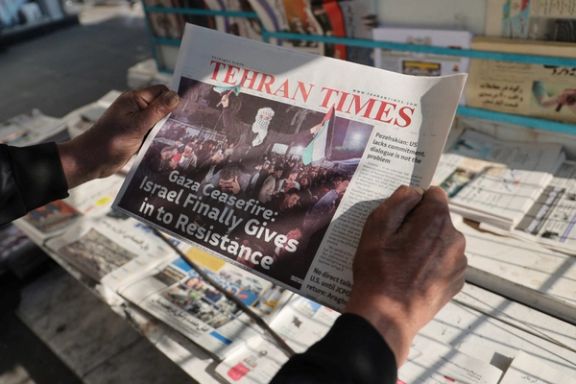
An Iranian man looks at a newspaper after the news of a ceasefire between Hamas and Israel, in Tehran, Iran, January 16, 2025.
Even as a long-sought ceasefire in Gaza has yet to take effect, Iran's supreme leader and other top officials have already begun celebrating it as a victory for Palestinian fighters backed by Tehran.
Iran’s Supreme Leader Ali Khamenei said that the so-called Resistance Axis had succeeded in forcing Israel to retreat.
"Today, the world understood that the patience of the people of Gaza and the steadfastness of the Palestinian resistance forced the Zionist regime to retreat," he wrote on X.
"History will record that one day, a Zionist group, with the most heinous crimes, killed thousands of women and children and ultimately failed."
A ceasefire agreement between Hamas, the Tehran-backed Palestinian armed group, and Israel, mediated by the US, Qatar and Egypt, is expected to begin on Sunday.
The agreement stipulates the release of Israeli hostages held during the 15-month conflict, triggered by Hamas’s October 2023 attack, which devastated Gaza and resulted in the deaths of tens of thousands of Palestinians.
Iran's other armed allies in the region including Hezbollah in Lebanon and the Houthis in Yemen joined the fight against Israel, and the Islamic Republic itself has twice launched missile fusillades against the Jewish State.
The dominant theme in nearly all statements from Iranian officials is the celebration of the resistance's victory against Israel.
This perceived victory is attributed to the resilience and steadfastness of the Gazan population, the majority of whom have been displaced.
An Iranian newspaper with a cover photo of Israel's Prime Minister Benjamin Netanyahu is seen after the news of a ceasefire between Hamas and Israel, in Tehran, Iran, January 16, 2025.
"Peace be upon you for your patience. We welcome the ceasefire agreement in Gaza and salute the souls of the martyrs. It was this brave 15-month Palestinian resistance that thwarted the Zionist regime from achieving its strategic goals," Mohammad Bagher Ghalibaf, Speaker of the Iranian Parliament, wrote on X,.
A statement from the Islamic Revolutionary Guard Corps (IRGC) framed the agreement as a ceasefire imposed on Israel.
"The end of the war and the imposition of a ceasefire on the Zionist regime (Israel) is a clear and great victory for Palestine and a greater defeat for the Zionist regime," it said.
The IRGC also warned against any Israeli violations of the ceasefire and emphasized its forces' readiness to confront future conflicts, saying, "The resistance remains alive, thriving, strong... and has deeper faith in the divine promise of liberating the al-Aqsa mosque and Jerusalem."
Iranians walk next to a billboard with a picture of late Hamas leader Ismail Haniyeh, late senior Iranian military commander General Qassem Soleimani, late Lebanon's Hezbollah leader Sayyed Hassan Nasrallah and late Hamas leader Yahya Al-Sinwar on a street in Tehran, Iran, January 16, 2025.
Almost none of the Iranian statements detailed any specific achievements for Hamas, instead focusing on portraying the truce as a loss for Israel.
The Iranian Ministry of Foreign Affairs also issued a statement declaring the agreement a "historic victory for the Palestinians" and condemned the role of Western nations in supporting Israel and prolonging the conflict.
Hamas, designated a terrorist group by countries such as the US and UK, has been significantly weakened since Israel's relentless retaliatory action following Hamas's October 7 2023 attacks.
IRGC Deputy Commander Ali Fadavi declared the ceasefire a major victory because Israel was compelled to accept "all the conditions of Hamas and the resistance front."
Iranian Ambassador to Lebanon Mojtaba Amani said that Israel was forced to sign an agreement it had initially rejected, labeling it as a failure for Israeli Prime Minister Benjamin Netanyahu in his efforts to dismantle the organizational structure and military capabilities of Hezbollah, Hamas, and Islamic Jihad.
However, Sadegh Zibakalam, a former lawmaker known for his critical views, offered a contrasting perspective. "The ceasefire between Hamas and Israel hasn't even begun, and the Islamic Republic is already claiming victory. I wish they would define what victory means," he said.
He said US President-elect Donald Trump was to be credited with the ceasefire: “Netanyahu hasn't won either because the agreement is the same one they had reached before, but Biden couldn't stand up to Netanyahu. If there is a victory, it belongs to Trump, who was able to force the Israeli hardliners to agree to a deal."
Israel's acceptance of the deal would not be official until approved by the country's security cabinet and government, with a vote scheduled for Thursday, according to Reuters.
Netanyahu accused Hamas of making last-minute demands and reneging on agreements. Reuters reported that Gaza residents and authorities said Israeli airstrikes killed at least 70 people in the enclave overnight on Thursday.
In November, Hezbollah and Israel agreed to a 60-day ceasefire weeks after escalating conflict led to the death of Hezbollah leader Hassan Nasrallah in an Israeli airstrike in Beirut.
In October, Israeli forces also killed Hamas leader Yahya Sinwar, the architect of the October 7 attacks which killed around 1,100 Israelis - most of them civilians - and ensnared over 250 hostages.
Ismail Haniyeh, the head of the group's political bureau was killed in an Israeli bombing of his guesthouse in Tehran in August.
Western officials, including White House National Security Advisor Jake Sullivan, have suggested that the conflict between Israel and the Iranian-backed "Resistance Axis" has significantly weakened Tehran.
However, the IRGC's top commander Hossein Salami stated last week that Iran's enemies are experiencing a "false sense of delight" regarding recent regional developments including the fall of Syrian President Bashar al-Assad, Tehran’s longtime ally.
The spokesman for Iran's Ministry of Foreign Affairs said Thursday that Trump advisor Elon Musk had no involvement in the recent release of Italian journalist Cecilia Sala, as reported in US media.
Esmaeil Baghaei dismissed reports from the New York Times in November as "media storytelling and pure fabrication."
Officials from the Italian Foreign Ministry also said they had no knowledge of any connection between Musk and Sala’s release.
Iranian media reported that Baghaei also reiterated that there was no meeting between Ambassador Amir-Saeid Iravani and Elon Musk.
Cecilia Sala, a 29-year-old journalist and podcaster, was arrested in Iran last month on unspecified charges, despite holding a valid press pass. She was placed in solitary confinement, raising international concerns about her well-being.
A source familiar with discussions between Sala's family and the Italian government told Iran International that Tehran had tied her release to Italy’s handling of an Iranian detainee.
Iran suggested that Sala’s freedom was contingent on the release of Mohammad Abedini Najafabadi, a 38-year-old Iranian detained by Italian authorities at the request of the United States, according to the source. Tehran denies any connection between the two cases.
Following Sala's release, Najafabadi was also freed on Sunday by Italian authorities, according to Iran's Judiciary.
Iranian President Masoud Pezeshkian and Tajik President Emomali Rahmon shake hands
Iranian President Masoud Pezeshkian said Iran opposes war and violence during his visit to Tajikistan, his first international trip of 2025.
Speaking to students and faculty at Avicenna Tajik State Medical University on Thursday, Pezeshkian said, "We despise war and violence. From a medical perspective, anyone who engages in war likely has an issue in their brain; otherwise, humans would not fight one another."
Earlier this week, Pezeshkian told NBC News that Tehran is committed to peace and de-escalation, delivering a message likely aimed at the incoming US administration.
"The Islamic Republic of Iran is committed to peace and de-escalation in the region and globally. It condemns the Zionist regime's war-mongering, aggression, and genocide, and stands ready for honorable and equal negotiations," Pezeshkian said in an interview broadcast from Tehran on Wednesday.
Pezeshkian went on a two-day trip to Tajikistan, where Iran and Tajikistan signed 23 Memorandums of Understanding (MoUs) covering economic, political, cultural, educational, and trade cooperation.
The agreements, signed in the presence of Pezeshkian and Tajik President Emomali Rahmon, highlighted both countries' commitment to strengthening bilateral ties, according to Iranian local media.
While visiting Avicenna University, Pezeshkian, a heart surgeon by profession, was awarded a professorship and an honorary diploma in recognition of his contributions to healthcare and public service.
The please comes amid international sanctions against Iran for its ongoing nuclear program, support of Russia's invasion of Ukraine, and support of armed groups across the Middle East.
Tehran has also been sanctioned for its violent crackdown of protesters in 2022 which saw over 500 people killed by security forces following the death of Mahsa Amini in morality police custody for not wearing her hijab properly.
Palestinians and journalists react to news on a ceasefire deal with Israel, in Gaza City, January 15, 2025.
Iran's IRGC called the ceasefire between Israel and Iran-backed Hamas a "conquest" for the Palestinian resistance in a statement Thursday.
"Today marks the end of the war and the imposition of a ceasefire on Israel, a clear conquest and a great victory for Palestine, and an even greater defeat for the monstrous Zionist regime," the statement read as quoted by IRGC media Tasnim.
"It brings joy, vitality, and resilience to the people of Gaza as they return to their homes," the statement said, in spite of swathes of Gaza being turned to rubble since Israel's retaliatory offensive following the October 7, 2023, Hamas attacks.
A long-sought Gaza ceasefire-for-hostages deal emerged after an intense 96 hours of negotiations in Doha on Wednesday, brokered by US, Egyptian, and Qatari diplomats who persuaded Israel and Hamas to finally conclude the agreement.
The long-fought war has done nothing to secure more territory or freedoms for the people of Gaza, many of whom have no homes to return to and have suffered a humanitarian crisis.
Hamas, designated a terrorist group by countries such as the US and UK, has also been significantly weakened after the longest Gaza war since the group took control of the strip following a violent coup in 2007.
A senior Biden administration official credited the presence of President-elect Donald Trump's incoming Middle East envoy, Steve Witkoff, as being critical to reaching the agreement announced.
Prominent Iranian satirist and author Ebrahim Nabavi died by suicide in Maryland on Tuesday night, his family said in a statement to Iran International.
"Our father took his own life last night in Silver Spring, Maryland. Over the past decade, our father was suffering from depression and missed Iran, and the impossibility of living in his homeland weighed heavily on him," the statement said on Wednesday.
"He passed away without ever being able to come to terms with his forced exile away from Iran," the family added in the statement.
Born on November 13, 1958, Nabavi was a prominent stand-up comedian and satirist who left Iran for France on April 9, 2003, after serving multiple prison terms due to his activism and criticism of the Islamic Republic.
During his more than two decades in exile, Nabavi worked with several news websites and TV channels, including Voice of America, Zamaneh Radio, Rooz Online, and Gooya.
A widespread network of brokers online are working to facilitate a trade in eggs, sperm, embryos and surrogate wombs, Iranian newspaper Ham-Mihan reported in an investigation.
The report on Wednesday details how the transactions are advertised using coded language such as "work from home" on platforms like Divar - a popular Iranian online classifieds site - Instagram and Telegram.
Iran's lack of a clear legal framework governing the donation of reproductive cells and embryos has allowed the brokers to flourish, with some even collaborating directly with doctors.
The advertisements primarily target young adults aged 18 to 31, with varying prices, Ham-Mihan added. Surrogacy typically costs between 3 and 4 billion rials (approximately $3,750 to $5,000), plus an additional 90 million rials (less than $110) paid monthly to the surrogate until delivery.
In May, Tejarat News, another Iranian news outlet, reported a wider range for surrogacy costs, from 4 to 9 billion rials (roughly $5,000 to $11,000). Citing a gynecologist and a maternity ward nurse, it reported that individuals born in the 1990s are the most common surrogates.
Ham-Mihan reported that sellers are required to provide a physician-certified ultrasound confirming the size and reserve of each ovary, along with a certified copy of their national identity card obtained through a designated notary public.
For married donors written spousal consent is mandatory, while unmarried donors must provide a divorce or death certificate. A psychiatric evaluation is also required for all donors.
Zahra Ahmadi, director of social work at the Royan Infertility Treatment Center, a leading facility in Iran, told Ham-Mihan that brokers and intermediaries profit from the unregulated market.
She emphasized that donors can bypass these intermediaries by contacting the Royan Center directly for anonymous donations, dealing directly with the center rather than individual recipients. Ahmadi added that direct egg donors at Royan receive 160 million rials (about $200) per donation under a formal contract.
The report by Ham-Mihan also connects this trade to a broader trend of organ selling in Iran, which has sharply increased in recent years, even involving buyers in neighboring countries.
In June 2023, Hossein Biglari, head of the Kermanshah Kidney Patients Support Association, reported that kidneys were being sold in the province for negotiated prices between 2.5 billion rials (approximately $3,000 at current exchange rates).
Iranian media reports over the past two years have documented the growing prevalence of advertisements for liver, bone marrow, and cornea transplants, as well as sperm and egg donations appearing publicly alongside the sale of kidneys. Some advertisements even offer hearts for sale.
In May 2023, the Jahan-e-Sanat daily reported that some brokers facilitate the sale of organs in neighboring countries like the United Arab Emirates, Turkey and Iraq, fetching prices between of up to $15,000 for sellers.