Yemen’s Houthis serve Iran and will face more strikes, Netanyahu says
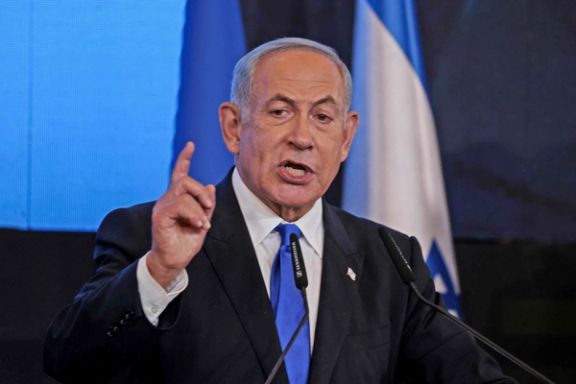
Israeli Prime Minister Benjamin Netanyahu said on Friday that Yemen's armed Houthi movement is advancing Iran's regional agenda and will face continued military action for their attacks on Israel.
“The Houthis are an extension of Iran, and they serve the terrorist goals of the Iranian axis in the Middle East,” Netanyahu said.
The Israeli prime minister said Iran-backed militants “pose a danger to Israel and the entire region, including harming global freedom of navigation.”
His remarks follow airstrikes on Houthi-controlled ports and infrastructure in Yemen on Friday. The Israeli military said that the strikes targeted the Hizaz power station, as well as the Hodeida and Ras Isa ports.
Netanyahu added that Israel will continue “with determination and force against any entity that threatens Israel – wherever and whenever necessary.”
Pro-Houthi Yemeni media reports described nearly 30 airstrikes across Sanaa and Hodeidah.
Iran's foreign ministry condemned Friday's attacks on Houthi positions in Yemen, which it said were carried out by Israel, the US, and Britain, calling the strikes unacceptable.
At least one person was killed and nine others injured in the attacks, according to the Houthi-affiliated Al-Masirah TV.
Outside the building of the General Directorate of Prisons of Semnan Province
A Swiss citizen Iran says died by suicide in prison was a 64-year-old tourist, a Swiss foreign ministry spokesman told Iran International, adding that Switzerland is seeking more details on his arrest and death from Tehran.
The foreign ministry added on Friday that the individual had been living in South Africa for the past 20 years and was traveling in Iran as a tourist.
The email response from the ministry said that the Swiss embassy in Iran was earlier denied access to the prisoner and now wants Tehran to provide full information about his arrest and death.
"Since Switzerland was informed of the arrest, the Swiss Embassy in Tehran has been in daily contact with the Iranian authorities to obtain more information about the circumstances of the arrest and to gain access to the detained Swiss citizen," the foreign ministry said.
"However, due to the accusations (espionage – national security), the requested consular access was not granted," it added. "Switzerland is demanding that the Iranian authorities provide detailed information."
The Swiss citizen who allegedly committed suicide in Semnan Prison on Thursday had been arrested while collecting soil samples in Iran’s central desert during an Israeli airstrike, media affiliated with Islamic Revolutionary Guard Corps reported.
Meanwhile, local media quoted unnamed Iranian official as saying that person was conducting espionage when he was arrested. The name of the Swiss citizen and the circumstances of his arrest and death remain unclear.
“This individual used prior intelligence training to take their own life during a specific opportunity,” Mashregh News, a publication affiliated with the Islamic Revolutionary Guard Corps (IRGC), reported late Thursday, citing an unnamed security official.
"Switzerland is demanding that the Iranian authorities provide detailed information on the reasons for his arrest and a full investigation into the circumstances of his death," the Swiss foreign ministry said.
The individual, detained by the IRGC Intelligence Organization, was accused of gathering information in a sensitive area during Israel's October air attack. The media report specifically said that this occurred during the Shahroud attack, which targeted an IRGC missile facility. Satellite imagery from Planet Labs later revealed significant damage to the site, known for building ballistic missiles and launching rockets as part of Iran’s space program.
After their arrest, the person was transferred to Semnan Prison, where they allegedly revealed information about their network and communication links, according to the outlet.
A local judiciary official confirmed the death on Thursday, saying that the Swiss national, facing espionage charges, had committed suicide in their cell.
Switzerland has also confirmed the death. "The FDFA confirms the death of a Swiss citizen in Iran," spokesperson Pierre-Alain Eltschinger told Iran International. "The Swiss Embassy in Tehran is in contact with the local authorities to clarify the circumstances of the death in an Iranian prison," he added.
According to Mizan, Iran's judiciary news website, the detainee asked their cellmate on Thursday morning to purchase food from the prison canteen. While alone in the suite, the detainee reportedly took their own life. "Prison officials immediately intervened to save the individual, but their efforts were unsuccessful," Mohammad Sadegh Akbari, a local judiciary official, was quoted as saying. “Suicide has been definitively confirmed.”
Iran has arrested dozens of dual nationals and foreigners in recent years, often on charges of espionage or security-related offenses. Some of these detainees have been released in exchange for deals involving Iranians held in foreign prisons.
A missile is launched during a military exercise in an undisclosed location in the south of Iran, in this handout image obtained on January 19, 2024.
Iran has more missiles than it can store, the Revolutionary Guards commander said, dismissing what he called enemy propaganda about the weakening of Iran's armed forces following consecutive attacks by Israel on Iran and its allies.
Providing no details about what he meant by the term, Hossein Salami stressed that Iran faces no shortages of missiles, drones or naval vessels, calling them key elements of the country’s deterrence strategy.
He also announced that the country will unveil new underground missile and drone cities, highlighting them as symbols of military strength and self-reliance, independent of foreign territories like Syria.
Iranian military commanders have been announcing the procurement of new offensive weapons since their proxies and allies in the region suffered consecutive defeats last year.
Tehran was pushed out of Syria in December after the ouster of its ally Bashar al-Assad from power at the hands of opposition insurgents.
Salami added that Iran does not rely on Syria for its deterrent power, stating, "Syria fell, but we did not rely on military advantages from Syria to an extent that would impact our deterrence."
"Our deterrence is not based on operations from any other land. It is fully rooted in Iranian soil, will, decisions, and actions," he added.
However, since establishing its military presence in Syria in 2011, Tehran has frequently emphasized Syria’s importance to its Axis of Resistance, referring to it as its strategic depth.
This comes as two senior IRGC commanders said this week that financial constraints and the loss of Syria, a key regional ally, have left the Islamic Republic unable to retaliate against Israel's October airstrikes.
The loss marks one of the most significant setbacks for Iran’s so-called Axis of Resistance in 15 months of conflict with Israel. Tehran, which frames the Axis as legitimate resistance against Israel, has been cautious to avoid full-scale conflict with its better-armed foe.
Prominent Baha’i poet Mahvash Sabet, 71, may soon be sent back to Evin Prison in Tehran following open-heart surgery, sparking alarm among human rights organizations and activists.
The Baha’i International Community has urged Iranian authorities to release Sabet unconditionally, warning of the serious risks to her life if she is sent back to prison.
Activists worldwide have rallied around her case, organizing a social media campaign under the hashtag #FreeMahvash.
Despite having recently had open heart surgery and worsening health condition, Iranian authorities have granted her only one month of medical leave and expect her to return to prison—a decision that has provoked global campaign.
PEN International voiced grave concern on Thursday over Sabet's return to prison, urging Iranian authorities to release her unconditionally.
Sabet, who suffers from severe heart and lung conditions, as well as osteoporosis and a lung tumor, has spent over 13 years of her life behind bars.
She was most recently arrested on July 31, 2022, and sentenced to 10 years in prison by a preliminary court on charges of leading an “illegal group with the intention of disrupting national security.”
This follows a previous decade-long sentence she served from 2008 to 2017 for her involvement in the governing body of the Baha’i community in Iran.
Sabet’s daughter, Negar who is based in Australia, shared a personal story on her X account, recounting her three-year-old child’s question: "Mommy, is prison even farther away than Iran?"
She reflected on the painful reality of her mother being separated from the family, particularly her granddaughter, who has never met her.
In 2017, Sabet was named an International Writer of Courage by PEN International, recognizing her literary contributions and courage in the face of persecution. She has also received a prestigious literary award in Norway and is an honorary member of PEN branches in Austria, Denmark and the UK.
At around 300,000 people, Baha'is constitute Iran's largest non-Muslim religious minority. Rights groups say that Bahai's have faced systematic persecution and discrimination since the 1979 revolution.
The Islamic Repubic's current constitution only recognizes four religions: Islam, Christianity, Judaism and Zoroastrianism.
Jimmy Carter and the Shah of Iran, November 15, 1977
The ousted Shah and not the United States under Jimmy Carter was responsible for the the rise of the Islamic Republic, a senior aide delivering a eulogy at the late president's funeral said on Thursday.
"Jimmy Carter did not lose Iran, the Shah did," Stuart Eizenstat, Carter’s chief domestic policy adviser, told luminaries gathered at Washington DC's national cathedral.
"The hostage crisis was a major factor in denying him a second term, despite his support for the Shah, because he placed the safe return of the hostages above his own political fortunes."
President Joe Biden, President-elect Donald Trump and all other living former US presidents were in attendance.
Carter and Shah met twice during Carter's presidency, in Washington DC and Tehran, in November and December of 1977. In Tehran, Carter famously toasted the Shah, praising Iran as "an island of stability" in a turbulent region.
Two years later the Shah was forced to leave Iran as revolutionaries led by Ruhollah Khomeini gained control, storming the US embassy in Tehran and holding more than 50 Americans hostage.
The 444-day hostage crisis was an excruciating political liability for Carter, who was painted as weak by his Republican successor Ronald Reagan. A US military raid to free the captives failed, deepening Carter's humiliation.
It crystallized US domestic debates on how forceful US policy abroad should be and put Iran and Washington on track for nearly half century of mutual enmity.
"(Carter) took full responsibility for the failure of the hostage rescue mission and worked tirelessly even after his bitter re-election defeat to Ronald Reagan, securing their release on the last day of his presidency," Eizenstat added.
The US role in the 1979 events remains hotly contested by Iranian critics of the country's Islamic rulers, some of whom say Mohammed Reza Pahlavi was let down by Washington and long for a renewed monarchy under his US-based son, Reza.
Other Iranian dissidents say the late Shah's authoritarianism and mismanagement of the country deprived key ally Washington of an effective partner.
A French mayor has cancelled an advertising campaign on sorting garbage which lampooned Supreme Leader Ali Khamenei, citing safety concerns after Iran decried it as an insult.
The campaign on the back of municipal buses features Khamenei alongside North Korean leader Kim Jong Un and Russian President Vladimir Putin under the slogan "Don’t forget to sort your waste".
Far-right Mayor Robert Ménard of the southern French city of Béziers had spearheaded the initiative but announced the removal of the adverts on Thursday.
Describing the move as a precautionary measure, Ménard told AFP: "We take this very seriously. I don't want there to be the slightest problem, for example, for our bus drivers."
"We've run lots of campaigns, but they never achieve anything. Nobody even notices them. This one, at least, everyone noticed," he added.
Majid Nili, an aide to Iran’s Foreign Minister, announced Thursday that the Iranian Embassy in Paris has lodged an official complaint against the campaign, which he described as an insult to the Islamic Republic, hate speech and disrespect for Iran's cultural values.
Nili further said that the embassy had demanded what he called an appropriate response from the French government, calling for measures to prevent provocations in the future.
The campaign was launched on January 4, 2025, as part of an initiative to encourage residents to participate in waste sorting.
Since then, images of the municipal buses have been shared widely on social media platforms, including the city’s official Facebook page with the caption: "To start the year off right, think about sorting your rubbish."
French media earlier quoted Ménard saying, "These are scoundrels, non-recyclable waste. One wages an unjust war on his neighbors and sends his army to die, another imprisons his population and the last treats women worse than doormats while eliminating his opponents."
In his New Year’s statement, he also expressed solidarity with the women of Iran, saying: "I am also thinking of those women who, in Iran and elsewhere, refuse to be confined behind a veil, a prison of fabric."