The remnants of an Iranian ballistic missile downed on October 1, 2024
April to October 2024 may well be recorded by historians as the critical months when the simmering shadow war between Iran and Israel erupted into open conflict, reshaping the Middle East irreversibly.
As analysts work to interpret Israel's decisions and the growing challenges it faces, President Joe Biden and some Western allies have criticized Prime Minister Benjamin Netanyahu’s hardline approach toward Iran's proxies. They describe this stance as "unhelpful," attributing part of the ongoing attacks from Iran and its allies, which have intensified since October 2023, to Israel's own actions.
Nearly a year since Hamas’s attack on October 7, 2023, it is ever more apparent that even those in the highest seats of power require a sobering reminder of the events that have plunged the Middle East into chaos. Let there be no ambiguity: circumstantial evidence and irrefutable facts make plain that any perceived obstinacy on Prime Minister Netanyahu’s part in the drawn-out ceasefire talks is a necessary answer to crises not of Israel’s making. These dire circumstances have been thrust upon Israel, the Palestinians, the Lebanese, and the Iranians alike by the malevolent machinations of Iran’s mullahs and their armed henchmen. It is they who have brewed this bitter draught, imperiling the peace of the Middle East—and indeed, the world.
The road to escalation
The present crisis was unleashed in the early hours after Hamas's brutal assault upon southern Israel on October 7, 2023. As Israel moved swiftly to repel and extinguish the invaders in the south, Hezbollah—Iran’s foremost armed proxy in the region and Israel’s northern neighbor—opened a barrage of projectiles on October 8 upon northern Israel, forcing the nation into a multi-front struggle against Iran’s sprawling web of armed proxies. By the dawn of 2024, the flames of conflict, fanned by these proxies, had set the entire region ablaze.
Over the past year, and most markedly since February 2024, the Biden administration has sought to fortify its military might in the region, deploying a formidable fleet—several aircraft carriers, an attack nuclear submarine, and a host of air squadrons—all with the declared purpose of deterrence. Yet, whilst thus brandishing its strength, it has exerted ever-mounting pressure upon Israel to curtail its operations in Gaza and assume a more flexible stance in ceasefire talks with Hamas. Accompanying these efforts has been a tireless shuttle diplomacy led by the administration’s foremost emissaries—Secretary of State Anthony Blinken, CIA Chief William Burns, National Security Advisor Jake Sullivan, and, as of March 2024, Special Envoy for Lebanon Amos Hochstein. However, this flurry of diplomatic ventures has, thus far, yielded but scant fruit and remains barren of tangible success.
In the spring of 2024, the IRGC and Hezbollah, hand in glove, fortified their forces and missile sites along Israel’s northern frontier, with the express aim of forcing Israel's hand in the faltering ceasefire talks with Hamas. To secure full coordination and devise new schemes—including the rumored audacious incursion into northern Israel, mirroring Hamas’s brazen October 7 assault on the south—Tehran dispatched several of its IRGC high command, led by General Zahedi, to Damascus.
On April 1, in a bold pre-emptive strike, Israel eliminated General Zahedi and his lieutenants within the very walls of the Iranian embassy compound in Damascus—an act swiftly condemned by some as a breach of international law but vindicated by the exposure of Iran's exploitationof diplomatic immunity, flouting the 1961 Vienna Convention on Diplomatic Relations.
Iran’s reprisal came on April 13, unleashing a slow-motion barrage of hundreds of projectiles upon Israel. Six days later, on April 19, Israel struck back, dismantling a critical anti-aircraft radar system within an airbase deep in the Iranian heartland. This was merely the prelude to what followed. On July 31, Israel struck down Hamas’s political chief, Ismael Haniyeh, in Tehran—a blow that disgraced Iran's intelligence and marred President Masoud Pezeshkian's inauguration. And on September 27, Israel eliminated Hezbollah’s Secretary General, Hassan Nasrallah, in Beirut, marking a decisive shift in the balance of power.
On the very day that Iran unleashed nearly 200 projectiles upon Israel on October 1, 2024, Israel commenced its limited ground incursions against Hezbollah in southern Lebanon. At this moment, not just the region, but the entire West, stands confronted with a stark and ominous reality: A nuclear threshold state—Iran—has openly demonstrated its resolve to strike at Israel, for a second time, employing ballistic missiles that stands but a few short strides away from being armed with nuclear warheads. Furthermore, Iran’s formidable proxy, Hezbollah, however hitherto somewhat decapitated, bruised, battered, and on its backheels, holds an arsenal of tens of thousands of rockets and precision-guided missiles, poised and ready to be hurled upon Israel at any given moment.
Dilemmas and options
Those who strive to prevent a region-wide conflict would be wise to confront the stark realities of the Middle East as they truly are. It is not simply a matter of averting a conflict that looms on the horizon—for that conflict is already upon us. Rather, their task is to prevent the entire region from spiraling into total war—a total war overshadowed by the specter of nuclear proliferation, driven by a Shia fundamentalist theocracy whose professed aim for the past 45 years has been the destruction of the State of Israel, and whose leaders have openly threatened to accelerate their march towards nuclear armament as of May 8, 2024.
Indeed, as the world held its breath, anticipating Iran’s reprisal for the elimination of General Zahedi by Israel, the author of this very piece observed on April 10, 2024, that Iran might hasten its march toward nuclear armament, seeking to wield such weapons as a deterrent against Israel and the United States. Israel has sounded the alarm to the world since at least 2004, but those warnings have all too often fallen upon deaf ears.
In this grave hour, it is certain that the majority of Israelis stand as one, ready to support their government should it act to vanquish any threat to the very existence of the Jewish State. Of all perils upon the horizon, none is more immediate than the specter of Iran's nuclear program. Its destruction—whether partial or total—is not merely a strategic aim but a matter of survival. Equally vital is the crippling of Iran’s military-industrial capabilities. Let there be no delusion: Iran has become a purveyor of military drones, missiles, and munitions, threatening the peace and stability of the Trans-Atlantic world, and proving itself a menace not just to the region but to the global order.
Israel faces the delicate task of navigating the goodwill of Iran and Lebanon, nations it may need to strike. Yet, solace lies in the deep bitterness harbored by millions of Iranians and Lebanese against the Shia clerics and their armed minions, who have brought years of turmoil and economic ruin. The recent deployment of anti-riot forces across Iran—to quash any celebration after Hassan Nasrallah’s elimination—reveals the depths to which the regime has fallen in the eyes of Iranians, who valiantly rose in 2022 to cast off the mullahs, though in vain. A similar sense of relief resounds in Lebanon, Nasrallah's own land, exposing the growing chasm between the people and their so-called protectors.
Netanyahu, keenly attuned to this discontent, directly addressed the Iranian and Lebanese peoples, urging them to rise and shatter the chains imposed by Hezbollah and the Islamic Republic of Iran—appeals that resonated deeply. Thus, Israel would be wise to wield its might with utmost precision, striking at the military-industrial sinews of both the Iranian regime and Hezbollah. If Israel chooses to target Iran’s petrochemical plants—lifeblood of revenue for the ruling echelon and the IRGC—and their refineries, it would deliver a grievous blow to a regime already struggling to provide petrol to its own citizens, despite its status as an oil-exporter. Such a crippling of economic power would shake the very foundations upon which the regime's dominion rests.
On a final, yet vital note of protocol, Israel has, throughout its history, scrupulously refrained from the assassination of heads of state or government, even amidst its most formidable foes. As the fog of war clouds the judgment of many, any such speculation that Israel intends to strike down Ali Khamenei verily appears as naught but a far-fetched fancy.
The fallout
Israel must brace itself to weather condemnation from both friend and foe, should it unleash devastating blows upon the Islamic Republic of Iran and Hezbollah in the coming days and weeks. Such rebuke, though it may ring loud and strident, shall, in all probability, dissipate into the ether, drowned by the manifold crises with which humanity now grapples. From a contested US presidential election to the grim intensification of the Russo-Ukrainian War, and any unforeseen calamities that may yet darken our shared destiny, these cries of censure shall become mere whispers, lost to the winds of time.
In the final reckoning, Israel’s strikes may prove fatal to Hezbollah, dismantling it as a paramilitary behemoth—a state within the Lebanese state—and reducing it to a mere political faction. The twin blows of military decimation and economic ruin upon Iran’s economic and nuclear infrastructure may well mark the beginning of the end for a regime that has held sway over Iran for nearly half a century. Yet, let none forget that such regimes seldom relinquish power without a sanguinary struggle, as they stare into the abyss of their own collapse.
Opinions expressed by the author are not necessarily the views of Iran International
Iranians attend a gathering to support the IRGC attack on Israel, in Tehran, Iran, October 2, 2024.
As anxious Iranians followed the news of the October 1 ballistic missile attack on Israel and awaited Israel's response, others speculated about a possible shift in the Islamic Republic's nuclear doctrine.
Some speculated that Supreme Leader Ali Khamenei's prominent appearance to lead Friday prayers in Tehran on October 4 might signal a new era, potentially marked by Iran's withdrawal from the Non-Proliferation Treaty (NPT), as hardliners on state TV suggested. There was also widespread anticipation that Khamenei could announce the weaponization of Iran’s controversial nuclear program. On social media, some Iranians even suggestedthat Khamenei's next move might be pursuing the development of a nuclear bomb.
Political analysts were less direct than social media users in their assessments. International relations analyst Reza Nasri conveyed a nuanced perspectiveto Etemad newspaper in Tehran, suggesting that "Iran's defense doctrine operates independently of public sentiment. Decisions are made at higher levels of the political structure, likely referring to Khamenei's office, based on all indications. Nonetheless, the regime has yet to make a definitive decision regarding the pursuit of nuclear weapons."
According to Etemad, the IRGC's Javan newspaper, however, wrote in May that "The strategic implication of the rhetoric surrounding a shift in Iran's defense doctrine is that, regardless of whether we possess nuclear weapons, the United States should recognize Iran as a nuclear power, given our capacity to develop them. This approach effectively sidesteps the ongoing discourse about the nuclear issue."
However, the greatest fear for a nation still haunted by the memories of the 1980s Iran-Iraq war is that escalating military actions between Iran and Israel could spiral into a prolonged and far more destructive conflict.
Iran kept the aviation industry was kept in the dark about the imminent attack. Videos on social media show passenger aircraftchanging route over Urmia and landing in Shiraz against a backdrop of missiles flying in the sky despite the obvious danger, creating further terror for Iranians.
Iranian Foreign Minister Abbas Araghchi told reportersin Tehran that the government let the United States know about the attack via the Swiss Embassy in Tehran after it was done. However, it was the United States that informed the world of the upcoming attack more than two hours in advance.
Aviation experts on social media revealed that Iranian airspace was finally cleared only at the end of the missile attack. In the meantime, some failing missiles dropped in areas including Zanjannear Tehran.
Some Iranians reminded the government that Israel has provided bomb shelters for its citizens while if missile strikes occur in Iran, the people have no shelter other than the basements of high-rise buildings where they could possibly be buried alive in heavy bombardments. The call for shelters and a demand for briefings by officials on the situation was made repeatedly on social media. Lack of concrete and accurate reporting by the official media outlets make the situation even more chaotic and terrifying.
Speculations on what exactly Israel's reaction to Iran's attacks might be are even more terrifying for ordinary Iranians. Iranian social media user Ehsan Soltani, a student in Middle east Studies at the University of Venice, summed up some of the possible scenarios as: "Attacks with deep psychological impact such as the attacks on pagers in Lebanon, strikes on Iran's missile depots, assassination of top military commanders and political leaders, attacks on Iran's nuclear establishments and infrastructure such as refineries."
While none of these scenarios may come to pass, the mere possibility of them is deeply unsettling.
Planet Labs satellite images published by AP on October 3, 2024 show damage to a hanger at the Nevatim Airbase
Satellite images released Thursday have revealed the extent of the damage caused by Iran's ballistic missile attack on Israel’s Nevatim air base, located near Be'er Sheva.
The missile strike, which occurred Tuesday night, marks an escalation in the ongoing hostilities between Israel and Iran, which supports Hezbollah and Hamas militants.
The images, shared by the Associated Press, show a large hole in the roof of a hangar near the main runway of the base, with debris scattered around. Nevatim is home to several critical Israeli Air Force squadrons. However, Israeli Defense Forces (IDF) officials have not confirmed what caused the destruction seen in the photos.
The IDF confirmed structural damage at multiple bases but stressed that no casualties were reported, and no aircraft were harmed.
The air base prior to Iran's attack (Photo: imagery @2024 cnes \Airbus, Maxar Technologie, Map data@2024 Mapa GISrael \ AP)
Sky News has also identified at least seven impact sites, including two Israeli airbases, a school, and two locations near the area believed to house Mossad's headquarters.
The news outlet has geolocated three videos indicating that the Nevatim airbase was targeted in the recent missile strike. Although none of the videos confirm a direct hit on the base or the extent of any damage, the footage collectively suggests that missiles landed within its perimeter, with at least shrapnel damage to the site.
In the videos, at least eight missiles are seen exploding in the direction of the base.
The strike, the second direct attack from Iran, follows an earlier missile bombardment by Iran which included targeting Nevatim in April, the base considered a critical target for Israel’s air defense.
Nevatim base, situated east of Be'er Sheva in southern Israel, houses three squadrons of F-35 fighter jets, along with transport units flying Super Hercules and Hercules aircraft. It also serves as the home of the Wing of Zion, Israel's official state aircraft.
Interceptions by Israel's air defense systems, designed to destroy or deflect incoming missiles, make it challenging to determine if the eventual landing sites of missiles or debris were the intended targets. Iran claimed that 90% of the missiles hit their targets, while Israel reported that many were intercepted.
Although the Iron Dome is the most recognized component of Israel's defense, Arrow 2 and 3 systems were the primary defenses against the long-range ballistic missiles launched by Iran. These systems operate outside the Earth's atmosphere, intercepting and neutralizing missiles before they can reach their targets.
President Masoud Pezeshkian’s order to the Supreme Council of Cyberspace to crack down on the sale of anti-filtering software has left his supporters confused, as he had previously promised to lift internet filtering.
“I can’t understand the meaning of this order about anti-filtering software and how it can help the removal of filtering,” reformist political activist Hasan Asadi-Zeidabadi complained in a tweet Wednesday.
As president, Pezeshkian leads the Council, which includes several key cabinet members, such as the ministers of telecommunications, intelligence, culture and Islamic guidance, science and technology, education, and defense.
Before being elected, Pezeshkian strongly opposed the filtering of the internet which has forced tens of millions of Iranians to pay for anti-filtering software to get access to thousands of websites as well as all major social media platforms such as Instagram, WhatsApp, Telegram, and YouTube for personal use and business.
In the past two decades, the Islamic government has censored thousands of websites deemed religiously inappropriate or politically dangerous, while also blocking access to foreign social media. This has left citizens with no choice but using circumvention tools, such as VPNs.
Many allege that influential groups and companies that sell anti-filtering software have a strong foothold in the establishment and and have huge vested interests in the continuation of internet filtering. A majority of the population spends a few dollars a month on circumvention software.
The President’s supporters expected him to speak about filtering at the first meeting of the Supreme Council of Cyberspace which convened Tuesday for the first time since he took office and convince other members to lift it.
“Mr. Pezeshkian, we didn’t vote [for you] to investigate the sale of anti-filtering software, we voted because we wanted filtering to be removed,” a disillusioned supporter tweeted.
Instead, the media reported that he ordered action against the companies that make hundreds of millions of dollars from selling anti-filtering software and declined to set a definite term for the removal of filtering.
Many allege that influential groups and companies that sell anti-filtering software have a strong foothold in the establishment. These groups, they say, have huge, vested interests in the continuation of the filtering.
“Mr. President, trust us that one of the most important things for national unity and dignity for Iran is normalizing the conditions of the internet [access]. Remove the filtering and the mafia [that controls the sales] of anti-filtering software will be gone by itself,”journalist Ehsan Bodaghi tweeted.
Rouydad24 news website on Wednesday argued along the same lines saying that Pezeshkian’s order to take action against vendors of anti-filtering software could be an indication that there was “no will to lift the filtering of social networks in the short term”.
"The challenges of Pezeshkian's path don't stop people from holding him accountable," Rouydad24 wrote. "He promised to lift filtering and even vowed to stake his life on it."
Government spokeswoman Fatemeh Mohajerani stated on Wednesday that the administration is actively addressing the removal of filtering through various relevant bodies and councils, expressing hope that the promise made to the public will soon be fulfilled.
The Supreme Council of Cyberspace was formed in February 2012 by Supreme Leader Ali Khamenei’s decree which mandated it to establish a “national cyberspace center” and invested it with the power to decide internet control policies.
The majority of the Council's members are either directly appointed by Khamenei ("natural" members) or hold their positions due to roles in other parts of the government that he assigns to them.
These include the chief justice, parliament speaker, head of the state broadcaster, as well as commanders of the Revolutionary Guards (IRGC) and the Law Enforcement Forces (Police).
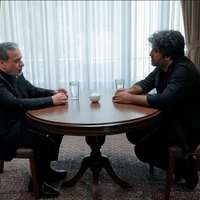
Qatar's Emir Sheikh Tamim bin Hamad al-Thani meets with Iran's President Masoud Pezeshkian, in Doha, Qatar, October 2, 2024.
Iranian President Masoud Pezeshkian warned that Tehran would deliver a strong response to any further Israeli actions, however he mentioned that Tehran is not seeking war with Israel.
“We are not in pursuit of war with Israel. They promised us peace. But Israel has terrorised our guests in Tehran during our presidential inauguration. We want to establish peace. If you disagree, peace will not be established,” he said on Thursday during his trip to Qatar.
Pezeshkian’s trip came a day after Iran launched waves of ballistic missiles at Israel, prompting tensions between the two arch enemies. In response, Israel escalated its ongoing conflict with Tehran’s ally Hezbollah by sending more troops across the border into Lebanon. Israeli Prime Minister Benjamin Netanyahu stated that Israel would retaliate against Iran following the missile strikes.
"If the Zionist regime does not stop its crimes, it will face harsher reactions," Pezeshkian stated before leaving Tehran, according to Iranian state media. He reiterated his position during a joint press conference in Doha with Qatar's Emir Sheikh Tamim bin Hamad al-Thani, emphasizing that if Israel acts against Iran, Tehran will respond more severely.
Qatar, which does not have diplomatic relations with Israel, has been one of the mediators between Israel and Iran-backed Hamas. Israel has accused Qatar of being too soft with Hamas which has one of its political offices in Doha.
Pezeshkian also addressed the recent assassination of Hamas leader Ismail Haniyeh on July 31 in Tehran, which Iran blames on Israel, though Israel has not officially confirmed its involvement.
The Iranian president called on the United States and European countries to pressure Israel to avoid further “destabilizing” the region, without taking responsibility for Tehran's proxies being active across all Israel's borders. Since Hamas's invasion of Israel on October 7, Iran's militias in Yemen, Syria, Iraq and Lebanon have launched attacks on the Jewish state in allegiance with Hamas in Gaza.
The Qatari Emir, Sheikh Tamim, reiterated Doha’s commitment to mediating peace efforts, particularly in the ongoing conflict between Israel and Hamas in Gaza, which has been ongoing for nearly a year. Efforts to reach a ceasefire have so far stalled.
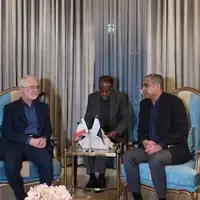
Iran’s President Masoud Pezeshkian (left) meeting Hamas officials in Doha on October 2, 2024.
While in Qatar, Pezeshkian also met with a high-ranking delegation from Hamas and Saudi Foreign Minister Faisal bin Farhan. During his talks with the Saudi official, Pezeshkian expressed satisfaction with what he described as expanding relations between Iran and Saudi Arabia and highlighted Iran's interest in strengthening ties across the region, in spite of the limited progress between Iran and Saudi since last year's resumption of diplomatic relations.
The Iranian president will continue his visit by attending the Asia Cooperation Dialogue (ACD) Summit in Doha, where he is expected to seek broader regional support against Israel. He is scheduled to address the summit, which includes 35 Asian countries.
Iran's uranium enrichment facility in Natanz, Isfahan. File photo
Following the recent escalation between Iran and Israel, a hardline Tehran newspaper is calling for a significant shift in the Islamic Republic’s nuclear doctrine, advocating for a major “transformation.”
On October 1, Iran launched a large-scale ballistic missile attack on Israel, citing the need to defend its national interests following Israeli strikes against its primary military proxy, Hezbollah, in Lebanon. In response, Israel has vowed a forceful retaliation.
As Iran braces for Israeli retaliation, the Javan newspaper, representing the Islamic Republic’s ultra-hardliners, argued on Thursday that it is time for Iran to revise its nuclear doctrine, which has long claimed the country is solely focused on peaceful objectives.
In a note written by Ali Ghannadi, Javan emphasized that "while Iran's nuclear doctrine over the past fifty-plus years (including the Pahlavi era) has been focused on the peaceful use of nuclear energy, today Tehran has the capacity, context, and opportunity for an immediate transformation in this program."
The note argued that conventional attacks on Israel fail to provide adequate deterrence, "given the resolve of Israeli leaders to use devastating military technology to establish a new order. This approach risks escalating the conflict even further. While some may propose creative solutions to manage the situation, one immediate option is a shift in Iran's nuclear doctrine."
The article noted that if the escalating confrontation and mutual attacks lead to a point when Israel faces and existential threat, would its government issue a nuclear threat against Iran? “Is the possibility of Israel issuing a clear or secret nuclear ultimatum out of the question?"
The hardliner newspaper went on to argue that Iran needs a deterrence against Israel’s overwhelming technological advantage, hinting at what could be interpreted as mutual nuclear deterrence.
Supreme Leader Ali Khamenei is expected to deliver a sermon during Friday prayers in Tehran on October 4, with speculation that he may unveil a new nuclear doctrine following the severe damage to Hezbollah, Iran’s key proxy force. Currently, Iran is amassing a stockpile of uranium enriched to 60%, which could be refined to 90%—the level needed for a nuclear bomb—in just two weeks. A shift in Iran's nuclear doctrine could signal an open move to enrich uranium to 90%, threatening the development of a nuclear weapon if Israel targets its vital interests.
Nearly a dozen nuclear sites in Iran are potential targets in an Israeli attack aiming to destroy or cripple Tehran atomic program, specifically its enrichment centers in places like Natanz.
Former Israeli Prime Minister Naftali Bennett called Tuesday for the destruction of Iran’s nuclear program following the Iranian missile attack.
“Israel has now its greatest opportunity in 50 years, to change the face of the Middle East,” Bennett said on his X account.
“We must act ‘now’ to destroy Iran’s nuclear program, its central energy facilities, and to fatally cripple this terrorist regime.”