An Iranian missile system is displayed next to a banner with a picture of Iran's Supreme Leader Ayatollah Ali Khamenei and the late Lebanon's Hezbollah leader Hassan Nasrallah, in a street in Tehran, Iran, October 2, 2024.
In the wake of Iran's massive but largely ineffectual missile barrage, Israel has arrived at a critical crossroads that will test its ambition in dealing with its mortal enemy.
All options carry grave consequences for the balance of power in the region and Israel's standing in an increasingly intense conflict flaring on multiple fronts.
Israel could heed US and international pleas for calm by downplaying the attack - just as it did when Iran launched its last missile volley in April - and hold off on a major response.
It might decide to target Iran’s political and military leadership, killing key figures as it has with Iran-backed Hezbollah in Lebanon.
In an even more extreme scenario, the Jewish state could take aim at Iran’s nuclear facilities, vital military sites, and economic infrastructure such as oil fields and refineries.
Still more devastating would be a combination of the last two options: an all-out strategy in which assassinations are paired with widespread destruction of military and economic infrastructure.
No perfect option
The first option is highly unlikely.
With the stakes so high, ignoring the attack may be seen from Israel as emboldening Iran and sending a message of weakness to its regional allies just as Israel appears to be gaining a military advantage, particularly in Lebanon.
The assassination route, while projecting unabashed strength, would not have a game-changing impact on the ground: Iran would quickly fill any personnel gaps with even more hardline cadres with redoubled hatred towards Israel.
The most extreme options also carry the most risks. Targeting Iran’s nuclear sites and infrastructure would almost certainly escalate into a full-scale war and drag the United States into the conflict - something both presidential hopefuls are on record as seeking to avoid.
A hobbled Hezbollah would mean the end of Iran’s most effective deterrent force in the region
The Hezbollah Factor Iran has always been hopeful that if it faced a confrontation with Israel or the US, Hezbollah’s presence in Israel’s neighborhood would make them think twice.
But Iran’s deterrent force in Lebanon has now been significantly weakened by Israeli bombings and airstrikes. Israel systematically targeted and decimated Hezbollah’s leadership within two weeks, and its missile arsenal could be degraded next.
A hobbled Hezbollah would mean the end of Iran’s most effective deterrent force in the region. But might that lead Iran to pivot toward building a new deterrent? And what might this deterrent be other than a nuclear weapon?
This would be an enormous strategic setback for Israel and accelerate the very nightmare scenario it seeks to prevent.
One shot
For Israel, this moment presents a rare opportunity to deal a severe blow to Iran’s nuclear ambitions, one that it would be reluctant to pass up.
But the bigger question remains: Will President Joe Biden support Israel’s more aggressive actions, even if it means risking a new war in the Middle East?
The answer is far from simple. If the Biden administration doesn’t back Israel, the Democratic Party could appear feckless and weak, which may not help at polls. But if it chooses to support a military strike that cripples Iran, it could alienate the left wing of his party, potentially losing some progressive votes.
Such a move might also appeal to moderate Republicans who oppose Donald Trump, creating an unexpected coalition of support. Standing with Israel could also help guarantee the backing of the influential pro-Israel lobby in Washington.
Israel has not ruled out targeting Iran's nuclear facilities
Can Israel Truly Stop Iran's Nuclear Program?
Some experts believe that Iran’s nuclear program is too deeply entrenched underground for Israeli airstrikes to eliminate it entirely. While it’s true that Israel may not be able to completely destroy the program, a well-executed attack might delay it by a few years.
Furthermore, if Israel opts for a combined assault - targeting both Iran’s nuclear facilities and its leadership - it could wound the Islamic Republic to the point where it may no longer be able to rebuild its nuclear program. In this scenario, the collapse of the whole ruling system could become a real possibility.
Israel's response to Iran’s missile attacks will not only determine the future of the Middle East but also have profound implications for the US's role in the world.
The Biden administration will weigh its options carefully. A misstep could ignite a regional conflict with global consequences, but doing nothing might risk emboldening Iran and rattling the security of the region even more.
Iran’s Fragile State
For the Islamic Republic of Iran, the current situation is precarious. Supreme Leader Ayatollah Khamenei is 85 - and in declining health.
The theocratic 'system' narrowly survived a major uprising just two years ago, and the country's economic conditions have worsened significantly.
Millions of Iranians are grappling with severe economic hardship, while tens of thousands of government workers have protested in the streets over delayed salaries and unpaid wages.
Unemployment remains high, and less than three months ago, Iran held a presidential election that saw a record-low voter turnout, ushering in a president with an unprecedentedly weak mandate.
In this fragile state, and after suffering significant blows from Israel - including the assassination of Ismail Haniyeh in Tehran on the day of the new president’s inauguration - Iran finds itself much weakened.
The question now is: can the Ayatollahs contain the growing discontent within the country if it is drawn into a war?
An anti-Israel billboard is displayed on a building in Tehran, Iran, October 2, 2024.
Iranian netizens are expressing highly contradictory opinions about Tuesday’s missile attack on Israel, ranging from strong approval to calls for Israel to retaliate forcefully.
Posts from Iranian hardliners and ultra-hardliners expressed both enthusiasm for the missile strike and frustration with President Masoud Pezeshkian. This group, which typically supports Saeed Jalili, an ultra-conservative politician and former nuclear negotiator, criticized Pezeshkian and his Strategic Deputy, Mohammad-Javad Zarif, for delaying a response to Israel after the assassination of Hamas leader Ismail Haniyeh in Tehran in July. They argued that the government’s retaliation came too late, further deepening their dissatisfaction with Pezeshkian's leadership.
“Yes, you are right, war is scary but sometimes there’s no other option. War is like chemotherapy which has pain, costs, side effects and may even not work but it is sometimes the only and final path,” a pro-Jalili netizen posted.
“Patience and delay in revenge for Haniyeh did not stop the brutal killing. Fear of war causes war [because] it rouses the enemy’s greed,” another ultra-hardliner tweeted.
“Understand this you idiots: war can only be prevented with firing missiles. Showing fear and weakness is the biggest contributor to the start of a war,” a post by a similarly-minded netizen who used the hashtag #وعده_صادق٢ (Operation True Promise 2) read.
Some ordinary Iranians, who don't seem to support the establishment but may have backed Pezeshkian's presidency in hopes that he could improve their lives, are now expressing fears about the situation escalating into a full-scale war between the Islamic Republic and Israel.
“Israel has yet not responded to last night’s attack. We, the people, live in the shadow of fear, anxiety, and trepidation. We are worried about our children. Queues have formed for gasoline and we are waiting to see what is going to happen,” a netizen who has blamed the Islamic Republic for “starting the war” in her other tweets posted on X.
“The people of the future should know that the reason for the war was the Islamic Republic’s interference and full support for Palestine when other Islamic and Arab countries had withdrawn and were in complete silence,” she wrote in another tweet with the hashtag #نه_به_جنگ("No to war").
Many who advocate for the overthrow of the Islamic Republic, identifying as barandaz (those who seek regime change), are blaming Supreme Leader Ali Khamenei and his loyalists for actions that they believe could push the country into a devastating war.
Some within the barandaz group, who support the return of monarchy to Iran and view Israel as an ally of the Iranian people, are actively urging Israeli Prime Minister Benjamin Netanyahu to strike the Islamic Republic and its leaders.
They argue a massive strike is even more warranted, and justified, in retaliation for Iran's second attack on Israel Tuesday with ballistic missiles.
“They are enemies of humanity. Strike the houses of IRGC generals and top officials of the regime, IRGC bases, seminaries, and mosques. We are ready to pay that price for the weakening of the regime and its annihilation too if you are forced to strike infrastructures,”a barandaz tweeted with the hashtag#اسرائیل_بزن (Israel strike [the Islamic Republic]).
“Beware of the Islamic Republic’s self-inflicted harms to defame Israel and to earn international attention and pity. Avoid going to religious events and crowded public venues. Be careful not to fall victim to Khamenei’s ambition and madness,” a dissident netizen tweetedwith the same hashtag.
Other netizens on X who share similar views have suggested that Israel target nuclear sites, refineries, the parliament, the president’s office, and Supreme Leader Ali Khamenei’s residence.
However, there is also criticism of the barandaz who encourage Israeli attacks, with opponents arguing that such actions would cause widespread suffering and devastation for all Iranians, regardless of their political beliefs.
“My friends who think that Iranian people and the regime are separate, my dears, your food on the table will be less and your home will be destroyed if Israel strikes infrastructures. Israel will not give you a dollar even if the regime collapses. Look at the situation in Iraq and Afghanistan and stop posting [Instagram] stories and tweets [to tell] Israel to strike Iran…,” a Finland-based Iranian who appears unsympathetic to the establishment in his tweets posted on X.
“I feel sorry about those who are happy with the beginning of the war, whether they are supporters of the regime or its opponents. You haven’t seen war at close and don’t know what war means, I only know about the damages and consequences of war from what I’ve observed in friends and acquaintances, too … Remember that bombs and missiles don’t have eyes. Living and dead trees both burn when there’s a fire in the forest,” another opponent of war who appears to be living in Iran tweeted.
Remains of a ballistic missile lying in the desert, near Israel’s southern city of Arad on Wednesday following an attack from Iran.
US President Joe Biden on Wednesday said Israel should not strike Iranian nuclear sites in a retaliation for a missile attack the previous day, saying a response must be proportional.
Asked by reporters if the Jewish state should hit at the disputed nuclear program after Iran's greatest-ever attack on its soil, Biden said, "no".
An international consensus among world powers in the G7 group was that retaliation was warranted but should be limited, he added.
“All seven of us agree that they have a right to respond, but they have to respond proportionally."
Iran launched around 180 missiles at Israel on Wednesday, the Israeli military said. The attack was largely repulsed with US and Western help but several missiles hit their mark, including an Israeli air base.
Israel's ambassador to the United Nations Danny Danon told an emergency Security Council meeting on Wednesday that an Israeli riposte was inevitable.
"Let me be clear, Israel will defend itself. We will act," he said. "And let me assure you, the consequences Iran will face for their actions will be far greater than they could ever have imagined."
Iran's Islamic Revolution Guard Corps said the attack was in response to the killing of Hamas leader Ismail Haniyeh and Hezbollah chief Hassan Nasrallah, warning Israel that it will strike again if there was an Israeli response.
Israel was aided in fending off a previous one-off missile fusillade from Iran in April by the United States, Western and Arab partners, after which Washington urged Israel to hold off on a counterattack.
But the US government is not trying to dissuade Israel from hitting back this time, CNN said citing two senior US officials.
"No one’s saying don’t respond. No one’s saying ‘take the win'," one source said, referring to Washington's argument to Israel in April.
Israeli rescue force members inspect the site where a missile fired from Iran towards Israel hit a school building, in central Israel, October 1, 2024
War or Peace
Iran's president Masoud Pezeshkian accused Israel of forcing his country to react, saying that Tehran “is not looking for war but looking forward to peace”.
"We were asked to maintain calm. For the sake of peace, we have maintained self-restraint,” he said at a joint press conference with the Emir of Qatar in Doha. “If [Israel] acts, we will react more fiercely and harshly."
Israel declared Secretary-General Antonio Guterres persona non grata for what it said was insufficient rejection of Iran's attack.
Speaking at the Security Council later in the day, Guterres condemned the Iranian barrage on Israel the previous day, adding that the “deadly cycle of tit-for-tat violence must stop.”
“Time is running out,” he warned.
Meanwhile Israel announced the deaths in combat of eight Israeli soldiers in Lebanon, days after it launched an invasion of the country it said aimed at stopping rocket fire on its border communities by Iran-backed Hezbollah fighters.
Israel has landed devastating blows against Hezbollah, killing its leader Hassan Nasrallah in an aerial bombardment on Beirut on Friday along with much of its top leadership.
The attacks have killed up to a 1,000 people including many civilians while displacing nearly a million people.
A top Hamas leader Ismail Haniyeh was killed in an explosion Tehran in July in an assassination widely blamed on Israel, raising Iran's ire but not immediately drawing any response at that time.
Iranian IRGC Commander in Chief Hossein Salami (second from right), along with other senior IRGC officials, overseeing the launch of missiles towards Israel on October 1, 2024.
In the immediate aftermath of Iran's second missile barrage against Israel this year, Iranians turned to social media—not with fear or outrage, but largely with sharp humor.
The country's Islamic Revolutionary Guard Corps (IRGC) fired over 180 missiles towards Israel, claiming retaliation for the assassination of several key figures, including Hezbollah leader Hassan Nasrallah, Hamas leader Ismail Haniyeh, and IRGC commander Abbas Nilforoushan.
Instead of rallying behind their government's military display, many Iranians responded with humor, highlighting a widespread sense of skepticism and frustration toward the rulers of their country.
In one example, a viral video of an apparent failed missile launch in Zanjan, 300 kilometers from Tehran, became a source of widespread amusement. The seemingly malfunctioning missile, which crashed after launch, was humorously compared to a broken water heater, with jokes circulating about selling it for scrap metal.
Another widely shared meme depicted Iran's Supreme Leader Ayatollah Ali Khamenei holding a rocket-propelled grenade (RPG) launcher. Instead of hitting Israel, the RPG backfired and struck Iran, serving as a visual metaphor for the country’s perceived self-sabotage.
In one of the more scathing social media exchanges, hardline MP Hamid Rasaie tweeted, asking if others believed that former IRGC Quds Force Commander Qasem Soleimani and Hezbollah leader Hassan Nasrallah were the ones who launched the missiles. A respondent sarcastically shot back, "Of course not! We don’t use meth like you!"—implying that only someone disconnected from reality, or under the influence of drugs, would think such a thing.
Iranians also found humor in the timing of the missile launch. One user noted that Tuesday's attack took place in the early evening, in contrast to the April strike, which happened in the early morning hours. The user quipped, “Good for President Pezeshkian! Under Raisi, we had to stay awake until 6 in the morning.”
A video of a celebration in the religious city of Qom, where supporters of the Islamic government gathered to cheer the missile attack, became another target of mockery. During the fireworks display, some fireworks accidentally exploded within the crowd, prompting one user to joke, “The casualties from this celebration were higher than those from the attack on Israel.”
Even Iran’s top military leaders were not spared from public scorn. A clip showing IRGC chief Hossein Salami and other commanders cheering as missiles were launched went viral, with many mocking their childlike excitement. “Look at him, getting excited like a donkey given a treat,” one commenter wrote, referring to Salami’s apparent amazement at the successful missile firing. “The fool—it’s the first time in his life he’s seen how a missile works, and yet he’s called a commander.”
Some users also sarcastically referenced the missile attack's stated goal of avenging Palestinian deaths. After reports emerged that a Palestinian man had been the only person killed by shrapnel from an Iranian missile, one user shared the news with the caption: “Palestinians after this attack: ‘Guys, it’s okay, can you not take revenge for us anymore?’”
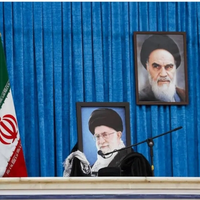
Ali Khamenei making a speech on October 2, 2024 in a meeting with a group of top students and scientific talents
In a speech on Wednesday, Iran’s Supreme Leader Ali Khamenei refrained from directly discussing the missile attack on Israel that occurred the previous day.
Instead, he focused on Israel's simmering conflict with Lebanon and the late Hezbollah leader Hassan Nasrallah, assassinated by Israel last month, stating, “I certainly have remarks regarding Lebanon and everything related to this great and beloved martyr (Nasrallah), which I will share in the near future, God willing.”
In an open and seemingly unprovoked attack on Western democracies, Khamenei accused the US and European nations of being "the root of the problem in our region—which creates conflicts, wars, concerns, and hostilities".
He said: "If they reduce their interference in this region, undoubtedly these conflicts, wars, and confrontations will completely vanish. The countries in the region can manage themselves, govern their own areas, and live together in peace, safety, and well-being.”
Unusually, he did not mention Iran's archenemy Israel in the blast.
Khamenei’s comments come at a significant moment, as there are reports that he will lead Friday prayers in Tehran this week for the first time in nearly five years. An announcement from a manager at Iran’s IRGC-affiliated Fars website confirmed that Khamenei will personally deliver the sermon, a responsibility he typically delegates to representatives such as Ahmad Khatami and Kazem Sedighi. It is significant as historically, Khamenei only steps in during critical times or significant occasions.
The last time Khamenei led Friday prayers, considered the most holy day of the week for Muslims, was on January 17, 2020, the first time in eight years. His sermon occurred during a particularly tense period, just after the killing of Iranian IRGC Quds Force Commander Qassem Soleimani in a US drone strike and the subsequent downing of a Ukrainian passenger plane by Iran's military.
Ali Khamenei leading a prayer in Tehran
If confirmed, the timing of Khamenei’s appearance is noteworthy due to Iran’s second attack on Israel on Tuesday and recent killing of Hezbollah’s Secretary General, Hassan Nasrallah, in an Israeli airstrike which has seen Iran's biggest proxy hit most drastically by Israel since its creation. Around 1,500 operatives are believed to have been taken out of action after a mass infiltration of pagers and walkie-talkies belonging to the group. Its top commanders have also been eliminated in a wave of assassinations.
Now, according to reports from Reuters, Khamenei has been moved to a secure location within Iran amid heightened security following Nasrallah’s shock assassination.
On Tuesday night, after the launch of nearly 200 missiles at Israel and the Israeli prime minister's promise of strong retaliation, reports indicated that he remained in a secure location. However, he appeared for a public meeting on Wednesday.
Iran launched over 180 missiles toward Israel on Tuesday, claiming it was a response to the killing of Hezbollah leader Hassan Nasrallah and others, including Hamas's political leader, Ismail Haniyeh, killed in an air strike in Tehran in July.
Khamenei also led the funeral prayers for the slain Hamas figure, in addition to leading prayers for former president Ebrahim Raisi who died in a mysterious helicopter crash earlier this year.
Across multiple locations in Israel, barrages of missiles streaked through the sky as sirens wailed throughout the country. At least one person was killed in the West Bank, with several others injured during the attack, according to the Israeli military.
Hours after the assault, Prime Minister Benjamin Netanyahu warned: “Iran made a big mistake tonight - and it will pay for it. The regime in Iran does not understand our determination to defend ourselves and our determination to retaliate against our enemies.”
The US also vowed that it would work with longtime ally Israel to ensure Iran faced "severe consequences" for Tuesday's attack.
Democratic vice presidential nominee Minnesota Governor Tim Walz and Republican vice presidential nominee US Senator JD Vance shake hands at the end of the Vice Presidential debate hosted by CBS in New York, October 1, 2024.
In Tuesday's vice presidential debate, Democratic Governor Tim Walz dodged the question of supporting a preemptive Israeli strike on Iran, while Republican Senator JD Vance declared that the decision should rest entirely with Israel.
Just hours before the debate, Iran launched its largest attack on Israel, firing over 180 ballistic missiles. The escalation followed Israel's targeted assassination of Hezbollah leader Hassan Nasrallah in Lebanon and a key commander of Iran’s IRGC. With the latest developments shaping the debate, CBS moderator Margaret Brennan opened by asking Democratic VP candidate Walz whether, as the final voice in the Situation Room, he would support or oppose a preemptive Israeli strike on Iran.
Republican VP candidate JD Vance, in turn, said it is up to Israel to keep its country safe – and that the US should support its allies wherever they are when they’re fighting adversaries.
The bestselling author and military veteran, started his response by accusing the current administration for providing Tehran with sanctions relief, which he argued helped bolster Iran’s arsenal.
“Iran, which launched this attack, has received over $100 billion in unfrozen assets thanks to the Kamala Harris administration. What do they use that money for? They use it to buy weapons that they're now launching against our allies and, God forbid, potentially launching against the United States as well,” Vance told the moderators.
However, it should be noted that the Biden administration released $16 billion in frozen assets from South Korea and Iraq, while it failed to enforce oil export sanctions on Iran, which generated additional tens of billion dollars.
Walz avoided directly addressing the allegation of sanctions relief and asset unfreezing, instead criticizing Trump for exiting the Iran nuclear deal without offering a replacement, which he argued brought Iran closer to obtaining a nuclear weapon.
In September of 2023, the US issued a sanctions waiver for banks to transfer $6 billions of frozen Iranian funds from South Korea to Qatar, paving the way for the release of five Americans held by Iran. Many Republicans condemned the transfer arguing that President Joe Biden paid a "ransom to the world's worst state sponsor of terrorism". Democrats meanwhile, defended the action claiming that Iran could only use the money for humanitarian trade.
Walz also referenced the April military clash between Israel and Iran, noting that despite Iran's large-scale retaliation, Israel and its allies successfully intercepted most of the missiles, minimizing the damage.
“Steady leadership like you witnessed today, like you witnessed in April. Both Iranian attacks were repelled. Our coalition is strong, and we need the steady leadership that Kamala Harris is providing,” Walz said.
In his final comments on Iran, Vance rejected Walz’s criticism, arguing that Iran’s nuclear advances and the October 7th attacks occurred under the Biden-Harris administration, not Trump’s.
He also defended Trump’s foreign policy, portraying it as more effective in ensuring global stability – arguing that the former President’s communication style is irrelevant to real outcomes.
“So Governor Walz can criticize Donald Trump's tweets, but effective, smart diplomacy and peace through strength is how you bring stability back to a very broken world,” Vance said.