Supporters try to glorify Iran’s president-elect Pezeshkian
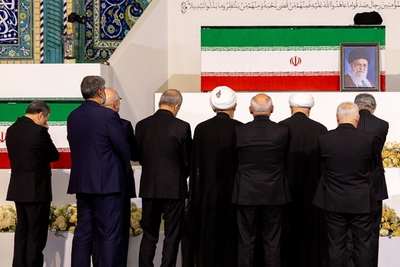
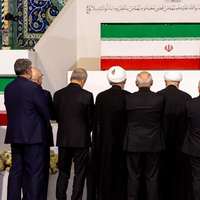
Iran's President-elect Masoud Pezeshkian and Iran's Supreme Leader Ayatollah Ali Khamenei attend a Muharram mourning ceremony in Tehran, Iran July 12, 2024.
Supporters of Iran's President-Elect Masoud Pezeshkian, with good intentions, have recently caused trouble for him, prompting him to publicly affirm that he remains the same person and that his election has not changed his self-perception.
Some of his supporters have been attempting to elevate his status above his predecessors by highlighting that he is the first and only president in the world who is both a medical doctor and a fully accredited university professor.
Iranian fact checkers at home and around the world maintained that this a myth. Foreign-based fact-checking group FactNameh refuted the claim as a flat lie, adding that both at the present time and in the past many heads of state have or had equal or higher academic credentials than Pezeshkian.
According to FactNameh, "These include former German Chancellor Angela Merkel who had a Ph.D. in Physics, former Afghan President Mohammad Ashraf Ghani Ahmadzai who was a doctor of cultural anthropology, Cameroon's former Prime Minister Joseph Ngute who had a Ph.D. in Law, the Prime Minister of Congo Anatole Collinet Makosso who has a Ph.D. in law, former Albanian President Alfred Moisiuwho was a doctor of military sciences, and Jordanian Prime Minister Bishar Khasawneh who is a doctor of philosophy of law."
FactNameh added that many of those heads of state are perhaps much better educated than Pezeshkian with high recognitions as graduates of law, political scienceand economics.
Meanwhile, Iran's first president, Abolhassan Banisadr, held a doctorate in economics, and former president Mahmoud Ahmadinejad held a Ph.D. in transportation and traffic engineering.
At the same time, an initiative to introduce Pezeshkian as a deeply religious individual backfired as he went to see preacher Hossein Ansarian. Ansarian gave the president-elect his own black handkerchief and rosary. However, Pezeshkian's supporters were displeased that he visited Ansarian, one of the few clerics permitted to enter Khamenei's residence and recount the tragedy of Karbala to move the Supreme Leader to tears.
To add a dramatic flair to the session, Ansarian told Pezeshkian that he wanted the handkerchief to be buried with him when he dies, as he had shed many tears into it for the martyrdom of Imam Hussain, the third Imam of the Shiites.
In another dramatic show, some of Pezeshkian's supporters doctored a video of his arrivalat Ansarian's mosque, creating a slow-motion version accompanied by epic music, making it appear as though he was performing an extraordinary act by visiting a mosque during the mourning month of Muharram. Social media users harshly criticized Pezeshkian for this utterly sensational yet otherwise banal video.
Iranian journalist Maryam Shokrani wrotein a tweet that it was ridiculous that some of Pezeshkian's supporters expected to behave like one of those traditional landlords who bossed citizens around. She reminded that in other countries, even the biggest officials are the people's servants, not the other war round.
Meanwhile, as Pezeshkian was caught offhand on live TV while a crowd chanted slogans in support of Green Movement leader Mir Hossein Mousavi, who has been under house arrest since 2011. The president-elect was suddenly speechless and finally he was saved by the state TV cutting off the sound, otherwise, whatever he said could turn out to be controversial or worse.
The new president seems to need some training on how to diplomatically handle such situations, as appearing in large crowds could expose him to unexpected challenges. His supporters defended him by saying he did not comment on the slogans because Mousavi did not support him in the election. However, expecting support from an elderly man who has been under house arrest for so long is unrealistic. This incident has already tarnished Pezeshkian's reputation as someone who promised to uphold the rights of all citizens.
Iraqi Kataib Hezbollah during the early years of its formation
The Iranian-backed Iraqi militant group Kataib Hezbollah issued threats against Saudi Arabia, despite the recent détente in Tehran-Riyadh relations.
After years of severed diplomatic relations, Iran and Saudi Arabia agreed to resume their diplomatic relations by signing a China-brokered renormalization deal in March 2023.
The threats also extended to Bahrain and the UAE, countries that normalized relations with Israel under the Abraham Accords. Kataib Hezbollah called for increased resistance against Israel and stronger support for Gaza, consistent with its history of Iranian proxy warfare.
Despite last year’s reconciliation between Iran and Saudi Arabia, Kataib Hezbollah's stance suggests the possibility of renewed hostilities.
Kataib Hezbollah is part of a broader coalition of Tehran-backed militant groups, called the Islamic Resistance in Iraq, which has been launching rocket and drone attacks against Israel and the US since the beginning of the Gaza war last year.
The US has sanctioned Kataib Hezbollah since 2009 due to its connections with the IRGC and involvement in attacks on US interests.
President Donald Trump moments after a failed assassination attempt on July 13, 2024 (left) and former Iranian president Mahmoud Ahmadinejad
Iran's former president Mahmoud Ahmadinejad condemned terrorism on Sunday in an apparent reaction to the recent assassination attempt on former US president Donald Trump.
Trump was targeted in an assassination attempt at a rally in Pennsylvania on Saturday, resulting in the death of one attendee and critical injuries of two others.
Without naming Trump, Ahmadinejad took to X to denounce terrorism as a violation of human rights.
"Terror and terrorism, whether state-sponsored or non-state, are among the most heinous anti-human actions that words cannot express the depth of their evil," in an apparent reference to the attack."Humanity around the world suffers from such severe pains," he said on X.
The statement is part of his efforts in recent years to rebrand himself as a moderate figure in Iranian politics, although many still remember his hardline policies during his tenure, which included the arrest, torture, and killing of numerous protesters.
Having served as the president of Iran from 2005 to 2013, Ahmadinejad has remained an active and often controversial figure in Iranian politics. He has run for president in every single election since 2017 but has been barred from running three times.
After his latest disqualification, he boycotted the June 28 votes and then travelled to Turkey, sparking mixed reactions. Iranian outlets criticized Ahmadinejad for his photos with women not wearing hijab and questioned the timing of his departure, suggesting a deliberate boycott of the July 5 runoff presidential election.
In an interview with Turkish media, Ahmadinejad emphasized his dedication to peace and global harmony, distancing himself from his past hardline image. It was during his time in office when the morality police were launched to enforce the mandatory hijab on women in Iran.
Ahmadinejad's apparent reaction to the attack on Trump comes one month after he criticized the Supreme Leader's foreign policy, expressing willingness to engage in economic relations with the US and hold talks with Donald Trump.
Iran's President-elect Masoud Pezeshkian on Sunday reiterated the Islamic Republic's support for the Palestinian Hamas militant group as well as Yemen's Tehran-backed Houthis.
While Pezeshkian has not identified himself as a reformist nor has he officially aligned with any reformist factions, Western media has recently portrayed him as a "reformist" or "moderate." However, his actions and statements since his election victory align with the policies set by Khamenei, including supporting the anti-Israel "Resistance Front."
In a phone conversation with Hamas chief Ismail Haniyeh on Sunday, Pezeshkian said the Islamic Republic will never leave the Palestinian nation alone in these difficult times."
This was their first phone call following Israel's Saturday strike targeting Hamas military chief Mohammed Deif.
Pezeshkian had earlier on Wednesday reiterated Tehran's support for its proxy groups fighting Israel, a move that once again signals Iran's major policies are dictated by Khamenei, leaving presidents with little room for change.
Similar sentiments were conveyed to Syrian President Bashar al-Assad and Hezbollah Secretary General Hassan Nasrallah, demonstrating Pezeshkian's commitment to the so-called Axis of Resistance.
Praise for Houthis amid ship attacks
In a separate call with Houthi military leader Mahdi al-Mashat on Sunday, Pezeshkian said the "people of Iran and free nations appreciate the actions of the Yemenis under the current difficult circumstances." He also expressed hope for expansion of relations between the two sides.
Iran has been arming, training, and funding the Houthi militia, which have been launching attacks against commercial vessels since the beginning of Israel-Hamas war in Gaza Strip last year.
Over 60 targeted attacks on vessels, along with missile and drone launches, have resulted in the deaths of four sailors and the kidnapping of dozens. These attacks followed a call from Iran’s Supreme Leader Ali Khamenei for Muslim nations to blockade Israeli trade.
In his phone call with al-Mashat, the Iranian president-elect criticized certain Muslim countries for acting “based on their own interests and merely issue statements" in the wake of Israel's war on Gaza.
“Naturally, free nations will judge those rulers who have not taken action to stop the crimes of the Zionist regime against the Palestinian people," he said.
The comments echo similar statements by Khamenei who has criticized other Islamic countries for not severing all relations with Israel and "being soft" on the Jewish state.
Iran’s exiled prince Reza Pahlavi, who has become a leading opposition figure since the start of Women, Life, Liberty movement, during a rally against the Islamic Republic in Washington in 2022
Iran’s exiled Prince Reza Pahlavi called on the new British government to classify the Islamic Revolutionary Guard Corps (IRGC) as a terrorist organization, arguing that the proscription will boost democrats in Iran.
The IRGC is currently designated as a terrorist group by the United States, Bahrain, Canada, Israel, Saudi Arabia, and Sweden. The European Union is also considering a similar listing based on an initiative by Germany. The UK has sanctioned the IRGC “in its entirety,” yet London has not declared it a terrorist organization.
In an article published in The Telegraph, Iran's exiled prince emphasized that the IRGC has a long history of exporting “radical revolution,” including hostage-taking, assassination attempts, and terrorist attacks, which have also impacted Britain. He praised Canada’s recent decision to list the IRGC as a terrorist group and called on Britain to lead Europe in taking similar action.
Highlighting the IRGC's involvement in funding and supporting terrorist activities by groups like Hamas, Hezbollah, and the Houthis, as well as its support for Russia's invasion of Ukraine, Pahlavi argued that the evidence against the IRGC is “unequivocal.” He also condemned the IRGC’s repression of the Woman, Life, Freedom movement in Iran.
The former UK government, led by the Conservative prime minister Rishi Sunak, had considered proscribing the IRGC but decided against it on a number of occasions, arguing that listing the IRGC as a terrorist organization would hinder diplomatic dialogue with Tehran.
The Iranian prince dismissed the Sunak administration's stance, asserting that decades of appeasement have only emboldened them.
Pahlavi's plea comes amid political shifts in Iran, following the death of former President Ebrahim Raisi in a helicopter crash and the rise of Masoud Pezeshkian as his successor.
In his article, Pahlavi warned against viewing Pezeshkian as a reformist, describing him as a staunch supporter of the Supreme Leader and the Islamic Republic’s hardline policies.
“The Islamic regime is rattled, weak, and desperate. This is why they have allowed a so-called ‘reformer’ to win the presidency. He is a fig leaf. Western democracies should not fall for this political maneuver,” the prince said.
He also stressed the need for Western nations to support the Iranian people's desire for democracy and freedom, urging them to increase pressure on the Islamic Republic rather than easing it.
The prince called for a policy of maximum support for the Iranian people's fight for democracy, akin to the policies that helped end apartheid in South Africa and communist regimes in Eastern Europe.
Pahlavi concluded by envisioning a democratic, secular Iran at peace with its neighbors and contributing to regional prosperity, urging Britain to take the first step by listing the IRGC as a terrorist organization.
The leading figures in the Labour Party do not share the Conservatives' hesitation and would be willing to back a change in the law that would allow for the IRGC’s proscription.
Proscribing the IRGC as a terrorist group would mean it would become a criminal offence in Britain to belong to the group, attend its meetings or carry its logo in public. The IRGC is already subject to British sanctions.
An Iranian pediatrician has taken her own life in Yazd, central Iran, amid a growing suicide crisis within the nation's medical community.
Dr Noor Foroughi Nasab was a resident of the pediatric department of Shahid Sadoughi Hospital and the mother of a young child. "The deceased had a history of suicide and the relevant authorities were aware of her condition," said Mohammadreza Asadi, a member of the board of directors of Iran's Medical Council (IRIMC), according to KhabarOnline.
Recent figures provided by Tejarat News, a non-independent news outlet, indicate that a doctor has taken their own life approximately every 10 days since the beginning of the Persian New Year in late March this year.
Experts have attributed the increased suicides in Iran to the systemic reluctance and neglect of Iranian authorities to address workers' conditions.
The Iranian Psychiatric Scientific Association has highlighted that 16 medical residents took their own lives last year alone. According to medical journal The Lancet, the head of the Iranian Psychiatric Association has accused the Ministry of Health of withholding exact numbers of suicides.