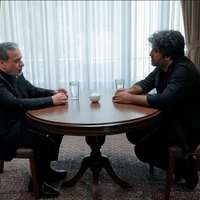
Mohammad Bagher Ghalibaf and Saeed Jalili. File Photo
Supporters of Mohammad-Bagher Ghalibaf and Saeed Jalili are fiercely blaming each other for the defeat of the so-called ‘revolutionary front’ in the elections against Masoud Pezeshkian backed by reformists.
Ghalibaf, who came third in the first round of the snap elections with nearly one-third of Jalili's votes, was eliminated, with Jalili representing 'revolutionaries' in the final round. He urged his supporters to vote for Jalili in the July 5 runoff to avoid dividing the votes of the 'revolutionary front.'
However, some of Ghalibaf’s supporters and campaign members openly endorsed Pezeshkian instead of Jalili who they said had no executive experience or viable plans for running the country.
Jalili’s supporters on social media accuse Ghalibaf of “hypocritically” announcing that he would vote for Jalili but refusing to mobilize his campaign capabilities including social media networks in his support.
Journalist Abdolrahim Ansari who supported Jalili scolded Ghalibafin a tweet on Sundaytelling him that he made no attempt to help Jalili by shifting his votes to him.
“We must not allow their treachery to be forgotten … This revolution should no longer be harmed by mudslinging and division,” he wrote.
Jalili and Ghalibaf’s supporters had fought an intensive media and social media battle for months, particularly before the parliamentary elections of March 1 during which both sides extensively made allegations of corruption and fraud against each other.
Since the announcement of his defeat, some Jalili supporters have also defiantly slammed the ultra-hardliner election watchdog, the Guardian Council, whose members are appointed by Supreme Leader Ali Khamenei.
They say the Council paved the way for Pezeshkian’s victory by pitching him against at least four hardliners and one conservative, causing the revolutionary front’s votes to be divided between the candidates.
Mohammad Mannan-Raisi, a lawmaker from Qom charged that the make-up of the approved candidates could not have been more “in reformists’ favor” to guarantee their candidates’ win.
Jalili supporters’ anger against the Guardian Council was also reflected in a tweet on the day of the runoff elections by Mohammad-Mehdi Fatemi-Sadr, a well-known Qom-based cleric and ardent Jalili supporter.
The Guardian Council should expect repercussions,he tweeted in a highly defiant language. Such open defiance of the Guardian Council could be interpreted as defiance of Khamenei. However, these hardliners never mention that the Council barred key candidates in the 2021 election, all but guaranteeing a win for their favorite man, Ebrahim Raisi.
Jalili who is not an official member of any political party or group was backed by the ultrahardliner Paydari (Steadfastness) Party led by Sadegh Mahsouli, a business tycoon and interior minister under populist Mahmoud Ahmadinejad as well as the recently established Jebhe-ye Sobh Iran. The latter, often referred to as MASAF, is a political group led by hardliner politician and theorist Ali-Akbar Raefipour.
The Paydari (Steadfastness) Party has its appendages in all government institutions including the parliament where their members formed a very influential minority in the past few years. They have often taken a leading role amid the weak presence of established conservative and reformist parties.
Paydari and MASAF are believed to have considerable influence among the Basij militia of the Revolutionary Guards (IRGC). The top brass of the IRGC, however, are widely claimed to have been behind Ghalibaf, a former commander of the IRGC’s air force.
Many of the top figures in the Paydari Party were Ahmadinejad allies who denounced him following his eleven-day standoff with Supreme Leader Ali Khamenei in 2011. They and other Khamenei loyalists dubbed Ahmadinejad and those who remained loyal to him “deviant” after the incident.
“It’s still the beginning. We will not let you be until we disgrace the Paydari grouplet and MASAF. You and your group are dangerous for the Revolution,” a Ghalibaf supported tweeted Monday.
President-elect Masoud Pezeshkian during an event in Tehran after victory on July 6, 2024
With Masoud Pezeshkian announced as the winner of Iran’s snap election, which followed the sudden death of President Ebrahim Raisi, uncertainties remain about when he will assume office and form the new government.
The inauguration of new presidents in the Islamic Republic typically occurs in early August, although no specific date is set. However, since there is currently no incumbent in office, there is some debate about when the new administration will officially begin.
The only timeframe that applies in case of the death of a president is 50 days until a new one should be elected. Raisi died in a helicopter crash on May 19, and the election was held on June 28 and the runoff on July 5.
There are several steps until the president-elect can be called Iran’s President.
After the election, the Guardian Council should confirm the validity of the results, ensuring that the election process followed legal precepts. Then, it issues a certificate of appointment for the president-elect. This document should be signed by the members of the Council and then sent to the Supreme Leader, who would announce the date for Tanfiz, when he officially endorses the election results and ratifies the new president. It is followed by Tahlif, or the swearing-in ceremony, which usually happens within a few days.
During the Tanfiz, Ali Khamenei hands over a decree, known as the "decree of confirmation" or "decree of validation", to the president-elect, formally recognizing him as the legitimate president. Without the Supreme Leader's approval, the president does not have the authority to assume office. During Tahlif, the newly elected president takes an oath before the Parliament (Majlis) in the presence of the head of the judiciary and the members of the Guardian Council, promising to uphold the constitution and faithfully execute his duties as the head of state. Both ceremonies are essential in the transition of presidential power, ensuring both legal and symbolic legitimacy for the incoming president.
Mojtaba Yousefi, a member of the parliament's presiding board, said this week the inauguration ceremony for Pezeshkian is scheduled for August 4 or 5. The president will then have 15 days to present his proposed ministers to the parliament for a vote of confidence, which is reportedly set to be held on September 5.
There is controversy about why the parliament, dominated by hardliners whose candidates lost to Pezeshkian, would not vote on the proposed cabinet sooner, given that fact that the country does not have a president and is run by interim Mohammad Mokhber, Raisi’s first vice president.
Mohammad Mokhber, the acting president, along with the members of late President Ebrahim Raisi's cabinet during a meeting with Supreme Leader Ali Khamenei, July 7, 2024
According to Abbas-Ali Kadkhodaei, the former spokesman of the Guardian Council, until the new government assumes office, members of the former cabinet can make decisions or appointments that could have financial implications for the next government.
This comes despite Mokhber’s directive in June that called on all executive bodies to “refrain from any changes to organizational structures, personnel reassignments, transfer of government property, implementation of new regulations, changes in tariffs and fees, and any actions outside the rules and regulations until the establishment of the fourteenth government.”
However, Kadkhodaei noted that unless there is a specific legal provision that states otherwise, the incumbent officials can make such decisions, implying that Mokhber’s directive may not be binding. “These are customary practices and have never been subject to legal debate,” he said.
Hossein Mirmohammad Sadeghi, a former lawmaker, said that there is no regulation for setting a date for the vote of confidence on the new cabinet, explaining that such dates are primarily based on considerations of different factors. These include the parliament's summer recess ending on July 21st and upcoming calendar events, like the observance of the Shiite mourning period, Ashura, on July 14th in Iran.
Hamid Aboutalebi, a former deputy chief of staff for political affairs of the office of Iran’s president under Hassan Rouhani, wrote a commentary on his X account on Monday, stressing the legal necessity of holding the endorsement ceremony as soon as possible. He said the president-elect should assume office by the 50th day after the death of the incumbent. He argued that according to the constitution, until the new government is formed, the parliament cannot impeach ministers or pass a vote of no confidence, leaving the body with no oversight capability in case of negligence or errors by the ministers.
Aboutalebi said this would present a serious constitutional challenge if the country would be without an incumbent president at the end of the 50-day period and would be governed by an unelected first vice president, with ministers who are not subject to parliamentary oversight.
Iran has accused the United States of "interfering" with its political affairs during a weekly briefing on Monday after a US spokesman said the recent presidential elections were "not free or fair".
Foreign Ministry Spokesperson Nasser Kanaani argued that such statements, following Iran's "transparent and free elections," reveal "non-constructive and hostile policies" within US government structures towards Iran.
A US State Department spokeswoman told Iran International on Saturday that the elections will not significantly impact the US approach to Iran, citing unchanged concerns about Iran’s behavior, from its nuclear program to its ongoing proxy war in the Middle East.
The spokeswoman also remarked that the Iranian elections were "not free or fair," leading many Iranians to abstain from voting, and doubted the elections would result in significant changes or improved human rights in Iran, without specifying exactly which changes.
Kanaani countered, citing Iran’s alleged commitment to "constructive engagement" with various countries, stating that confrontational behavior by some European nations have hindered progress in relations.
However, he failed to address the issue of Iran's ongoing nuclear program or its proxy war which has driven a wedge between Iran and the West as the Islamic Republic edges ever closer to a nuclear weapon.
The first round of Iran's snap presidential election saw a 39.92% turnout, the lowest in the Islamic Republic's history. Despite a reported 10% rise in the runoff, over 50% of eligible voters boycotted the election.
Iranian opposition figures have urged Western powers not to engage with the new government. Exiled Prince Reza Pahlavi called the election a "fraudulent" attempt to legitimize dictatorship.
Turkish President Recep Tayyip Erdogan expressed hopes for a positive development in Turkey-Iran relations under the new president-elect, leveraging Masoud Pezeshkian's ethnic background as a potential diplomatic bridge.
"Masoud Pezeshkian is actually a Turk," Erdogan stated. "He speaks Turkish in Tabriz, can speak Kurdish in Kurdish regions, and is also fully proficient in Persian."
Pezeshkian's ethnic background is in fact rooted in the Azeri community, a significant ethnic group in Iran, particularly in Azarbaijan province, where Turkish is widely spoken. He was born in the Kurdish city of Mahabad.
While Erdogan expressed hopes for a new era of “rapid development” in Ankara-Tehran relations, the reality on the ground in Iran remains fraught with challenges. The Turkish president's overtures, though diplomatically significant, may also be seen as an attempt to exploit Iran's internal vulnerabilities for regional advantage.
Trade between Turkey and Iran peaked in 2012 at nearly $22 billion but has since declined significantly. According to Turkish Trade Minister Omer Bolat, trade stood at $7.4 billion in 2023, down from around $10 billion the previous year.
Iran's economy has been severely crippled by sanctions imposed due to its nuclear program, although Tehran denies Western allegations that it seeks to develop nuclear weapons
Pezeshkian narrowly won a runoff race against ultraconservative Saeed Jalili on Friday, in an election marred by historically low turnout. In the first round, less than 40 percent of eligible voters participated, highlighting the growing disillusionment with Iran's clerical rule.
In a meeting with the outgoing government, Iran’s Supreme Leader, Ali Khamenei, lavished praise on the late president Ebrahim Raisi, stating that "he was an exemplary model of management," for all officials.
Khamenei’s remarks came just one day after he told the newly elected Masoud Pezeshkian to follow in Raisi’s footsteps. Although the president-elect has vowed not to propose any major plans and execute Khamenei’s vision, he has also criticized certain policies and actions pursued in the past three years by the Raisi administration.
In this meeting, which was the final gathering of the members of the Raisi government, Khamenei described the administration as the "government of work, hope, and progress." He said, "Martyr Raisi was truly hopeful and rightfully optimistic about the future, and he was determined to achieve the outlined goals."
Ebrahim Raisi, a cleric backed by hardliners and elected in June 2021 in a highly stage-managed election, was killed in a helicopter crash in May. So far, no clear cause for the incident has been provided.
Khamenei’s praise for the former president contradicts his administration’s poor record in managing the economy and its conduct during anti-government protests in 2022-2023, when security forces killed around 550 civilians, injured hundreds more and arrested 22,000 people.
The Iranian currency doubled its losses in less than three years during Raisi, sinking to more than 600,000 rials per US dollar. This worsened inflation, especially for food and consumer necessities while the government was unable to meaningfully boost salaries. Monthly wages for ordinary workers has remained below $200, impoverishing tens of millions of people.
When Raisi was elected, there was some hope for a nuclear agreement with the United States and European powers that could have lifted crippling US sanctions. Negotiations had been underway in Vienna since April 2021, but the talks paused for nearly six months. When they resumed in November of that year, they ultimately failed in 2022.
This left Iran struggling with a deepening economic crisis. While it is widely known that Khamenei determines Iran's foreign policy and the president has little say in strategic issues, Raisi praised the Leader’s wisdom and continued to preach self-reliance and closer relations with Russia and China.
This was perhaps what Khamenei valued most as he praised Raisi's deep belief in domestic capabilities on Sunday. "We have talked about this with officials at various times, and no one disagreed with this appraisal; however, one could see that Raisi genuinely believed in the domestic capacities and capabilities to solve the country's problems."
However, the fact was that even many conservative politicians began criticizing Raisiearly in his term for mismanagement and a lack of ability to make changes necessary to alleviate economic pressures.
While suspicions linger among many Iranians about the helicopter crash that killed Raisi, Khamenei and his ideological establishment do their utmost to present him as a hero and a martyr.
Khamenei in his speech even tried to credit Raisi with a project to transport sea water to Iran’s arid interior, a lofty plan that preceded the late president and will probably remain on paper for years to come.
In the concluding part of his speech, Khamenei delivered remarks that many will interpret as a message to the new president: These characteristics were highlighted to establish a model and to be recorded in history, demonstrating that the head of the executive branch can possess a collection of intellectual, heartfelt, and practical virtues and can pursue them in both governance and personal conduct.
The United Nations Special Rapporteur on human rights in Iran, Javaid Rehman, speaks in an interview with Iran International
UN Special Rapporteur Javaid Rehman says due to systemic issues within Iran's judicial system, a change in presidency is unlikely to improve the country's human rights situation.
"There are certain systemic issues in Iran starting from 1979 (Revolution). The system is very repressive, intolerant, and non-accepting of democratic values," Rehman said in an interview with Iran International's Mahsa Mortazavi in Toronto, Canada.
He pointed out that the constitutional framework concentrates all powers with the Supreme Leader, creating an absence of an independent judiciary where people's rights can be respected. "There is a need for reform in the constitutional framework," he said, emphasizing that the people need to be recognized with the right to democratic governance, which has been absent for the last 45 years.
Rehman, who will leave his post in July, discussed his findings publicly for the first time outside the UN in Toronto, Canada, after being unable to travel to Iran to investigate human rights in Iran during his six-year tenure. The Iranian government, which dismisses all accusations regarding human rights violations, has not permitted UN special rapporteurs to visit the country and conduct investigations.
In response to Iran International’s question about how he could investigate Iran’s human rights issues without traveling to Iran, Rehman explained that he had held many meetings with the Iranian diaspora and individuals who had first-hand experiences of human rights violations, allowing him to collect substantial evidence.
"We certainly work on the basis of dialogue and human rights discourse and the improvement of the human rights situation," Rehman said.
Rehman also noted that the regime has not allowed any space for civil society to grow, repressing even non-governmental organizations like the Imam Ali organization. "The system needs substantial changes for it to accept democracy, rule of law, and the rights of the people," he asserted.
Previously, Rehman had labeled Iran's mass executions of political prisoners in 1988 as "genocide" and "crimes against humanity." In June, during a UN Human Rights Council session in Geneva, he unveiled a detailed report showing systemic state-sponsored atrocities during a brutal crackdown on dissent. His investigation revealed that thousands of political prisoners, including Baha'is, Kurds, and members of groups like the MEK, were executed in the 1980s, particularly in the summer of 1988, following a fatwa issued by Iran's then-leader, Ruhollah Khomeini, and approved by a four-member death committee.
Rehman said he chose Toronto as his destination due to its significant Iranian diaspora community. He said he wanted to meet people closely connected to Iranian communities within Iran. "It is important for them to understand the perspective of the Special Rapporteur and the challenges I face in my work, including the lack of access to the country, which Iran has unfairly denied me for the past six years," he explained. "Toronto offers a great opportunity to learn more from a community closely following developments in Iran," he added.
Rehman’s comprehensive reports, along with a detailed 400-page report from the Fact-Finding Mission on Iran, have paved the way for international tribunals and greater use of existing international jurisdiction to prosecute those responsible. The focus remains on collecting evidence that can withstand scrutiny in court. Rehman's latest report will be published on his website later this month.