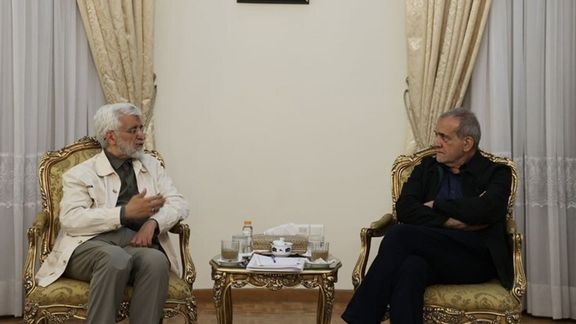
Saeed Jalili (left) and President-elect Masoud Pezeshkian during a meeting in Tehran on July 6, 2024
Iran’s defeated presidential candidate Saeed Jalili visited president-elect Masoud Pezeshkian’s office on Saturday night, less than one day after the election results were announced, where the two held a meeting.
Media in Tehran reported that in this “cordial meeting,” Jalili once again congratulated Pezeshkian on his election and outlined his views on the most important issues facing the country and the solutions to address them.
Jalili who was the candidate of so-called “revolutionary forces” insisted during the election campaign that he was the only candidate with comprehensive plans for the country. His ideas centered on Iran’s self-reliance and trade with friendly countries such as Russia.
President-Elect Pezeshkian reportedly told Jalili, “Having a plan is not the only condition for success; employing knowledgeable, skilled, and dedicated individuals is essential to ensure the effective implementation of those plans. “
Pezeshkian’s predecessor, Ebrahim Raisi, often faced criticism for appointing officials based on ideological credentials, favoring "revolutionary forces," particularly members and supporters of the ultra-hardliner Paydari party. In contrast, Pezeshkian has pledged to prioritize meritocracy, emphasizing the qualifications and dedication of candidates for top government positions.
However, a lot depends on Supreme Leader Ali Khamenei in case of ministers and directors of numerous government agencies in Iran’s sprawling bureaucracy. Khamenei or his office have the final say in military, intelligence, ideological and many economic appointments. Pezeshkian also faces a potentially hostile parliament where hardline politicians hold sway, who will closely scrutinize high-level appointments.
Jalili and his hardline political block were able to fill the Raisi administration with ministers and top managers. He often appeared sharing advice with the president and backed him despite his administration’s obvious failure to improve the battered economy.
Media in Tehran reported that Pezeshkian agreed to receive Jalili’s proposals and ideas, but that could have been more of a show of political courtesy than a genuine desire. Jalili’s isolationist ideas seems contrary to Pezeshkian’s pledges about improving Iran’s international relations and trying to reduce sanctions.
“A few hours ago, I had a meeting with Dr. Pezeshkian, and I told him that we consider it our duty to assist in the path of the revolution, the direction of the country, and the three branches of government, including the newly elected president,” Jalili was quoted as saying.
The key phrase here is “the direction of the country” for Jalili, who is steadfast in opposing the West and supporting Khamenei’s foreign policy tenet of relying on Russia and China instead of resolving the nuclear and other issues with the United States and its European and regional allies.
Some speculate that Khamenei allowed Pezeshkian’s candidacy and victory because he has decided to iron out problems with the West, ahead of a possible Donald Trump victory in the US presidential race in November. Others say that he simply wanted new faces representing the Iranian government in order “to buy time” and breathing space considering possible Trump pressures. Whatever the case, Jalili, who has been deeply involved in the Islamic Republic’s national security apparatus for nearly two decades, is here to stay. He may potentially serve as the Supreme Leader’s lever of pressure in both domestic and foreign policy.
Iran's President-Elect Massoud Pezeshkian began his challenging journey to the presidency just one day after his comfortable victory in the July 5 runoff election.
The Iranian parliament (Majles), which must approve his cabinet appointments, went on a 10-day holiday for the Shiite mourning month of Muharram, which began on Saturday.
This delay might not be entirely detrimental for Pezeshkian, who previously stated he has no plans or list of cabinet ministers. He now has over a month to formulate a plan and compile a list. So far, none of his campaign advisers, primarily from the centrist Executives of Construction Party and the Development and Moderation Party, seem to have provided him with any plan or list.
In the meantime, it is not clear yet, whether Supreme Leader Ali Khamenei will endorse Pezeshkian's credentials before the mourning period which could well extend to two weeks, or he is going to do it regardless of religious rituals.
On the other hand, on his first day as President-Elect, a news conference with Iranian and foreign reporters planned for Saturday afternoon was cancelled. The news conference was first re-located from a conference center in northern Tehran to an auditorium in south Tehran without giving any reason to the reporters.
Pezeshkian praying with former foreign minister Javad Zarif and former deputy foreign minister Abbas Araqchi.
While the reporters were making their way from one venue to another, it was announced without giving a reason that the news conference was cancelled. It is not yet clear who arranged the news conference and who cancelled it as Pezeshkian has no staff and chief of staff yet. However, later during the day, pro-reform Emtedad News said that it was cancelled because Pezeshkian had to go to a meeting with Khamenei.
State television reporter Mohammad Hossein Ranjbaran was quoted by Iranian media as saying that during the meeting, Khamenei offered suggestions to the President-Elect. These suggestions may have included advice on addressing questions about foreign policy, including relations with the United States and Europe, and Iran's role in the Middle East.
Some Iranian reporters suspect that the cancellation of the news conference was an attempt to prevent surprises during the meeting with foreign reporters. They believe that those who hastily arranged the news conference intended to throw the inexperienced politician to the media wolves.
During the televised debates, Pezeshkian and other candidates evaded such questions when posed by their rivals. The TV presenters were aware that these topics were off-limits for the candidates, as only Khamenei has the final say in these matters.
Khamenei has assured foreign entities that the new president's tenure will not bring any changes in foreign policy or unexpected surprises for international players. He reiterated in his felicitation message on Saturday that Pezeshkian's mandate is "to continue President Raisi's path" with literally translates into taking no initiative of his own.
Even before the election, the US Department of State said that a change of presidents in Iran will not lead to a change in the country's foreign policy. The DOS reiterated after the elections that “We have no expectation these elections will lead to fundamental change in Iran’s direction or more respect for the human rights of its citizens. As the candidates themselves have said, Iranian policy is set by the Supreme Leader.”
With all those assurances, Khamenei is likely arranging a series of briefings and introductions for the newly elected president before he dives into the deep end of Iranian politics.
As Masoud Pezeshkian was named Iran's next president, his presidential rivals sent messages of congratulations as the Supreme Leader called for government unity.
Presidential runner-up, Saeed Jalili, Iran's former nuclear negotiator and the ultraconservative contender, congratulated the incoming president. “As before, I consider it my duty to support the new government in overcoming challenges and achieving the nation's development goals,” Jalili stated.
Alireza Zakani, another former contender and Tehran Mayor also congratulated Pezeshkian and recognized the significance of the election as a “testament to religious democracy,” echoing Jalili’s comments and overall state line.
Zakani, who had earlier withdrawn from the race, urged government unity as news of the new cabinet awaits. He stated, "Now, I present all my plans, which have been written with the support of a large group of elites, to the elected president, and knowing the heavy burden of the government, it is expected that the elected president will choose a strong and capable cabinet."
Additionally, former President Hassan Rouhani, a notable supporter of Pezeshkian, extended his congratulations to the first reformist president to be elected in two decades. Rouhani underscored that the people's vote reflected a clear mandate for constructive engagement with the international community and a revival of the 2015 nuclear deal, formally known as the Joint Comprehensive Plan of Action (JCPOA), which was signed during Rouhani’s tenure.
He emphasized that the new administration "is not a continuation of previous administrations", refuting claims by other candidates that Pezeshkian’s government would simply continue his policies. He also highlighted the importance of addressing the concerns of those who abstained from voting, urging the new administration to work inclusively.
As Pezeshkian prepares to take office, he now faces the challenges of a nation grappling with an inflation rate of around 50% with its national currency, the rial, having depreciated 15-fold since 2018 driving millions of Iranians into poverty.
With sanctions causing around $1.2 trillion in damages from 2011 to 2023, experts argue another critical challenge for the newly elected president will be making strategic foreign policy decisions to lift US sanctions.
Amid widespread anti-Islamic Republic sentiment following Iran's 2022 nationwide Woman, Life, Freedom protests sparked by the death of Mahsa Amini in morality police custody, Pezeshkian must now address the country's human rights issues.
Despite the significant role of the president, the ultimate power in Iran rests with Khamenei who holds authority over all branches of government, including the military and judiciary. Regardless of the president, his influence shapes the direction of the country’s domestic and foreign policies.
In Episode 5 of 'Eye for Iran', we discuss the Arab League’s decision to remove Hezbollah from its terror list and also the record-low voter turnout in the first round of Iran's presidential election.
Why did the Arab League’s decision come on the heels of a potential war between Israel and Southern Lebanon? And does the low voter turnout in Iran's recent election signify a distrust in the ruling system?
Host Negar Mojtahedi speaks with Roya Boroumand, the Co-founder of the Abdorrahman Boroumand Center and Dr. Walid Phares, a foreign policy expert on those topics.
When it comes to the Arab league's decision, Phares, who has has advised US presidential candidates, said Washington and the Iran lobby have a big role to play, in his view.
"It's all about the weakness that Washington is showing in international relations," said Phares on 'Eye for Iran.'
Phares believes that stems from influence by the Iran lobby in D.C.
"Those who are forming the Abraham Accord and the Arab coalition are telling the Israelis, look, guys, I mean, we cannot sustain this if the US administration is not even helping you. What do you want us to do? So that's one part. Another part of the Arab League, like the Syrian Assad regime or the Iraqis, who are very close to the Iranian regime or even the Lebanese government under the influence of Hezbollah. Yeah, they're saying we are winning."
In terms of Iran's internal politics, the historically low voter turnout in the first round of the country's presidential elections, signifies a "vote of distrust" according to human rights advocate Roya Boroumand.
"The low turnout means that people don't believe in the legitimacy of the elections. And that is a good analysis because people are much more informed now that they used to be 20 years ago or 30 years ago," said Boroumand.
Political analyst Mohsen Sazegara told Iran International that Ali Khamenei, the Supreme Leader of the Islamic Republic, ultimately decides whose name comes out from the ballot boxes.
Earlier in the day, President-elect Masoud Pezeshkian, during a speech at the burial site of Ruhollah Khomeini, said, "First, I must thank Khamenei. Certainly, without him, I don't think my name would have come out of the ballot boxes so easily."
During his campaign, Pezeshkian mentioned that he had no specific program and would implement Khamenei's policies.
Iran's President-elect Masoud Pezeshkian speaks during a gathering with his supporters at the shrine of Iran's late leader Ayatollah Ruhollah Khomeini, in south of Tehran, Iran July 6, 2024.
Former head of Iran's Central Bank, Abdolnaser Hemmati in 2021
Former chief of Iran’s Central Bank, Abdolnaser Hemmati, told local media that one of the first tasks for the new president should be reaching an agreement with the West to lift sanctions.
In the first 100 days, “it is important to establish a policy of understanding with the United States and the three European powers to reduce sanctions and thus lower inflationary expectations. The government's first step should be to suppress these inflationary expectations,” Hemmati, a critic of Iran’s hardliners stated.
Nuclear negotiations by the Biden administration and Britain, France and Germany, which started in April 2021 failed to forge a new agreement to revive the Obama-era JCPOA nuclear deal. As a result, Trump administration’s oil export and international banking sanctions remained in place seriously impacting Iran’s weak economy.
Hemmati and numerous other experts and analysts in Tehran have long called for a change of course by the Islamic government, which has increasingly adopted a more hardline posture since 2020, not only in foreign policy but also in its repressive measures against social and political freedoms. Many hope that the election of the relatively moderate Masoud Pezeshkian can bring about a measure of change in both foreign and domestic policies.
The former chief banker is considered a ‘reformist’ who was a candidate in the 2021 presidential election when the hardliner candidate Ebrahim Raisi was elected amid heavy-handed engineering of the election process. He registered as a candidate again for the latest presidential elections but the notorious Guardian Council rejected his qualification.
“In the first 100 days, the government must demonstrate that it does not intend to continue the previous erroneous path,” Hemmati said. Although the new president, Masoud Pezeshkian has made many promises, he has offered few concrete plans for change. He has emphasized the need to improve relations with the international community, but when it comes to the United States, everyone believes the key is in Supreme Leader Ali Khamenei’s hand.
However, beyond improving ties with the West and lifting of sanctions, the government needs to open up the state-controlled economy to more market competition, Hemmati emphasized. “It is important to announce the main economic policy of distancing from a command economy and implementing primary policies based on competitive strategies to align and integrate the private sector with the state economy.”
Hemmati also highlighted his concern about Iran’s annual inflation rate hovering around 50 percent. The government must “correct wrong decisions to control the budget deficit and manage variables that lead to increased inflation."
With sanctions stifling oil revenues, the government has resorted to printing money to balance its budget, which has fueled runaway inflation in the past five years.
Calling for the president to be able to exercise his constitutional power, Hemmati said there is no need for a stronger or weaker president, but the constitution should be respected and applied in regards with presidential authority.