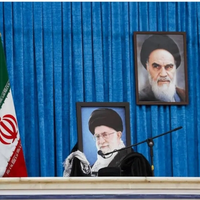
Political analyst Mohsen Sazegara told Iran International that Ali Khamenei, the Supreme Leader of the Islamic Republic, ultimately decides whose name comes out from the ballot boxes.
Earlier in the day, President-elect Masoud Pezeshkian, during a speech at the burial site of Ruhollah Khomeini, said, "First, I must thank Khamenei. Certainly, without him, I don't think my name would have come out of the ballot boxes so easily."
During his campaign, Pezeshkian mentioned that he had no specific program and would implement Khamenei's policies.

Political analyst Mehdi Arabshahi told Iran International that political prisoners stood with the people by boycotting the election this week, just as they did last week.
The move by the prisoners is in line with Iranian protesters who believe that the sham elections of the Islamic Republic cannot bring about change, and that the path to change lies elsewhere.
According to Arabshahi, boycotting elections is a recognized tactic of civil disobedience worldwide.
He says this widespread boycott has boosted the morale of dissidents while instilling fear among the officials of the Islamic Republic, particularly Supreme Leader Ali Khamenei.

Iran will have a new president by Saturday, July 6. However, two factors have badly damaged the status of the President, whoever he might be, and even the institution of the presidency.
First, the two finalists engaged in serious mudslinging toward the end of their campaigns, damaging each other's credibility. Second, at least 60 percent of voters refused to go to the polls, exposing a significant rupture in the legitimacy of the Islamic Republic.
The relatively moderate Masoud Pezeshkian and hardliner Saeed Jalili have accused each other of lying, hypocrisy, inefficiency and corruption several times during this week’s debates. Neither had even the chance to respond to the allegations because of the chaotic nature of the debates aired on Iran's state television.
All the candidates, particularly the final two, have seriously undermined the status of Iranian Presidents, both past and future. They repeatedly emphasized that presidents are unable to bring about any change in the country's rigid political system. They also pointed out that there are areas, such as hijab enforcement and internet filtering, where Iranian presidents have no influence.
The debates aired on national TV revealed to voters that the two men, one of whom will certainly be the country's next president, are incapable of engaging in a healthy dialogue. They frequently interrupted each other and displayed visible irritation, undermining their credibility.
Numerous programs aired on state TV showed that both politicians, along with their aides and supporters, were unable to control their anger. They proved incapable of handling challenges and disputes diplomatically and calmly. None of their interactions could be characterized as civilized debate, often ending in unresolved conflict.
All that said, the winner has to face serious international challenges starting with the saber rattling in the Middle East and the prospects of political changes in Europe and the United States that are likely to affect Iran's place in the international equilibrium.
There is also the ongoing war in Ukraine and allegations about Iran's involvement in the conflict. Tough decisions and compromises are needed to balance Tehran's interests, especially considering China’s and Russia's interactions with Iran's southern neighbors.
Hard decisions in terms of foreign policy need to be made to lift crippling sanctions on the country’s oil exports imposed by the United States to rein in its nuclear program. Tehran is in desperate need of dollars to finance its essential imports and make at least minimal investments in its aging oil and gas industry.
Responding to allegations about Iran's regional ambitions and its involvement in international terrorism may be even more challenging than routine diplomatic transactions. Additionally, these challenges are compounded by a significant portion of the population that chose not to vote in the first round, driven by lingering resentment from the violent crackdown on the 2022 protests and ongoing financial problems that have worsened over the past three years under an ultraconservative government.
Addressing hunger, providing jobs to the unemployed, and pacifying disgruntled youths and women should be the new president's priorities within the country. Achieving these goals requires overcoming the ideological barriers between the people and the state.
Beyond these immediate concerns are the systemic challenges that have hindered the country's development since 1979. Regardless of who wins the election on Saturday, the pressing question remains: Given the significant damage to both candidates' reputations during the debates and the diminished status of the presidency, will either be able to accomplish even half of what is expected?

In the wake of the IAEA chief’s recent trip to Iran and the US-Israel row over Rafah, the bravado of high-ranking Iranian officials has reached new levels regarding “nuclear deterrence”.
On May 9, 2024, Kamal Kharrazi, the Supreme Leader’s foreign policy advisor and former Iranian foreign minister, said that Iran will consider a doctrinal shift to nuclear deterrence if Israel attacks Iran’s nuclear sites. Whilst there has been only a low-key “reprimand” by the US State Department’s Spokesperson to such a nakedly threatening statement, calling it “irresponsible,” the record indicates that neither of Iran’s public expressions of resorting to nuclear deterrence, nor its attempts at materializing this goal are new.
Biden administration would be very well advised to take this latest “statement of intent” by one of Supreme Leader’s own men all too seriously for it is being uttered in the context of Iran and Israel entering open conflict as of April 2024 after thirty-years of shadow wars.

Since the outbreak of the conflict between Israel and Hamas on October 7, Iran and its allied regional armed proxies militarily engaged Israel and the Western alliance on several fronts. Hezbollah began firing various daily barrages into northern Israel, whilst the Houthis started their incessant attack on international shipping lanes in the Red Sea, and Iranian armed proxies in Iraq and Syria each sent salvos of projectiles to US bases in the region and Israel. Matters came to a head when Israel and Iran clashed over Israel’s levelling of the Iranian Damascus’ consular annex that dispatched seven of the IRGC top brass. The result was an open and direct projectile warfare attack from Iran against Israel.
Eight days after the Israeli elimination of IRGC top brass in Damascus in early April, I stated in “Amid Serious Iran-Israel Tension, The Nuclear Elephant Is In The Room” that Khamenei’s regime could be considering resorting to nuclear deterrence despite its “religious” and “practical” disputations to the contrary. A few other analysts of note also identified this possibility shortly after my assessment was published on Iran International English.
Soon after Israel struck a radar site in Isfahan in retaliation for Iran’s failed barrage of projectiles, the IRGC commander, Brigadier Ahmad Haghtalab, in charge of the safety of nuclear sites in Iran, publicly declared that the regime may revise its present position vis-à-vis nuclear weapons and forge ahead to achieve full nuclear deterrence.

To date, the most unequivocal expression of preparedness for nuclear weaponization has been the February 2024 statement of the former Iranian Atomic Energy Chief, Ali Akbar Salehi, who not only did proclaim Iran’s ability to rapidly produce adequate amounts of fissile material to weaponize warheads, but also revealed that Iran had already manufactured all the parts required for the integration of weaponizable fissile material along with the requisite fuses, warheads, and missiles. In other words, he stated that Iran is almost ready to weaponize at moments notice.
Such statements that are being uttered with increased frequency may be dismissed as empty bravados and bluffs. There are some who argue that Russia and China, which have grave stakes in controlling a junior ally like Iran, may be loath to allow Iran to become a nuclear power. Others claim that even if Iran wishes to break out into full-fledged nuclear weaponization, it may not have the delivery platforms, nor may it have readily made fuses, not to mention that it first must leave the IAEA on Nuclear non-proliferation.
If history is any guide, the Islamic Republic of Iran has over thirty years of experience in developing projectile delivery devices, i.e., missiles, upon which nuclear warheads can be deployed. During 1990-1991, the IRGC and Iranian defense ministry missions visited North Korea to observe the launch of North Korea’s first intercontinental ballistic missiles. Such visits harbingered Iran’s Al’Qadir project, dedicated to developing missiles capable of deploying warheads of all kinds. Indeed, Iran and North Korea continue their decades-long cooperation on missile development including nuclear warhead technology.
Details on the will and progress of Khamenei’s regime to become a nuclear power is certainly available to President Joe Biden somewhere in the West Wing of the White House. The pressing question is why the present administration is not expressing the requisite serious alarm in the face of such nuclear weaponization bravados. Expression of such alarm would be especially warranted in the wake of Iran’s latest attempt at sending over three-hundred projectiles to Israel; projectiles that could have theoretically deployed nuclear warheads.
In the name of “de-escalation” and reducing tension in the region, Biden’s administration continues to conduct secret negotiations with Khamenei’s regime and has prevented the IAEA’s board of governors from censuring Iran for its hitherto refusal to cooperate with the IAEA monitoring and inspection teams. The most recent trips of the IAEA’s chief, Rafael Grossi, to Iran were nothing but a series of futile exercises in nuclear diplomacy that have led to no re-installation of surveillance equipment in the designated sites and no new timetable for further inspections.
Khamenei’s regime has engaged in double speak about many aspects of its ongoing difference with the US since President Donald Trump left the Iran Nuclear Deal in 2018 and the US introduced maximum pressure sanctions. On the one hand, the Iranian regime and its cohorts of apologists often claim that the sanctions have been hurting the Iranian people and demand their suspension. On the other, Iran constantly exclaims to the world that the sanctions have had little impact on the regime’s strength whilst the regime has committed unspeakable military grade brutal suppression of several popular uprisings from the 2019 Bloody November to the “Woman, Life, Freedom” 2022 uprising.
Similarly, the regime professes a “religious” and sacrosanct opposition to nuclear weapons, wrapped in the rhetoric of an anti-nuclear weapon’s “fatwa” since 2005. Based upon the secret documents that were brought to the attention of the world first in 2003, then in 2009 and later in 2018, the regime has been always pursuing a nuclear weapons program in secret. Despite their invocation of the anti-nuclear fatwa, regime officials have intensified their threats to embrace nuclear deterrence since 2018 when Trump left JCPOA. The frequency of such threats has just increased since February.
In view of PM Netanyahu’s defiant stance vis-à-vis President Biden’s threat that the US would refuse bombs to Israel should Israel attack Rafah, the US administration must be acutely aware the Islamic Republic of Iran may get a wrong signal from the US-Israel quarrel over Hamas and Gaza. Iran may in fact have been preparing itself for a nuclear breakout for quite a while and such squabbles can hasten it. There is not doubt that if Israeli intelligence confirms to any Israeli cabinet that Iran is approaching five minutes to midnight for nuclear warhead deployment, Israel may not hesitate to act to destroy whatever Iranian nuclear facilities that it can.
Biden cannot count on Russia and China to prevent Khamenei from resorting to nuclear deterrence. If Russia and China did ever truly have such intentions to ensure that nobody else would ever join the nuclear club of the Permanent Members of the UN Security Council, they would have “actively” stopped India, North Korea (especially since the late 1990s), and Pakistan from achieving nuclear weapons, and they did not. In fact, scholarly surveys do offer that China and Russia have been both “a cause” and “a contributor” to “nuclear” and “missile” proliferation in Asia. Hence, at a time that both Russia and China are at logger heads with the United States (be it under Trump or Biden), not only is there no incentive for them to deny Khamenei his nuclear weapons’ ambitions, but they may be motivated to check the US-leaning emerging Arab-Israel entente by a nuclear armed Iran.
Long before Russia declared that it treats the introduction of F-16sto the Ukrainian Air Force as a nuclear threat, Russia and Iran have been solidly united in one camp. In defiance to extensive Western sanctions, Iran has become an indispensable source of cheap oil for China, whilst being a major supplier of suicide drones, missiles, and bombs to Russia since 2022. Russia, China, and Iran have been constantly and notoriously testing the West’s resolve over the past year at every tactical, economic sanction, and military strategic juncture and the West’s restraint and caution has been interpreted as hesitation by them all too clearly.
Let us not forget that the US and Western alliance declared once that if Iran would cross the red line of enriching 60% plus uranium, they would activate “the trigger” stipulation of the UN Security Council Resolutions. It is true that Iran was in formal compliance of the JCPOA when President Trump abruptly pulled out of it, however, Iran’s mass uranium enrichment ever since has been on a scale that brings it dangerously close to weapons’ capacity and constitutes a clear and present threat to world peace that has so far been left unaddressed. In other words, the West has not reacted to Iran crossing the high-level nuclear enrichment redline.
Furthermore, Biden’s most recent squabble with Netanyahu only convinces the Iranian regime that he is too concerned with winning the Arab American and Muslim American vote for re-election and would not dare to act against an Iran that would be on the threshold of becoming a nuclear weapons’ state.
If Biden continues to dither and Iran breaks out towards nuclear warheads, whether Bibi Netanyahu is at the helm or not, Israel will not shrink from action. And if such eventuality ever materializes, the world must brace itself.

On November 8, 2024, the world may expect a re-enactment of Donald Trump’s temperamental mono in foreign affairs after a four-year interval upon his possible re-election.
For those in the Middle East, the day could mark anticipation and expectation seamlessly fused as a sense of “anticipancy.”
During his presidency, two fundamental features of Trump’s tactical foreign policy toolkit were “Transactionality” and “Unpredictability.” Both tactical tools ostensibly serve to preserve and promote Trump’s cardinal national security doctrine: “America First.”
The leaders of Egypt, Israel, Qatar, and Saudi Arabia (EISQA) may already be preoccupied by a sense of informed anticipation, but they could also be keeping Trump apprised of their efforts towards a region wide peace settlement, i.e., a possible sequel to the Abraham Accords.
The most pressing question for the emerging EISQA peace quartet is how a new Trump administration would deal with an ever-unruly Iranian regime and its proxies. Whilst the response to this question may be in “Project 2025”, Trump’s tried and tested “temperamentality”has proven that he abides by no pre-ordained stratagem other than his idiosyncratic appreciation of how to fulfill the “America First” agenda.
It is imperative to note that many of Trump's domestic policies during his first term, such as the so-called “Muslim travel ban”, astonished many analysts of US public policy. Certainly, one can equally characterize Trump’s foreign policy decisions, such as abandoning the Iran nuclear deal or killing IRGC general Qassem Soleimani as abrupt or unpredictable. However, when viewed through the prism of “America First,” Trump’s actions were generally idiosyncratic for they did not comport with the precedents set by the previous administrations, and they thus caught most domestic and foreign observers by surprise.
Heritage Foundation’s Project 2025 seems to offer a blueprint as to how Trump’s second administration would forge ahead in foreign policy, but equally makes allowances for Trump to act idiosyncratically based on a combination of personal rapport with world leaders and opportunism.
Trump’s First Presidency: A Catalogue of Disconformities
Trump inherited from Obama a Middle East in turmoil in his first term. In Syria, Russia and Iran supported the Assad regime against anti-Assad forces, consisting of those armed backed by US and Turkey, as well as the Kurdish peshmerga) and ISIS. In Iraq, Iran’s proxies, the Kurdish peshmerga, US advisors, and the Iranian IRGC advisors fought against ISIS, and in Yemen, Saudi Arabia and UAE were at war with Iran-backed Houthis. Trump also inherited the Iran Nuclear Deal, signed by Obama, that had lifted most sanctions against Iran.
Trump succeeded in reducing ISIS with minimal US intervention by early 2018. On this score, and only a week after US backed Syrian Democratic Forces launched an attack to vanquish ISIS in its last stronghold in Syria, Trump pulled out of the nuclear deal with Iran on 1 May 2018 and introduced “maximum pressure” comprehensive sanctions against the Iranian regime.
Feeling betrayed, Iran sought to retaliate using its complex network of proxies in Iraq and Syria. To Trump the Iranian proxies’ attacks on American bases warranted a severe retaliation, the assassination of Qassem Soleimani, the IRGC top commander who was the godfather of the many militia proxies of the Iranian regime in the region and a mastermind of asymmetrical warfare.
In addition to its military achievements, the Trump administration signed extensive aid packages with Israel and Egypt, and spearheaded negotiations with the Taliban, mediated by Qatar, to begin the phased withdrawal of US forces from Afghanistan.
Trumps crowning diplomatic achievement was the Abraham (peace and normalization) Accords signed between Israel and Bahrain, UAE, and Morocco, through US guarantees and mediation. The Accords were propitious to engage Israel and Saudi Arabia in intense normalization negotiations.
Promises and Perils of Project 2025
In terms of foreign policy, Project 2025 is a voluminous 920 page policy paper consisting of proposals for the incumbent nominee of the Republican Party, Donald Trump, that correspond to Trump’s first term presidency. The report resonates with Trump’s vision of “America First” but also accords with him in identifying China as the greatest threat to US national security, devoting over 200 pages to it. The report states that “The United States and its allies also face real threats from Russia, as evidenced by Vladimir Putin’s brutal war in Ukraine, as well as from Iran, North Korea, and transnational terrorism…”, (93) concluding that “In this light, US defense strategy must identify China unequivocally as the top priority for US” (125).
Project 2025 and US Foreign Policy in Action à la Trump
With Biden taking over the reigns of US foreign policy, his administration has faced upheavals that were unlike any that Trump had to face. Many in conservative circles across the globe believe that Biden’s disastrous withdrawal from Afghanistan most likely emboldened Putin to attack Ukraine, which in turn provoked Western sanctions against Russia and led to mass Western military aid to Ukraine.
Trump’s administration will inherit a world totally remade by Covid and Russia-Ukraine War, and Project 2025 seeks to supply the upcoming Republican administration with a menu of options that would reverse many of the Biden’s foreign policy decisions. The project clearly relies on Trump’s vision of a transactional foreign policy.
It considers the President indispensable as the final arbiter of US foreign policy decision making, toeing the traditional line of “imperial presidency” in foreign policy (181). The prime directive, according to Project 2025, that Trump shall follow in executing his role as the captain of the US foreign policy is “America First”: “Rather each foreign policy decision must ask: What is in the interest of the American people? US military engagement must clearly fall within US interests; be fiscally responsible; and protect American freedom, liberty, and sovereignty, all while recognizing Communist China as the greatest threat to US interests.” (182)
Project 2025 assesses Iran to pose a dual threat to Middle East stability, first, through its network of regional armed clients and, second, through its highly expanded weaponization threshold nuclear program. It thus proposes the promulgation of an Arab-Israeli entente with the full support of the US military industrial complex. Such advice accords with what former Trump advisors still see as the most viable options to confront and contain Iran. Second, it calls for sanctions and pressures to contain Iran’s nuclear program (185).
However, Project 2025 remains ambiguous as to how the US should deal the final blow to Iran’s nuclear program or eliminate Iran’s armed proxies. In realpolitik terms, Iran functions as a Gordian knot that binds itself at once to China and Russia in an awkward security, military, and economic arrangement.
To decouple Russia from this arrangement through whatever incentives that Trump can “unpredictably” muster would help neutralize Iran’s threat. This means that Trump would have to somehow decouple Russia from China before he can make any strides against Iran. Decoupling Russia from China and Iran would mean that Trump would have to somehow break the deadlock in the Russia-Ukraine conflict. Being “unpredictable” could mean that Trump may decide not to implement many anti-Russia sanctions in violation of all special Russian sanctions act and would demand the Congress to repeal such acts as an incentive to Russia in a Trump mediated peace round with Ukraine.
Trump’s intervention on Russia’s behalf through easing sanctions would sway Putin to support him against Iran, and enable him to start a process to contain Iran’s nuclear program without resorting to threats of military strikes; a possibility that cannot be discounted if Trump becomes the commander-in-chief once again. In effect, in his most unpredictable, transitional minded logic, Trump could perceive winning Putin to his side is worth isolating China and dealing with Iran at once.
Biden’s Euro-American sanctions and massive military assistance to Ukraine in the fight against Russia’s invasion have drastically changed the world that Trump had to deal with during his first term. During Trump’s first term “America First” policies provoked closer Sino-Russian military and economic relations under the Shanghai Security Organization and Euro-Asian Economic Union (EAEU). Yet, such relations completely transformed into an de facto Sino-Russian entente in the wake of Russia’s 2022 Ukraine invasion.
To complicate matters, since 2022, Iran has advanced itself to the level of a junior partner to both Russia and China as a dependable source of military ammunition and arsenal logistics, as well as being a reliable strategic oil supplier to China. Iran, Russia, and China have effectively formed a mutually beneficial de facto pact over the past four years that can be characterized as an unofficial military-economic triple entente. To contain and neutralize Iran’s threat would thus require decoupling Russia from both Iran and China.
It would come as a surprise if in his effort to deal with Iran, Trump would introduce a new version of his first term’s “maximum pressure sanctions.” However, with the complex sanction evasion networks that the Iran has developed on a global scale in tandem with Russia, “maximum pressure sanctions” would not be sufficient. Trump’s administration would have to use all the power of the US navy and its allies to stop Iran’s oil exports to China. Whereas Biden has refused to meaningfully enforce sanctions on Iran’s oil exports to China, as it is wary of a surge in oil prices that can infuriate the American consumer at the gas pump, a Trump administration will be bent on expanding US oil production in contravention of all “green” concerns of Biden democrats.
Nonetheless, not enforcing the Russian sanctions would not be sufficient to bring Putin onboard against Iran. Nor would mediating between Russia and Ukraine in and of itself decouple Putin from Xi. Trump would need to offer an invaluable prize to Putin. The only bargaining chip available to Trump is to force Ukraine to sign away some of her eastern provinces to Russia. Do the Project 2025 authors believe that Trump could offer Ukraine as a sacrificial lamb, for all intents and purposes, to Putin so that it would successfully decouple Russia from China? If one is guided by the America First directive, such an interpretation is not too far-fetched.
Furthermore, Trump may seek to arrive at a compromise with Putin over Iran. In all the 57 instances that Iran appears in Project 2025, it is abundantly clear that the authors are taking more than a cue from the precedent set by the first Trump administration’s treatment of the Islamic Republic. They are in fact rigorously applying the America First directive: “What is in the interest of the American people?” No international commitment to anyone is more sacrosanct to Trump than America First.
On a last note, one cannot discount Trump’s idiosyncratic inventiveness and spontaneity in foreign policy. If Trump’s first term is any guide, Trump may still send, say through Oman, all manner of secret messages to sway Tehran Mullahs to cut a deal with him. He is on record to have dispatched messages to that effect to Iran Supreme Leader Khamenei; especially one for direct talks through the late Japanese PM Abe Shinzo. None can put it past Trump that he would seek make a deal with the Mullahs, especially if Putin seeks to drive a hard bargain before he joins Trump against Iran.
Despite Trump’s characteristic unpredictability, four contours of Trump’s approach to foreign policy seem to have remained constant from his first administration to date: his distrust of China, his affinity for Putin and Russia, his eagerness to forge an everlasting rapprochement between Arabs, chiefly the kingdom of Saudi Arabia, and Israel, and his unflinching adherence to “America First” as his realpolitik compass.
The late Henry Kissinger, who counselled Trump during his presidency, quipped with much insight during an interview with the Economist last May that: “’I have never met a Russian leader who said anything good about China, and I’ve never met a Chinese leader who said anything good about Russia. They are not natural allies.” Of everything that Kissinger could have whispered in Trump’s ear, these insights must still echo in Trump’s head. Neither a territorially intact Ukraine nor a democratic Iran fair more prominently in Trump’s vision than “America First.” Accordingly, sacrificing both Iran and Ukraine at Putin’s altar is a small penance, especially if they could secure the greatest prize of all: sowing division between Russia and China.


Despite recent public outcry and opposition to the construction of a mosque in one of Tehran’s public parks, the head of the city council definitely said: "We should build prayer rooms and mosques in all parks."
Tehran’s citizens swiftly demanded the municipality stop the building of the mosque with a petition that circulated on social networks, garnering over 147,000 signatures within just a few days.
But, this all transcends the mere building of a mosque in Qaytariyeh Park in the north of Tehran.
Since 1979, the Islamist regime has escalated the count of mosques in Iran from approximately 25,000 to roughly 75,000 presently. Yet, as stated by a senior cleric within the regime, around 50,000 of these mosques remain shuttered, devoid of congregants for prayer.
Various polls converge on a singular explanation: the remarkable and rapid transformation of the Iranian populace towards irreligiosity and apathy towards religious rituals over the past four decades.
Last year, in a government study titled the National Attitude Survey of Iranians, respondents were asked about the change in the level of religiosity among the people compared to five years prior. 85% of respondents stated that, based on their observations, the level of religiosity among Iranians had decreased, while only 7% reported an increase.

So, why does the Islamist regime insist on building mosques that are likely to remain empty?
First: New mosques are constructed in areas where Basij bases and repression centers are absent or few, and the government uses the mosques as cover to expand its social and political control.
The Basij, which plays a significant role in quelling dissent, is a paramilitary volunteer militia force that operates under the Islamic Revolutionary Guards (IRGC).
In the past, the country's mosques have indeed been used to mobilize forces during street protests, and protesters have even been shot by Basiji snipers from rooftops. The government also seeks to establish a surveillance and information-gathering infrastructure within neighborhoods, without paying the price associated with public intimidation.
Second: The mosques are a base for gathering and recruiting for the regime's repression organizations. Today, the Islamist regime is desperately seeking to expand the network of Basiji forces and its plainclothes forces. In the past, these forces were the ones who assassinated the opposition figures. There were mosques with Imams such as Mojtaba Tehrani and Azizullah Khushvaght who were accused of issuing fatwas for killing dissidents and writers.
The attendees of their mosques were mostly working for the Iranian security agencies. The assassin who shot Saeed Hajjarian, an advisor to former President Mohammad Khatami, in the head, was affiliated with one of the politicized mosques.
Supreme Leader Ali Khamenei has filled his security, military, and paramilitary apparatus with worshipers of the same type of mosques.
Third: The state-controlled mosques have become centers of brainwashing and political propaganda. These mosques host kindergartens and indoctrination classes that propagate anti-Semitism, anti-Westernism, anti-Americanism, and political Islam.
All of the aforementioned objectives are centered around security and political agendas.
The objective of attaining complete state control over mosques in matters of religion and religiosity entails direct intervention by governmental institutions in the organization and execution of religious ceremonies. This is achieved through: the appropriation of public spaces by advocating Sharia as a way of life, and by substituting religious teachings with governmental directives.
Prior to the establishment of the Islamist regime in 1979, Iranian mosques served as civil institutions for worship and congregation, with ownership being shared. The Imam of the congregation was selected by the local community, and management was overseen by a board of trustees elected by the locals, with minimal political involvement. Every class and group of Muslims could claim the local mosque as their own.

However, the Islamist regime usurped the mosques by establishing Basij bases, appointing Imams, and constructing new and additional mosques. Following the usurpation, it treated the public domain as its conquered property.
Over the past 45 years, any Imam who has made a critical statement against the government has been dismissed from their position. Sunnis are unable to have even a single mosque in major cities like Tehran, Mashhad, Kerman, and Shiraz.
The country's mosques underwent governmentalization through three specific processes.
The first involved the formation of the Headquarters of Imams and Congregations to appoint and control mosque imams. This institution was established in every province and operates under the supervision of the Leader’s office.
The second process entailed the establishment of Basij bases in mosques as the initial government institution installed there.
The third process involved setting up "cultural centers" within mosques, managed by the Supreme Headquarters of the Cultural and Artistic Centers of the country's mosques, aimed at countering the "cultural invasion of the enemy" as mandated by the Supreme Council of the Cultural Revolution in 1992.
This way, the Islamist regime turned mosques that the Iranian people voluntarily built with their own hands and funds, into government institutions.
The regime transferred religious institutions such as seminaries, mosques, endowments, and mausoleums from civil institutions into completely state-owned entities.