• العربية
  • فارسی
Brand
  • Iran Insight
  • Politics
  • Economy
  • Analysis
  • Special Report
  • Opinion
  • Podcast
  • Iran Insight
  • Politics
  • Economy
  • Analysis
  • Special Report
  • Opinion
  • Podcast
  • Theme
  • Language
    • العربية
    • فارسی
  • Iran Insight
  • Politics
  • Economy
  • Analysis
  • Special Report
  • Opinion
  • Podcast
All rights reserved for Volant Media UK Limited
volant media logo

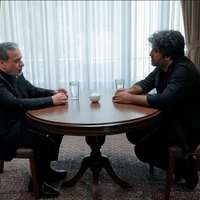
Iranian Presidential Candidate Meets Javad Zarif

Jun 13, 2024, 06:40 GMT+1
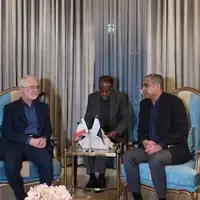
Photo of Pezeshkian and Zarif released by Iranian media on June 13. It is not clear if the image shows their recent meeting.

Iran’s proreform presidential candidate Massoud Pezeshkian held a meeting with former foreign minister Mohammad Javad Zarif, after reports that he might choose the former diplomat as his foreign minister in case of victory in the June 28 vote.

Iranian media reported on the meeting on Thursday without offering much detail. “Zarif provided an analysis of the country's foreign policy situation and recent ups and downs, sharing his views on international relations,” the conservative Mehr News reported.

Pezeshkian has refrained from expressing his views on foreign policy since being approved on Sunday as one of six hand-picked regime insiders allowed to run for president. However, in the past he has expressed support for the 2015 nuclear deal and for the need to achieve a new agreement.

Local media reported that “Pezeshkian also shared his views on diplomacy, emphasizing the need to move towards opening new horizons in foreign policy,” during the meeting with Zarif.

All candidates have so far avoided the issues of foreign policy, crippling sanctions and reaching a deal with the West over Tehran’s fast-expanding nuclear program. While they speak about Iran’s economic vows, they offer domestic solutions, none of the candidates has referred to a foreign policy shift in order to reduce or remove US oil export and other sanctions.

Most Viewed

Iran diplomacy wobbles as factions compete to avoid looking soft on US
1
INSIGHT

Iran diplomacy wobbles as factions compete to avoid looking soft on US

2
VOICES FROM IRAN

Bread shortages, soaring prices strain households in Iran, residents say

3
ANALYSIS

The politics of pink: how Iran uses cuteness to rebrand violence

4

Scam messages seek crypto for ships’ safe passage through Hormuz, firm warns

5
EXCLUSIVE

Family told missing teen was alive, then received his body 60 days later

Banner
Banner

Spotlight

  • Diplomacy tolls at Hormuz as conflict returns to its doorstep
    OPINION

    Diplomacy tolls at Hormuz as conflict returns to its doorstep

  • Opposition to US talks grows in Tehran as ceasefire deadline nears
    INSIGHT

    Opposition to US talks grows in Tehran as ceasefire deadline nears

  • Tehran moderates see ‘no deal–no war’ limbo as worst outcome
    INSIGHT

    Tehran moderates see ‘no deal–no war’ limbo as worst outcome

  • The future has been switched off here
    TEHRAN INSIDER

    The future has been switched off here

  • Lights out, then gunfire: Witnesses recount Mashhad protest crackdown
    VOICES FROM IRAN

    Lights out, then gunfire: Witnesses recount Mashhad protest crackdown

  • Is Iran entering its Gorbachev moment?
    INSIGHT

    Is Iran entering its Gorbachev moment?

•
•
•

More Stories

Iranians Clash Over Presidential Candidate on Social Media

Jun 12, 2024, 21:09 GMT+1
•
Maryam Sinaiee

Controversy continues around Massoud Pezeshkian, the only proreform candidate running for president in Iran, as some claim that his chances for the June 28 vote are high, while others dismiss him as another regime pawn.

His interview Monday on state television seems to have disillusioned many who expected Pezeshkian to openly criticize the establishment and its policies or even express defiance against unpopular policies. 

The interview was focused on the economy and general issues. Throughout the interview, no reference was made to sensitive issues such as foreign policy, the nuclear issue, or hijab by the interviewer or Pezeshkian.

The candidate stressed that his government would not introduce any new economic strategies and policies. Instead, he said, he would try to efficiently implement the existing development plan by reforming the administrative system while making it transparent and accountable.

“He spoke 45 minutes about the economy and said nothing about the sanctions. He didn’t even use the word sanction. All he said about the economy was that he would continue the path of Raisi’s administration and the same plans. If so, those closer to Raisi’s administration (other candidates) can do it better,” Arash Sepehri, an economic pundit, tweeted.

UK-based Iranian political analyst Shahir Shahidsaless in a tweet said Pezeshkian revealed that he had no plans and was only going to execute Supreme Leader Ali Khamenei’s slogans, adding that he could not “light any glimmer of hope in the hearts” of Iranians. “I don’t think even subservient [candidates] such as Jalili and Ghalibaf would say such things,” he argued.

Some also allege that he is a ‘Pan-Turk’. This is based on his defense of teaching Turki, a sister language of Turkish and Azerbaijani, which is spoken by around 20 million in several provinces. Pezeshkian who was among the founders of a Turki-speaking faction in the parliament in 2016 is also known for advocating federalism.

“Who is the best candidate? A separatist [and] Pan-Turk who supports the Woman, Life, Freedom rebels:),” one of hardliner Saeed Jalili’s supporters alleged in a tweet.

Similar views have been expressed by some pro-monarchy and nationalist users on X.

“Precarious view of Pan-Turk Pezeshkian: the country must be administered federally!!” Armin1991 wrote on X.

A user who appears to adhere to ultra-nationalistic views argued that in these elections ‘reformists’ have resorted to playing the “Pan-Turk, separatist Pezeshkian card” and hardliners have rallied behind Saeed Jalili whose ideology is focused on the concept of Islamic ummah (nation).

Whereas Pezeshkian’s rivals including Saeed Jalili and Mohammad-Bagher Ghalibaf have bigger support in domestic social networks such as Eitaa and Rubika, Pezeshkian seems to be much more popular on X.

“Ghalibaf is president in Rubika, Jalili in Eitaa, and Pezeshkian in Twitter. On the street, however, no one knows the date of the elections,” Sina Sarmadi, a businessman, said in a tweet.

The supporters of the 69-year-old former lawmaker and minister of health praise him for having a down-to-earth lifestyle, being honest and outspoken, and say he is not corrupt like Ghalibaf and some of his other rivals.

Pezeshkian supported the 2015 nuclear deal. He has opposed the government’s plans of hijab enforcement and advocates freedom of speech and free access to the internet.

“They say Dr. Pezeshkian did not appear strong in last night’s interview. They are right. They have been accustomed to hearing [other candidates’] lies…and astronomical promises (four million housing units). They are not used to honest, implementable, and realistic statements,” Seyed Morteza Mir, a Pezeshkian supporter tweeted.

Pezeshkian tried not to make promises, and not take people for fools, Ali Ahmadnia, a reformist journalist, tweeted in Pezeshkian’s defense. “He knows due to his presence in the parliament the non-implementation of past development plans is caused by inefficient executives and governments having created plans after plans.”

Babak Majidi, a political reporter with the reformist Iranian Labour News Agency (ILNA), in a tweet, too, praised Pezeshkian for saying it is him who must listen to experts, not vice versa. “This was a real golden sentence,” he wrote.


Iran Denies Faltering of Iran-Russia Cooperation Agreement

Jun 12, 2024, 18:57 GMT+1

Denying claims of a halt in the recent Iran-Russia cooperation agreement, Ali Bagheri Kani, the acting head of Iran's Ministry of Foreign Affairs, has attempted to dismiss reports.

Claiming the agreement is merely "under expert review by both sides", his assertion contrasts with statements from Russian officials.

Russian Foreign Minister Sergey Lavrov acknowledged that although the agreement's text has been coordinated, it cannot yet be signed due to pending "procedural legislative actions," further complicating the process.

Tehran and Moscow established a partnership in March 2001 through the signing of a long-term agreement. Originally set to expire after ten years, the treaty has seen two five-year extensions, with the most recent extension in 2021 pushing its expiration to 2026.

In 2023, emerging difficulties threatened the development of a new agreement between Iran and Russia. The challenges stemmed from Iran's objections to a joint statement released after the Russia-Gulf Cooperation Council (GCC) Strategic Dialogue. A particular point of contention for Iranian officials was a statement they interpreted as Moscow aligning with the UAE's stance in a territorial dispute over three islands in the Persian Gulf, which Tehran claims as its own.

The explanations provided by Moscow were deemed inadequate by the Iranian authorities, raising concerns over the solidity of their bilateral relations in spite of Tehran's dependence on Moscow which has been a key partner in the wake of deepening sanctions. 

Ex-Iranian President Says Government's Top Priority Must Be Lifting Sanctions

Jun 12, 2024, 17:34 GMT+1
•
Niloufar Goudarzi

Former Iranian President Hassan Rouhani has stated that the most crucial task for the upcoming president will be to help lift sanctions.

“It is clear that the task of lifting sanctions is not a simple one, but it can be achieved with a balanced approach that neither leans towards Eastern nor Western policy,” Rouhani said in a statement published on Wednesday. “And with a global collaboration strategy and the utilization of competent, dedicated, and fearless personnel.”

Rouhani advocated for a foreign policy stance transcending the dichotomy of East versus West, contrasting with Khamenei's prominent "Looking East" strategy, underpinning the hardliners' push for a "revolutionary economy."

Major decisions concerning Iran’s foreign policy originate from Khamenei's headquarters.

“At present, the primary concern of the populace revolves around the soaring cost of living and the stagnant employment growth witnessed in recent years, as reflected in the escalating ‘Misery Index,’” Rouhani said, in what seems like a direct message to Khamenei.

The Misery Index, which measures combined unemployment and inflation rates, consistently ranks Iran among the top countries in the region with high misery scores.

The foreign policy decisions of the Islamic Republic have significantly worsened the economic situation. Sanctions, imposed due to Iran's ongoing nuclear weapons program and support for terrorist groups, have intensified economic strain. However, the Supreme Leader and his loyalists have been reticent in acknowledging economic hardships.

There will be a snap election on June 28 following the sudden death of President Ebrahim Raisi in a helicopter crash last month with the six handpicked presidential candidates having begun airing recorded interviews.
None have addressed foreign policy except for hardliner former nuclear negotiator Saeed Jalili, who explicitly stated his opposition to the nuclear talks and deal.

Khamenei demonstrated flexibility during Rouhani's tenure by accepting the Joint Comprehensive Plan of Action (JCPOA), signed in 2015 between China, France, Russia, the United Kingdom, the United States, and Germany. The agreement was considered a landmark achievement in curbing Iran's nuclear program. Then-President Donald Trump subsequently withdrew the United States from the deal in 2018, citing its purported ineffectiveness in combating Iran's missile program and regional influence.

“Some officials made us wait for three or four countries and made Iranians suffer for years. They followed a path that yielded no results”, the ultraconservative said on Tuesday.

Praising Raisi's hardline administration, Jalili stated, "The same officials claimed that without the deal [JCPOA], the country’s economy would collapse. However, over the past three years, we have managed to sustain a strong economy and export to various countries."

This is while over the past three years, numerous observers, ranging from hardliners to 'reformists,' have also blamed the current situation on the failings of late President Ebrahim Raisi's economic team. Despite this, Raisi had adhered to Khamenei’s policy of strengthening ties with Russia and China and reducing ties with the West.

Meanwhile, Iran remains dependent on its allies, China and Russia. Russia’s suspending a new comprehensive cooperation agreement has put Iran’s dependency on the world stage. Some analysts, including former Iranian diplomat Hossein Alizadeh, believe Russia is leveraging Iran's global isolation to extract more favorable terms akin to the 25-year deal with China.

Also, tensions persist as both Russia and China support the territorial claims of Arab Persian Gulf countries against Iran such as in the United Arab Emirates’ claim over three disputed islands.

Iran's Military Advisor Stresses Presidential Loyalty to Supreme Leader

Jun 12, 2024, 11:11 GMT+1

General Yahya Rahim Safavi, the top military advisor to Iran’s Supreme Leader Ali Khamenei, has declared that Iran's next president must align closely with the Supreme Leader's directives.

Speaking to state media, Safavi emphasized that the ideal candidate must view himself as "the second-in-command" to Khamenei, warning against any divergence between the executive actions and Khamenei's vision.

"People should elect a president whose views do not conflict with those of the Leader of the Revolution and who considers himself the second-in-command."

The statement comes in the wake of former President Ebrahim Raisi's sudden death in a helicopter crash on May 19, which has precipitated a snap election scheduled for June 28.

The Guardian Council, which answers to Khamenei, has disqualified a significant majority of hopefuls, permitting only six to run, five of whom are staunch loyalists to Khamenei. The sole moderate reformist cleared to contest, Masoud Pezeshkian, a current parliament member, has notably swayed public sentiment by pledging unwavering loyalty to Khamenei during his campaign, much to the disappointment of reformist supporters.

Safavi's remarks mirror the broader strategy of Iran's leadership to consolidate power around a singular ideological line, especially as the country faces escalating domestic discontent and international pressures. His tenure as the former chief of the Revolutionary Guards further bolsters the weight of his statements, highlighting the military's integral role in shaping and securing the country’s political landscape.

TV Viewers Disappointed With Iran's Proreform Candidate

Jun 12, 2024, 07:53 GMT+1

The first TV interviews with the leading 'reformist' and conservative candidates on state television Monday appear to have disappointed both politicians and ordinary voters.

Although all the candidates have similar weakness according to viewers comments on social media, most criticisms were directed at proreform candidate Massoud Pezeshkian and conservative hopeful Mohammad Bagher Ghalibaf.

Pezeshkian's blunders and weaknesses came as a surprise to viewers who had high expectations of him. Many anticipated that he would be as neatly dressed and articulate as former reformist President Mohammad Khatami.

Many criticized Pezeshkian for his more than casual outfit, while other candidates appeared nice and tidy. But not all the criticisms of the ‘reformist’ candidate was about his appearance. As one observer noted: "The way he dressed was disrespectful to the people. He spoke about the economy for nearly 40 minutes and did not mention the word 'sanction' even once. Generally, he said that he would continue former President Ebrahim Raisi's path and will follow his policies. He reiterated that he does not have any plan or policy of his own."

One of the key issues in this election is the future of the country’s battered economy and the steep fall in living standards. US and other sanctions are a key factor in devastating an already weak economy, mired by state controlled, lack of competitiveness and mismanagement. Ordinary workers now make around $200 a month in the capital Tehran, while Iran sits on vast oil and natural gas reserves.

A pro-reform politician Mahmoud Sadeghi wrote that "based on the initial review of proreform voters' views about Pezeshkian's interview, he appeared less than their expectations. If the only reformist candidate continues his campaign in the same way, he cannot encourage voters to go to the polls for him."

Iranian journalist Mohammad Aghazadeh wrote: "The televised interview showed that none of the conservative candidates were as loyal as the reformist Pezeshkian to former President Raisi's policies and the government's conservative guidelines. I think he is the most loyal individual to the hard core of political power in Iran."

Another Iranian journalist, Gholamreza Nouri Ala, advised Pezeshkian to be himself and not to imitate anyone. "Do not shut the people's last outlet for hope!" Meanwhile, an Iranian journalist in London, Homayoun Kheyri opined that "Pezeshkian's first interview was good. He delineated the playground for all the pillars of power in Iran as well as for his rivals and did not offer any irrelevant promise."

Proreform Muslim scholar Yaser Mirdamadi wrote: "Pezeshkian disappointed everyone as he said he has come to continue the old policies, though with minor alteration, not by introducing essential changes."

Ghalibaf faced criticism for stating in his interview that, if elected, he would run his government using the same politicians, statesmen, and staff currently working with the government.

An observer pointed out that when speaking about the economy, Ghalibaf avoided the terms market economy and free market and said instead that progress will come with investment and wealth creation but did not say how.

As observed by one viewer, before broadcasting Ghalibaf's interview, the Iranian state television showed a caption that said the airing of his interview has been delayed as edits had to be made to the tape! During the interview, Ghalibaf said that he was the father of Iran's missile industry.

As Iranian journalist Davoud Heshmati pointed out, it seems that the candidates have missed their first opportunity to let viewers know about their plans and ideas for the future.