‘Reformist’ Politician Registers to Run for Iran’s Presidency
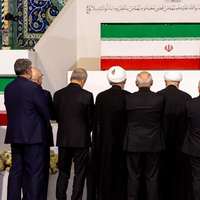
Photo of Mahmoud Sadeghi wearing the IRGC's outfit during a parliamentary session where all MPs expressed their support for the Revolutionary Guard in April 2019
Mahmoud Sadeghi, a ‘reformist’ politician, and former lawmaker who has become known as an outspoken critic of Iran’s Supreme Leader Ali Khamenei's policies, registered for Iran's presidential election on Sunday.
The Guardian Council, however, had earlier disqualified him from running in the 2020 legislative elections, and is unlikely to approve him this time either.
The Council dominated by Khamenei’s conservative loyalists has barred hundreds of regime insiders from running in elections since 2020.
The field of candidates is dominated by conservatives and hardliners. 'Reformists' are still undecided about fielding a candidate, and Sadeghi would hardly be chosen as their main candidate.
Sadeghi, a former Shia cleric, wrote on Twitter in 2021, "The function of reformist and moderate governments is to get the system [regime] out of its crises, then the system will throw them away like a used handkerchief."
Former Iranian president Mahmoud Ahmadinejad after registering as a candidate for the presidential election at the Interior Ministry, June 2, 2024
Former Iranian President Mahmoud Ahmadinejad on Sunday registered his candidacy for the June 28 presidential vote, as a steady stream of conservatives and hardliners have joined the fray.
The controversial politician, who has been largely sidelined by the regime's ruling core for nearly a decade, arrived at the Interior Ministry to officially submit his credentials and register for the election.
“Today, I have come to once again greet the people of Iran,” he said as he registered his candidacy.
“The challenges we face today in all spheres are far greater than those of 2013," said the former president, pointing out that the economic hardships of the people have exhausted their patience.
Iran is grappling with soaring food prices amidst economic and social turmoil and the devaluation of the rial compounded by regional tensions. The root cause of this alarming price surge lies in Iran's faltering economy, exacerbated by the continuous devaluation of the Iranian rial. The rial has continuously fallen since the inception of the Islamic Republic in 1979, but it turned into a steep fall in 2018 when the United States withdrew from the JCPOA nuclear deal, demanding its revision. Oil export sanctions and international banking restrictions imposed by the Trump administration badly hurt Iran’s oil-dependent economy.
“My top priority will be to address the economic problems of the people," added the former president.
However, registering as a candidate does not mean that a politician can automatically participate in the election. Iran’s governing system has a powerful watchdog called the Guardian Council that vets all candidates and according to obscure criteria decides whose name can be on the ballot.
Ahmadinejad arriving accompanied by former aides to register candidacy. June 2, 2024
Asked if he thinks he will be permitted by the Guardian Council to run for the presidency, Ahmadinejad kept silent and just smiled, a video of him at the Interior Ministry shows.
The Guardian Council, loyal to Supreme Leader Ali Khamenei barred Ahmadinejad from running in the 2017 and 2021 presidential elections. Following his disqualification in 2017, the hated and loved politician became a vocal critic of the ruling elite’s governance, even going as far as criticizing Supreme Leader Ali Khamenei.
He was not the only well-known figure who was barred from running in mid-2021. Former Parliament Speaker Ali Larijani and former Vice President Es’haq Jahangiri were also barred, opening the path for Ebrahim Raisi to win a low-turnout election as a hardliner candidate.
After Raisi’s victory, Ahmadinejad was apparently put on a short leash and mostly stopped commenting and criticizing. With Raisi’s death in a helicopter crash last month, he came out of the shadows and began commenting about a bright future for Iranians.
Six prisoners, including one who was a minor at the time of his sentencing, were transferred to solitary cells in Adelabad prison in Shiraz, Iran on Thursday, in preparation for their execution.
Among these prisoners is Aref Rasouli, a 20-year-old young man whose case has underscored a significant ongoing issue: Iran's persistent violation of international human rights standards by sentencing minors to death.
Rasouli was reportedly born on 25 April 2004, making him 17 years old at the time of his alleged crime. Norway-based Iran Human Rights (IHRNGO), which reported on his transfer to solitary confinement, has urged the international community and all countries with diplomatic relations with Iran to use every available channel to halt these executions. IHRNGO Director, Mahmood Amiry-Moghaddam stated:
“The international community’s reaction can prevent the execution of Aref Rasouli and the other death row prisoners. Executing child offenders is a flagrant breach of international law and the Islamic Republic’s treaty obligations. The international community shouldn’t allow child offender executions to continue.”
The Islamic Penal Code and Iran’s Breach of International Laws
Executing individuals for crimes committed under the age of 18 contravene international human rights norms, including the International Covenant on Civil and Political Rights and the the Convention on the Rights of the Child, both of which Iran has ratified.
According to Iran's 2013 Islamic Penal Code, the age of criminal responsibility is 15 for boys and 9 for girls. This means they can be sentenced to death for murder and other capital crimes in Iran.
Although the May 2013 update to the Islamic Penal Code allowed judges to replace the death penalty if juvenile offenders lacked an understanding of the crime or their mental maturity was in doubt, Iran persists in imposing such sentences. Amnesty International stated that Iran’s claims of reform of the justice system with the 2013 May are “not reality” and that “little has changed in practice”.
Notably this provision further emphasized Iran’s disregard for meeting its international obligations, which strictly prohibit such sentences for juvenile offenders under any circumstances in the first place.
Even if Iran were to adhere to its obligations under international law, the country's judiciary faces scrutiny by International rights groups for its track record of sham trials and blatant disregard for due process, with detainees frequently denied legal representation.
Recent Cases of Child Offenders on Death Row Executed in Iran
Earlier this month, 20-year-old Ramin Sa’adat was executed at Miandoab Prison in West Azarbaijan province for a murder he committed at the age of 16, as reported by Kurdpa. Despite Saadat maintaining his innocence throughout his trial, his sentence was carried out on 18 May 2024.
Ramin Saadat
Transparency remains elusive, with Iran withholding crucial data on executions, including those of juvenile offenders. However, as many as 85 juveniles could be on death row in Iran’s prisons as per a 2021 UN report.
Of the juvenile offenders on death row, at least 5 were executed in 2023, as per Amnesty reports.
One of those executed in 20203, was Hamid Azari who not only was sentenced to death when he was a minor, but also executed when he was only 17 years old.
Hamidreza Azari
“Hamidreza Azari was arrested when he was just 16 years old and executed less than seven months later after a grossly unfair trial that was expedited by prosecution authorities. The Iranian authorities misrepresented his age as 18 in domestic media to evade accountability for violating international law which prohibits the imposition of death sentences on people under 18 at the time of the crime,” Amnesty stated.
Yousef Mirzavand
In 2022, at least 3 juvenile offenders were executed on murder charges according to IHRNGO. Of those executed, included Yousef Mirzavand who was sentenced to death for a murder he allegedly committed at age 16.
“His family said he was innocent...someone else committed the murder and Yousef had taken the wrap for it…Yousef was from the Mirzavand tribe in Lorestan…” an informed source told IHRNGO. Mirzavand was executed in Dezful Prison on 26 December 2022.
With the fate of Rasouli and other juvenile offenders including Arvin Ghahremanihanging in the balance, and as advocacy groups continue to sound the alarm, the imperative to confront Iran's egregious human rights violations grows ever more urgent.
Zohreh Elahian, in a military weapons exhibition in Tehran in August 2023
Former female lawmaker Zohreh Elahian has registered to run in Iran's June 28 snap presidential vote, potentially becoming the first woman ever allowed to stand if approved by the Guardian Council.
Elahian, 57, is a physician and former member of the parliament’s National Security and Foreign Policy Committee. She was elected to parliament twice on the hardliners’ slate.
In her speech following registration, Elahian declared her motto: “Sound government, sound economy, sound society,” and pledged to combat corruption.
Like other hardliners, Elahian supports compulsory hijab rules. In March, Canada imposed sanctions against her for endorsing the death penalty for protesters involved in the “Woman, Life, Freedom” movement. Her candidacy comes after months of harsh policies and actions by the government against women who defy compulsory hijab.
Zohreh Elahian enters interior ministry to register
Elahian’s qualification to run hinges on the Guardian Council's interpretation of a controversial article of the Constitution. The Guardian Council, the sole body empowered by the Constitution to interpret it, has historically disqualified female candidates. This disqualification is based on Article 115, which stipulates that candidates must be from among political or religious "rijal" (the plural of "rajul"), a masculine Arabic noun meaning "men."
However, some constitutional experts and politicians interpret "rijal" to mean "figures" or "persons" irrespective of gender, rather than exclusively "men."
Azam Taleghani, a veteran reformist politician and journalist, registered to run in every presidential election from 1997 until her death in 2019. Despite being described as an “Islamic feminist,” Taleghani was rejected by the Guardian Council every time.
In 2009, populist Mahmoud Ahmadinejad proposed Elahian as Minister of Welfare and Social Security. However, she declined the nomination, citing opposition from senior Shia clerics (maraje’) to women serving as ministers.
Another of Ahmadinejad’s female nominees, hardliner Marzieh Vahid-Dastjerdi, a physician and former lawmaker, was approved by parliament as Minister of Health, making her the first and only female minister in the history of the Islamic Republic.
Several other political figures registered to run on Saturday, including ultra-hardliner Tehran mayor Alireza Zakani, reformist lawmaker and former first deputy speaker Masoud Pezeshkian, and Vahid Haghanian, a member of Supreme Leader Ali Khamenei’s office.
Haghanian’s registration, dubbed by social media users as the “biggest surprise” of the election registrations, and his motives has baffled observers. Like Elahian, many believe there is no chance he will be qualified to run. Some people even claim he no longer holds a position at Khamenei’s office.
“We were quick to judge about him. He is known as the black box, but he has apparently not held any positions in a long time,” Hossein Ebrahimi, a conservative cleric and politician, tweeted. Ebrahimi added that there is a high possibility of Haghanian’s disqualification, apparently due to open cases with the judiciary.
This may refer to allegations of espionage against him that surfaced in January after the execution of Mohsen Saravani, 24, on charges of spying for Israel. Saravani had been photographed with Haghanian and was said to be close to him. Around the same time Haghanian ceased to appear in public.
Behnam Gholipour, expatriate journalist, in a tweet on Saturday called Haghanian an “scapegoat candidate”. “He will be sacrificed to mask disqualification of others. Then everyone will say Larijani and Ahmadinejad don’t even count [because] Khamenei’s right-hand man was disqualified,” he wrote.
An Iranian hacking group, called IR Leaks claimed to have accessed personal information of millions of pilgrims who participated in the Hajj from 1985 to 2024.
The data breach includes detailed records of government officials, law enforcement personnel, and clerics—all of whom have been dispatched to the Hajj over nearly four decades. The group has allegedly given the Hajj and Pilgrimage Organization of Iran a 24-hour ultimatum to negotiate before they proceed to sell 1.25 terabytes of the critical data.
The compromised data includes names, surnames, fathers' names, dates of birth, places of birth, and identification numbers.
The published sample image by the hackers shows detailed information on Basij militia members sent to the Hajj, highlighting the depth of the intrusion.
This is not the first time IR Leaks has targeted Iranian entities. Previously, the group engaged in negotiations with Snapp Food, the country's largest food delivery app, and the ride-hailing app Tapsiafter hacking their systems and obtaining vast amounts of user data. While they refrained from publishing Snapp Food’s data after reaching an agreement, they went ahead and sold the data from Tapsi when negotiations failed.
Given the history of this group, it does not seem that they have any political motives in their activities.
The hacking of the Hajj and Pilgrimage Organization's database represents a serious escalation in the group’s activities, pointing to severe vulnerabilities within Iran's cyber infrastructure.
The breach not only raises questions about the effectiveness of Iran's data protection policies but also about the possible implications for the Islamic Republic's national security.
Nasser Kanaani, the spokesperson for Iran's foreign ministry reacted defiantly to the latest sanctions imposed by the European Union and the United States.
He accused the EU on Saturday of favoring the interests of the "Zionist regime and America" above those of its own member nations.
The sanctions, announced Friday, specifically target high-ranking officials and entities within Iran, including the country's defense minister and its Revolutionary Guards, for their role in transferring arms and military equipment used against Israel, Ukraine, and in the Red Sea region.
Kanaani criticized the European Union for what he described as "double standards" and for resorting to "repeated, baseless, and unsubstantial excuses and accusations" that overlook the realities of West Asia.
Despite these international rebukes, he affirmed that Iran would persist with its "fundamental policies."
The EU’s actions, which also align with measures taken by the United States and Britain, follow Iran’s alleged involvement in sending missiles and drones to support Russia in its conflict in Ukraine, as well as to militant groups in the Middle East.
Highlighting the gravity of the situation, the EU stated that the listed individuals and entities were actively involved in undermining peace and security by supplying drones and missiles to "armed groups and entities" in conflict zones.