Biden Praises US Military for Thwarting Iran Attack Against Israel
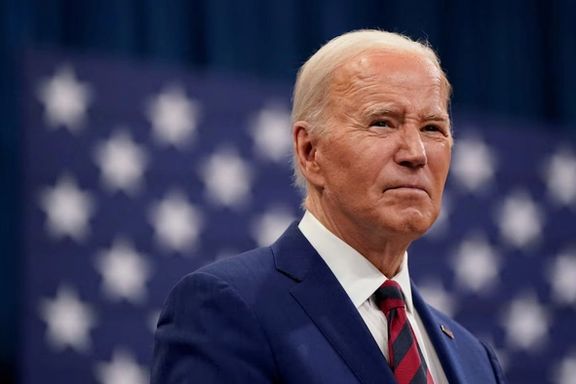
U.S. President Joe Biden looks on during his visit at the Chavis Community Center in Raleigh, North Carolina, US, March 26, 2024.
During a commencement speech at the US Military Academy in New York, President Joe Biden, praised American forces for their role in intercepting the Iranian drone and missile attack aimed at Israel.
“Ninety-nine percent of the missiles, drones,” Biden highlighted, never reached their targets “because of the quality of our forces.”
Biden was referring to the unprecedented attack of April 13 when Iran initiated an unprecedented offensive from its territory against Israel, deploying over 350 killer drones, cruise missiles, and ballistic missiles. In response, a coalition of jets from the US, UK, France, and Jordan effectively formed a defensive barrier, thwarting the Iranian offensive.
“Thanks to the US Armed Forces, we’re doing what only America can do as the indispensable nation, the world’s only superpower,” Biden stated.
US Central Command (CENTCOM) detailed that US forces neutralized over 80 one-way attack drones, accounting for 47% of the drones launched by Iran. This marked the first-ever direct attack from Iranian soil on Israel, an action that shifted global attention from the ongoing Gaza conflict towards Iran, rallying international support for Israel and sparking widespread condemnation of Iran.
The attack was an alleged retaliation to an Israeli air strike on the Iranian consulate in Syria. Following the Iranian bombardment, Israel conducted a precise counterstrike aimed at preventing further escalation into a full-scale conflict. This included targeting and destroying a component of the S-300 air defense system at the Isfahan base, a fact revealed through satellite imagery analysis.
Iran, seemingly cautious of igniting a larger regional conflict, played down the damage inflicted on its airbase and declared it would not pursue further retaliation.
The candlelight ceremony planned for Ebrahim Raisi and his companions in front of the Iranian embassy in London on Saturday was canceled due to a gathering of Iranian protesters celebrating Raisi's death.
The cancellation came just one day after Islamic Republic loyalists attacked Iranian protesters in London.
Celebrating the demise of Raisi, outside the embassy on Saturday, protestors chanted "Death to Khamenei, Curse Raisi" and displayed a balloon shaped like a helicopter, symbolizing Raisi's helicopter crash as they danced.
This demonstration was a direct response to the violence from the previous day when supporters of the Islamic Republic attacked anti-government protesters.
Following the attack on Friday, a spokesperson for the London Metropolitan Police confirmed the incident to Iran International. During the attack, four people were injured and one person was arrested, although the identity of the arrested individual had not been disclosed. The police said they are investigating the incident, reviewing videos from social media, and urging the public to provide any additional footage or information.
Eli Borhan, an opposition activist injured during the attack, stated that her mobile phone was stolen by the attackers and later accessed within the Iranian embassy in London.
Meanwhile, another protestor was hospitalized due to a serious spinal injury as a result of being attacked.
The attack sparked a wave of reactions from political activists and opposition figures. Prince Reza Pahlavi condemned the violence, noting that Iranian protesters face threats both at home and abroad. He called for the arrest and trial of those responsible for the attack.
Prominent activist Masih Alinejad criticized the British government for its negligence regarding the Islamic Republic, urging the authorities to take decisive action against such attacks.
Actress and human rights activist Nazanin Bonyadi echoed these sentiments, stressing the need for a thorough investigation by London police and for the perpetrators to be held accountable for the attack.
This attack was not an isolated incident and part of a broader issue of Islamic Republic loyalists' aggression on Iranian dissidents.
Despite the cancellation of the candlelight ceremony in London, similar events continue to occur elsewhere. The Islamic Education Center in Maryland in Michigan held a memorial service for Raisi earlier this week, claiming that it was in solidarity with the people of Iran and supporters of global peace and justice. Meanwhile, Islamic Republic loyalists who went to the ceremony threatened Iranian protestors outside the center with death.
Mojtaba Zolnouri, the representative from Iran's holy city of Qom and a conservative cleric, has announced his candidacy for the speakership of the Iranian parliament.
Zolnouri, who previously held roles within the Islamic Revolutionary Guard Corps and as chairman of the Nuclear Subcommittee, is leveraging the recent death of President Ebrahim Raisi to assert his ambitions amid Iran's political volatility.
Zolnouri's campaign for the speakership highlights his claims to reshape parliamentary dynamics, advocating for a shift from a speaker-centric to a representative-centric model. Amidst this political maneuvering, Iran's parliamentary elections have recently witnessed a historically low voter turnout, reflecting deep-seated public disillusionment with the government's legitimacy.
Reports from state media claimed a turnout of over 40%, yet contrasting narratives on social media suggest significantly lower participation, indicating a divide between official accounts and public sentiment. The voter apathy was even more pronounced in the subsequent run-off elections, where more than 90% of Tehran's eligible voters abstained, signaling a disconnection between the Iranian populace and the government.
As Zolnouri enters the race for parliament speakership and Iran gears up for a presidential electionin June, following the sudden death of President Ebrahim Raisi in a helicopter crash, the forthcoming political events will be pivotal in assessing whether his leadership can redirect the parliament's focus and reinvigorate a disillusioned electorate, or simply maintain the status quo masquerading as reform.
Iranian lawmaker and Presidential hopeful Masoud Pezeshkian
As Iran prepares to hold a snap election after the death of President Ebrahim Raisi, reformist politician Masoud Pezeshkian announced his bid for the presidency on Sunday.
Pezeshkian, known for his previous tenure as health minister and first deputy speaker of the parliament, said he “aims to increase voter turnout,” challenging the disenchantment with the electoral process in Iran.
Pezeshkian's announcement comes at a time as Iran prepares for an early presidential election slated for June 28, following Raisi's sudden death last week in a helicopter crash in northwest Iran.
The election arrives amid the Supreme Leader's efforts to consolidate power within hardline factions, pushing the presidency further into a ceremonial corner while ensuring all key positions are held by loyalists.
Public interest in electionshas plummeted, with recent parliamentary elections marking a historic low in voter turnout. In Tehran alone, only seven percent of eligible voters participated in the recent run-offs, underscoring the growing disconnect between the electorate and the government. In the elections which saw Raisi gain the presidential seat in 2021, it was also record lows for the presidential elections indicating a similar challenge next month in the sham elections.
The upcoming presidential electionis shrouded in uncertainty, with the Guardian Council likely to bar any significant non-hardline candidates.
As the acting president, Vice President Mohammad Mokhber, endorsed by Supreme Leader Ali Khamenei, temporarily fills the void until the elections, the political landscape in Iran remains tightly controlled. Statements from government officials continue to emphasize a hard stance against Iran's perceived enemies and a commitment to unyielding policy directions, signaling no change in the country's political and social climate, ultimately in the hands of the theocratic dictator, Khamenei.
President Ebrahim Raisi's Helicopter that crashed in northwest Iran on May 19.
Iran has arrested several people across the country for "insulting" officials and "disturbing public opinion" as Iranians celebrate the helicopter crash that killed President Ebrahim Raisi and his companions.
The crackdown extends to online speech, with authorities detaining six men and one woman in Gilan for their social media posts about the incident.
Colonel Hamidreza Feizi of the Fuman police in Gilan emphasized the government's sensitivity to online discussions, stating that “any content deemed insulting to those killed in the helicopter crash would lead to police action.”
The Iranian government and affiliated media continue to glorify Raisi and his companions as "martyrs of service," attempting to quash any criticism or ridicule that followed the crash amid a leadership crisis.
The narrative control coincides withbroader measures against free expression, including the arrest of a Tehran resident whose social media activity, once reaching six thousand followers, was forcibly curtailed under threat of legal action.
On Tuesday, Reza Babrnejad, the brother of Mehdi Babrnejad, a victim of the Woman, Life, Freedom protests, was arrested in response to his reaction to the death of Ebrahim Raisi, sharing a dance of his brother on Instagram celebrating the disaster. "The pure blood and the sufferings of all the mothers and fathers who seek justice will have their retribution. It may take time, but there is no escaping," he wrote.
Additionally, three days ago, the Judiciary Information Center of Kerman Province announced that 254 people were given "telephonic warnings and guidance" for posting "insulting" content, and eight individuals were also summoned for judicial proceedings.
After the news of the disappearance of the helicopter carrying the president, the former foreign minister of Iran, and their entourage on May 19, Persian-language social networkswere filled with sarcastic messages praying for the news of their deaths to be true.
A group of Afghan refugees at the border with Iran
The Deputy Governor of Tehran has warned about the "threatening" presence of undocumented Afghan immigrants in the province, likening their removal to going to war.
"In dealing with illegal residents, we are like our youth who took up arms and went to war, becoming martyrs," Mahdi Babolhavaeji was quoted as saying by state media on Saturday.
Immigration of Afghans has drastically increased in the past one year, with some claiming that up to 10,000 have been entering Iran each day, and the total population of Afghans in the country is approaching 10 million.
Furthermore, the IRGC-affiliated Tasnim News Agency reported in March that a police plan had been initiated to round up and repatriate unauthorized immigrants from Tehran Province. Last week, it was announced that a "special patrol" has been established in Shahr-e Rey, south of Tehran, to identify and collect illegal foreign nationals.
According to Afghan authorities, Iran deported over 20,000 Afghan children last year, many of whom were unaccompanied and without guardians.
The majority of immigrants, both legal and illegal in Iran are Afghans, who are often referred to as “foreign nationals” by officials and the media. According to the 2016 census, over 1.5 million Afghans were in the country, followed by 34,500 Iraqis and 14,320 Pakistanis.
Currently, officials are estimating that the number of Afghan immigrants is between 5 and 8 million.
When the current administration took power in 2021, policies toward Afghan refugees changed. Those opposed to the new measures have referred to them as "open border," with the government's hardliners slamming the concerns as "Afghan Phobia."
The rapidly growing Afghan population in Iran sparked protests on social media and debates in government-controlled media. Many claimed that the government had a hidden agenda in allowing thousands of Afghans to enter the country illegally each day.
Videos from border regions showed crowds of Afghans simply walking into Iran, with some alleging that “a network” quickly helps them find housing and jobs.
The government did not take any steps to slow the influx of refugees, leading to accusations that the Islamic Republic might have sinister plans to use the Persian-speaking Afghans for political or military purposes.
Iran International reported exclusively last year that Unit 400 of the Quds Force of Iran's Islamic Revolutionary Guard Corps (IRGC) recruits Afghans for suicide attacks and collaborates with Al Qaeda to target Israelis.
In Syria, Afghan militias, trained and recruited by the Revolutionary Guard, played an essential role in supporting Bashar al-Assad's government.
However, with the economy suffering, the plan to retain the Afghan population appears to have changed. While the policy and the ideological reasoning behind it are still being defended, there is a backtrack in practice.
A relic of the last remaining justifications, on Friday, IRNA, the Iranian state news agency, reported that “more than one hundred thousand people from the Sunni and Shia communities of Afghan immigrants mourned the loss of” President Ebrahim Raisi and his delegation in the funeral in Mashhad on Thursday.