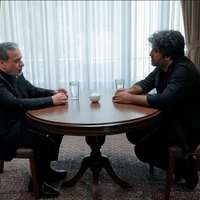
Washington institute executive director Robert Satloff (L) and Iran International's Arash Alaei (R) in Washington DC
If Joe Biden is reelected as US President in November, there is a “heightened possibility of considerable military pressure on Iran,” warned Washington Institute executive director Robert Satloff.
He suggested that the administration could either revisit the spirit of the JCPOA, as seen in the second Obama administration or adopt a different, more assertive approach towards Iran.
“I don't think the government will say, let's try JCPOA again and get around to the bargaining table. You will hear a debate about military pressure producing diplomatic options. There's a heightened possibility in a second Biden administration that there will be more considerable military pressure on Iran,” Satloff stated.
In 2015, Iran and major world powers, including the five permanent members of the UN Security Council, signed the JCPOA in Vienna. Under the agreement, Iran pledged to reduce its nuclear capability in exchange for relief from economic sanctions. In 2018, President Donald Trump withdrew from the Iran deal and imposed sanctions that crippled the Iranian economy.
In spite of sanctions, Iran has continued to enrich uranium far beyond JCPOA boundaries with the UN warning that Iran is weeks not months from a nuclear weapon, a major threat to global peace.
Asked about Biden’s Iran stance that critics from both sides of the political spectrum call soft, especially about Tehran’s role in Hamas' October 7th attack on Israel, Satloff stated the administration wanted “to lower the potential for a truly regional conflagration.”
Not least, over 200 attacks took place against US positions in the Middle East after the outbreak of the Gaza war as punishment for the US supporting Israel’s right to defend itself.
Critics of Biden question the claim that Iran was unaware of the October 7 attack despite actively supporting militias in the region, primarily through its so-called “Axis of Resistance,” including Hamas in Palestine, Hezbollah in Lebanon, and other militant groups in Syria, Yemen, and Iraq. In the course of last year Iran’s leaders had held a series of meetings with Hamas’s political leaders in the build-up to the attack. Within hours of the attack state-sponsored celebrations took place in Iran.
The Hamas invasion saw at least 1,200 killed, including at least 30 US citizens, and 252 more taken hostage. In its subsequent military operation in Gaza, Israel has killed over 35,000 people, according to the Hamas-run health ministry.
If the US wants to “adequately deal with what is going on in Syria, Iraq, Yemen and in Lebanon, they need to deal directly with what is going on in Tehran as it is the capital of this alliance of terror,” Satloff said. Last year the US named Iran as the world’s number one state sponsor of terror.In spite of the US revealing Tehran's funding of Hamas to the tune of at least €100m a year, plus arming and training the terror group, the Biden administration has largely held that Tehran was not responsible for October 7, the trigger for the longest and bloodiest Gaza war since Hamas took control of the Strip in 2007 in a bloody coup.
Iran and Israel’s shadow war has escalated since the start of last month, forcing Biden to confront an ever-more bold and aggressive Tehran. Iran attacked Israel last month in retaliation for an apparent Israeli strike on its consulate inDamascus that killed 7 Islamic Revolutionary Guard Corps (IRGC) members.
Satloff said Tehran’s retaliatory attack showed how vulnerable Iran is and not as militarily capable as it portrays. “As we say in America, they couldn’t hit the broad side of a barn as many missed not their targets, but the country they were even attacking, landing in Jordan, Lebanon, or elsewhere.”
While over 300 drones and missiles were used in the attack, almost all wereintercepted by Israel’s defense system and a US-led coalition.
Six days after the operation, an Israeli strike targeted a vital component of the S-300 air defense system at Iran's central city of Isfahan.
“Israelisopted for retaliation with a powerful message which showed the Iranians we can go anywhere, do anything, hit any target, and you can not stop us,” Satloff said.
The US has also been dragged into Iran’s proxy war most recently against Yemen’s Houthi militia. The Iran-backed terror group’s Red Sea blockade targeting global shipping has seen the US and UK engage in strikes on Houthi infrastructure in Yemen as well as defensive actions against drone and missile strikes in the vital trade route.
Talking about the future of tensions in the region, Satloff said hopes for de-escalation look unlikely, “I'm not sure it's in Iran's interest for there to be quiet, and so I think we're already seeing some Iranian militias also have an uptick and activity in the last couple of weeks coming out of Syria and Iraq, so I fear that we will have a higher level of tension as we move toward our November election.”
Vehicles swept away by powerful currents in northeastern city of Mashhad
The death toll in Iran's northeastern Khorasan Razavi province has reached 12, as floods sweep through the region, exacerbated by government mismanagement and flawed urban planning.
Officials have pledged accountability, but the public remains skeptical as the crisis exacerbates. The flooding, which began last Tuesday following intense rainfall, has inflicted severe damage across several areas in Mashhad and other provincial cities, with streets inundated and vehicles swept away by the powerful currents. Videos circulating on social media illustrate the chaos, with cars floating down waterlogged streets.
Criticism by citizens and experts has mounted against the "reckless and unprincipled environmental destruction" for construction purposes, and the ongoing mismanagement by city officials, pinpointed as the primary factors behind the flooding disaster in Mashhad.
A car submerged following flooding in Mashhad.
An eyewitness in Seyedi district, in the southeast of the city of Mashhad, which suffered the most damage from the flood, stated in a video that city officials were responsible by building a wall in the neighborhood. “During the recent flood, this wall broke like a dam, causing the floodwaters to flow through the area,” he added.
The threat persists with meteorologists predicting more heavy rainfall, which could worsen the situation further.
Mashhad’s outdated and unstable urban infrastructure underscores the broader governmental failures that consistently endanger its residents.
Iran's second most populous city faces numerous challenges with deteriorating urban fabrics. These areas, which include old buildings and neighborhoods with inadequate infrastructure, have become worn due to insufficient attention and investment over time. Problems such as structural instability, lack of safety against natural disasters like earthquakes, and poor quality of life for residents have arisen.
The current crisis is reminiscent of the floods of April 2019, when heavy rainfall impacted vast areas across Iran, particularly in Golestan, Fars, Khuzestan, Lorestan, and several other provinces. During that period, Iran experienced three significant waves of rain and flooding over two weeks, affecting at least 26 of its 31 provinces. The catastrophic events resulted in the deaths of at least 70 people nationwide.
Iran has re-authorized the import of previously banned “luxury” goods including sunglasses, musical instruments, and ski equipment.
The items, banned in 2021 under the guise of protecting the national economy, have been reintroduced, signaling potential desperation within the regime's economic strategy.
According to the latest update from the Trade Development Organization, the easing includes a variety of goods such as ski clothing, woodworking tools, sunglasses, off-road vehicles, and musical instruments.
The policy shift occurs as Iran continues to grapple with a severe economic depression, including rampant inflation and restricted access to international markets, largely due to crippling sanctions imposed by the US and Europe over its controversial nuclear activities.
The sanctions have devastated Iran's primary revenue source by severely cutting its oil exports, leading to a significant currency devaluation and budget deficits far worse than officially acknowledged.
Reports suggest the Iranian government may be overstating its oil revenue to mask the extent of its financial woes. Amidst the economic crisis, the government has been pushing for a "resistive economy" to lessen its dependency on oil revenues. However, the recent relaxation of import restrictions on luxury goods indicates a potential acknowledgment of failure in such policies.
As the national currency plummets, Iranians are increasingly converting their savings into more stable assets like gold.
The control of a large portion of Iran's economy by the government and quasi-state foundations, where hardliners are prevalent, has led to a conflict of interests that further complicates the economic landscape.
Ghasem Ghoreyshi, Deputy commander of Iran's paramilitary Basij
The deputy commander of Iran's paramilitary Basij, Ghasem Ghoreyshi, boasted about Iran's transformation from an arms importer to an exporter.
"There was a time when sanctions were imposed to prevent us from obtaining weapons, but today we have transformed from an importer to an exporter of arms," Ghoreyshi stated on Saturday.
"One world power asks us to give them this capability in a conflict, while another pleads with us not to."
Since mid-2022, Tehran has supplied Russia with hundreds of Shahed Kamikaze drones. The drones have been used against civilian targets and infrastructure in Ukraine, exacerbating the humanitarian crisis.
Despite denials from Iranian officials, evidence from recovered drone parts suggests a direct line of supply from Iran to Russia and there are emerging signs that Tehran might also be supplying long-range missiles to Russia.
The United Nations Security Council's arms embargo on Iran expired in October 2020 amid geopolitical tensions and failed attempts by the United States to extend it.
Last year, the US named Iran the world’s primary state-sponsor of terror as it arms proxies in countries including Lebanon, Syria, Iraq and Palestine.
In Yemen, the Houthi rebels, supported by Iran, have used an array of Iranian missiles and drones to disrupt international shipping in the Red Sea, prompting military responses from both the US and the UK.
In its first direct assault on Israeli territory, Iran fired more than 350 drones, missiles, and ballistic missiles on April 13. Most of the attack was intercepted by Israeli defenses and a US-led coalition.
Iran’s Interior Minister announced plans to divide the Sistan-Baluchestan province, one of Iran’s largest, into several smaller regions with threats to relocate millions of the predominantly Sunni minority population.
“This is a large province, and managing a province of this size may require more divisions,” Ahmad Vahidi stated.
He said on Saturday that a technical review is underway, and should the Iranian parliament pass the proposal, the Ministry of the Interior is prepared to implement the changes.
The proposal under discussion aims to split the predominantly Sunni-inhabited Sistan-Baluchestan into four distinct areas. The region, adjacent to Afghanistan and Pakistan, is economically underdeveloped and has been a hotspot for ethnic tensions and government neglect.
Controversially, plans reportedly include relocating 10 million people and transferring control of the province's coasts to other regions, raising fears among the Baluch community of an "occupation of the coast of Baluchestan" and threats to their existence.
The government asserts that the division is intended to promote development. However, the Baluch people view it as an attempt to fragment Baluch lands and alter the ethnic composition of the region.
Recently, Sistan-Baluchestan saw significant unrest during nationwide protests following the death in custody of Mahsa Amini, recording the highest number of casualties among Iran's 31 provinces.
The province continues to be a focal point for protests driven by unemployment, water shortages, and security policies perceived as targeting the Baluchi minority.
Prominent filmmaker Mohammad Rasoulof explained that the reason he recently fled Iran was to share the brutal truth of life under Iran’s theocratic regime.
In his first interview after leaving Iran, the Award-winning artist, now in Germany, told the Guardian that, due to his legal status, he had "no choice" but to leave the country because he was determined to continue telling his people's story.
His latest film, The Seed of the Sacred Fig, will be screened at this year's Cannes Film Festival. It explores Iran's protest movements following Mahsa Amini's death in 2022, in which security forces killed over 550 protesters. The UN found the Iranian regime responsible for the physical violence that led to Amini's death - after she was detained and beaten by "morality police" for reportedly wearing her hijab improperly.
Iran's Culture Minister, Mohammad Mehdi Esmaeili, condemned the production and distribution of his film, calling it "illegal."
“My mission is to be able to convey the narratives of what is going on in Iran and the situation in which we are stuck as Iranians. This is something that I cannot do in prison,” He told the Guardian, “like any other dictatorship or totalitarian system, they want absolute control over images they don’t like that confront the reality of their own being and their own system.”
The dissident filmmaker fled Iran on foot, crossing rugged mountainous borders after receiving an eight-year prison sentence, a flogging, a fine, and property confiscation for “the signing of statements and the making of films and documentaries,” which the regime claimed are “collusion to commit a crime against the country's security.”
Although his prison sentence was first announced by the court in January and sent for execution this month, Rasoulof told the Guardian he only had a few hours to decide whether or not to stay in Iran.
A friend advised him to cut off all communication via mobile phones and computers and walk to the border. “It was a several-hour long, exhausting and extremely dangerous walk that I had to do with a guide,” Rasoulof said.
Rasoulof first announced his departure on Monday in a statement: “I arrived in Europe a few days ago after a long and complicated journey. About a month ago, my lawyers informed me that my eight-year prison sentence was confirmed in the court of appeal and would be implemented on short notice,” he said.
“Knowing that the news of my new film would be revealed very soon, I knew that, without a doubt, a new sentence would be added to these eight years. I didn’t have much time to make a decision. I had to choose between prison and leaving Iran. With a heavy heart, I chose exile. The Islamic Republic confiscated my passport in September 2017. Therefore, I had to leave Iran secretly.”
First jailed in 2010, Rasoulof was banned from making films for 20 years for creating anti-regime content. An appeal reduced the jail sentence to one year. Despite the ban, he produced There Is No Evil, a drama that captured Iranian society under the Islamic Republic regime and won the Berlinale Golden Bear.
Rasoulof was arrested in 2022 after signing a letter in which he called on military and security forces not to suppress protesters, released later that year. He is one of dozens of celebrities punished for supporting the uprising, with several arrested, suffering travel bans, salary cuts, property confiscation and in the extreme case of dissident rapper Toomaj Salehi, the death penalty.