An Israeli Arrow 3 missile being launched during a test
Several countries are interested in purchasing Israel's Arrow air defense systems that helped thwart Iran's massive missile and drone attack last month, said the developer's chief executive.
Iran's unprecedented attack overnight between April 13 and 14, repelled by Israel's multi-tiered defense shield with the help from allies, included more than 100 ballistic missiles.
The Arrow system, according to Israel's air force, "carried out the main part" in their interception. Nearly 99% of Iran’s 300-plus projectiles were shot down, with negligible damage inflicted on the ground.
That success immediately drummed up global interest, Boaz Levy, CEO at state-owned Israel Aerospace Industries ISRAI.UL (IAI), the project's main contractor, told Reuters.
The US is a partner in the Arrow project and Boeing BA.N is involved in its production.
"A number of countries have approached us asking for information," Levy said. "I'm very optimistic that there will be more deals for the Arrow system, especially after the very special demonstration we did."
He declined to name any of the countries since talks are in the early stages.
Arrow is the upper layer of Israel's missile defenses, together with the Iron Dome, which takes out short-range threats like mortars and rockets, and mid-range defender David's Sling.
Arrow-2 has been around for years and intercepts ballistic missiles at long range. The newer Arrow-3 specializes in knocking out missiles while they are still outside Earth's atmosphere. The main threat to Israel emanates from Iran and its armed proxy groups in the region. Iran has developed an array of missiles, some with a range of up to 2,000 kilometers.
Israel, with US approval, agreed last year to sell the Arrow-3 system to Germany in a $3.5 billion deal, its biggest ever defense sale. The agreement comes as Germany and its neighbors in Europe are boosting defense spending in the wake of Russia's war in Ukraine.
The Germany deal took almost two years to sign, Levy said, and that would likely be the time frame of new deals in the works. The process is handled between governments and again would need US approval, he said.
Each Iron Dome interceptor, used frequently to shoot down rockets from Gaza and Lebanon, is estimated to cost about $50,000. The Arrow missiles are on a different level.
"The cost of the Arrow interceptor is on par with similar interceptors around the world, even cheaper. The amount passes a million dollars," Levy said, without elaborating.
Iran's attack spurred IAI to boost both production of current Arrow systems and also the development of its next generation, the Arrow-4, which will replace Arrow-2.
"It's in a very accelerated process towards the start of production. And we are doing this in full coordination with the security establishment here in Israel and the Missile Defense Agency in the United States," Levy said.
Kioumars Heydari, Commander of Iran's Army Ground Forces
Kioumars Heydari, the commander of Iran's army ground forces, has once again warned Israel against military action amid the ongoing shadow war between the two nations.
According to the Tasnim News Agency, closely linked with the Revolutionary Guards, Heydari declared, "If a threat against us originates from the Zionist regime, it will be responded to from the Islamic Republic."
In a detailed account of military actions, Heydari highlighted the April 13 operation where Iran launched hundreds of projectiles at Israel, though nearly all were intercepted by the Israeli Defense Forces (IDF) and a US-backed coalition.
In the latest state propaganda against Israel lauding the attack, he claimed that this operation “advanced the prospect of Israel's destruction”, rhetoric repeated for many years as Iran has waged a proxy war against the Jewish state, funding terror groups across Israel’s borders.
The ongoing tension between Iran and Israel is marked by a series of alleged cyber-attacks, assassinations of key figures, and missile strikes, reflecting a deep-rooted shadow war going back years.
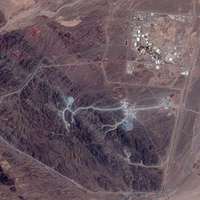
It is speculated that Israel carried out two major acts of sabotage in 2020 and 2021 targeting Iran’s substantial nuclear facility in Natanz, situated in the heart of the country.
Most recently Iran has been at the heart of the Middle East conflict which saw Iran-backed Hamas invade Israel on October 7. Since then Iran’s proxies have joined the war from countries including Syria, Lebanon, Yemen and Iraq, targeting both Israel and the US.
Commander of Iran's Basij militias, Gholamreza Soleimani
The commander of Iran's Basij militias linked the wave of pro-Palestinian student protests across US universities to what he describes as an "Islamic awakening."
Addressing the media, Gholamreza Soleimani claimed that "the awakenings we are witnessing today in America, Canada, and Japan all originate from Islamic awakenings and are derived from the culture of Islamic resistance."
Soleimani's remarks followed comments from Ahmad Alamolhoda, a senior Iranian cleric and father-in-law to Iran’s President Ebrahim Raisi, who attributed the mobilization of the student protests to the influence of letters from Iran's Supreme Leader, Ayatollah Ali Khamenei.
This contrasts sharply with the Iranian regime's harsh treatment of domestic dissent, particularly among its own student activists, who face severe penalties for similar protest activities. The discrepancy has drawn criticism from within Iran, with many pointing out the regime’s apparent hypocrisy.
The Iranian leadership, including Khamenei, has portrayed the student protests as a victory for pro-Palestinian sentiments among Western youth, interpreting it as a sign of growing global sensitivity towards the Palestinian issue. The more the world aligns with Palestine, the greater the victory Tehran feels against its archenemy Israel.
Throughout his leadership, Khamenei has maintained a strong anti-Israel and anti-West stance, supporting groups like terror group Hamas. His policy has contributed to Iran's isolation from the global economy, exacerbating existing economic challenges such as a shrinking GDP and soaring inflation rates.
The leveraging of anti-Israeli and anti-Western sentiments on international stages is seen as part of Iran's strategy to assert the legitimacy and righteousness of its political stance in the face of domestic and international pressures.
Esmail Qaani, the commander of IRGC Quds Force, issued a threat to France, Germany, and the UK accusing them of supporting Israel in intercepting Iran’s barrage of missiles and drones last month.
“All criminals should know that their actions and crimes have been recorded. France, Germany, and England should not think that that night [April 13] they came, brought their planes, and left, the matter was over and done with. Yes, that night ended, but their accountability remains.,” Qaani said on Wednesday.
Speaking at a commemoration of one of the commanders killed during an attack on Iran’s consulate in Syria by an alleged Israeli air strike earlier in April, which triggered Iran’s unprecedented aerial bombardment of Israel, Qaani said: “The American president, who is devoted to defending the Zionist regime, officially announced to the Israelis; ‘I will not enter the conflict.’”
Asserting that the US used "the maximum defense power" to protect Israel from Iran, he warned that regional leaders "who rely on America" should be "more sensible." "Is America going to defend them more than the Zionist regime?"
Critics in the US have warned that President Joe Biden's policies to pressure Israel in the Gaza war will send the wrong signal to allies in the Middle East and elsewhere.
In its first direct attack on Israeli territory, Iran launched over 350 drones, missiles and ballistic missiles on April 13, Most of the attack was intercepted by Israel and a US-led coalition.
US President Joe Biden said US forces "helped Israel take down nearly all" drones and missiles launched by Iran, and the US Central Command (Centcom) reported destroying more than 80 drones and six ballistic missiles.
The White House later said they would not take part in any further retaliatory action against Iran, a stance that Qaani referred to in his speech as a means to threaten regional Arab countries and European powers.
“The victory is not about the missiles and drones that reached the occupied land. Many secrets are hidden within this operation, which will take a long time to unravel,” Qaani said of the air attack as the regime plays down its failings.
As part of his threat against Western countries for supporting Israel, Iran’s archenemy, Qaani included Germany in his threat. While Germany did not take part, it condemned Iran’s attack, German Chancellor Olaf Scholz branding it “unjustifiable and highly irresponsible”, stressing that “Germany stands by Israel.”
President Biden's Iran policy in general has been widely criticized for being too soft. By reversing Trump's maximum-pressure policy in pursuit of a nuclear agreement, Biden and his team did not enforce oil export sanctions imposed in 2018. Also, prisoner swaps and waivers have freed $16 billion in previously frozen Iranian funds, which pumped tens of billions of dollars into the regime's coffers.
As part of the Biden administration's sanctions waiver in 2023, Iran gained access to upwards of $10 billion in electricity revenues previously held in escrow in Iraq—also, the US made a deal to swap prisoners detained by Tehran in exchange for the transfer of $6 billion in Iranian funds that had been frozen in South Korea.
A general view shows a unit of South Pars Gas field in Asalouyeh Seaport, north of Persian Gulf, Iran November 19, 2015.
A US lawmaker has criticized the Biden administration for inadequately addressing the increase in Iran's petroleum trade which has allegedly generated $88 billion since President Joe Biden took office.
In a recent television interview, Mike Lawler attributed the increase to what he perceives as a weak stance on Iran by the current US administration.
“His [Biden’s] appeasement of Iran is extremely dangerous… You look at the unholy alliance between China, Russia and Iran, and you see that they are seeking to undermine and destabilize the free world,” he stated.
Lawler championed the SHIP Act, a legislative measure aimed at curbing the illicit petroleum trade that allegedly funds Iranian-supported terror activities.
“I fought to get the SHIP Act passed and signed into law so we can finally crack down on the illicit petroleum trade funding Iranian terror. This Administration must hold Iran accountable,” he wrote on X.
The issue of Iranian oil revenue has become a hot topic, with reports indicating a substantial increase in the past year.
In 2023, Iran has been exporting approximately 1.4 million barrels of oil daily, with a significant portion being purchased by China, according to tanker shipment tracking firms. Although the exports would value around $41 billion at Brent crude prices, it is likely that Iran is selling at a lower rate.
Lawler's comments reflect a growing unease among US lawmakers who are pushing for immediate action to prevent Iran from accessing additional financial resources that could be used to support terrorism. More than 60 House members in January called on the President to reverse the current policy and take a tougher stance against Iran.
Members of the Islamic Revolutionary Guard Corps (IRGC) attend an IRGC ground forces military drill in the Aras area, East Azerbaijan province, Iran, October 17, 2022.
A detailed report from The Spectator has revealed the detailed strategies employed by Iran in the assassination of its opponents abroad.
According to the report, Iran is actively transforming the murder-for-hire industry across the US and Europe, contracting out killings to avoid direct involvement.
The Spectator's investigation indicates that Iran employs the same covert tactics abroad that it uses to manage proxy forces like Hezbollah and militia groups across the Middle East, outsourcing murder plots through proxies or criminal gangs.
“There appear to be no set rules for the methods Iran uses to find the criminals to do its work abroad, except to avoid the obvious. Biker gangs and people-traffickers are better able to operate away from the gaze of counter-terrorism police than politically motivated ideologues,” wrote the Spectator.
Plots have reached the highest levels of state. Two years ago, the US charged an Iranian man with attempting to hire a hitman to kill John Bolton, a former national security adviser in the Trump administration, for a lucratively tempting $300,000.
The report highlights the activities of Unit 840, a secretive branch of Iran’s IRGC Quds Force, which orchestrates the operations. One of the thwarted plans involved the attempted assassination of Sima Sabet and Fardad Farahzad, two presenters for Iran International TV. While the US has proscribed the IRGC, other nations have as yet failed to make the designation.
Last year the US named Iran the number one state sponsor of terror and countries such as the UK have named it as a leading foreign threat on British soil. Israel’s spy chief last year said dozens of plots against Jewish and Israeli targets abroad had also been foiled.