Revolutions differ from episodic unrest not by the scale of any single demonstration, but by their structure and direction. They are sustained rather than spontaneous; cumulative rather than cathartic. Their power lies in endurance, in the gradual erosion of legitimacy, authority, and administrative control, until the system itself becomes untenable.
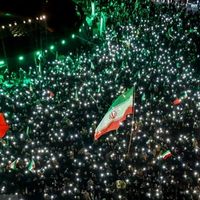
Compared with past protest waves, the current unrest appears more nationally synchronised, socially broad, and symbolically convergent. Equally significant is the re-emergence of a shared national language of opposition that Tehran has long sought to crush through ideology, patronage, and repression.
This matters because revolutions do not target the security apparatus alone. They strike at the regime’s ability to govern routinely. A state under revolutionary pressure must deploy coercion continuously rather than episodically. That is costly, exhausting, and politically corrosive.
Iranian police have circulated text messages warning families to keep young people and teenagers at home, citing the alleged presence of “terrorist groups” and armed individuals at demonstrations and threatening decisive action. The author has independently verified these messages.
Such warnings are not merely informational; they are designed to shift responsibility for state violence onto families themselves.
Yet repression alone does not explain the regime’s present fragility. For much of its rule, governance in the Islamic Republic has been hollowed out by a deeply entrenched kleptocratic system, in which political authority, security power, and economic privilege are fused.
Years of sanctions, chronic inflation, currency collapse, and fiscal mismanagement have hollowed out state capacity. Recent military setbacks have compounded internal strain. The result is a regime increasingly reliant on force at a moment when its economic and institutional resilience is at its weakest.
Mass killing
Iran International reported on Tuesday that at least 12,000 people had been killed in the recent protests, describing the crackdown as “the largest killing in Iran’s contemporary history.”
The emerging scale of violence therefore places Iran’s crisis under increasing strain within the framework of the Responsibility to Protect doctrine (R2P). When a state is credibly accused of mass killing, collective punishment, and systematic efforts to conceal casualties, its claim to sovereign non-intervention comes under acute pressure.
R2P does not mandate automatic military action, but it does impose an obligation on the international community to consider diplomatic, economic, legal, and—if atrocities escalate further—coercive measures.
In this sense, the internationalisation of Iran’s crisis would be the consequence of Tehran's own conduct, not foreign imposition.
In 2011, the UN Security Council invoked the Responsibility to Protect in Libya when the Gaddafi regime threatened mass atrocities during the Arab Spring. Western alliances have acted to prevent large-scale civilian harm even in the absence of an explicit UN mandate.
From Bosnia and Kosovo during the wars of the former Yugoslavia to Sierra Leone and parts of the Sahel, the underlying logic has been consistent: when states engage in or enable mass violence against civilians, sovereignty ceases to function as an absolute shield.
Trump’s intervention
It is in this context that US President Donald Trump’s increasingly explicit warnings to the Islamic Republic should be understood.
Earlier today, Trump issued a direct message to Iranian protesters on Truth Social, urging them to “KEEP PROTESTING–TAKE OVER YOUR INSTITUTIONS,” announcing that he has cancelled all meetings with Iranian officials, and declaring that “HELP IS ON ITS WAY” if the killing of protesters does not stop.
This marks a notable escalation in both tone and signalling.
Trump has now repeatedly framed continued repression as a red line, stating that the United States will not tolerate mass killings of civilians.
It is unlikely that US planners would ignore the lessons of Israel’s recent 12-day campaign against Iran, a campaign in which American forces ultimately participated and which demonstrated both the reach and the limits of strikes narrowly focused on infrastructure.
Any strategy under consideration would likely be shaped less by symbolic targets than by the regime’s security architecture itself: the institutions, decision-making structures, and coercive networks that sustain repression.
Whether such pressure remains declaratory or translates into action, the signal is unmistakable: the regime’s own conduct has pushed the crisis beyond routine diplomacy and into active contingency planning.
Change in strategic terrain
The comparison most often drawn is with 2009. But the analogy is misleading.
The Green Movement was largely urban, middle-class, and procedural in its demands. It challenged an election outcome, not the foundational legitimacy of the system itself. The current movement contests the regime’s right to rule altogether.
Nor does this moment resemble many leaderless uprisings of the past century, which fractured under pressure or collapsed into ideological ambiguity. What distinguishes the present phase is the growing convergence around a figure and a direction.
Reza Pahlavi, the son of Iran’s last shah—whose reign ended in February 1979 following the revolution led by Ruhollah Khomeini—appears to be functioning, through popular recognition rather than formal appointment, as a focal point for disparate strands of opposition.
Whatever one’s view of monarchy, the presence of an identifiable political centre of gravity marks an important departure from previous cycles of unrest.
For now, the Islamic Republic retains formidable coercive capacity. Revolution does not guarantee swift collapse. What it does guarantee is a change in the strategic terrain.
The question is no longer whether the regime can suppress protests tonight, but whether it can sustain governance tomorrow, next month, or next year under unrelenting strain.