Actress Taraneh Alidoosti and filmmaker Mostafa Al-Ahmad have been diagnosed with diseases after serving time in Iranian prisons for voicing dissent, the latest in a series of mystery illnesses contracted by political prisoners.
Taraneh Alidoosti – best known for the Oscar-winning movie "The Salesman" - was arrested as part of the Woman Life Freedom movement sparked by the death in police custody of Mahsa Amini, a 22-year-old woman who reportedly defied the hijab rule.
The news of her illness started when her mother during an Instagram Live on Sunday hinted that her daughter might have an “undiagnosed disease” which Iranian media reported as DRESS Syndrome.
Cinema Etemad, in an article that has since been removed from the website, defined the condition as "causing numerous symptoms such as fever, blood abnormalities and organ inflammation throughout the body” and is associated with “overreaction to certain medications.”
Security forces arrested Alidoosti in December 2022 at her home for posting a photo of herself without the mandatory veil on social media and criticizing the death penalty. A month later, she was released on bail.
On Wednesday, Zahra Minuei, Taraneh Alidoosti’s lawyer, confirmed the reports while emphasizing that Alidoosti did not wish the public to be aware of the disease.
“Taraneh Alidousti has been diagnosed with DRESS Syndrome since August 2023, which doctors said was caused by drug interaction,” Minuei wrote on X. “Mrs. Alidousti is currently making a partial recovery after a long treatment period,” she added.
However, that was not an isolated incident. Mostafa Al-Ahmad’s lawyer said on April 23 that the filmmaker “like other activists, has been suffering from some kind of autoimmune disease ever since he was released from prison.”
“Human rights activists are worried by the recurrence of these diseases,” Maryam Kianersi wrote on X.
In July 2022, Mostafa Al-Ahmad was arrested as part of a crackdown on the signatories of the "Lay down the gun" letter issued by over 100 members of the film industry in Iran.
The statement urged military and security forces not to suppress protesters as a wave of demonstrations spread across Iran after a 10-story building collapsed in Abadan, south of Iran, killing at least 40 people.
The cases of Alidoosti and Al-Ahmad in recent days have brought the issue of the illnesses and unexplained deaths of political prisoners into the spotlight once again. The authorities often attribute suspicious deaths or suicides in prisons and detention centers, or shortly after prisoners' release, to mental health or personal issues.
Photo of Iranian border guards arrested by Taliban (April 2024)
The Taliban has arrested five Iranian border guards in Afghan territory and handed them over to the its intelligence department.
Taliban and Iranian officials have not yet commented about the guards, who claim they had entered the Afghan territory "by mistake." They were arrested in Farah province in southwestern Afghanistan. Thursday night, Iranian state media reported that they were freed.
The Iranian government and Taliban have been involved in several border disputes over the past months. Clashes at the borderover water rights in May claimed the lives of at least two Iranians and one Taliban soldier.
Photo of Iranian border guards arrested by Taliban (April 2024)
The situation has recently been tense in Iran’s eastern borders as the insurgent Sunni Baluch group known as Jaish al-Adl (Army of Justice) intensified its operations against Iranian security forces. The group advocates for enhanced rights and improved living conditions for the Baluch ethnic minority.
Earlier in the month, six law enforcement officers were killedby Jaish al-Adl militants during an ambush on police vehicles along the Sib and Suran county route in Sistan-Baluchistan province. The week before, the group also launched simultaneous attacks against military posts in Chabahar and Rask, killing 16 police forces; the clashes also claimed the lives of 18 Jaish al-Adl militants.
Jaish al-Adl has also been a source of tension between Iran and its nuclear neighbor, Pakistan, for years. In January, the IRGC attacked positions in Pakistan in what it called an attempt to target terrorists. Pakistan retaliated by attacking locations in southeastern Iran.
A billboard in Jerusalem that reads "the end of Ayatollah's regime in Iran"
Massive Evangelical-funded billboards have been installed in Tel Aviv and Jerusalem, predicting the collapse of the Iranian government by October 28, 2028.
Towering the Ayalon Highway in Tel Aviv, the billboard demonstrates the phrase “The end of the Ayatollah’s regime in Iran” in Hebrew, English and Persian. Underneath the inscriptions is an hourglass which symbolizes the downfall of the Iranian government in the near future.
The billboard has been erected by “Jerusalem Prayer Team,” a US organization whose aims are to “guard, defend, and protect the Jewish people” and raise funds to “meet humanitarian needs of the Jewish people in Israel,” according to its website.
“Hundreds of millions of Evangelicals have Israel’s back. Israel, you’re not alone,” read the statement written at the bottom of the billboard.
Likewise, “Jerusalem Prayer Team” published a similar announcement in Israel Hayom daily on Monday, warning that “all who have lifted their hands against Israel are in the dust pan of history.”
Erecting a billboard promising the downfall of the Islamic Republic resembles similar state-sponsored moves in Iran over the past years. In 2015, Ali Khamenei said Israel must be destroyed in 25 years and the government set up a countdown clock in Tehran and a few other cities.
Tensions between Iran and Israel have risen sharply over the past weeks. On April 1, Israel launched a precision missile strike on Iran's consulate building in Damascus, including Mohammad Reza Zahedi, the top commander of the IRGC Quds Force. In retaliation, Iran launched on April 13 its first ever direct offensive against Israeli territory with more than 350 drones and cruise and ballistic missiles.
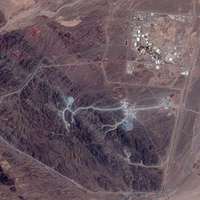
Early Friday, Israel reportedly targeted Esfahan's 8th Shekari Air Base in reprisal for Iran’s operation. Though satellite images and reports indicate that a major defense system in the airbase was damaged, Iranian officials and state media have unanimously played down the operation.
A view of drones during a military exercise in an undisclosed location in Iran, in this handout image obtained on August 24, 2022.
Washington and London on Thursday issued further sanctions on Iran, targeting Iranian drones, including their use by Russia in the war in Ukraine.
The US Treasury Department in a statement said the action, taken in coordination with the United Kingdom and Canada, targets over one dozen entities, individuals and vessels it accused of playing a key role in facilitating and financing the clandestine sale of Iranian unmanned aerial vehicles to Iran's Ministry of Defense and Armed Forces Logistics (MODAFL).
MODAFL in turn supports Iran's elite Revolutionary Guards (IRGC) and Russia's war in Ukraine, the Treasury said.
“Iran’s Ministry of Defense continues to destabilize the region and world with its support to Russia’s war in Ukraine, unprecedented attack on Israel, and proliferation of UAVs and other dangerous military hardware to terrorist proxies,” Treasury's Under Secretary for Terrorism and Financial Intelligence, Brian Nelson, said.
Washington also targeted two companies and a vessel involved in the shipment of Iranian commodities, the Treasury said.
“The United States, in close coordination with our British and Canadian partners, will continue to use all means available to combat those who would finance Iran’s destabilizing activities," Nelson said.
British Foreign Secretary David Cameron said in a statement, "The Iranian regime's dangerous attack on Israel risked thousands of civilian casualties and wider escalation in the region.”
"Today the UK and our partners have sent a clear message – we will hold those responsible for Iran's destabilizing behavior to account.
Britain also said it would introduce new bans on the export of drone and missile components to Iran, seeking to limit its military capabilities.
Iran's mission to the United Nations in New York did not immediately respond to a request for comment.
The engine of an Iranian drone shot down over Kyiv on May 28,2023
The Treasury said it targeted Sahara Thunder, accusing it of being a main front company that oversees MODAFL's commercial activities in support of the IRGC and Russia's war in Ukraine.
It said the company plays a key role in Iran's design, development, manufacture and sale of thousands of drones, many of them ultimately transferred to Russia for use against Ukraine.
As of 2022, Russian officials were negotiating a deal for Sahara Thunder to deliver and produce thousands of drones per year at a facility in Russia under U.S. sanctions, the Treasury said.
Sahara Thunder's leadership and shipping network, which the Treasury said the company relied on for the sale and shipment of Iranian commodities on behalf of MODAFL to jurisdictions including China, Russia and Venezuela, were also targeted.
An Iran-based company involved in the procurement and development of unmanned aerial vehicles, its leadership and an Iranian cargo airline were also among those hit with sanctions.
The US earlier this month had warned it would impose further sanctions on Iran following its unprecedented attack on Israel.
Washington has since taken measures, including targeting Iran's drone program, steel industry and cyber actors.
Iran this month launched more than 300 drones and missiles against Israel, its first direct attack on the country, in retaliation for a suspected Israeli air strike on its embassy compound in Damascus on April 11 that killed elite military officers.
Imprisoned Islamic scholar Sedigheh Vasmaghi has contracted heart disease in notorious Evin Prison and has lost her sight, leaving her dependent on inmates' support.
Her husband announced the news on Thursday about the high profile prisoner, a staunch critic of Supreme Leader Ali Khamenei and his compulsory hijab policy.
“She had not had any heart problems prior to her arrest. I hope it is not a serious illness and is only caused by the pressure of the prison,” said Mohammad Ebrahimzadeh.
According to him, Vasmaghi went to the clinic of Evin Prison one month ago with symptoms such as chest pain but the authorities at first refused to send her to hospital, giving her only “medicines at hand.”
“They were finally convinced that her problem was serious and sent her to Taleghani Hospital, where she was kept in the ICU only for one night,” Ebrahimzadeh went on to say. Vasmaghi is just one in a long line of sick prisoners not given sufficient, if any, access to medical care while incarcerated.
He also revealed that she has now completely lost her vision due to a long-running genetic condition and is dependent upon other inmates to perform even basic everyday tasks.
Mahmaoud Alizadeh Tabatabaei, Vasmaghi’s lawyer, told Rouydad24 news website that a forensic doctor's report has been sent to the prosecutor urging her immediate release from prison due to her health conditions.
Security forces arrested Vasmaghion March 16 and subsequently transferred her to Evin Prison. The arrest came after the scholar described Khamenei as a dictator, slamming the compulsory hijab laws which have been at the heart of the 2022 Women, Life, Freedom movement, triggered by the death in morality-police custody of Mahsa Amini.
In a statement issued earlier this month, 320 Iranian political and civil activists urged her release, saying the scholar “has shown over the past four decades her care and concern for both Iran and Islam.”
European Union flags fly outside the European Commission headquarters in Brussels, Belgium, March 1, 2023
In a resolution adopted Thursday in response to Iran’s recent aerial attack on Israel, the European Parliament urged the EU to hand more sanctions to Tehran and designate the IRGC a terrorist organization.
“The resolution also reiterates Parliament’s long-standing call to include Iran’s Islamic Revolutionary Guard Corps on the EU list of terrorist organisations, stressing that such a decision is long overdue due to malign Iranian activities. It similarly calls on the Council and EU Foreign Policy Chief Josep Borrell to add Hezbollah in its entirety to the same list.,” wrote the European Parliament statement.
Hezbollah in Lebanon is Iran's largest and wealthiest proxy and is currently waging war on Israel's northern front. Since October 7 when Iran-backed Hamas in Gaza invaded Israel, over 3,200 projectiles have been fired into Israeli territory from Lebanon and this week, the Israeli military announced over half the terror group's commanders in south Lebanon have been eliminated.
The latest resolution passed by 357 votes in favor, 20 against and 58 abstentions and comes just days after sanctions were levied against Tehran by the EU for Iran's aerial bombardment of Israel.
The adoption of the latest resolution came a day after heated arguments in the parliament where Borrell was severely taken to task by the representatives for his failure to designate the IRGC as a terrorist organization. Arguing that the bloc has already listed Tehran’s paramilitary force under the “Iran Weapons of Mass Destruction” sanctions’ regime, Borrell saidthat “listing this organization as a ‘terrorist organization’ would have no practical effect.”
In response to Borrell’s argument that the legal grounds for the listing have not been met, Charlie Weimers, a Swedish representative, called the EU chief “a liar.”
“That is nonsense. Here, I have the council's secret legal opinion. Nowhere in this document does it say that it has to be an authority in the EU… You know that. You knew the truth. You shamelessly lied to protect the IRGC. We won't miss you, Mr. Borrell, but I'm sure the mullahs will,” Weimers stated.
During the session, the European Parliament strongly condemned Iran’s unprecedented attack on Israeli territory, vowing full support for the security of Israel and its citizens against the threats of the Iranian government and its proxies.
On April 13, Iran launched its first ever direct offensive against Israeli territory with more than 350 drones and cruise and ballistic missiles, 99% of which were intercepted by Israel and a US-led coalition, according to the Israeli army.
For months after the start of the Gaza war on October 7, the Iranian government avoided direct involvement in the conflict. Until this month, it had used its proxies to target Israeli and American targets in the region, punishing America for supporting Israel's right to defend itself after the most deadly day for Jews since the Holocaust. Over 1,200 mostly civilians were killed and over 250 taken hostage.
The European Parliament welcomed the EU’s recent decision to impose further sanctions against Tehran, especially those targeting Iran’s production and supply of drones to Russia and the wider Middle East. The resolution demanded that the EU’s new regime of sanctions be urgently enforced.
Since mid-2022, Iran has supplied a substantial number of kamikaze Unmanned Aerial Vehicles (UAVs) to Russia, which have been extensively deployed to target civilian infrastructure and cities. The drones have also been incorporated into large-scale missile attacks, overwhelming Ukrainian air defenses.
Slamming the Iranian regime’s notorious “hostage diplomacy,” the parliament demanded that the EU “launch a strategy to counter it with a dedicated task force to better assist detainees’ families and effectively prevent further hostage-taking,” according to its website.
Critics accuse the Islamic Republic of Iran of leveraging the detention and trial of Western or dual-national citizens as a means to advance its political agendas and to provoke tensions with Western governments.
Tehran denies any policy of hostage taking and insists all foreigners are tried legally. However, it has frequently shown readiness for prisoner exchanges and receiving monetary payments and participated in swaps in the past. Last year, the United States unfroze $6 billion of Iran's blocked funds in exchange for the release of five hostages.