Iran’s President Warns Of ‘Painful Response’ To Israeli Actions
Iranian President Ebrahim Raisi
Iran’s president has threatened Israel with a “severe, extensive and devastating” response to further military actions after Israel’s army chief stated plans to retaliate to Saturday night’s bombardment.
The threat by Iran’s President Ebrahim Raisi follows the launch of over 300 missiles and drones by Iran towards Israeli territory, Iran’s first open assault against its main enemy state.
The bombardment was in retaliation for an Israeli air strike on the Iranian consulate building in Damascus on April 1, killing two senior Quds Force commanders and other IRGC personnel.
"We firmly declare that the slightest action against Iran's interests will definitely be met with a severe, extensive and painful response."
Adding to the tensions, Israeli Lieutenant General Herzi Halevi vowed retaliation during a statement to troops at the Nevatim air base, one of the sites hit in the Saturday attack.
Further complicating matters, Iranian Deputy Foreign Minister Ali Bagheri Kani warned that Iran would react instantly to any Israeli counterstrikes.
“The retaliation would come in a matter of seconds, as Iran will not wait for another 12 days to respond," he told state TV.
The situation has also aroused international concern. US Secretary of the Treasury Janet Yellen stated that Iran threatened stability in the Middle East and could cause economic spillovers.
She said the US would use sanctions and work with allies, to keep disrupting Iran’s "malign and destabilizing activity."
Israel Foreign Minister Israel Katz addresses the 74th session of the United Nations General Assembly at UN headquarters in New York City, New York, US, September 26, 2019.
Israeli Foreign Minister Yisrael Katz called upon the world to toughen sanctions against Iran and designate the Iranian Revolutionary Guard a terrorist organization.
That plea comes in the aftermath of a large drone and missile attack by Iran against Israel last week, which Katz termed as needing a strong political and strategic response.
"I am leading a political attack against Iran. This morning, I sent letters to 32 countries and spoke with dozens of foreign ministers and leading figures in the world demanding that sanctions be imposed on the Iranian missile project and that the Revolutionary Guards be declared a terrorist organization, as a way to contain and weaken Iran. Iran must be stopped now – before it is too late," stated Katz.
Iran launched a mass drone and missile attack Saturday night in response to Israel’s air strike on the Iranian consulate in Damascus earlier this month. It killed two senior commanders and other senior figures in the IRGC.
The UK Prime Minister Rishi Sunak is also under pressure to outlaw Iran's Islamic Revolutionary Guard Corps (IRGC) as a terrorist organization in the United Kingdom.
Shadow Defense Secretary John Healey and former Conservative leader Iain Duncan Smith criticized the UK government's hesitancy in dealing with the IRGC amidst growing risks to UK interests.
Healey emphasized the IRGC's pivotal role in threatening not only Israel but also Arab countries and Western interests across the region through its support for violent military militias.
Since its establishment in 1979, the IRGC has grown into a dominant military, political, and economic force in Iran, with actions extending beyond its borders, including plots against individuals on British soil. Earlier this year, the UK sanctioned members of the IRGC's Unit 840 related to assassination attempts on British nationals.
Internationally, the IRGC's reach, and influence remain a concern, with its activities prompting security measures such as the temporary relocation of Iran International’s UK offices to Washington, following threats from IRGC agents.
Bahrain, Saudi Arabia, Sweden, and the United States have already designated the IRGC as a terrorist organization.
China's Director of the Office of the Central Foreign Affairs Commission Wang Yi
China's Foreign Minister Wang Yi told Iranian FM Hossein Amir-Abdollahian that “China has noted Iran's statement that its action taken was limited and was an act of self-defense".
In a phone call Monday, Wang condemned the alleged Israeli attack on the Iranian consulate compound on April 1, supporting Iran's right to self-defense, calling it a violation of international law, according to the Xinhua state news agency.
On Saturday night, Iran launched over 350 drones and missiles towards Israel, 99 percent of which were intercepted by Israel and its allies including Jordan, the US, and the UK.
Wang also said China appreciated Iran's decision on not targeting regional and neighboring countries. He added that “China has noted Iran's statement that its action was limited and was an act of self-defense.”
Iran had handled "the situation well and spared the region further turmoil while safeguarding its sovereignty and dignity”, Wang said.
He blamed the escalations on the ongoing Gaza war, triggered by the Iran-backed Hamas invasion of Israel on October 7, in which 1,200 mostly civilians were murdered and 250 or more taken hostage.
Urging the implementation of UN Security Council Resolution 2728, China continues to call for a ceasefire in Gaza, citing the humanitarian disaster as grounds for intervention. Hamas claims over 32,000 people have died in the last six months.
However, with over 130 hostages still in Gaza, Israel has so far refused ceasefire demands, its war aims to rescue the hostages and to destroy the capabilities of Hamas.
It is the latest show of support from China which has recently carried out military exercises with Iran and remains Iran's biggest oil customer defying US sanctions on the export of Iranian oil. With huge construction projects from Chinese companies underway in Iran in addition to trade links, Iran is at the behest of Beijing which remains a key partner amid sanctions.
However, as the Middle East's allegiances shift, the Wall Street Journal reported Monday that Saudi Arabia was among the countries providing key intelligence about Iran’s plans to attack Israel, crucial to the success of the air defense measures that almost entirely prevented the attack.
Mohsen Sazegara, a US-based journalist and political activist, told Iran International that this is the first time Arab nations have supported Israel in a military operation against another Islamic country.
In the wake of Israel's declaration of retaliation to Saturday night's aerial bombardment, Iran Airports and Air Navigation Company denied any flight restrictions at Iranian airports.
Several Iranian news outlets reported that Iran's air defense was on high alert, suggesting potential flight restrictions due to Saturday night's Iranian bombardment of Israel with over 350 drones and missiles. However, authorities claim that all air routes across the country remain open.
On Monday evening, Israel's Military Chief of Staff, Herzi Halevi, confirmed that Israel would retaliate, though specifics of the response remain undisclosed. "This launch of so many missiles, cruise missiles, and drones into Israeli territory will be met with a response," Halevi said during a briefing at the Nevatim air base which had minor damage following the strike.
Israeli Prime Minister Benjamin Netanyahu has been actively consulting with his war cabinet, having convened meetings twice in less than 24 hours to discuss potential responses to Iran’s recent attack in which 99 percent of the projectiles were intercepted by Israel and its allies.
It was the first direct strike from Iranian soil to the Jewish state, bringing its shadow war into the forefront of the region's geopolitics. Two air bases were among the targets and one seven-year-old Bedouin girl remains in a critical condition from shrapnel injuries.
Iran launched the assault as a response to what it claims was an Israeli airstrike on its embassy compound in Damascus on April 1, emphasizing its intention to avoid further escalation.
The ongoing developments have stirred concerns among Iranians, many of whom are already grappling with economic challenges and increased socio-political restrictions following the protests which began in 2022.
Israeli air force pilots and commanders on April 15, 2024
Israel and Iran exchanged warnings and threats Monday, as the US government set out to contain the looming Israeli attack, fearing that a tit-for-tat between could lead to an all-out war.
Several Israeli officials have stated that Iran’s larger-than-expected attack would not be left unanswered, even though 99% of all Iranian missiles and drones were intercepted by Israeli defense systems and allied air forces.
“Iran will face the consequences for its actions,” Israel Army Chief of Staff Gen. Halevi said in a video statement. “We will choose our response accordingly."
At the same time, pressure from Europe and some Arab counties might force Israel to adopt a retaliatory strategy the would be less likely to lead to a major escalation.
This was the clearest indication of Israeli intentions after the war cabinet, headed by prime minister Benjamin Netanyahu, met twice in less than 24 hours to weigh their options. No details were offered officially, but Israel’s Channel N12 News claimed that the response would likely be one that hits the Iranian regime in a way that doesn’t trigger an even bigger response.
Anticipating the attack, Iran went on the propaganda offensive.
Iran's deputy foreign minister Ali Bagheri Kani said any Israeli attack would be responded to in “less than a few seconds". A member of Iran’s Islamic Parliament (Majles) went further. "We are prepared to use a weapon that we have never used," said Abolfazl Amouei, the spokesman for the Majles’ National Security Committee, urging Israel to "act wisely".
Experts and unnamed Israeli officials have suggested several ‘possible’ courses of action: large-scale cyber-attack, hitting Iranian proxies, or covert operation inside Iran. This would not surprise many, since several Iranian nuclear scientists have been killed inside Iran in the past, and there have been mysterious explosions in nuclear facilities and other strategic locations.
Israel never took responsibility for these incidents and never denied it either. Now also, Israel could attack important targets and keep silent, not putting the Iranians in a situation to be forced to respond.
Whatever the Israeli response, it will likely be consulted with the Americans, according to media reports in Israel. The Biden administration has saidit will not take part or assist in the Israeli operation, downplaying the significance of the Iranian attack and highlighting Israel’s success in thwarting the offensive almost entirely.
"What we showed on Saturday night was that Iran is not militarily superior, is not 10 feet tall, and that Israel is not alone," White House National Security Council spokesman John Kirby told NBC News Monday, when asked if he agrees that Iran would be emboldened without a response.
The administration’s stance has angered Biden’s more hawkish critics, who have accused him of ‘appeasing’ Iran and ‘abandoning’ Israel.
“Sadly, Iran isn't worried about the United States,” former national security advisor John Bolton told Newsmax. “They don't see Biden as having the spine to cross Iran's red line of not attacking Israel directly.”
Officials in Iran maintain that Israel’s attack on Iran’s consulate in Damascus crossed a red line and had to be responded to restore deterrence. The Israeli response would test this idea –and potentially trigger a cycle of retaliatory attacks that could spiral into a full-scale war.
“We’re on the edge of the cliff and we have to move away from it,” EU foreign affairs High Representative Josep Borrell said in a radio interview. “We have to step on the brakes and reverse gear.”
Rafael Grossi, Director General of the International Atomic Energy Agency. March 2022
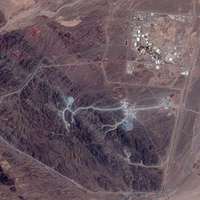
UN nuclear inspectors in Iran have stayed away from related facilities since Sunday, amid threats of an Israeli attack, the head of the UN nuclear watchdog, the IAEA said on Monday.
Rafael Grossi, director of the International Atomic Energy Agency, told reporters in New York that Iran had closed its nuclear facilities on Sunday over “security considerations.” While they reopened on Monday, Grossi said he kept IAEA inspectors away “until we see that the situation is completely calm.”
After Iran targeted Israel with a massive barrage of around 350 drones and missile on Saturday/Sunday night, Israeli leaders have vowed retaliation. The United States, European powers and some regional counties have urged Israel to exercise restraint, but Israel military and political officials have vowed to restore deterrence.
“We are going to resume tomorrow,” Grossi added. “This has not had an impact on our inspection activity.”
Asked about the possibility of an Israel strike on Iranian nuclear facilities, Grossi said, “We are always concerned about this possibility.” Grossi also urged “extreme restraint.”