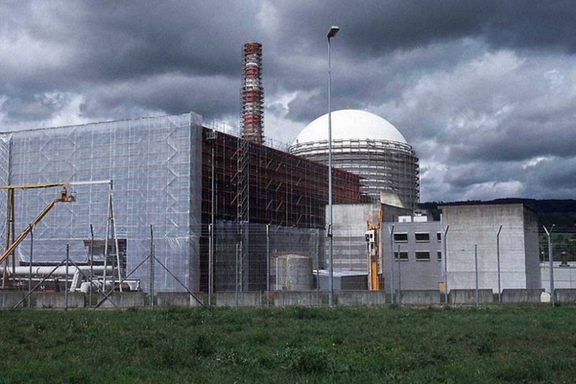
The Biden administration has decided to let sanctions waivers for Iran-Russia nuclear cooperation expire. This has allowed the two countries to carry on with their joint nuclear activities.
However, the administration has not yet determined whether they will enforce the sanctions, leaving some uncertainty surrounding US policy, as reported by The Washington Free Beacon.
According to the report, Iran and Russia are progressing with Tehran's planned expansion of its nuclear reactors. The waivers, last renewed in August 2023, expired at the start of 2024.
These would enable Russian-state-controlled organizations to generate more than $10 billion in revenue, with a focus on the Rosatom energy company involved in various nuclear ventures in Iran.
A spokesperson from the State Department mentioned an ongoing assessment process without offering a clear reason for the lapse. The uncertainty has led to queries being raised in Congress, particularly as Iran is preparing to make significant investments.
Republican legislators have continuously pushed the Biden administration to end the waivers and enforce penalties to stop such cooperation. Iran and Russia have been working to increase Tehran's nuclear capabilities. Iran's declaration of intentions to upgrade its Russian-made Bushehr nuclear plant and build other nuclear reactors highlights the need for action from the US, as The Free Beacon reported.
These plans have gained more significance by Iran's uranium enrichment efforts, leading to more concerns. Initially, the Obama administration granted waivers under the 2015 JCPOA nuclear pact, which were subsequently revoked by the Trump administration. However, President Joe Biden restored them as part of diplomatic endeavors to bring back the agreement.
Follow developments on Iran International's Live coverageof ongoing tensions between Iran and Israel.
The European Union is imposing sanctions against three Hamas and Palestinian Islamic Jihad entities, over “widespread sexual and gender-based violence” that occurred across Israel on October 7.
“The Council decided today to list three entities under the EU Global Human Rights Sanctions Regime in view of their responsibilities in the brutal and indiscriminate terrorist attacks that occurred across Israel on 7 October 2023,” a press release read.
Thesanctions target the Al-Quds Brigades, the armed wing of the Palestinian Islamic Jihad, the Nukhba Force (special forces unit of Hamas) and the Qassam Brigades (military wing of Hamas).
Israel’s Foreign Minister, Israel Katz, took to Xto laud the decision, saying it “sends a clear message: those who murder, rape, burn, abuse the bodies of babies, girls, women, and men, and commit atrocities against humanity -- will pay the price.”
Individuals and entities listed under the sanctions regime face an asset freeze, meaning their financial assets are blocked. Providing them with funds or economic resources, either directly or indirectly, is prohibited. Persons listed are also banned from traveling to the EU.
The EU had already classified Hamas and the Palestinian Islamic Jihad as terrorist entities.
Last month, the UN Special Representative on Sexual Violence in Conflict reportedthat she and a team of experts found “clear and convincing information” of rape and sexualized torture being committed against hostages seized during the 7 October terror attacks.
Pramila Patten said that in addition there are also reasonable grounds to believe that such violence, which includes other “cruel, inhuman and degrading treatment”, may be continuing against hostages still being held by Hamas and other extremists in the Gaza Strip.
As calls to designate the IRGC grow, US lobbyists are pushing to ban Iran's foreign minister and delegation from the upcoming United Nations meeting on the Gaza war.
Among those leading the calls is Mark Wallace, the CEO of United Against Nuclear Iran (UANI), who said, “April 18 will mark the 41st anniversary of Hezbollah’s bombing of the US Embassy in Lebanon. Hossein Amir-Abdollahian’s presence on US soil would be an outrageous insult to the victims and their families,” in a letter to Secretary of State Antony Blinken.
According to reports, Amir-Abdollahian is scheduled to travel to the US to attend a United Nations meeting on the Gaza conflict on April 18, coinciding with the anniversary of the 1983 US Embassy bombing in Beirut which claimed the lives of 63 people, including 17 Americans.
Citing Amir-Abdollahian’s repeated meetings with Hamas political leader Ismail Haniyeh and Hezbollah chief, Hassan Nasrallah, the UANI ambassador also pointed to his complicity in the October 7 onslaught, which marked the deadliest day for Jews since the Holocaust, sparking the current Gaza war. According to the Wall Street Journal, the IRGC directly helped Hamas devise the plan for the October 7 attack.
Wallace also referred to the brutal repression of dissent in Iran as another reason Washington should refrain from issuing visas for Iran’s top diplomat and delegation. “While Amir-Abdollahian was in New York in January 2024, the regime executed Mohammad Ghobadlou, a 23-year-old Iranian protester - perhaps just as Amir-Abdollahian was ordering room service from his penthouse suite at the Millennium Hilton Hotel at UN Plaza," he said.
Ghobadlou was arrested during the 2022 nationwide protests and was executed in January on the charge of killing a policeman.
Back in March, 27 members of the House of Representatives called on the Biden administrationto ban the entry of Iranian officials to the US but Washington continues to allow the regime entry to high level meetings of global leaders in spite of its being labeled as the world's leading state sponsor of terroraccording to the latest US reports.
The verdict of Tuesday 9 April hearings of the Senate Banking Committee is simple: the Biden administration has failed to plug a yawning gap in its vast sanction regime: the abuse of cryptocurrency by the Iranian proxies’ crime nexus.
This was the second time that the US Treasury has made such a request. And the first time?It was in November. An oddly “inharmonious” chorus from left, Elizabeth Warren, to right, Thom Tillis, treated Mr. Adeyemo to their Senatorial concert in dissatisfaction at the committee. Senator Tim Scott’s denunciation of the Biden administration’s handling of the sanctions in the case of Iran encapsulated the republican dissatisfaction with the administration’s much too lenient approach to the Iranian regime. However, the hearing was hinge on much more cryptic theme.
The hearing’s buzzword was “stable coin”; a type of crypto currency immune from market fluctuations whose base value stably corresponds to “one US dollar.” According to a Wall Street Journal (WSJ) report, , companies like Tether Holdingswith their specialization in “stable coin” have helped fuel Russian sanction evading traders to acquire parts and weapons across the world. The statement Adeyemo indeed underscored the importance of “stablecoins” as means of circumventing US sanctions. Senator Warren, taking an inquisitive cue from Adeyemo’s own statement, pointed out that the Iranian proxies’ crime nexus used the same stable coins with skill and agility reaping multimillion dollar transactions in “drug trade”. The hearing also shed light on how the Iranian IRGC has been usingcryptocurrency to fund Hamas and Islamic Jihad of Palestine.
Deputy Secretary of the Treasury Adewale "Wally" Adeyemo in the Dirksen Senate Office Building, in Washington, DC
As poignantly put to me by Iran International’s Fardad Farahzad in an interview on the very day of the Senate Banking Committee hearing (9 April 2024), the burning question remains: What set of reasons may account for the Biden administration to appear so powerless or incapable of dealing with the Iranian regime chicaneries and shenanigans? Should one ascribe these shortcomings to the administration’s proclivity to avoid escalation with the Iranian regime? Or should one seek to find the problem in the technical troubles that afflict the running of the administration’s vast sanctions’ regime: from North Korea, Cuba, and Venezuela to Iran and Russia, to name a few?
In short: All the above! First, the US Treasury must be fully apprised of studies published as late as 2019 on how countries like Venezuela and North Korea have turned to cryptocurrency to circumvent sanctions. Second, the Biden administration adheres to a national security orthodoxy: to avoid any tension escalation with the Iranian regime as it continues to hold secret “(in)direct” talks with it in Oman.
Third, long before there was any internet in its present form, Iran, Syria, and Hezbollah were schooled in the shadowy trade of arms and drug smuggling through money laundering and other types of financial crimes by some of the professionals of the end of the Cold War era, namely, Gadhafi’s Libya and the IRA. Both Gadhafi’s Libya and the IRA had masterly dabbled in the arms and drug trafficking circa 1970s-1990s using transnational financial crime schemes. Thus, before 2009 bitcoin revolution, the IRGC and the Hezbollah of Lebanon had already ventured in multitude criminal enterprises to generate revenue as they put to practice all they had learned from Gadhafi and the Provos.
Ever since the 2000s, the Iranian regime and its nexus of criminal proxies have survived, adapted, and thrived through mastering the tools made available to them via cyberwarfare and the dark web. As IRGC expanded into cyber warfare, its main proxy, the Hezbollah too expanded cyberwarfare capabilities to break into Israeli and Euro-American cyberspace; which availed them with data commodities that they could sell or barter. Yet, the 2009 bitcoin revolution availed them with the holy grail of “mobile currency” that would ease the onerous and menacing task of gold bar and cash smuggling across national borders. It was just a question of time where and when they would seek to tighten their grip over crypto currency. In the advent of the Civil War in Syria, which ushered in a new era of US sanctions against the Iranian and Syrian regimes along with their Hezbollah of Lebanon ally, cyber currency found a niche amongst many transnational non-state actors like no other. Not only did Hezbollah begin to dabble in bitcoin but so did others like al-Qaeda and ISIS.
February 2022 Russian invasion of Ukraine made Russia a major member of the club of the countries subjected to US sanctions. Russian officials indeed shuttled back and forth to Tehran to not only integrate the Russian banking system with the Iranian one, but to sit in as astute “sanction evasion” apprentices in the workshops of Iranian sanction evading masters. Such a vast and unrequited collaboration undoubtedly has created a challenge for the US: How to effectively enforce its sanctions.
US Securities and Exchange Commission logo and representations of cryptocurrency Binance are seen in this illustration taken June 6, 2023.
Over the past thirty years, sanctions have become a major tool of US foreign policy. In fact, the number of sanctioned countries on the respective US treasury website includes over twenty different countries. Such an estimate is indeed a nominal one, for any third-party country, financial institution, enterprise, and individual that does not abide by the US sanction regimes can themselves be subjected to “secondary sanctions” and penalties. A report by the Economist establishes thatsanctions are a favourite foreign policy tool for great many countries in the 21st century for they are perceived to be a low cost foreign policy leverage as opposed to direct military conflict.
Yet, no country, not even the United States with all its bureaucratic might and high-tech prowess, can muster all the human and technological resources to enforce the sanctions it has itself imposed on, one could say, the whole planet. As the United States continues to be the number one economic powerhouse in the world, many major US financial institutions and enterprises are in dire need of master experts to help them avoid violating the complex behemoth of US sanction regimes and regulations. The Biden administration seems to be shedding much invaluable human resources assets to a private sector that is willing to outbid the US government to stave off the wrath of US Treasury. The “Brain Drain” of “Sanctions Experts” started long before Biden took office.
As Trump administration ramped up sanctions against China and other US competitors, the US sanction regime ballooned to an unexpected size. Many US and Western financial institutions and enterprises have since been desperate to hire the right expertise. In such an environment, the US government sanction mandarins are thus the first-class experts. Against the backdrop of such a huge demand, when Bloomberg reported the departure of Elizabeth Rosenberg, then Assistant Secretary for Terrorist Financing and Financial Crimes at the US Department of the Treasury, observers wondered about the reasons of her departure and queried about her replacement.
In the end, the Senate Banking Committee hearings underscored that more than ever the United States needs to collaborate with Israelon this critical issue of stopping shady international actors from using crypt to fund their criminal enterprises. Irrespective of who is the occupant of the 1600 Pennsylvania Avenue, to unravel the complex crypto networks that “tether” the Iranian proxies’ criminal nexus, the US needs both the human expertise and the Artificial Intelligence that such a formidable task necessitates. To plug the crypto criminal gap, the US should perhaps first plug the Sanctions Experts’ Brain Drain and it is only then that all new laws can be effectively enforced.
The body of Mohammad Sarur, a Lebanese financier for Iran, sanctioned by the US for involvement in sending funds from Iran to its terror proxies, was discovered on Tuesday in a suspected assassination.
Lebanese citizen Sarur was found at home in possession of an undisclosed sum of money left untouched by the assassin.
Sarur has known affiliations with financial institutions linked to terror group Hezbollah, backed by Iran. In August 2019, the US Treasury imposed sanctions on Sarur and others, accusing them of transferring "tens of millions of dollars" from the foreign operations arm of Iran’s Revolutionary Guards through Hezbollah in Lebanon “to Hamas for terrorist attacks originating from the Gaza Strip.”
The Treasury revealed Sarur's role as a “middleman” between Iran's Revolutionary Guards' Quds Force and Hezbollah, collaborating with operatives to also facilitate funds for Hamas's armed wing, the Izz-a-Din al-Qassam Brigades in Gaza.
“As of 2014, Sarur was identified as in charge of all money transfers” between the Quds Force and the Qassam Brigades, the Treasury added.
According to the Treasury, Sarur also has an extensive history working at Hezbollah's sanctioned bank, Bayt al-Mal. Washington blacklisted Bayt al-Mal in 2006.
Since October 7’s Hamas invasion of Israel, alongside the subsequent war in Gaza, Lebanese Hezbollah has been engaged in daily clashes with the Israeli military. Proxies in Syria and Yemen have also joined the offensive in solidarity with Hamas in Gaza.
October 7’s attacks saw 1,200 mostly civilians murdered and 250 or more hostages taken to Gaza. Israel’s retaliatory offensive in a bid to rescue the hostages and eliminate Hamas has led to over 32,000 deaths according to Hamas. Israel claims around 13,000 terrorists have been killed since the war began.
Illicit Iranian oil is en route to Bangladesh for the second time with its arrival scheduled at Chittagong anchorage on Wednesday, as Iran continues to evade sanctions.
According to reports from NGO United Against A Nuclear Iran (UANI), the oil originated from Kharg Island, Iran, and was transferred in United Arab Emirates waters before being sent for delivery to Bangladesh.
UANI has urged Bangladesh to take a stand against the transaction and return the oil to Iran. The organization highlighted concerns over the use of ship-to-ship transfers by Iran to avoid detection of the destination of its cargo. This method involves turning off vessel transponders at sea and covertly transferring oil cargos.
Additionally, Iran has reportedly begun providing oil to state organizations, including the IRGC, as a means to bolster their budgets without direct financial allocation.
Such operations are typically orchestrated by state bodies and business figures with close ties to the regime, yielding substantial profits in the process.
Iran's oil exports have experienced a notable increase in recent years, rising from less than 500,000 barrels per day after the US re-imposed sanctions in 2019 to over 1,500,000 barrels per day.
Regime officials attribute the surge to strategies aimed at bypassing punitive measures rather than engaging in transparent dealings with the international community.