Pouria Zeraati, the television host of the "Last Word" program on Iran International, at hospital following a knife attack in London (March 30, 2024)
The stabbing of an exiled Iranian TV presenter in London has renewed calls for action to confront and deter the regime in Tehran from expanding its malign activities.
Pouria Zeraati, a journalist and host at the UK-based Iran International, was attacked outside his home in Wimbledon Friday afternoon, reportedly by a few men who fled in a car after knifing him.
It is still unclear who the attackers were and what their motive was. But fingers were pointed at the Iranian regime almost immediately after the news broke, given the Islamic Republic’s track record in plotting against dissidents –and even foreign officials.
“The long arms of the brutal Iranian regime,” commented Hannah Neumann, a Green member of the European parliament. “We all need to urgently do our homework to protect those who seek refuge here from transnational threats and violence.
This is not the first time the Iranian regime seeks to harm Iran International journalists. An ITV investigation last year revealed that Iran’s Revolutionary Guards (IRGC) had commissioned a hitman to assassinate the hosts of two flagship shows on Iran International TV. The plot unraveled because the hitman turned out to be an agent of a ‘western intelligence agency’.
This time they got much closer, stabbing and injuring another Iran International journalist.
“Thankfully his condition is not believed to be life-threatening and he is in a stable condition,” London Metropolitan police announced in a statement. “However, due to the victim’s occupation…coupled with the fact that there has been a number of threats directed towards this group of journalists in recent times, the incident is being investigated by specialist officers from the Met’s Counter Terrorism Command.”
According to the police, since 2022, a number of plots to kidnap or kill UK-based individuals perceived as enemies of the Iranian regime have been disrupted.
British MP and Chair of Foreign Affairs Committee Alicia Kearns said, "Iran continues to hunt down those brave enough to speak out against the regime. Yet I remain unconvinced that we and our allies have clear strategies to protect people in our countries from them, and protect our interests abroad."
Critics like Kearns believe inaction or confusion in dealing with Iran’s threats has emboldened the Iranian regime to attempt to silence dissidents anywhere in the world with almost absolute impunity.
“The Islamic Republic feels safe in attacking journalists like Pouria Zeraati because it knows that it won’t face any consequences,” wrote Alireza Nader, an expert on Iran and US policy. “The Biden admin has no Iran policy, just a vague hope that it can return to “diplomacy” with the regime. And Europe follows Biden’s lead. How many more people will be knifed before @POTUS changes his policy?”
In February 2023, Iran International was forced to temporarily shut down operations in London and move to Washington, as threats against the organization and its employees were deemed too dangerous and imminent.
Not long before the incident, Iran's minister of intelligence had called Iran International a terrorist organization, laying the grounds for all sorts of action against the broadcaster and its journalists.
“I appreciate the wider concern this incident may cause,” said Commander Dominic Murphy, head of the Met’s Counter Terrorism, “particularly amongst others in similar lines of work, and those from Iranian communities. We continue to work closely with the victim’s organization.”
“This is a wakeup call for US and European officials,” Karim Sadjadpoor of Carnegie Endowment for Peace said on X. “Iran is actively trying to kill reporters and activists in the West and nearly succeeded in the middle of London.”
An Iranian-Swedish citizen says he has been threatened by the Iranian authorities’ security forces over his involvement in anti-regime protests.
Saman Taherpour says that the threat, received in a phone call two weeks ago, came from an Iranian official who urged him to end his activism in support of the Women, Life, Freedom protests.
These protests, unprecedented and nationwide, erupted in Iran in September 2022 following the death of Mahsa Jina Amini, who died in the custody of the regime’s so-called morality police for not wearing her hijab properly.
In the 17-minute-long phone call, excerpts of which have been disclosed, the security agent further alleges Taherpour's involvement in "leading" anti-regime protests in Sweden, accusing him of committing crimes “against Iran's national security”.
Prior to this call, Iranian officials reportedly also reached out to Taherpour's family in Iran and his next of kin in Sweden – informing them of alleged ongoing investigations against him.
Taherpour is the founder of Kiani Concept, a Sweden-based brand specializing in products like clothing, jewelry, and ornaments.
“We spoke to your father. The government’s position is that Iranians abroad should be treated with more tolerance but only if they express remorse and continue their activities within the framework that we set,” the security agent told Taherpour, further warning him that his actions in Sweden are being monitored.
Encountering Taherpour’s resistance and his expressed commitment to keep working against the regime, the agent threatened that he will come after Taherpour in Sweden and that “they will meet soon.”
When Taherpour resisted and declared his steadfast commitment to continue his activism against the regime, the agent issued a threat – stating his intention to come after Taherpour in Sweden, declaring that "they will meet soon."
In an interview with Iran International, Taherpour said the callers made it very clear to him that the Iranian regime has "forces" in Sweden, capable of exerting pressure or taking action against him.
According to Taherpour, the regime’s security agents were aware of the details of his whereabouts and those of his family members and close friends in Sweden.
After the threatening phone call, Taherpour contacted Sweden’s Security Service (SÄPO), which then launched a probe into the incident and asked him to adopt certain security measures.
SÄPO also told Taherpour that such threats are a frequent occurrence for Iranians living in Sweden.
According to reports, Iran’s security agencies have called a large number of Iranian residents in Sweden and threatened them not to participate in protests against the regime. In February, SÄPO maintained that Iran, Russia and China pose the largest security threats to Sweden.
This is not the first time Iranian citizens or dual-nationals in the Iranian diaspora have been threatened or attacked by purported security agencies of the regime in Tehran.
In February 2023, Guardian reported, via personal accounts from the Iranian diaspora, that the regime appears to be behind “a Europe-wide campaign of harassment, surveillance, kidnap plots and death threats” to target foreign-based political dissidents.
In January 2023, an audio file shared on social media revealed that an Iranian security agent, who introduced himself as an agent of the intelligence ministry, threatened "Massi Kamri”, an Iranian activist living in France – tell her that if she does not stop acting against the regime, they will imprison her parents and family members in Iran.
Using an insulting tone, the agent tells Kamri if she cares about her family and does not want them to be taken to the notorious Evin prison in Tehran, she should not engage in anti-Islamic Republic activities.
In an explicit reference to the Iranian regime’s continued crackdown, Iran’s top Sunni cleric Mowlavi Abdolhamid warned no government will be able to ensure its survival by use of force.
“Governments cannot be maintained by weapons…All the systems in the world need the support of the people to survive,” said the top religious leader of Iran’s largely Sunni Baluch (Baloch) population in his Friday prayer sermons in Zahedan, the provincial capital of Sistan-Baluchestan.
His remarks come against the backdrop of Tehran’s severe crackdown on dissidents and protesters, including ethnic and religious minorities. Human Rights Activists in Iran (HRA) reported that 324 people were arrested in 2023 over their ethnic activism, 19 of whom were given 984 months of imprisonment by Iran's judiciary.
In his sermon, Abdolhamid also discussed Iran’s worsening economic crisis, further adding that conditions will not improve if there is no political stability in the country.
“The economy has been hit so hard that we sleep at night and we wake up in the morning only to find that the value of the national currency has dropped,” he pointed out.
In more than a decade, the country's economic growth has averaged zero. The situation has been further exacerbated since the US withdrawal from the JCPOA nuclear deal in 2018. Over the past six years, the rial, Iran’s national currency, has fallen 15-fold, fueling inflation and plunging millions of citizens into poverty.
As on previous Fridays, Iran’s security forces patrolled around the Makki Jameh Mosque of Zahedan, where Abdolhamid delivers his critical sermons on a weekly basis, reports from Zahedan said.
Pouria Zeraati, the television host of the "Last Word" program on Iran International, was attacked by a group of unidentified individuals as he exited his residence in London on Friday.
Zeraati, who was attacked in the early afternoon in south London, suffered knife wounds. He is in a stable condition, but remains hospitalized. The Metropolitan Police in London are conducting an investigation into the incident.
The Metropolitan Police in a statement said that "due to the victim’s occupation as a journalist at a Persian-language media organisation based in the UK, coupled with the fact that there has been a number of threats directed towards this group of journalists in recent times, the incident is being investigated by specialist officers from the Met’s Counter Terrorism Command."
A spokesman for Scotland Yard confirmed they were aware of the incident and were investigating. Although the motive for the attack remains unclear, it is understood that MI5 have been made aware.
Iran International’s journalists have long been a target by the regime for their coverage of Iran, and the platform it provides to critics and human rights activists.
A frame of the footage released by UK police showing Magomed-Husejn Dovtaev gathering intel on Iran International's former headquarters
In November 2022, the London Police provided protection to Iran International’s offices, acting upon credible intelligence about real threats against two of its journalists based in London.
In early 2023, the network had to temporarily shut down operations in London and move its broadcasting studios to Washington DC. In September of that year, operations resumed at a new location in London.
A man surveilling the previous London office was arrested by the police in February 2023. The Central Criminal Court of England sentenced him in December for gathering information on Iran International's London headquarters to 3.5 years behind bars.
Originally from Chechnya but residing in Austria, Magomed-Husejn Dovtaev (Mohammad-Hussein Dovtaev) was detained at Chiswick Business Park by officers from London’s Metropolitan Police Counter-Terrorism Command. He was charged with a single count of attempting to collect information "likely to be useful to a person committing or preparing an act of terrorism." The jury court returned a guilty verdict for him.
UK's National Union of Journalists condemned the attack on Zeraati. Michelle Stanistreet, NUJ general secretary, said, “This cowardly attack on Pouria is deeply shocking, and our thoughts are with him, his family and all of his colleagues at Iran International. We hope he makes a swift recovery...this brutal stabbing will inevitably raise fears amongst the many journalists targeted at Iran International and the BBC Persian Service that they are not safe at home or going about their work."
British MP and Chair of Foreign Affairs Committee Alicia Kearns said, "This is deeply upsetting, Iran International had to shut down its UK arm for a short period, it only recently returned to the air from London. Whilst we don’t know the circumstances of this attack, Iran continues to hunt down those brave enough to speak out against the regime. Yet I remain unconvinced that we and our allies have clear strategies to protect people in our countries from them, and protect our interests abroad."
In December 2023, UK’s ITV revealed that Iran’s Islamic Revolutionary Guard (IRGC) was plotting to assassinate two Iran International television anchors in London in 2022 amid Iranian anti-government protests.
The plan was foiled because the man hired to do the job turned out to be a ‘double-agent’ working for a western intelligence agency. He would relay all information to his handler, but then shared some details with ITV.
Based on irrefutable evidence – seen and verified by ITV and multiple officials– the plot was commissioned and signed off by Mohammad Reza Ansari, the IRGC commander in charge of assassinations outside Iran.
Ansari is the ‘mastermind’ behind failed plots to assassinate former US officials Mike Pompeo and John Bolton –for which he’s been sanctioned by the US treasury. He is based in Syria and is reported to have links with the family of the Syrian dictator Bashar al-Assad.
According to ITV, Ansari hired and directed the hitman (Ismail) through another Assad associate, Mohammad Abd al-Razek Kanafani, requiring him first to use a car bomb and then a ‘quiet’ way to kill his targets: “simply stab [them] with a kitchen knife.”
The plot was cynically codenamed the “wedding”. The targets, Sima Sabet and Fardad Farahzad, were “bride” and “groom”. They did not know about the details of the plot until told by ITV during the making of the report.
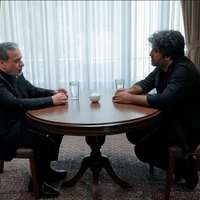
Iran's Ambassador to Azerbaijan Abbas Mousavi during an interview at Iran's embassy in Baku (March 2024)
Iran’s Ambassador to Azerbaijan, Abbas Mousavi, has been dismissed from his role, according to the IRGC-affiliated Tasnim news agency.
This news, just a mere two weeks after Iranian state media started a barrage of criticism against the now former Ambassador, following an interview he gave to a female reporter in Baku, who was not wearing a hijab.
A career diplomat, Mousavi served as spokesman for the Ministry of Foreign Affairs from 2019 to 2020 – most notably during the time of then-Foreign Minister Javad Zarif. Mousavi was appointed as Iran's ambassador to Azerbaijan in August 2020.
While not confirmed officially, it appears the controversy over this interview may have been the reason for Mousavi’s dismissal from his role as Ambassador.
Prior to the dismissal, the Tasnim news agency had made its case that the interview took place in the Iranian regime’s embassy in Baku, which is considered Iran’s territory under international law – and that Iranian diplomats worldwide are mandated to adhere to the principles of the Islamic Republic.
Furthermore, the agency claimed that the female reporter's presence without a hijab is viewed as a disregard for Iran's rules and regulations.
Tasnim argued that Gülməmmədova's “breach” of hijab codes is especially serious because it transpired within the confines of the Iranian embassy and in the company of the Iranian ambassador, insisting the Ambassador should resign "for the sake of Iran’s honor”.
Gülməmmədova, who has conducted interviews with various foreign officials, has not faced criticism for not wearing a hijab, even during interviews with Ambassadors from the UAE and Pakistan.
Meanwhile, BultanNews, aligned with regime hardliners, had asserted that the Azerbaijani reporter's attire violated diplomatic protocols and showed insufficient respect for Iranian officials. The media outlet emphasized that the interview took place beneath the portraits of Iran's former leader Ruhollah Khomeini, Supreme Leader Ali Khamenei, and Qasem Soleimani, the top Iranian military commander killed in a 2020 US drone strike in Iraq.
“The Ministry of Foreign Affairs should be held accountable [for this interview]. Why should Iran’s honor be tarnished on Iranian soil?” BultanNews added.
The regime imposes draconian hijab laws, severely punishing Iranian girls and women who fail to abide by the Islamic Republic’s strict codes.
One of the last victims of the Iranian regime’s repressive hijab policy was Armita Geravand. The 16-year-old girl passed away on October 28, 2023, after spending approximately a month in a coma due to brain damage inflicted during a violent altercation with the regime’s hijab enforcers.
A view from Iran’s pavilion at Doha International Maritime Defense Exhibition and Conference (DIMDEX) (March 2024)
The news of Tehran regime’s military-industry complex showcasing its “Gaza” drone at Doha International Maritime Defense Exhibition and Conference (DIMDEX) surprised few industry observers.
Until DIMDEX entered the stage in 2008, Turkey’s Istanbul International Defense Industry Fair, “IDEF” (1993-present), UAE’s Abu Dhabi International Defense Exhibition, “IDEX” (1993-present), and Pakistan’s Karachi International Defense Exhibition and Seminar, “IDEA S” (2000-present), did enjoy unrivalled seniority over Qatar’s DIMDEX as regional biennial military exhibition hubs. But Iran’s effective “show” of its military hardware at DIMDEX 2024, the Qatari military exhibition just took the whole concept of arms deals and commerce to a grand new level.
Certainly, this is not Iran’s first rodeo at DIMDEX as the Iranian military industrial complex has been an enthusiastic participant at Qatar’s military expo for quite a few years. Since 2014, Qatar and Iran have become increasingly aligned in a cold war against Saudi Arabia and their military and security cooperation and sponsorship of non-state antagonists such as Hamas has bonded them in an unprecedented way.
Iran Aircraft Manufacturing Industrial Company (HESA) Shahed 149 Gaza drone
Iranian generals at Doha International Maritime Defense Exhibition and Conference (DIMDEX) (March 2024)
DIMIDEX has served the Mullahs in Tehran, their praetorian IRGC, and their proxy henchmen across the Middle East by leaps and bounds. Whilst DIMIDEX helped establish the Tehran regime as a competitively “affordable” and “lethally” reliable supplier of military drones, as well as missiles, in the era of post-Cold War “asymmetrical warfare”. More importantly, it has established Tehran as a global middle power with far reaching destabilizing potentials like no other.
The tale of the recent rise of a regime like the Islamic Republic of Iran that has been frequently called“rogue” by various members of the Euro-American alliance over the past forty-five years to such lethal and de-establishing pre-eminence was authored with the enabling hand of the combined EU-US diplomatic appeasement or practical complacencies. Also, increasing US isolationism in the aftermath of Iraq War, and the economic upheavals inflicted upon the West by the 2008 Great Economic Recession played a role.
Intervening catastrophic events, namely, the Arab Spring and the rise of ISIS, acted as a catalyst to catapult the Iranian regime to its present hegemonically destabilizing status. The advent of the Arab Spring, in tandem with President Obama’s phased withdrawal of the US troops from Iraq and his administration’s hesitation to intervene in Syria in the face of the usage of unconventional warfare by the Syrian regime against civilians, marked the beginning of the rise of the Iranian regime to this high station.
A model of Iran's Shahed 149 Gaza drone at Doha International Maritime Defense Exhibition and Conference (DIMDEX) (March 2024)
As ISIS emerged in the wake of Iraq’s sectarian conflict and the worsening of the Syrian civil war, Iran joined Russia to keep Assad in power in Syria and reinforced its proxy militias in Iraq. The IRGC under Qassem Soleimani began developing all manner of military hardware suitable for application in asymmetrical warfare like one waged by anti-Assad militia in Syria and ISIS across the region. By 2018, the Iranian drones rivalled the Turkish ones in the skies of Syria and became an indispensable strategic arm of Iraqi militia forcesand Yemeni Houthi army. Certainly, rivalry with Saudi Arabia and the Gulf Cooperation Council states was a primary casus belli for the Iranian regime to ever fortify the Houthi arsenal with missile and drone technology.
Some could, and did, justify the Euro-American alliance’s appeasement and rapprochement with the Iranian regime that culminated to the 2015 JCPOA on grounds of “raison d’états”, namely, quelling ISIS. In fact, they went as far as likening such “expedient policies” to the Grand Alliance between the Anglo-American powers and Stalin’s USSR during WWII against Hitler. Yet, this invoked a bizarrely flawed historical analogy.
The Iranian regime was allied with Russia primarily to destroy anti-Assad Syrian rebellion, and ISIS was a bloody inconvenience that turned up amid such an intervention and was dealt with accordingly. In the course of their alliance, Iran and Russia partook in the massacre of hundreds of thousands of Syrian civilians and displaced millions of others, and they also quelled ISIS. The Russo-Iranian military alliance in Syria was thus not a benevolent humanitarian intervention. It was only akin to the Italo-German intervention on behalf of Franco’s fascists in the Spanish Civil War. In fact, such an exercise was precursor to, and did congeal, the later Italo-German military alliance as Axis against France and Britain in 1940.
Similarly, the collaboration between Iran’s IRGC and Wagner group during the Syrian Civil War consolidated the already deeply developed military industrial collaborations between the two countries; and drone development was one of many such collaborations. Against the backdrop of their earlier military collaboration in Syria, the Iranian drone contribution to Russia’s lethal operations against Ukraine was thus not an aid expected from a “client” of Russia but was an urgently needed assistance offered by “an ally” that had already showcased the usage of this technology against militants and civilians alike to their Russian partners in Syria.
Euro-American appeasement diplomacy vis-à-vis the Iranian regime continues to date despite the end of ISIS. EU and the US continued to subject the Iranian regime to “sanction regimes, threats and public chastening” but in effect have not deterred the regime effectively and concretely from its destabilizing practices.
Iran’s Shia Imperium have sent many shots across the Euro-American alliance’s bow in the region; some have even taken the life of US service members in the past six months. The recent March 19, 2024 Wall Street Journal’s reporting on EU-US rift over sanctioning Iran for weapons transfers in the Middle East is illustrious of the European pathological enabling of the Iranian regime’s military industrial complex; an enabling appeasement diplomacy that has imposed high energy costs for average European households with inflationary results and led to catastrophic consequences for millions from the Russo-Ukrainian war front to the troughs of Bab-al-Mandab and the Red Sea.
EU diplomacy, which might as well be dubbed “Borrell’s diplomacy”, is symptomatic of a deep-seated complacency in the attitude of the Euro-American alliance towards the Iranian regime. Whilst Biden administration turned a blind eye to Iran’s surging oil exports to China, both the US (under successive Obama, Trump, and Biden administrations) and EU were guilty of willful blindness towards Iran on the transfer of UAV parts and academic knowhow to Iran.