Editor-in-Chief Of Iranian Reformist Daily Receives One-Year Ban
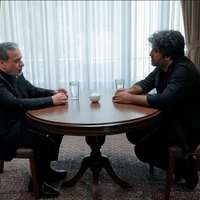
Behruz Behzadi, chief editor of Iran's reformist Etemad newspaper
Behrooz Behzadi, the editor-in-chief of Etemad, one of Tehran's prominent reformist dailies, has been barred from media activities by a court in Iran.
After a complaint lodged by IRGC's Thar-Allah headquarters in the capital, and a trial, Behzadi received a six-month prison sentence on grounds of "publishing false content." However, in a subsequent decision, the court opted to amend the sentence to a one-year prohibition from engaging in any form of media responsibility.
The Thar-Allah Headquarters, is a command within the Islamic Revolutionary Guard Corps, responsible for security in the Tehran area. This means it is the principle military force organzing suppression of protests.
The charges against Behzadi primarily stemmed from an interview conducted by Etemad with Dariush Farhood, a revered figure in the field of Iranian genetic science and his alleged abduction by plainclothes agents. Another complaint concerned an article highlighting the arrest of cinematographers and artists who stood in solidarity with the people during nationwide protests.
The court contended that the interview with Farhood presented information that was deemed “false and misleading”.
The case's outcome brings to attention the ongoing challenges faced by media professionals in Iran, where press freedom has been a contentious issue for decades. The 2023 World Press Freedom Index, as compiled by Reporters Without Borders (RSF), ranked Iran at the lowest position on the list, marginally above countries like Vietnam, China, and North Korea, reflecting the gravity of the situation.
Throughout the years, Iran has incarcerated hundreds journalists, writers, and bloggers, often accusing them of jeopardizing national security by expressing their opinions. Tragically, some of these individuals have lost their lives while in detention.
Iranians mourning during a Muharram ceremony in Tehran’s bazaar on July 27, 2023
Some Iranians taking part in the annual Shiite mourning ceremonies this week chanted religious verses that were critical of the regime and its repressive actions.
In one large gathering to mark the anniversary of the revered Shiite saint, Imam Hussein, son of the first Imam, Ali, mourners chanted:
“O Motherland, do you know why I’m devastated?
It’s because these people (the regime) only care about hijab.
They don’t see the poverty in our houses,
They have stolen so much from public coffers,
They don’t see the tears and laments of workers,
They don’t see that widows are destitute,
No bread on their tables,
That fathers are ashamed, and mothers distressed.
God be my witness that this is not the Justice of Ali!
All our problem is not a strand of hair!”
These verses were sung in the local dialect in Dezful in the oil-rich Khuzestan Province by the maddah whose role is reciting the praises of the prophet and his companions and mourning the slaying of his grandson, Imam Hussein in the battle of Karbala. While the maddah sings, his audience rhythmically beat their chests and move in tandem.
In recent years some maddahs have increasingly been using the story of the grandson of Prophet Mohammed, Imam Hussein, and his martyrdom to express their opposition to an interpretation of Islam that the regime has been promoting for four decades during the Ashura ceremonies.
The Day of Ashura, the anniversary of the slaying of Imam Hussein and his 72 companions on the 10th of the Islamic lunar month of Muharram, is the highlight of the month-long mourning ceremonies. The Imam and his companions were killed in 680 in a battle that took place in the plain of Karbala in present-day Iraq.
An Iranian Shiite Muslim mourns after covering himself with mud during a ceremony to mark Ashura, the holiest day on the Shiite Muslim calendar, in Tehran, Iran July 28, 2023.
Every year during Muharram, the beginning of which fell on July 19 this year, thousands of local mourning groups known as hey'at organize large congregations and street processions with thousands of participants.
Thousands of others usually gather along the streets to watch the procession of men rhythmically beating their chests or using a bundle of chains to beat their backs to the beat of massive drums amplified by speakers. The self-beatings symbolize the pain and suffering of the Imam and his companions in Karabla.
Unlike the fearless maddah in Dezful who openly referred to present time issues of hijab and destitution of the people, others voice their criticism in veiled terms, often in the form of verses associated with certain historical and revolutionary eras that their audience easily understands.
“Stop oppression, God’s blood has come to boil,
heavens and earth are wailing,
because the earth has been clothed in poppies,” a maddah and his congregation sang in the very religiously conservative city of Yazd.
“Poppies have sprung from the blood of the youth of the motherland!
And cypress trees have bent under the grief of their lost lives,” the congregation continued singing. This verse was taken from the very famous poem of Mirzaadeh Eshghi, a 19th century poet who dedicated it to the martyrs of the Constitutional Revolution (1905-1911).
By creating a parallel between their own time and circumstances and the time and circumstances that led to Imam Hussein’s martyrdom, they identify the regime and it leaders with the Arab ruler, Yazid, whose troops killed the Imam. The verses and steps are often practiced for months before the actual ceremonies.
Muharram ceremonies have been held for centuries in Iran and among Shiites in other countries. However, since the Islamic Revolution of 1979, the ceremonies and rituals have gained more prominence as the clerical government have made them a vehicle to show that the people are religious and loyal.
Iranians mourning during a Muharram ceremony in the central city of Bam, Kerman province (July 2023)
But increasingly mourning gatherings pop up around the country that include non-regime religious groups, who use the very Shiite ideology of seeking justice and condemning oppression to direct criticism at the clerical rulers.
Some people believe that the regime’s actions have resulted in the weakening of religion among Iranians while others argue that it is only the regime’s interpretation of Islam that has weakened and led to thousands of mosques being abandoned.
In a note published on Telegram Thursday entitled “Confiscation of History”, sociologist Ali Zamanian argued that using religious occasions such as Ashura to create an “ideological dichotomy” in which one side is all good and the other is all evil is unacceptable whether by regime-affiliated maddahs or those who sympathize with the opposition.
Zamanian, however, pointed out that critical maddahs’ expression of their frustration with the current economic crisis may show the government that it is not only those who believe in a secular state who oppose religious rule, but many religious people are “at the end of their ropes” too.
Even under the Shah, who was very proud of being the ruler of the only Shiite state in the world, the country was shut down for several days for the ceremonies and Ashura sermons were broadcast live on national radio.
Iranians mourning during a Muharram ceremony in Tehran (July 2023)
Robert Malley has been suspended from his position as Special Envoy for Iran.
A classified briefing Friday at the US House Foreign Affairs Committee by administration officials did not reveal the reasons for the suspensions of US Iran envoy Rob Malley.
The Jewish Insider reported that committee Chairman Michael McCaul said officials had not been able to offer details on Malley’s status regarding an investigation over his security clearance.
Iran International first reported June 29 that Malley’s security clearance had been suspended and he has been under investigation related to his handling of classified documents. The Federal Bureau of Investigation is reportedly involved in the investigation, although until now no official details have been announced, except that Malley is on “unpaid leave.”
Chairman McCaul (R-TX) had threatened the Biden administration with subpoena if they failed to brief his committee on Malley’s status. While he had been suspended perhaps as early as April, the administration did not inform Congress about it.
“We don’t really have any details” on the Malley investigation “because it’s an ongoing investigation,” McCaul said according to the Insider. He also said that the administration will likely not be able to provide a full briefing until the investigation ends.
A spokesperson from the Committee told Iran International that officials refused to provide any significant new information, including the reason Malley's security clearance was revoked, citing the Privacy Act, but the Committee will try again to obtain more information.
McCaul was quoted by the Insider as saying, “They couldn’t get into the details,” adding, “the question is, is the FBI involved because if they are, then that’s a national security problem.”
Malley who was chief US nuclear negotiator with Iran has been replaced by Abram Paley as acting envoy.
The outspoken Sunni cleric of Zahedan has urged officials to exercise restraint and compassion amid the current economic crisis during Friday prayers.
Amid immense financial pressure faced by Iranians all over the country, Molavi Abdolhamid delivered a compelling Friday prayer sermon, emphasizing the need for support from the authorities and compassion for the situation of regular citizens.
Addressing the congregation, Abdolhamid criticized the common practice of attributing inefficiencies and problems to external "enemies." He was referring to the term "enemy," often used by Supreme Leader Ali Khamenei and his loyalists to refer to the United States, he deemed it incorrect to solely blame external factors for internal issues, particularly in relation to domestic economic challenges.
During the Friday prayer, which coincided with the 10th of Muharram and the Day of Ashura, Abdolhamid, the Imam of Zahedan said, "No government, whether Muslim or non-Muslim, should resort to violence against its own people merely to ensure its survival."
He further stressed that the regime, its rulers, and the entire system owe their existence to the people, adding that the right to govern and elect officials lies with the citizens, and therefore, it is essential to listen to their voices and their concerns.
As the sermon concluded on the 43rd Friday of protests in Zahedan, Abdolhamid urged demonstrators to leave the mosque without engaging in chanting or further protests. During the previous two Friday prayers, worshipper and protestors honored Abdolhamid’s request and observe silence as a sign of respect for the sacred days of Muharram.
Shiite mourning ceremonies in the Iranian city of Zanjan
Shiite mourners in Iran refused to trample on the flags of Sweden and the United States during an Ashura mourning procession.
The incident, captured in a video obtained by Iran International, shows supporters of the oppressive Iranian regime placing the Swedish and US flags on the procession route in an attempt to exploit the religious sentiments of the crowd and encourage further public outrage at the recent Quran burnings.
However, the mourners rejected these attempts, refusing to step on the flags and the propagators of the political agenda, were forced to the flags.
This incident is not the first time that Iranians have expressed their refusal to disrespect the US flag.
Back in 2020, following the tragic shooting down of a Ukrainian International Airlines passenger jet by the IRGC, people outside Beheshti University in Tehran similarly resisted trampling upon giant American and Israeli flags that had been painted on the ground.
Prominent figures, including Professor Sadegh Zibakalam, an academic and author who is described as reformist and neo-liberal, have also exemplified their commitment to avoiding acts of disrespect towards foreign symbols. In 2016, Zibakalam chose to show his respect for other nations by shuffling along a nearby railing to avoid stepping on flags painted on the ground
Concerns have been raised within Germany over the alleged treatment of an Iranian human rights violator in Hanover.
The individual in question, Hossein-Ali Nayeri, reportedly received medical care at the International Neuroscience Institute (INI), a private neurosurgical clinic in Hanover headed by prominent Iranian-born neurosurgeon Prof. Madjid Samii.
Nayeri was involved in the summary trial and execution of thousands of Iranian prisoners during the 1980s, which led to widespread condemnation. His medical treatment in Germany was revealed by German media outlet Presseportal reported last week on Nayeri’s admission to the INI.
Reacting to the news, Norbert Röttgen, a member of the German Bundestag, or federal parliament, expressed his concerns in a tweet on Thursday, calling Nayeri a “mass murderer” and stating that, "if he is here and leaves again, it will be a first-class scandal."
Volker Beck, the president of the German-Israeli Society, took immediate action after being informed of Nayeri's presence in Germany. On July 7, he notified Germany’s Federal Public Prosecutor, the Foreign Office, and the Federal Interior Ministry, urging them to initiate criminal prosecution measures against Nayeri.
"This must come to an end," he asserted, referencing a previous case involving another Iranian judge, Mahmoud Hashemi Shahroudi, who received treatment at the same clinic in Hanover back in 2018.
The allegations also sparked outrage among Iranian opponents of the Islamic Republic, who accused the INI of deleting Nayeri’s medical records.
Bild, Germany’s highest circulating newspaper, reported that the expunging of Nayeri's medical records appeared to be an attempt to avoid a new scandal against the Iranian regime; however, Prof. Samii, INI’s director, denied this allegation.