German MP Seeks Clarity On Iranian Hanging Judge's Treatment
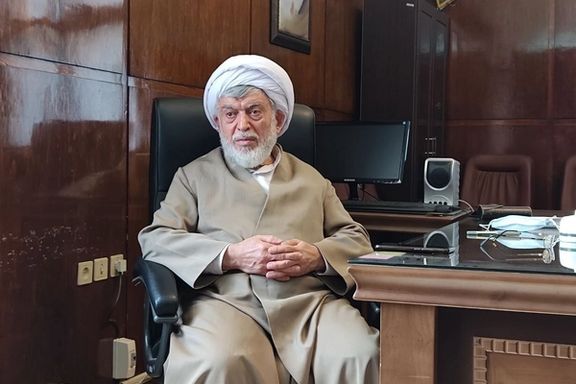
Iranian prosecutor Hossein-Ali Nayeri
Concerns have been raised within Germany over the alleged treatment of an Iranian human rights violator in Hanover.
The individual in question, Hossein-Ali Nayeri, reportedly received medical care at the International Neuroscience Institute (INI), a private neurosurgical clinic in Hanover headed by prominent Iranian-born neurosurgeon Prof. Madjid Samii.
Nayeri was involved in the summary trial and execution of thousands of Iranian prisoners during the 1980s, which led to widespread condemnation. His medical treatment in Germany was revealed by German media outlet Presseportal reported last week on Nayeri’s admission to the INI.
Reacting to the news, Norbert Röttgen, a member of the German Bundestag, or federal parliament, expressed his concerns in a tweet on Thursday, calling Nayeri a “mass murderer” and stating that, "if he is here and leaves again, it will be a first-class scandal."
Volker Beck, the president of the German-Israeli Society, took immediate action after being informed of Nayeri's presence in Germany. On July 7, he notified Germany’s Federal Public Prosecutor, the Foreign Office, and the Federal Interior Ministry, urging them to initiate criminal prosecution measures against Nayeri.
"This must come to an end," he asserted, referencing a previous case involving another Iranian judge, Mahmoud Hashemi Shahroudi, who received treatment at the same clinic in Hanover back in 2018.
The allegations also sparked outrage among Iranian opponents of the Islamic Republic, who accused the INI of deleting Nayeri’s medical records.
Bild, Germany’s highest circulating newspaper, reported that the expunging of Nayeri's medical records appeared to be an attempt to avoid a new scandal against the Iranian regime; however, Prof. Samii, INI’s director, denied this allegation.
A protester holds a flare during a demonstration against Israeli Prime Minister Benjamin Netanyahu and his nationalist coalition government's judicial overhaul, days after a parliament vote on a contested bill that limits the Supreme Court's powers to void some government decisions, in Tel Aviv, Israel July 27, 2023.
The Israel air force chief has said its country's enemies might exploit the political crisis triggered by an overhaul of the judiciary, seeing it as an opportunity.
Major-General Tomer Bar said his forces needed to remain "vigilant and prepared" after parliament Monday passed the first of Netanyahu's widely contested changes, removing the Supreme Court's authority to void what it deems "unreasonable" decisions by government and ministers.
"It is possible that at a time like this they (Israel's enemies) will try to test the frontiers, our cohesion and our alertness," Bar said in an address to his forces, according to a statement released on Friday. He did not elaborate.
Reuters reported this week that Iran’s IRGC and security officials held a three-hour meeting last week with the Lebanese Hezbollah and Palestinian Hamas to see how they can take advantage of Israel’s internal problems.
The overhaul pursued by Netanyahu and his right-wing government has sparked a seven-month crisis, spurring unprecedented protests, opening up a deep social divide and shaking the commitment to call-up duty of some army reservists.
Protesters attend a demonstration against Israeli Prime Minister Benjamin Netanyahu and his nationalist coalition government's judicial overhaul, days after a parliament vote on a contested bill that limits the Supreme Court's powers to void some government decisions, in Tel Aviv, Israel July 27, 2023.
As the crisis escalated following Monday's vote, Israel's Ynet news said Netanyahu received at least four letters from Military Intelligence warning of serious security ramifications arising from the judicial overhaul.
According to the report, senior intelligence officials said Israel's enemies, particularly Iran and its heavily armed proxy in Lebanon, Hezbollah, view the crisis as a historic low point in the country's history.
A spokesperson for the prime minister declined comment.
Iranian government media and those of his proxies have been highlighting Israel’s political crisis, claiming that end of the Jewish state is near.
A poll conducted by Maariv, one of Israel's leading newspapers, found that 58 percent of Israelis feared civil war, and 36 percent thought the right thing to do is for government to stop the judiciary legislation immediately, compared to 22 percent who said it should be promoted unilaterally.
Protesters say growing numbers of military reservists have decided to stop serving to express their opposition to the overhaul. The military has acknowledged an increase in requests to abstain from service, and said that damage would be done, gradually, to war-readiness if the no-shows proved protracted.
Netanyahu has argued that the change made this week is “a minor” issue and it is “silly” to say Israel will no longer be a democracy.
Protesters attend a demonstration against Israeli Prime Minister Benjamin Netanyahu and his nationalist coalition government's judicial overhaul, days after a parliament vote on a contested bill that limits the Supreme Court's powers to void some government decisions, in Tel Aviv, Israel July 27, 2023.
Political watchdog groups have appealed to the Supreme Court to strike down the new law, paving the way to a showdown among branches of government when it hears the arguments in September.
The legal tussle could begin next Thursday when the top court will hear an appeal against a coalition bill ratified in March that limited conditions for removing the prime minister from office.
Israel's democratic foundations are relatively fragile, and the Supreme Court is seen as crucial for protecting civil rights and the rule of law. The country has no constitution, the government holds a 64-56 majority in the one-chamber Knesset and the president's office is ceremonial.
Netanyahu says the changes will balance government branches. He casts the protests as a bid to thwart his democratic mandate.
His plans have hit the economy, triggering foreign investor flight. Deepening domestic political uncertainty will reduce economic growth this year, S&P Global Ratings said in a report.
The judicial reform drive, along with an expansion of Jewish settlements on occupied land where Palestinians seek to establish a state, have also weighed on relations with Israel's most important ally the United States.
Eid-Ali Karimi, the Executive Secretary of Qazvin Labor House
An Iranian labor activist has raised concerns over the increasing prices of red meat and chicken putting increased pressure on household incomes.
Eid-Ali Karimi, Executive Secretary of Qazvin Labor House, made the comments amid the government's delay in holding the meeting of the Supreme Labor Council, which plays a crucial role in determining workers' salaries in the state-controlled economy.
Karimi criticized, "red meat is over 5,000,000 rials ($10) per kilogram, and chicken is over 1,000,000 rials ($2). The increase in these prices places an immense burden on workers." He emphasized that the rising costs of essential items have made it increasingly challenging for households to make ends meet.
"If a worker wants to buy three kilograms of red meat and five kilograms of chicken to feed his family of four per month, he has to spend more than a quarter of his salary. This leaves little room for covering basic expenses like rent, daily necessities, and education for his children," Karimi said.
Officials have stated that the monthly minimum wage, currently less than $150, only suffices for nine days of a family's livelihood. The resulting financial struggles for workers and their families are further exacerbated by soaring inflation rates.
Furthermore, house rents have surged by more than 100%, leaving many workers with a major portion of their earnings dedicated only to housing costs. Karimi noted that this situation forces workers to take on multiple jobs, often working long hours, just to cover basic living expenses.
Hassan Akbari, the Supreme Leader's representative in the Revolutionary Guards of Qom province
In the aftermath of the Quran burning in Sweden, an Iranian cleric has proposed that the Swedish embassy should be transformed into a Quran teaching center.
During a speech on Thursday, Hassan Akbari, the Supreme Leader's representative in Qom province's IRGC, urged high-ranking officials in Iran to protest against the insulting act and its support by Western governments by closing the Swedish embassy in Tehran and turning it into a center for Quran teaching.
He also expressed strong condemnation and called for decisive actions from the judiciary and the Ministry of Foreign Affairs against such acts.
The Quran burning incident in Sweden garnered international condemnation, prompting Iran's Supreme Leader, Ali Khamenei, to call for the perpetrator to face the severest punishment. Khamenei claimed last week that his stance is supported unanimously by all Muslim clerics.
In a statement addressing the incident, he urged the Swedish government to hand over the culprit to the judicial authorities of Muslim countries for appropriate legal action.
The perpetrator, identified as Salwan Momika, an Iraqi immigrant, burned the Quran in front of the central mosque in Stockholm on the first day of Eid al-Adha, after obtaining a permit from the Swedish government. He repeated the desecration in front of the Iraqi embassy in Stockholm on July 20.
Issa Zarepour, the Minister of Information and Communications Technology
Iran's communications minister has defended internet filtering policies, claiming that a third of the blocked sites are “obscene” and “restricted worldwide”.
Isa Zarepour’s comments come in response to a report by the Tehran Electronic Commerce Association, which said that 30% of the top 100 most visited sites globally are filtered in Iran. Zarepour said that these websites are also “restricted worldwide”.
Among the blocked services in the country are major platforms such as YouTube, Facebook, Instagram, WhatsApp, Twitter, Reddit, Netflix, Bing, BBC, AliExpress, PayPal, and Quora. Attempting to corroborate the minister's claim, a website called Farazdaily investigated the restricted websites in Iran, but discovered that they do not contain any adult or restricted content.
The restrictions on social media platforms in Iran date back more than a decade, Facebook and Twitter being banned after the 2009 presidential election and Telegram in the aftermath of the November 2019 protests. Last year, Instagram and What’s App were blocked during the mid-September protests.
Despite these strict bans, Iranian officials, including Supreme Leader Ali Khamenei, maintain a presence on social media platforms, some possessing multiple accounts on each. Meanwhile, Iranians resort to using Virtual Private Networks (VPNs) to circumvent the bans and continue using social media.
Social media has significantly transformed the information landscape in Iran, challenging the government's control over the flow of information. Citizens now utilize these platforms as virtual town squares to openly criticize and challenge the clerical regime, heralding a shift in the power dynamics between the authorities and the public.
A 20-year-old woman, who was arrested and detained for not observing the mandatory hijab, has reportedly been sexually harassed by the Iranian regime’s agents.
Tabassom Jamalpour, who was arrested on July 17 for publishing a photo of herself without the compulsory veil in front of a religious mourning procession center, has been subjected to physical abuse and sexual harassment whist in a “safe house”, according to reports by Iran Prison Atlas.
The reports allege that agents forced her to remove her clothes, saying "You should be naked like the picture you published..." before beating and stripping her and touching her breasts.
Jamalpour was then transferred to Ward 209 of Evin Prison, where she endured consecutive days of interrogation. The charges brought against her include "insulting Islam" and "spreading corruption and prostitution."
At the time of her arrest, another woman who was also not wearing a headscarf and a man wearing shorts were also detained. Their whereabouts and well-being remain unknown.
There have been a spate of accounts of violence and sexual abuse against detainees, particularly during the uprising of Iranians against the clerical regime following the death in custody of Mahsa Amini.
In February 2022, the Guardian published a report quoting 11 male and female protesters saying that they were "raped, sexually assaulted, beaten and tortured" by the security forces of the Islamic Republic during their detention.