Iranian 'Hanging Judge' Under Treatment In Germany

One of the judges involved in the summary trial and execution of thousands of Iranian prisoners in the 1980s has been under treatment in a hospital in German city of Hanover.

One of the judges involved in the summary trial and execution of thousands of Iranian prisoners in the 1980s has been under treatment in a hospital in German city of Hanover.
According to German media outlet Presseportal, Hossein-Ali Nayeri was admitted to a private neurosurgical clinic -- the International Neuroscience Institute (INI) -- headed by Madjid Samii, a prominent Iranian-born neurosurgeon.
Nayeri, a cleric, judge and chief adviser to Iran’s judiciary, was one of the main figures in the "death committee" responsible for the mass execution of political prisoners in Iran in 1988. President Ebrahim Raisi was also a key member of this committee.
On July 7, Volker Beck, the president of the German-Israeli Society, notified Germany’s Federal Public Prosecutor, the Foreign Office, and the Federal Interior Ministry about Nayeri’s stay, urging them to initiate criminal prosecution measures against him.
While people are murdered and tortured to death in Iranian prisons, those responsible for the human rights violations travel to Germany with impunity, he said, stating, “This must come to an end.” He also referred to another Iranian judge -- Mahmoud Hashemi Shahroudi – who was treated in the same clinic in Hanover in 2018.
In July 2022, Nayeri defended the massacre in an interview with the Islamic Republic Documents Center, a government entity that collects the history of the 1979 revolution and more than four decades of rule by the Islamic Republic in Iran.
He tried to justify and explain away the killing of thousands of political prisoners, saying, “The country was in a critical state. If Khomeini [the Islamic Republic's first leader] did not stand firm... perhaps the regime would have not been able to survive.”

Amid tensions with Afghanistan over water, an Iranian lawmaker has suggested “non-diplomatic ways” to exert pressure on the Taliban, such as closing its Tehran embassy.
Fada-Hossein Maleki, a member of the Iranian Parliament's National Security and Foreign Policy Committee, said Sunday that a taskforce within the Supreme National Security Council is mulling over new measures to secure Iran’s share of water from Hirmand river, including closing the Taliban embassy and reducing political, commercial, and economic interactions through various means.
“We have many tools at our disposal that we can utilize for these purposes,” he noted.
Calling for stricter measures, Maleki said that considering the current position that the Taliban holds, Iran should not excessively appease them. “We have given them whatever they wanted, even compromising the relations between our Persian and Pashto speaking friends, who say demands by the Taliban are being accommodated one after another by Iran,” he said.
“We are witnessing a distressing situation in the Sistan and Baluchestan region, where villages are gradually becoming deserted,” he stressed, adding that the people of the province are facing imminent dangers and the first concrete step to address their grievances is to solve the water issue.
Flowing 700 miles, Hirmand -- which is called Helmand on the Afghan side -- enters Iran's Hamoun wetlands in the Sistan-Baluchestan province after originating in the Hindu Kush Mountains near Kabul. Lake Hamoun used to be one of the world's largest wetlands, straddling 4,000 square kilometers between Iran and Afghanistan.
The river, which both Afghanistan and Iran depend on for agriculture and drinking water, has been the biggest source of tension for years.
Iran has accused Afghanistan of restricting the flow of water from the river by building dams over it, a charge that Afghan authorities deny.
This comes as in the past few weeks, numerous reports have been published about water shortages in different regions of Iran, especially the Sistan and Baluchestan province.

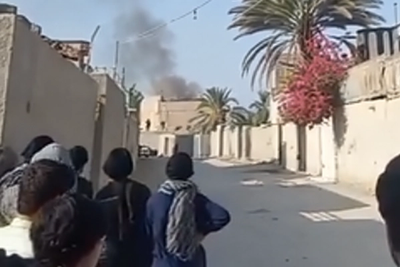
At least four road police officers were killed in an attack in the city of Zahedan in Iran’s restive southeastern Sistan-Baluchestan province.
“Today, attackers ambushed a police car and opened fire at the vehicle,” IRGC-affiliated Tasnim news agency reported, adding that a judicial order has been issued to arrest the perpetrators.
It was not immediately clear who was behind the attack, but the region is a scene of numerous clashes between regime forces and armed groups that the regime describes as bandits and terrorists.
In recent months, the situation in Sistan-Baluchistan has dramatically worsened. The overall atmosphere in provincial cities have become very tense, especially on Fridays, when residents come out to protest against the regime. Clashes also break out when smugglers try to traffic fuel or other contraband to or from neighboring Pakistan.
There have been reports of numerous attacks on military and government forces in the province in the past and since nationwide protests broke out in September 2022. The provincial capital Zahedan was the scene of a government massacre when around 90 citizens were gunned down during a protests September 30.
Several Baluch groups from the area are fighting an insurgency against the Islamic Republic. The most prominent is Jaish al-Adl, which has often targeted Iran's military, especially the Islamic Revolutionary Guard Corps (IRGC).
Earlier in July, an attack on a police station in the Sunni-majority city of Zahedan claimed the life of two policemen.

Iran’s former foreign minister Ali-Akbar Salehi in an interesting interview has implied that both Tehran and Washington share the blame for their negative relationship.
Salehi told Etemad newspaper that bilateral relations with the United States were fraught with negativity from the very beginning of the Islamic revolution and has remained so for 44 years. The two countries have negotiated on several issues in the past, such as prisoner exchanges, Afghanistan, and the nuclear issue, but they have never held comprehensive talks to resolve underlying differences.
“Now, considering all regional and international conditions, it is good and appropriate opportunity to hold multi-faceted political talks with the West, including Europe and the United States,” Salehi was quoted as saying.
It is said that Salehi was the Iranian negotiator who first launched talks with the Obama administration in 2013 in Oman to agree to start talks over Iran’s nuclear program. The process led to the signing of the Joint Comprehensive Plan of Action, JCPOA, or the 2015 Iran nuclear deal.
Salehi was foreign minister from 2010-2013 and he also headed the Atomic Energy Organization (AEOI) of Iran before and after his tenure as chief diplomat.

As head of AEOI, he was involved in the JCPOA talks, but the chief negotiator was then-foreign minister Mohammad Javad Zarif.
Salehi said that Iran had grievances against the United States during and after the revolution and it always expected an apology from Washington for alleged interference in its domestic politics in 1953, However, Salehi argued that when Secretary of State Madeline Albright once acknowledged US mistakes, Iran should have accepted it as an apology and smoothed out relations with Washington.
The former chief diplomat also had a message for hardliners currently dominating the government in Iran. “Some people mistakenly believe that being revolutionary gives them the freedom to act without bounds. However, the truth is quite the opposite. Being revolutionary demands the utmost thinking, rationality, and knowledge. A true revolutionary must be well-versed in political knowledge.”
Iranians should also consider the fact, that at the end of World War Two, it was the United States that forced the Soviet Union to withdraw from vast swaths of Iran’s territory, which Moscow could have easily colonized, Salehi pointed out. Americans and Europeans also did not understand the Iranian revolution in the late 1970s and were caught off guard, the former foreign minister argued. Many believed at the time that this was not a clergy-led revolution and suspected that the Soviet Union or China were behind it.
In short, as an Iranian regime insider, Salehi tried to present a more balanced view of the United States and urge comprehensive talks, that US presidents have on numerous occasions urged the Islamic Republic to agree to. However, Iran’s ruler Ali Khamenei who has been at the helm of power since 1989, has opposed wide-ranging talks, especially after 2018, when the former US administration withdrew from the JCPOA and imposed sanctions.
The Iranian regime wants to maintain is freedom of action in the Middle East, where it has built an arc of proxy forces from Yemen to Iraq and Lebanon. The regime has also isolated the country from the international economy, maintaining an overwhelming system of government ownership of major companies, banks and media.
Salehi, viewed as one of the more balanced and polished Islamic Republic officials, has occasionally spoken out in the past two years urging better governance, democracy, and a stronger economy.
Last November, current foreign minister Hossein Amir-Abdollahian invited his predecessors, including Salehi for a “friendly meeting and discussion” that local media called as urgent in nature. This was during fierce anti-regime protests and after talks to revive the JCPOA reached a deadlock.

Iran systematically summons, interrogates and often detains family members of dissidents, who are either themselves in prison, killed during protests or fled abroad.
A group of prominent Iranian human rights activists and dissidents issued a public letter and petition, urging Javaid Rehman, the UN’s Special Rapporteur on Human Rights in Iran, to secure the release of recently imprisoned political activists’ and journalists’ family members in Iran.
The letter titled “Condemning the Iranian Government’s Detainment of Political Activists’ and Journalists’ Family Members, and Discrimination Based on Ethnicity and Gender” was published in July in English and Persian.
When asked about the letter, a spokesperson for the US State Department told Iran International, “We are aware of this case and will continue to monitor its developments. We once again call on Iranian authorities to cease the arbitrary detentions. Iranian authorities have repeatedly violated Iranians’ human rights and punished them for exercising their fundamental freedoms. “

The US spokesperson added “While charges in this case have not been announced, sham trials and executions are key components of the regime’s attempt to suppress any form of dissent.The United States continues to coordinate with allies and partners to hold Iranian authorities accountable for their human rights abuses.”
The letter noted that in early July, “news emerged of the arrest of Saman Pashai[sic]. Pashai, a Kurdish citizen and the world’s third-ranked junior wrestling champion is Sardar Pashaei's brother, a former World Wrestling Champion and national team coach. Sardar Pashai had notably spoken out against the Islamic Republic since the death sentence of Navid Afkari, a former wrestling champion in Iran and a protester against the regime.”
The letter continued: “On September 23, 2022, Latifeh Pashai (Layla Saghezi), a women’s rights activist and Sardar Pashaei’s sister, was detained and interrogated about her brother’s activities. Security agents had previously summoned and questioned Sardar Pashaei’s parents.”
Sardar Pashaei told Iran International that“By arresting my younger brother, who is a professor and a wrestling champion, the authoritarian Islamic regime is sending my family and me a message: ‘Be quiet. Don’t criticize the regime. Don’t create problems.’”

He continued that “The government's ploys to silence us, either by holding our loved ones hostage or sending its mercenaries to kill us, will not help them keep power. Iranian authorities are now using arrests and in some cases the death penalty as a tool of political repression—but we have a message for the regime: We will not give up our fight for freedom.”
According to the letter, on “June 18, 2023, agents from the Iranian Ministry of Intelligence blocked the entryway to Iranshahr in the Sistan and Baluchistan province. They subsequently arrested Amer Dadafarin, the 18-year-old son of Fariba Baluch, and Mohammad Mollazehi, the 25-year-old brother of the same, both relatives of the Baluch human rights activist. Their whereabouts remain undisclosed.“
Speaking from Britain on WhatsApp with Iran International, Fariba Baluch said “They arrested my son and brother for nothing. Just for my activities.” Baluch is an outspoken critic of the Iranian regime’s repression of people in Baluchestan.
Iranian regime security forces murdered more than 100 people in Zahedan, the provincial capital of Iran’s Sistan-Baluchistan, in the autumn of 2022 in what has become known as “Bloody Friday.”
Baluch spoke in April in the European Parliament and said: “Over 20 of those killed in the protests were children under 18. Baloch were killed, wounded, arrested and suppressed more violently than anywhere else in Iran.”
She added “Being a woman on one hand and a Baluch on the other hand, means systematic and double discrimination against them, as the women of Balochestan not only suffer from the religious government policies, but also local social/cultural oppressions more than any other region in Iran.”
The public letter was authored by Lily Pourzand, women and gender issues professional; Parvaneh Hosseini, lecturer and civil activist; Moein Khazaeli, lawyer; Samaneh Savadi, gender equality activist; Hamed Farmand, children’s rights activist; and Nasim Mogharab (Sahra), women’s rights activist.
When asked about the letter, a spokesman for United Nations Security General António Guterres referred Iran International to Ravina Shamdasani, a UN Human Rights Spokesperson for Rehman, the UN’s Special Rapporteur on Human Rights in Iran Affairs.Shamdasani did not immediately respond.
Iran International reached out to the International Olympic Committee and United World Wrestling. Hualan Jiang, a representative for the IOC, referred Iran International to the IOC press office. The IOC declined to comment. Iran International also contacted Human Rights Watch and HRW’s Director of Global Initiatives, Minky Worden, who deals with the persecution of athletes. A HRW spokesperson wrote, “We regret to inform you that we are unable to meet your deadline due to the availability of our experts. Apologies for the inconvenience this has caused, but we hope to be more accommodating of future requests. We wish the best of luck with your reporting and hope to hear from you in the future.”
Iran International offered to extend the filing of its article to HRW to secure a comment. HRW and Worden declined to comment. Critics argue that HRW failed to intervene prior to the execution of Navid Afkari. On the day that Iran’s regime hanged Afkari, HRW issued a statement.

A video showing a cleric in Iran assaulting and beating an elderly woman in a property dispute has gone viral on social media, prompting officials to respond.
Local judicial authorities have announced that the clergyman's case will be referred to the provincial court for clerics. However, they also tried to emphasize that the incident resulted from a family dispute over property.
The sharing of such videos on social media is a sensitive issue for Iran's clerical regime, as many Iranians resent the power the clergy have wielded in the past 44 years since the establishment of the Islamic Republic. In recent protests since last September, there have been numerous instances of young people verbally assaulting clerics or expressing their dissatisfaction with them. In many instances young people filmed how they tossed the turban of clerics in the streets.
A judicial official in Gilan Province, where the incident occurred, has threatened to pursue those who filmed the cleric attacking the woman and promised to prosecute them.
The measures or punishment that the clerical court will decide upon are not clear, as proceedings in these courts are kept secret. Clerical courts operate independently of the Judiciary administration and function outside the legal framework.
In addition to this, another scandal that emerged earlier in the week is still causing reverberations among Iranians. A video surfaced showing an official and staunch regime loyalist responsible for enforcing hijab regulations, engaging in a sexual act with a young man. He has been fired from his job, and authorities state that he is under investigation.