Iran's national security chief has warned the government of looming food shortages and higher prices, a top-secret letter obtained by Iran International reveals.
In the confidential letter, dated February 5, the secretary of Supreme National Security Council (SNSC) Ali Shamkhani briefed President Ebrahim Raisi of a meeting with food importers and other officials of the agriculture ministry.
Shamkhani expressed concerns about prices of animal feed, particularly warning that prices for maize, barley and soybean meal will rise, affecting the production of poultry, eggs, red meat, milk and dairy products. He said the prices of soybean meal will probably double in the next few weeks, leading to a jump in the cost of meat.
According to the letter, the country will also face a shortage of maize or corn within one or two months as Brazil – which had been replaced by many countries as the main exporter – has run out of the produce and Ukraine will not supply Iran with its needed corn.
Iran has been supplying Russia with kamikaze drones that are used against Ukrainian infrastructure targets.
To provide the needed corn, Iran should buy from intermediaries, which will cost $30 to $40 more per ton, Shamkhani noted.
Iran’s economy, especially imports, are tightly controlled by the government that supplies the hard currency needed. The private sector has become largely dependent on the government for obtaining US dollars to import raw materials and food. With US sanctions crippling Iran’s oil export revenues, the government is short of hard currency and the Iranian rial has dropped by more than 60 percent in six months.
A sample of the letter obtained by Iran International
The letter also revealed that the Islamic Republic has not finalized any contract with foreign sellers for the coming months. Soybean meal, barley and corn for livestock and chicken feed are mainly imported from Russia and other countries. Iran annually imports around 8 million metric tons of corn, 4.2 million metric tons of soybean meal, and 400,000 metric tons of barley for animal feed. Any shortages or higher prices can further push up the price of meat.
Head of the Meat and Protein Industry Association of Iran said last week that amid reports about a sharp increase in food prices demand for red meat has decreased by 50 percent in the past one year.
Shamkhani also said that the Central Bank of Iran has not allocated any foreign currency to provide for animal feed in the past 37 days because the foreign currency transfer line via Trade Bank of Iraq has faced difficulties.
Recently, the United States imposed tougher regulations on Iraqi bank transfers to restrict Iran’s money laundering ability in the neighboring country. The secret letter proves that indeed Iraq was used to obtain US dollars.
The letter also revealed that the county needs about $1.4 billion for clearance of the goods that are stuck at the countries’ ports due to a lack of foreign currency.
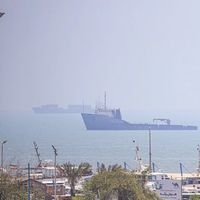
According to a report by Tasnim news agency, affiliated with the Revolutionary Guard, the deputy head of the Customs Administration has recently said that ships are stranded at Persian Gulf ports waiting to unload their cargo.
Importers need to receive US dollars or other foreign currencies from the government to pay suppliers before the ships would anchor at the ports and discharge their cargos. Iran is currently in a crisis for not having enough foreign currency and the US dollar has reached a historic high. One dollar can buy 500,000 Iranian rials, while five years ago the exchange rate was around 35,000.
In January, Iran’s judiciary chief Gholam Hossein Mohseni Ejei said tens of ships have arrived in territorial waters of the country, but the Islamic Republic cannot unload them therefore the country must pay fines for the delay in discharging cargos. The delay in payments is the main reason that has disrupted flows of goods into the country.
A photo showing Islamic Republic's parliament in session on February 20, 2023
Chaos reigned in financial and currency markets in Iran on Tuesday as the government scrambled to contain the damage from an unprecedented fall of the currency.
The rial, which fell to a low of 500,000 against the US dollaron Monday stayed around the same level as a string of measures were announced by the government on Tuesday, giving the Central Bank of Iran (CBI) “unprecedented powers” to contain the damage.
Officials announced that citizens will not be allowed to buy their annual share of foreign currency from official exchange bureaus, which previously was $2,000. They also said that the government will stop providing dollars to banks and official dealers for that purpose.
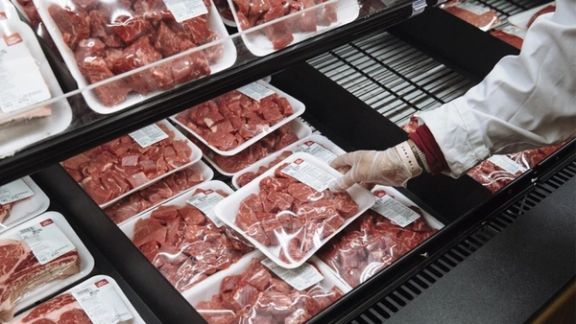
Meat and other prices shot up, as a general mood of panic emerged over rising inflation in the coming days.
The economic chaos can reinvigorate antigovernment protests, after large-scale government repression reduced street demonstrations in January. Iranian analysts in recent weeks were speaking of the “grey strata” in society, unwilling to come out and support younger protesters, but the economic chaos can be the catalyst for more Iranians to join the movement.
Iranians lining up to buy dollars in Tehran on Monday
Confidential government documents obtained by Iran International Tuesday showed that the Secretary of the Supreme National Security Council, Ali Shamkhani, was warning President Ebrahim Raisi of shortages in animal feed due to lack of imports. Iran is dependent on importing millions of tons of grains and animal feed to maintain food production and supply. Any serious shortages can lead to chaos for consumers.
Mohammad Machine-Chian, a senior research scholar at the Center for Governance and Markets at the University of Pittsburgh told Iran International Tuesday that the “Supply chain of essential goods in Iran is in an extremely vulnerable and dangerous situation.” He added that the government’s foreign currency reserves are running out and it is not able to secure sufficient imports.
The government claimed that it established a new “currency exchange center” to provide dollars and other hard currencies “for legitimate needs,” leaving a trail of unanswered questions in the wake of the announcement.
Ordinary people and businesses more likely will see the move as yet another dubious government scheme, typical of the state-controlled economy.
According to official figures, well over $10 billion have been taken out of the countryin the past few months. The real figure might be much higher as confidence in the economy and the government’s foreign policy seems to be at an all-time low.
The Biden administration, which was negotiating last year with Iran to resolve the dispute over Tehran’s nuclear program, not only has kept the Trump administration’s economic sanctions in place but has made attempts to strengthen their enforcement. The talks reached an impasse in September and since then Washington has repeatedly said that its focus has shifted to supporting the rights of Iranian protesters.
The mood among European powers has also shifted against the Iranian regime after it became obvious that it was supplying hundreds of kamikaze drones to Russia that are being used in Ukraine.
Iran’s rial fell to a new low Monday, breaking a crucial threshold despite repeated government promises of “soon” strengthening the battered national currency.
The rail fell to more than 500,000 against the US dollar from 460,000 only a week ago and 300,000 in late August. Parallel markets including gold, gold bullions, and even vehicles, both domestically produced and foreign made, will immediately reflect the change with higher prices. Essential food items, such as red meat, have already risen to unprecedented highs, making them unaffordable to the majority of people.
The British pound climbed to 600,000 rials and the euro was trading at around 535,000.
Many businesses, such as car dealerships, have already stopped trading while the general population tries to best preserve the value of their savings by making small investments in such commodities.
Further depreciation of the rial in the coming year, many say, would be certain if the situation is not somehow remedied. In a speech Saturday at the residence of Supreme Leader Ali Khamenei to civil and military officials and foreign ambassadors, President Ebrahim Raisi once again promised to bring inflation and the fall in the value of the national currency under control but failed to explain his envisaged solutions to the problems.
Two months ago, when one dollar traded for around 390,000 rials, government spokesman Mohammad Mokhber tried to reassure the public that the fall of the rial was only “temporary”. Other officials including those from the Central Bank of Iran (CBI) continue to make similar statements and promises.
Pensioners marching on Sunday, demanding food on their tables
Shiva Ravoshi, A CBI official, said Sunday that “the bubble in the currency exchange market” would definitely burst and advised people not to make rash decisions over purchasing foreign currencies. She also claimed that with new policies and changes to be introduced by the CBI “soon”, all of the country’s needs for foreign currency will be met and the situation will improve.
But this is what officials have been saying since early 2018 when the currency began to fall once markets anticipated a US withdrawal from the JCPOA nuclear deal.
Some pundits, such as conservative economist Hossein Raghfar, suspect that the government is intentionally pushing up foreign currencies to sell its own stock at higher prices to make up for its budget deficit. “This is the game that the government is playing itself because it’s the end of the year and they have no resources for paying employees’ bonuses and salaries,” he said Friday.
The Iranian currency has fallen 14-fold since the United States pulled out of the 2015 nuclear deal and imposed crippling economic sanctions. With further nuclear talks uncertain, the economic fundamentals work against the rial. The government boasts of large clandestine oil exports, mainly to China, but the fact remains that it faces a more than 50-percent budget deficit.
The drop in the value of the rial is expected to wreak havoc in the lives of many Iranians as the calendar year draws to a close and consumers prepare for the New Year shopping in March.
On Sunday retirees with fixed pensions, whose standard of living has dropped to unprecedented levels, staged rallies outside the Social Welfare Organization in the southwestern cities of Shush and Ahvaz. “Enough oppression! No food on our tables!” and “Inflation, high prices killing people!” retirees chanted. This was a small sign of what may still come amid a rebellious mood among the people.
The impact of rial’s steep fall will be highly reflected in the actual value of the government’s proposed minimum wage increase of 20 percent for the next year. Since early January when the budget bill was presented to the parliament, the rial has fallen by around 20 percent. Many commodities already cost at least 20 percent more than the wage increase which will come into effect on March 21.
Amid reports about a sharp increase in food prices in Iran, officials say that over the past year demand for red meat has decreased by 50 percent.
Head of the Meat and Protein Industry Association of Iran, Masoud Rasouli told ILNA news website Sunday that "Compared to the last Iranian year [Ending in March 20, 2022], the demand for red meat has decreased by 50 percent while the demand for poultry also experienced a 30 percent fall."
Iran's currency rial on Sunday dropped to an all-time low of 490,000 to the US dollar.
Regarding fish, he said most is exported because of the drop in the value of national currency making exports more profitable, and little domestic demand for it.
Rasouli further noted that some of the meat production units in Iran have shut down, adding that "out of 700 meat packing companies, only 120 are active and 20% of them have closed down last year."
Iranian media report that the price of boneless mutton has reached 5,000,000 rials or 11 dollars per kilogram. Compared with the minimum monthly salary of 42,000,000 rials which is nearly $87 in today’s exchange rates, workers cannot afford any meat.
In recent years, various reports have been published about the increase in the price of all kinds of meat, and the decrease in the consumption of high-protein foods in Iran.
In this situation, the government of Ebrahim Raisi has promised to deliver meat and chicken to the people at an "approved price", but the government has made many similar promises in the past.
The Iran panel in the Munich Security Conference on February 18, 2023
Iran’s exiled Prince Reza Pahlavi said in Munich that his country can play a positive role in the world if opposition forces get support from friendly countries.
Pahlavi told the Munich Security Conference on Saturday that the people of Iran are united and they expect the international community to support their ideals.
Women’s rights activists Masih Alinejad and British-Iranian actress and human rights activist Nazanin Boniadi as well as Hannah Neumann, a member of the European Parliament, and Bob Menendez, Chairman of the US Senate Foreign Relations Committee, also spoke at a meeting called “Woman, Freedom, Life: Visions for Iran” on the second day of the conference.
Pahlavi told the forum that “We need to make a transition as fast as possible because the opportunity costs grow every day that goes by — it becomes more and more costly for Iranians and not just for us but the rest of the world.”
Elsewhere in his remarks, he said millions of Iranians, who have fled the country since the Islamic Revolution to become German, French, Canadian, and US citizens can be back home serving their homeland.
“What keeps them from contributing is a regime that doesn't even listen to them because they're not interested in the welfare of Iran,” he noted.
He called on the West to work with a different Iran, arguing that “a different Iran would mean that you will have true allies who believe in the very same principles of human rights and liberty.”
Prince Reza Pahlavi during the Iranian forum at the Munich Security Conference on Feb. 18, 2023
“So, the minute this regime disappears, not only you instantaneously eliminate the combination of the problems that this regime has cumulatively created in four decades, but the replacement or the people who think like you and want to work with you.”
He added that a secular free Iran can satisfy the energy concerns that the West has, where Iran can be the greatest provider.
Talking about the significance of inviting Iranian opposition to the Munich Security Conference he stated that “this is a perfect opportunity as we engage with parliamentarians or leaders of different governments to discuss what exactly can be done besides maximum pressure.”
"We are also hoping to have maximum support for the people in Iran … in areas that can be immediately done, for instance, internet access or a strike fund to support striking workers and the funding of it."
Pahlavi said what Iran needs is solidarity in the principles that people are fighting for, raising hope that the countries who hold talks with Iranian representatives understand that their task is to be unified.
Alinejad also said she is very happy that for the first time she will not see dictators from Iran at the Munich Security Conference and the conference has invited people's representatives.
Well-known Iranian activist and women's rights campaigner Masih Alinejad, Feb 18, 2023
Talking about the uprising of the Iranian people against the regime, Alinejad said “clearly, we're not just fighting against compulsory hijab. As we all know, compulsory hijab is the main pillar of a religious dictatorship.”
“Compulsory hijab is like the Berlin Wall. If we tear this wall down, the religious dictator with Islamic Republic will be gone. So, women are in the streets, shoulder to shoulder with men. They're saying that enough is enough…Counting women like second class citizens, killing, torturing, assassinating is in the DNA of the Islamic Republic. And that is why this protest is taking place across Iran, to bring the Islamic Republic down.”
“We want the West to stop shaking the hand of this murderous regime. We want the West to stop saving this regime. In 2009 people were in the streets calling on Obama to support them, but at the same time, Obama's administration was trying to get a [nuclear] deal.”
She stressed that it has been two decades European countries trying to have a deal with Iran, but so far they have achieved nothing.
“This is the time that the Europeans, Americans, they have to sign a deal with Iranians, with the people of Iran, not with the government... The plan B is very, very clear now. Iranians want regime change. We don't want you to say regime change if you're scared of the word. But this is very, very important to stand on the right side of the history.”
Alinejad also warned that if the West does not take strong action against the Islamic Republic, the IRGC is going to come on US and European soil and assassinate non-Iranians.
“Believe me, people of Iran are better allies than these backward mullahs. You can count on us.”
She underscored that Iran without the Islamic Republic can be a better place and it can help the rest of the world to be safe.
“We are ready to have an Iran without the Islamic Republic. We are wondering whether the West is ready or still they sanction the Revolutionary Guard, the clerics and the other day they want to negotiate with this murderous regime. Be ready for an Iran without Islamic Republic.”
Talking about the 2015 nuclear deal known as the JCPOA, Alinejad said after the deal, its economic benefit did not go to the people of Iran but instead to the dictators.
“The benefit of the deal went to the terrorist organizations, to Hamas, to Hezbollah, to Bashar Assad, to Hassan Nasrallah. So clearly, we do not want the West to sanction the people of Iran,” underlining that she strongly believes a strategic sanction can help.
Leading Iranian activist, actress Nazanin Boniadi
For her part, Nazanin Boniadi emphasized that women played a central role in the recent movement reiterating that Iranians have become accustomed to mass uprisings nearly once a decade for the past 40 years, but nothing really compares in fervor or magnitude to what has been seen in the past five months.
“Of course, people are out on the streets, as they've been in the past few years opposing the Supreme Leader, Ali Khamenei. But not only that, they're now tearing down and burning photos, knocking down effigies of the founder of the Islamic Republic, Ayatollah Khomeini, and Qasem Soleimani, but really, the thing that sets these protests apart is that it's female led.”
She said the spark and the engine of the protests have been women because of the murder in custody of Mahsa Amini.
“Courage has been contagious and really what women have managed to do in Iran has galvanized Iranian society at large to understand gender equality and every other basic human rights. And it has turned into a pro-democracy movement and really the greatest threat to the Islamic Republic that we've seen in 44 years.”
Elsewhere in her statements Boniadi said the reform movement is dead in Iran and it is just not possible. She also added that the very pillars that keep the system up in Iran ensure that it's wrongs cannot be made right.
She also added that Iranian people are not looking for foreign intervention, but support and those two things are completely separate.
In this panel, Senator Bob Menendez, emphasized the difference between this uprising of the Iranian people and the previous periods of protests saying that this difference stems from the leadership of the movement by women.
Senator Bob Menendez speaking at the US Senate in February 2022
Highlighting that the international community should support people's protests, he called the uprising of the Iranian people an “opportunity”.
“I do believe that this process is an opportunity if we grab it. We lost the green revolution (Green Movement). We cannot lose another one…. I think the international community needs to wake up to the tear gas and start acting resolutely against the regime on behalf of the Iranian people. This can be a defining moment for a difference.”
The Senator from New Jersey said he did not vote for the first nuclear agreement with Iran because he thought it was a mistake noting that the deal known as the JCPOA did nothing about Iran's other “nefarious” activities.
“It did nothing about its missile development, did nothing about the destabilization of its neighbors and the region. It did nothing about its proxies, violent proxies in different parts of the world and it did nothing about violating the human rights of its own people.”
Menendez added that the iteration of the deal that was being contemplated did not make any sense, because it was even worse than the first deal.
He further raised hope that the Europeans would join the United States in sanctioning the regime entities because they should understand that only sanctions against regime leaders can work so that the people are not hurt.
Hanna Neumann, the representative of Germany in the European Parliament, also said that the protests showed “how brutal this regime is towards its own citizens.”
Neuman said the European Parliament has been very clear regarding its stance towards the Islamic Republic, but on the other hand, “for the celebrations of the 44th anniversary of the revolution, we had the ambassadors of Hungary and Poland shaking hands with President Raisi.”
“We have those who are very clear saying this regime does not represent the people of Iran anymore. And we have those who still try to figure out how to deal with the regime. And it's an internal debate that we're having. But I really have the impression it's shifting more. The more we can see what could the alternative vision be,… the more I think we see a shift,” she stressed.
Iran's ruler Ali khamenei in January 2021, with picture of IRGC's Qasem Soleimani seen in the background
A prominent Iranian economist in a letter meant to reach Supreme Leader Ali Khamenei has said that the Islamic Republic is in the final stage of its downfall.
Mohsen Renani, a professor at Isfahan University, says that he gave his paper to former foreign minister Mohammad Javad Zarif to hand it to Khamenei some two months ago, but after a while Zarif came back and said he was unable to deliver the letter to Khamenei. Renani decided to publish it on the social media platforms Telegram.
In the letter he argued that the downfall of any entity or political or social structure has four stages, and its collapse happens with the fourth stage. He further argued that the Islamic Republic is now at stage 4 and it is not quite clear for how long it can resist the collapse.
Furthermore, Renani warned that attempting to bring about a revolution from the top to avoid the downfall will add to the probability of a collapse.
According to Renani, the downfall of any institution or government has two dimensions and four stages which take place one after another: The first dimension, is the subjective downfall which includes the two stages of collapse of efficiency and collapse of competency. The second dimension, the objective downfall, consists of the two stages of collapse of symbols and collapse of structures.
Likening the society to a family, Renani said that the subjective collapse takes place when one or both sides are disappointed by the other and their emotional relationship collapses like an emotional divorce. But when the family really collapses, and a separation takes place there is an objective collapse or a legal divorce. Now the members of the family have realized that the father figure is not capable of solving the family's economic and social problems. Then his competency collapses.
Mohsen Renani, professor of economics at Isfahan University
Iran, according to Renani has left behind the first three stages and is now in the final stage, that is the collapse of its structures. He argued: "We all know that Iran will go through a stage of transition from the current impasse, but we need to make sure that the government will choose the least costly way of transition. It depends on the government to relive the experience of South Africa and Chile, or the ones that happened to Libya and Syria. Iran's national interests call for thinking of a violent revolutionary development is the very last choice."
He added: "I publish this text to tell the families who have suffered during the protests and their children that their movement has had a great achievement. I also wish to tell those inside the system who wish to take a closer realistic look at the situation that perhaps there is still time to save the country."
Renani warned that a revolution from the bottom is inevitable. It can be averted only if change starts from the top, if there is still time for that. The government should not be deceived by relative calm. Instead of suppressing and humiliating the new generation, the government should consider understanding and respecting it and holding a dialogue with it.
It is only in that case that bringing about a change in the structure can facilitate Iran's future development in a less costly way. However, at the current stage even a reform from the top may not be able to save the system as it has lost its all credibility. Nonetheless, it is the only thing that can be done at this stage if the system can restore its credibility among the people, Renani said.
"I know that publishing this paper may enrage the government or it may make angry those Iranians who think a violent regime change is the only solution for Iran's crisis, but as an intellectual it is my responsibility to warn both sides," Renani reiterated.
Earlier, former Prime Minister Mir Hossein Mousavi had called for a regime change and former reformist President Mohammad Khatami said that reformists have no future in Iran although moving toward a regime change might lead to violence and chaos in Iran. The reform camp supported Khatami's view and some seventy politicians expressed their support for Mousavi's idea although he did not offer a roadmap for the next steps.
In Renani's model, following the decline of legitimacy and symbolism, i.e., when parents no longer maintain cordial relations with children, the structure of the system, here the family, also collapses and the family no longer live under the same roof. "The Islamic Republic, I believe, is standing on the threshold of this final stage," Renani maintained.