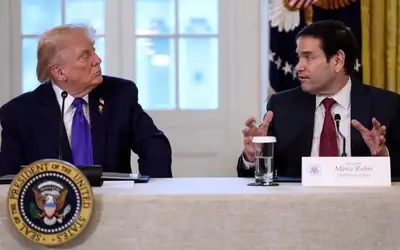
US Sec of State Antony Blinken meeting Israel's Benny Gantz on March 27, 2022
Israeli Defense Minister Benny Gantz and US Secretary of State Antony Blinken Friday discussed the impact of President Joe Biden’s visit to Israel and Saudi Arabia in July as well as ways to deepen regional defense cooperation.
Gantz said in a tweet that he talked with Secretary of State Antony Blinken about the need for continued pressure on Iran as well as negotiations for a nuclear agreement.
Earlier in the day, Iran's foreign minister reiterated his country’s resolve to clinch an agreement for the revival of the 2015 nuclear deal, known as the Joint Comprehensive Plan of Action (JCPOA).
Hossein Amir-Abdollahian made the remark in a late Saturday phone call with his Qatari counterpart, Sheikh Mohammed bin Abdulrahman Al Thani.
During the call, the two foreign ministers discussed the latest developments in their countries’ relations in various political, economic and consular sectors, including cooperation for the 2022 FIFA World Cup.
The top Iranian diplomat added that the US constantly claims it is in favor of an agreement, but that claim "should manifest itself [both] in the text of the agreement and in action."
On the same day, Amir-Abdollahian had phone calls with his counterparts from Kuwait, the United Arab Emirates, Qatar, Oman, and Iraq, saying Tehran is serious about reaching a durable and strong agreement on the revival of the JCPOA.
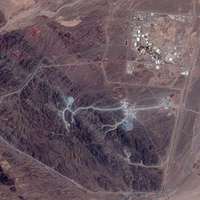
Entrance to Fordow nuclear, military site near Qom, Iran
Two Telegram channels with links to IRGC have suggested that Iran may build nuclear warheads “in the shortest possible time” if attacked by the US or Israel.
Bisimchi Media (Radioman Media) Telegram channel on Saturday published a short video entitled “When Will Iran’s Sleeping Nuclear Warheads Awaken” in which it said the Islamic Republic will begin building nuclear bombs in the shortest possible time “if the US or the Zionist regime make any stupid mistakes.”
The video also says that uranium enrichment in secret underground facilities of Fordow, near Qom, has brought Iran to the threshold of nuclear breakout and joining the nuclear powers’ club and stresses that transforming the country’s “peaceful nuclear program to a nuclear weapons program” is possible in a very short time.
Israeli has repeatedly threatened in recent months to use all means at its disposal to prevent Iran from becoming a nuclear threat, and has said its armed forces are preparing for action if necessary.
“The nuclear facilities of Fordow have been built deep under mountains of Iran and are protected against trench-busting bombs and even nuclear explosion… all infrastructures required for nuclear breakout have been prepared in it,” the video said while adding that the facilities at Natanz may be highly vulnerable to a possible attack by Western powers and Israel but Fordow will immediately assume war footing and begin the nuclear breakout project within a short time if Natanz comes under missile attack.
The video report also suggests that Iran’s ballistic missiles have the capability of “turning New York into hellish ruins”, citing Iran’s space program, which has so far been mostly a failure.
An underground uranium enrichment facility in Iran
EMAD, another form of an earlier weapons program, AMAD, refers to Iran’s purported secret nuclear effort, which started in 1989 under the leadership of Mohsen Fakhrizadeh and according to the UN nuclear watchdog IAEA, stopped in 2003. According to a IAEA director general’s report in 2015, Iran specifically denied the existence of the AMAD Plan and the ‘Orchid Office’ as elements of such a program.
Iran has now enriched enough uranium to 60 percent that if further enriched to 90 percent, the fissile material will be sufficient for a nuclear bomb within a few weeks.
Some Iranian officials, including Kamal Kharrazi, a senior adviser to Supreme Leader Ali Khamenei, have suggested that Iran is a nuclear threshold country but does not want or need a nuclear weapon and is only enriching uranium for energy and other civilian uses. They often add that Iran's supreme leader has declared that the production, stockpiling and use of nuclear weapons are all forbidden under Islam (haram).
Khamenei’s fatwa, or religious edict, against the acquisition or manufacture of nuclear weapons was first revealed in a statement from Iran to the International Atomic Agency (IAEA) in Vienna in August 2005.
Then-Intelligence Minister Mahmoud Alavi in February 2021 hinted that the fatwa could change. Former Iranian diplomat and IRGC brigadier-general Amir Mousavi also in an interview with Lebanon’s al-Mayadeen television in January 2021 had said fatwas are not permanent and are issued in accordance with developing circumstances. “Therefore, I believe that if the Americans and Zionists act in a dangerous manner, the [Khamenei] fatwa might change.”
The US and Israel agreed in July to take a joint stance against Iran's nuclear program and involvement in regional conflicts and said they would work together to prevent Tehran from obtaining a nuclear weapon.
European Union foreign policy chief Josep Borrell (L) with Iranian Foreign Minister Hossein Amir-Abdollahian in Tehran, June 25, 2022
Two days after State Department spokesman Ned Price said the US was mulling European Union proposals over Iran’s nuclear program, there are no signs of progress.
The English-language Tehran Times warned the “western media” Friday against “early judgment” on the fate of the 2015 nuclear deal, the JCPOA (Joint Comprehensive Plan of Action). EU foreign policy chief Josep Borrell recently produced new ideas to bridge differences between the United States and Iran and allow both to return to the agreement.
The Tehran Times highlighted the Wall Street Journal, which July 25 ran an opinion piece by Walter Russell Mead, Professor of Foreign Affairs at Bard College, New York, comparing the JCPOA to Schrodinger’s cat, a hypothetical feline in an indeterminate state that is neither alive nor dead.
Some analysts believe that agreement remains likely to revive the JCPOA, which the US left in 2018, with Iran by 2019 expanding its nuclear program beyond the deal’s limits. This remains the assessment of Mossad, Israel’s extraterritorial intelligence agency, Al-Monitor’s Israel correspondent Ben Caspit reported Friday.
But some European diplomats have this week privately expressed pessimism to journalists, arguing Borrell’s proposals will not achieve the necessary concessions from either Iran or the US, each of whom blames the other for the failure of seven-party talks in Vienna paused in March and June’s bilateral US-Iran two-day round in Qatar.
EU coordinator Enrique Mora (L) meeting Iranian negotiator Ali Bagheri-Kani in Qatar, June 28, 2022
The basic challenges remain agreeing which US sanctions breach the JCPOA, what guarantees Washington offers over respecting a revived deal, and exactly how Iran’s expanded and refined nuclear program should be brought back within JCPOA limits. There have also been reports that Iran has demanded that the International Atomic Energy Agency (IAEA) drop enquiries into nuclear work Iran conducted before 2003, although Tehran’s explanations deemed unsatisfactory by the agency led to a critical resolution passed by the IAEA board in June.
Russian, Chinese calculations
Analysts also suggest that wider factors, including the Ukraine crisis, have come to play a growing role in calculations made by all parties. Ali Vaez, director of the Iran project at the International Crisis Group, said this week that Iran might judge that Europe’s need for oil and gas come the winter would lead it to put pressure on the US to compromise, while Washington continues to think its ‘maximum pressure’ sanctions will put Iran under growing economic strain.
Vaez also noted that Moscow and Beijing, which is buying nearly all Iran’s oil exports, might both judge that as long as Iran did not ‘weaponize’ its nuclear program, the current drift would “bog down” the US “in the Middle East and divert its attention from Russia and China.”
This was also part of Mead’s argument in the Wall Street Journal. “Whatever their long-term concerns about a nuclear Iran,” he wrote, “both Xi Jinping and Vladmir Putin seem more interested in stiffening Iran's commitment to the anti-American alliance than in facilitating an agreement that would reduce the pressure on a beleaguered American president.”
The US administration appear to believe they can manage the situation. Brett McGurk, President Joe Biden’s Middle East advisor, reportedly said recently that while it was “highly unlikely” that the JCPOA would be revived soon, the administration thought it could continue to deploy sanctions “but not needlessly escalate the situation.”
Iraqi protesters carrying a portrait of influential Shiite cleric Moqtada Sadr
Thousands of Iraqi protesters, many followers of a popular cleric stormed Baghdad's Green Zone Saturday to protest Iran’s interference in the country's politics.
The protesters, mostly followers of influential Shiite cleric Moqtada Sadr who seeks to curb the influence of the Islamic Republic in Iraqi politics, gathered at the end of a bridge leading to Baghdad's heavily fortified Green Zone district – which houses government buildings and foreign embassies and mounted onto concrete barriers. According to Iran International’s correspondent Truska Sadeghi, they are heading for the Iraqi judiciary building.
Brandishing Iraqi flags and portraits of Sadr, the protesters chanted "All the people are with you Sayyed Moqtada," referring to Sadr with his title as a descendant of prophet Muhammad.
Calling for a consensus government and reforms, they demand ending foreign interference, particularly by the Islamic Republic, handing over corrupt officials to the law, and dissolving the parliament and the Coordination Framework, a coalition of Shiite parties close to Tehran.
Stressing the need for an independent government in Baghdad, they emphasize that they do not want an Iranian-linked government or a subordinate one. Protesters say they are not just the followers of Sadr; “we are all of Iraq,” they say.
Friday night, Sadr’s supporters shut down several offices of Iran-backed Hizb-ul-Dawa (The Islamic Dawa Party) and the Iraqi National Committee.
A senior Shiite scholar said on state TV that, “We will not let Iran’s Revolutionary Guard manage our country, we will cut off Iran's hand.”
According to unconfirmed reports, at least one protester is dead and several more are injured during the clashes with security forces.
There are also reports that Iran-backed Hashd al-Shaabi forces, also known as Popular Mobilization Forces, are on high alert.
Prime Minister Mustafa Al-Kadhimi has also called on protesters to show restraint to protect the safety and lives of the demonstrators.
In a show of strength on Wednesday, July 27, protesting Iraqis forced their way into the parliament, walked on tables, waved Iraqi flags, sat in lawmakers' chairs, and chanted anti-Iran slogans to protest a Tehran-backed prime ministerial nominee. On Monday, July 25, the Coordination Framework nominated Mohammed al-Sudani as the prime minister, a decision opposed by Sadr.
The mass gathering was considered a show of force by the firebrand cleric whose party won the highest number of seats in the October 2021 national elections but withdrew after failing to form a government with Sunni and Kurdish allies in Iraq's hectic power-sharing system free of Iran-backed parties that have dominated many state institutions for years.
It was the largest protest since the federal elections and the second time al-Sadr has used his ability to mobilize the masses to send a message to his political rivals this month,and renewed his call to dismantle outlaw armed factions, referring to the Iran-backed Shiite militia Hashd al-Shaabi, which was led by former Iraqi militia commander Abu Mahdi al-Muhandis before he was killed alongside Qasem Soleimani in January 2020 by a US drone strike.
European Union foreign policy chief Josep Borrell visiting Tehran on June 25, 2022
The State Department spokesman has said the United States is reviewing European Union proposals to take forward talks over renewing the 2015 Iran nuclear deal.
Ned Price, in his Thursday press briefing, said Washington would “convey feedback directly to our European partners” but reiterated a US position that holds “Iranian intransigence, the lack of constructive Iranian engagement” responsible for the failure of talks, in Vienna and more recently in Qatar, to resolve differences over restoring the 2015 agreement, the JCPOA (Joint Comprehensive Plan of Action).
The US and Iran take differing views over which US sanctions violate the JCPOA, while Tehran has sought guarantees that Washington would uphold any commitments made in reviving the agreement. Price said the US understanding was that proposals recently made by Joseph Borrell, the European Union foreign policy chief, were based on draft texts drawn up in Vienna by the time talks paused in March – ones Price said the US had been “prepared to accept…for months now.”
Price insisted that Iran had failed to “make that political decision necessary to return to compliance with the JCPOA” and that Washington as preparing “equally for scenarios where we have a JCPOA, scenarios where we don’t have a JCPOA.”
The US and the three European JCPOA signatories – France, Germany and the United States – have expressed growing concern in recent months at the expansion of the Iranian nuclear program, which began breaching JCPOA limits in 2019, the year after the US left the agreement and imposed ‘maximum pressure’ sanctions.
US State Department spokesperson Ned Price. FILE PHOTO
Price welcomed the release in Iran on bail of British-American-Iranian environmentalist Morad Tahbaz, thanking Oman for work on his case, and stressed it was among Washington’s “utmost priorities” to secure the “safe return home of wrongfully detained Americans.”
Price denied links between nuclear talks and efforts to secure their release or arrange a prisoner-sway for Iranians detained in the US. He insisted the administration was “very careful not to tie the fates to these wrongfully detained Americans to a potential mutual return to compliance with the JCPOA.”
In another development over Iran Thursday, Deborah Lipstadt, the White House ‘special envoy to monitor and combat antisemitism,’ condemned Iran’s leader Ali Khamenei over a tweet she called “unacceptable and dangerous.” Khamenei had criticized the extent of Zionist influence in the US as a “mafia.”
Lebanon ‘emergency’
President Joe Biden Thursday renewed for a further year a US ‘national emergency’ with respect to Lebanon first introduced by George Bush in August 2007. The measure gives the administration special powers to impose economic sanctions, with Biden’s statement citing “the actions of certain persons to undermine Lebanon’s legitimate and democratically elected government or democratic institutions.”
Biden expressed concern over Iran’s arms transfers to Hezbollah, the Shia party and armed militant group sanctioned by many countries, that has been for decades in conflict with Israel. The US has a variety of sanctions against Lebanon, many introduced under executive orders but also by statute.
Iran announced Friday it had appointed Mohsen Naziri Asl as its new ambassador to the United Nations bodies in Vienna, including the International Atomic Energy Agency, IAEA. Asl has previously served as ambassador to UN bodies in Geneva, while his new post will take in the International Atomic Energy Agency, which is based in the Austrian capital.
The US special envoy to monitor and combat antisemitism has decried remarks by Iran’s Supreme Leader Ali Khamenei, describing them as “unacceptable and dangerous.”
In a tweet on Thursday, Deborah Lipstadt said, “We denounce this continued, egregious antisemitism,” adding that “This rhetoric is unacceptable – not to mention dangerous – especially from a head of state.”
Calling on the Islamic Republic to end its antisemitic stance towards the world, she said, “It must cease.”
She was replying to a tweet by Khamenei’s official account who said a day earlier, July 27, that described the Western powers as “mafia,” noting that “At the top of this mafia stand the prominent Zionist merchants, and the politicians obey them. The US is their showcase, and they’re spread out everywhere.”
Earlier in the week, Israel’s envoy to the United Nations Gilad Erdan told Iran International that Iran is enriching uranium almost to military-grade, noting that “This is a clear threat to the security of our region and to the whole world. It needs to be addressed by this Security Council, and this Council is silent.”