As Mora Heads To Tehran, Borrell Says JCPOA Needed For Stability
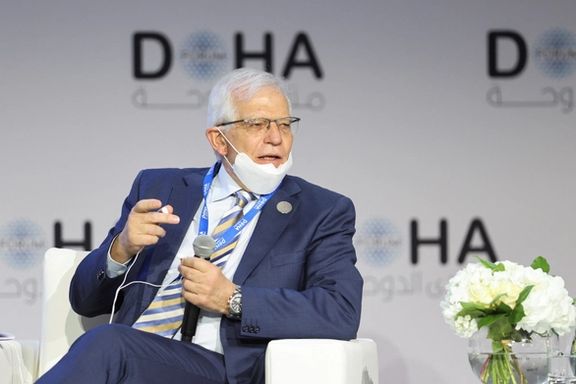
Josep Borrell attending the Doha Forum on March 26, 2022
Speaking at the Doha Forum international conference Saturday, Josep Borrell, the European Union (EU) foreign policy chief, said Iran and world powers were “very close” to reviving the 2015 nuclear deal.
Borrell reportedly discussed with Qatari Foreign Minister Mohammed bin Abdulrahman bin Jassim Al-Thani the humanitarian impact of Russia's invasion of Ukraine, which has sent the cost of food items spiraling across the Middle East and North Africa, whereone in three peoplewere short of food in 2020.
Borrell said he hoped a successful conclusion to 11-month talks in Vienna aimed at reviving the 2015 nuclear deal, the JCPOA (Joint Comprehensive Plan of Action) was possible as an “as important element of wider stability and security.”
Enrique Mora, the senior EU official chairing the Vienna talks, tweeted Friday that he would travel to Tehran Saturday to meet Ali Bagheri-Kani, lead Iranian negotiator in the Vienna talks. “Working on closing the remaining gaps…Much is at stake,” Mora wrote.
Speculation over delays in the Vienna talks has focused on Russia’s requests that any sanctions over Ukraine not affect Moscow's role in JCPOA and its trade relations with Iran and reported US-Iran deadlock over lifting a ‘foreign terrorist organization’ designation attached to Iran’s Revolutionary Guards by former president Donald Trump after leaving the JCPOA in 2018 and imposing ‘maximum pressure’ sanctions.
Russian and US chief negotiators meeting in Vienna in December.
Iran has denied a report about an alleged secret offer to help Russia evade Western sanctions in exchange for support in achieving a nuclear deal with the West.
Dismissing a March 23 report by the UK newspaper The Telegraph, an informed source with Iran’s Foreign Ministry said on Friday, “The claim by the Daily Telegraph that Iran and Russia have reached a secret agreement on the JCPOA and [Western] sanctions [on Russia] is merely an instance of news fabrication”.
The source, quoted by Iran's government-controlled media, added that such reports are made by Western security circles as part of their psychological warfare. It is worth noting that Iran's belated denial is not official.
On March 23, The Telegraph cited security sources about Iran’s secret offer to help Russia evade the impact of Western sanctions in return for getting “Moscow’s backing for a new nuclear deal”.
Diplomatic efforts in Vienna to revive the 2015 Iran nuclear deal, officially known as the Joint Comprehensive Plan of Action (JCPOA), broke up earlier this month after Russia demanded guarantees that any future business it conducts with Iran be exempt from Western sanctions imposed after the invasion of Ukraine.
It seems the Biden Administration has agreed with a Russian demand, which besides facilitating the restoration of the JCPOA, would involve lucrative deals for Moscow to expand Tehran’s civilian nuclear program. This would include the expansion of the Bushehr power plant with two additional nuclear reactors.
Russia announced on March 15, ten days after demanding the exemption that the Biden administration had agreed to waive Ukraine sanctions, noting that “Additions were made to the text of the future agreement on JCPOA restoration to ensure that all the JCPOA-related projects, especially with Russian participation, as well as Bushehr Nuclear Power Plant, are protected from negative impact of anti-Russian restrictions by US and EU”.
Still expressing optimism over the Vienna nuclear talks on Thursday, the Iranian foreign minister reiterated that Tehran would not surrender its "redlines", understood as the demand to remove the Revolutionary Guard from the US list of terrorist organizations.
The Telegraph article claimed security officials believe Iran has offered to use its sanctions-evading structure to help Russia sell its oil on international markets once the nuclear deal is signed, and sanctions have been lifted against Tehran.
“Russia is actively looking for ways to evade sanctions, and Iran has offered to help,” said a senior Western security official. “In return, Iran wants Russia to make sure the new nuclear deal is agreed so that sanctions are lifted against Tehran.”
EU's Enrique Mora, coordinator of Iran nuclear talks
The European Union coordinator for Iran nuclear talks, Enrique Mora, will travel to Tehran on Saturday to discuss unresolved issues, he tweeted late Friday.
“Travelling to Tehran tomorrow to meet Bagheri Kani. Working on closing the remaining gaps in the Vienna talks on the JCPOA. We must conclude this negotiation. Much is at stake,” Mora said.
The nuclear talks that started almost one year ago in Vienna ended inconclusively earlier in March, after Russia demanded exemption from Ukraine sanctions in its dealings with Iran. However, there are still unresolved issues between Tehran and Washington.
Iran is reportedly demanding that the United States remove the Revolutionary Guard, IRGC, from its terrorism list and the Biden Administration appears hesitant.
The prospect of such a move has galvanized opposition among US lawmakers, especially Republicans, who were skeptical or opposed to the revival of the 2015 nuclear agreement, JCPOA. Former president Donald Trump withdrew from the agreement arguing that it will not stop Iran from acquiring nuclear weapons.
US National Security advisor Jake Sullivan travelling in Europe said on Friday that if diplomacy with Iran fails, Washington is ready to increase pressure on Tehran in coordination with its European allies.
As the current stalemate continues, Iran-backed Houthi forces in Yemen launched drone and missile attacks against oil installations in Saudi Arabia on Friday, causing damage.
The United States will work with allies to increase pressure on Iran if diplomacy fails, White House National Security Adviser Jake Sullivan said on Friday.
The talks were close to an agreement until Russia made last-minute demands of the United States, insisting that sanctions imposed on Moscow over its invasion of Ukraine would not hurt its trade with Iran.
US officials have become more cautious lately in their assessment of efforts to revive the 2015 nuclear accord between Iran and world powers, which would curb Tehran's nuclear program in exchange for lifting tough sanctions on Iran's economy.
Substantial progress has been made in resolving several issues necessary for Washington to come back to the deal "on a compliance-for-compliance basis," Sullivan told reporters aboard Air Force One en route to Poland with President Joe Biden.
"There still are issues left. There still is work to be done," he added. "We are still seeking a diplomatic outcome here that puts Iran's nuclear program back in a box. Of course, if diplomacy doesn't succeed, then we will work very closely with our international partners to increase the pressure on Iran."
Iran is reportedly insisting that the US should lift a terror designation imposed on its Revolutionary Guard. The Biden Administration apparently has considered the demand, which has let to domestic criticism, particularly by Republicans.
Iranian foreign minister Hossein Amir-Abollahian in Beirut on March 24, 2022
Still expressing optimism over the Vienna nuclear talks on Thursday, the Iranian foreign minister has reiterated that Tehran would not surrender its "redlines".
At a meeting with the Lebanese Parliament Speaker Nabih Berri in Beirut Thursday evening, Hossein Amir-Abdollahian said Iran is serious about achieving a “good, lasting deal” in the negotiations.
He added that a prolongation of the process was not acceptable to Iran and that Iran would not cross its own red lines but did not elaborate on what Iran's redlines are, but reports in the past two weeks indicate this is related to Iran's demand that the US should remove the Revolutionary Guards (IRGC) from its list of Foreign Terrorist Organization (FTO).
“We are optimistic and at the same time serious about the outcome of the Vienna talks. In our view, the [possible] agreement should be such that the removal of [US] sanctions is done maximally,” he said at another meeting in Beirut with Lebanese Prime Minister Najib Makati.
Austrian journalist Stephanie Liechtenstein in a tweet Thursday said her sources who ten days ago seemed rather confident that a deal could be struck to restore the JCPOA now "sound increasingly pessimistic." "This is yet again another extraordinary turn of events, especially if you think just how close they are," she said.
The Trump administration listed the IRGC as a terrorist organization as part of his ‘maximum pressure’ after he withdrew from the JCPOA in 2018.
Some pundits maintain that listing of the IRGC as a foreign terrorist organization is only symbolical because the title Specially Designated Global Terrorists (SDGT) was merely added to a host of other designations of the IRGC without introducing newer or more effective sanctions. The IRGC and all individuals and entities related to it, they argue, were already sanctioned under executive orders 13382, 13553, 13606, 13224 between 2007 and 2017 as well as CISADA and other legislations in connection with human rights, missile programs, and terrorist activities.
Russia's role in a restored JCPOA has also become a matter of contention and possibly an obstacle to a quicker conclusion of the talks.
It seems The Biden Administration has agreed with a Russian demand to be exempted from Ukraine sanctions in its nuclear cooperation with Iran, which besides facilitating the restoration of the JCPOA would involve lucrative deals to expand Tehran’s civilian reactor.
Biden Administration officials speak about the Russian role only in terms of its traditional mediation to take enriched uranium out of Iran, but what Moscow has demanded goes further than that
The Telegraph, quoting Western security sources, reported on Wednesdaythat Iran has made a secret deal with Russia to help it evade Western sanctions related to Ukraine, in exchange for Moscow’s help to conclude a nuclear deal with the West, which can free up tens of billions of dollars in frozen funds and trade opportunities for its beleaguered economy.
But there is opposition even from some Democrats. "I don’t think Russia is at the table in a legitimate or honest way. I think they are looking at ways to get around the sanctions," Democrat Senator Kirsten Gillibrand told Fox News Thursday. "I think we have to be very careful in not negotiating against ourselves, especially with what Russia is doing against Ukraine."
Iranian official sources do not offer any explanation for the decline in production. Iran owes Russia hundreds of millions of dollars for the Bushehr reactor, and it is not clear if this has been impacting the reactor’s operations and maintenance.
After two decades of delays, Russian Rosatom finally inaugurated Iran’s only nuclear power plant, Bushehr, ten years ago.
Neither Iran nor Rosatom have reported the financial expenditure of this project, but Iranian former vice president Es’haq Jahangiri said in 2020 that around $8.5 billion was spent on this project.
Developing the Bushehr nuclear power plant (NPP) with 1000 MW capacity at this cost made it one of the most expensive nuclear power plants in the world. For instance, South Korean KEPCO has been developing the United Arab Emirates’ Barakah NPP with 6500 MW capacity since 2012 and its two reactors with 2800 MW capacity are already in operation, with two more reactors being built. The cost of building the reactors is estimated at just above $20 billion, much cheaper than Bushehr NPP.
On the other hand, official figures show that the cumulative electricity generation from Bushehr nuclear power plant during last ten years is about 47.7 TWh, worth about $5 billion. That is far behind its $8.5 billion capital expenditures. In fact, around 20 percent of power generated was used in the nuclear plant itself and 80 percent reached the power grid.
Bushehr nuclear power plant produced only 1.25% of the country’s electricity during last fiscal year, ending March 20, 2022.
Russia and Iran have started negotiationson building two more reactors with 2,000 MW capacity for a total of $10 billion. This price tag is also much too high, compared to KEPCO’s reactors for UAE with a cost of $20 billion for 6,500 MW capacity.
The issue of Russia’s involvement in Iran’s civilian nuclear reactor was long kept separate from its controversial nuclear program involving uranium enrichment that led to major international sanctions a decade ago. But this month as Iran and the West reached the final stages of a new round of talks in Vienna to revive the 2015 nuclear agreement, JCPOA, the Russian role in building reactors for Iran became entangled with the non-proliferation talks.
As the West imposed sanctions on Moscow for its invasion of Ukraine, Russia demanded an exception from the United States on March 5 to continue its activities in Iran unhindered. After a few days of behind the scenes talks, the Biden Administration apparently agreed amid an ever-tightening sanctions regime against Russia. This generated strong domestic opposition, mostly by Republicans and some Democrats, who were already skeptical about the nuclear talks with Iran.
They argue that restoring the JCPOA, abandoned by former president Donald Trump in 2018, is not worth giving an exception from Ukraine sanctions to Russia.